Cotton MSP Climbs 36% While Urea Remains at ₹242: Are Farmers Finally Gaining?
New Delhi: India's cotton farmers have benefited from a sharp increase in government support prices over the past five years, while the official price of urea has remained unchanged due to continued subsidy support. The development has renewed debate over whether rising Minimum Support Prices (MSP) are translating into higher farm incomes.
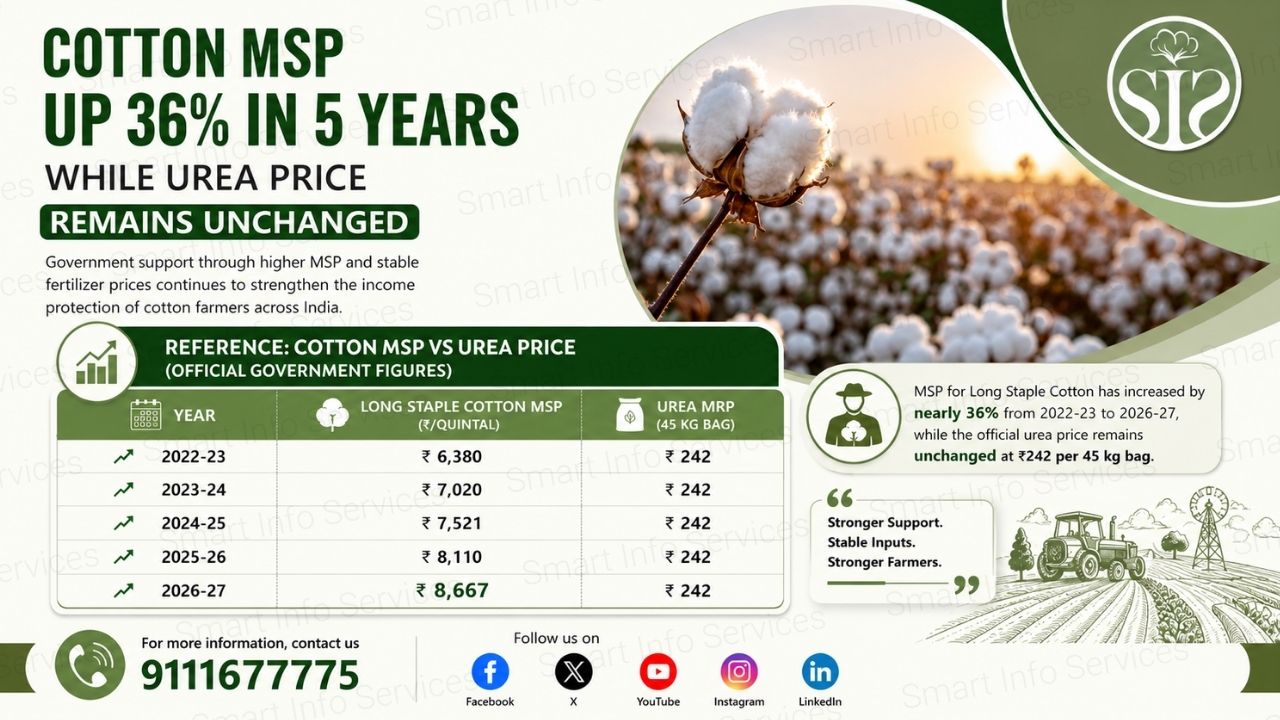
According to official government figures, the MSP for Long Staple Cotton has increased from ₹6,380 per quintal in 2022-23 to ₹8,667 per quintal for the 2026-27 season. This represents an increase of ₹2,287 per quintal, or nearly 36 percent in five years. The latest hike of ₹557 per quintal for 2026-27 is among the highest absolute increases announced for major kharif crops.
The MSP has risen steadily from ₹6,380 in 2022-23 to ₹7,020 in 2023-24, ₹7,521 in 2024-25, ₹8,110 in 2025-26 and ₹8,667 in 2026-27. For a farmer producing 20 quintals of cotton, the MSP-linked value of the crop has increased from ₹1.27 lakh to ₹1.73 lakh, resulting in a potential gain of more than ₹45,000.
In contrast, the Maximum Retail Price (MRP) of a 45-kg bag of neem-coated urea continues to remain at ₹242. The Ministry of Chemicals and Fertilizers has clarified that there is currently no proposal to increase urea prices, with the government continuing subsidy support to keep the fertilizer affordable for farmers.
The comparison highlights a significant trend: while the MSP of Long Staple Cotton has increased by nearly 36 percent since 2022-23, the official price of urea has remained unchanged. This has improved the relationship between cotton prices and one of the most widely used farm inputs.
However, agricultural experts caution that MSP and fertilizer prices alone do not determine profitability. Farmers continue to face higher expenses on labour, pesticides, diesel, irrigation and machinery. Rising cultivation costs have absorbed part of the gains generated by higher MSPs, meaning actual income growth is lower than MSP growth.
Even so, the government's twin strategy of increasing MSPs while maintaining fertilizer subsidies has provided stronger income protection for cotton growers. With cotton receiving one of the largest MSP increases among kharif crops and urea prices remaining stable, farmers are generally in a better position than they were five years ago.
The challenge ahead, experts say, is ensuring that higher support prices are accompanied by better productivity, efficient procurement and lower cultivation costs so that a larger share of the benefits ultimately reaches farmers' pockets.