India's Cotton Carry-Forward Stock Seen Rising 42% on Higher Duty-Free Imports
By jayesh chouhan 2026-06-16 12:39:24
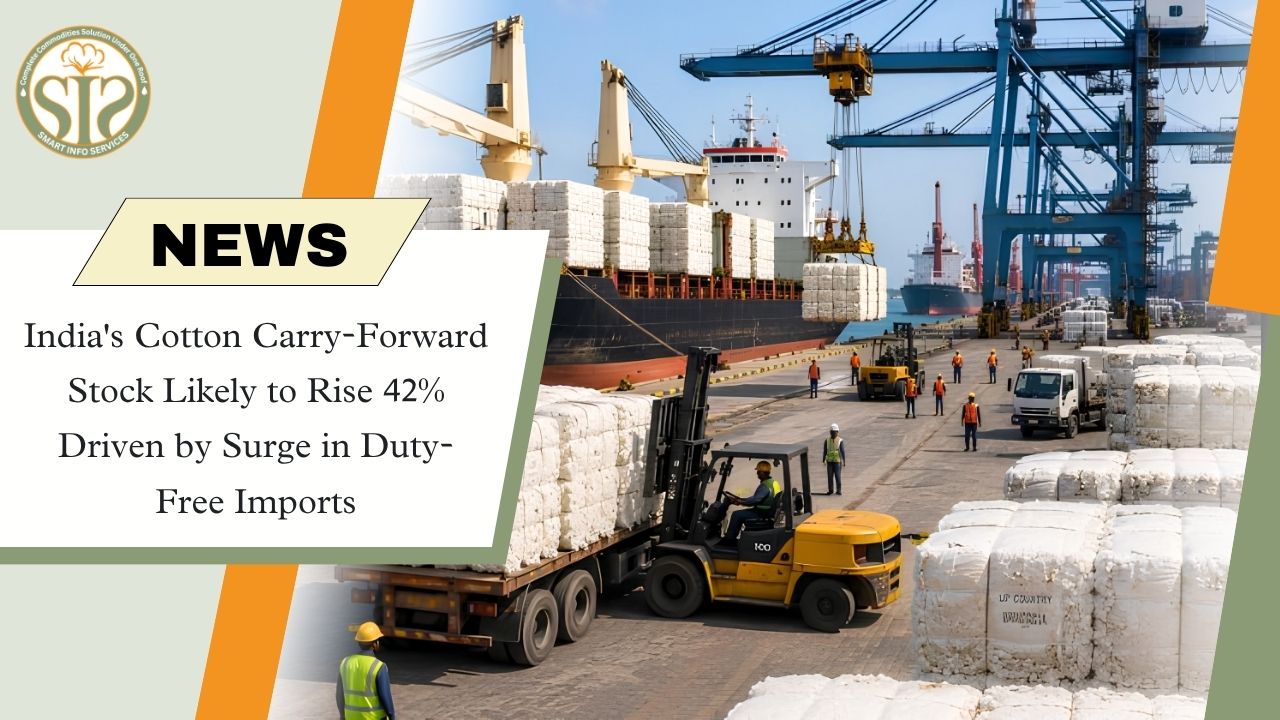
India's Cotton Carry-Forward Stock Likely to Rise 42% Driven by Surge in Duty-Free Imports
According to investment advisory firm Kedia Advisory, India's cotton carry-forward stock for the 2026-27 season is projected to rise by 42%, exceeding 85 lakh bales. This increase is attributed to the sharp rise in imports following the government's decision to waive import duties on cotton.
Experts believe that increased imports will improve cotton availability within the country, ensuring the next season begins with a robust opening stock. This will provide the domestic textile industry with greater security regarding raw material supplies.
According to the Cotton Association of India (CAI), cotton imports in the 2025-26 marketing season could reach 60–65 lakh bales (170 kg per bale). This is significantly higher than the earlier estimate of 47 lakh bales. By the end of May, imports had already reached 43.5 lakh bales, marking an increase of approximately 32% compared to the same period last year. Industry experts estimate that the duty exemption could lead to the import of an additional 15 lakh bales of cotton.
Consequently, India's carry-forward stock for the 2026-27 season—commencing in October 2026—is projected to stand at 85.59 lakh bales, up from approximately 60 lakh bales in the previous season. This represents a likely increase of around 42% in stock levels.
The CAI has maintained its estimate for the country's cotton production in the 2025-26 season at 334 lakh bales. Cotton pressing stood at 322.35 lakh bales by the end of May, while exports for the entire season are estimated at 10 lakh bales. Although the price gap between domestic and global cotton is narrow, textile mills continue to prefer imported cotton. Industry sources indicate that imported fiber yields superior quality yarn—estimated to be about 4% better in quality. Furthermore, yarn produced from imported cotton commands a market premium of approximately ₹7 per kilogram, making it a more profitable option for spinning mills.
By the end of May, the country's total cotton stock was estimated at 191.44 lakh bales. Of this, mills held around 82 lakh bales, while the remainder was distributed among the Cotton Corporation of India, traders, ginners, and multinational companies.
Analysts believe that high levels of imports will bolster cotton availability in the domestic market, help meet the textile industry's demand for high-quality raw material, and further strengthen supply security for the 2026-27 season.