Continuous trade agreements with UK, EU and US: India becomes the new center of global trade
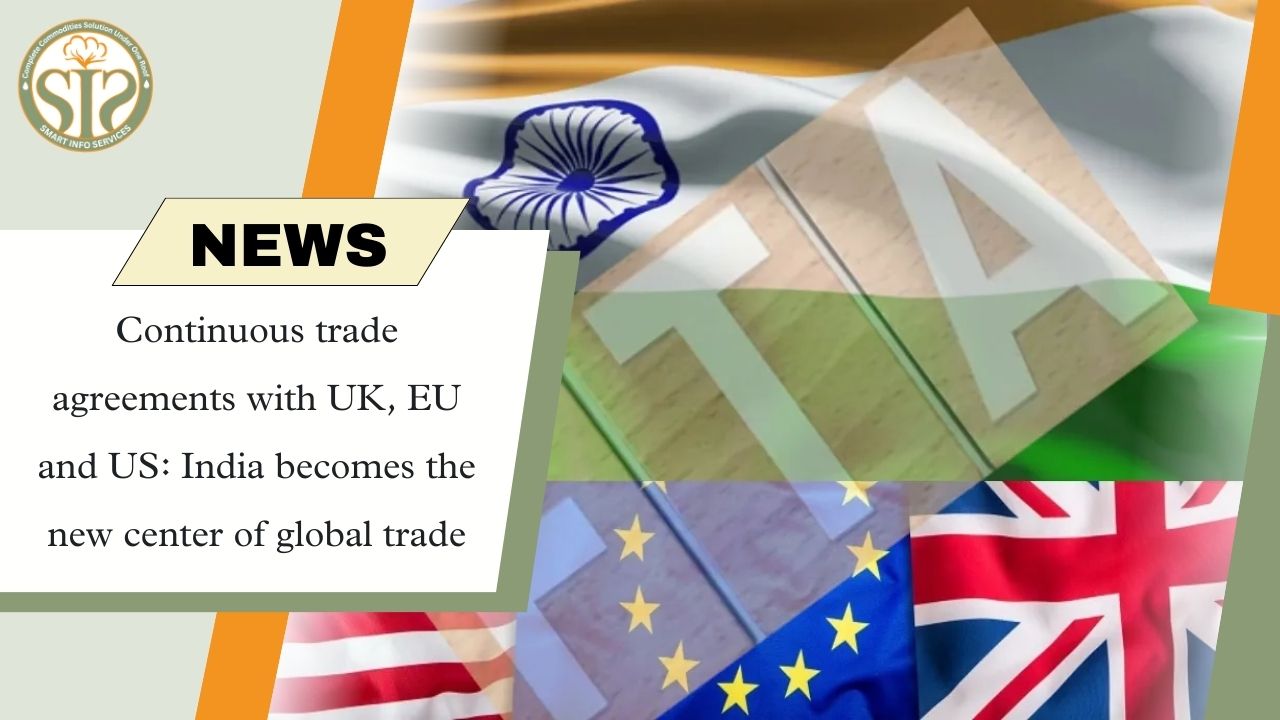
The trade agreements signed by India with the United Kingdom (July 2025), the European Union (January 2026) and now the United States (February 2026) have signaled a sea change in the global trade landscape. With these agreements, India has emerged as the most attractive manufacturing and sourcing hub among emerging economies, especially in highly trade-sensitive sectors like textiles and apparel.
The reduction in tariff on Indian goods to 18 percent under the latest India-US trade agreement has brought major relief to exporters. The US is the largest market for apparel exports to India and the industry believes that this tariff cut will give Indian suppliers an edge of about 2 per cent over competing countries. This is expected to reactivate stalled production capacities and generate new orders.
The free trade agreement concluded with the European Union on 27 January 2026 is being considered as a structural change for the Indian textile industry. Till now, Indian apparel attracted 9 to 12 per cent duty in the EU, while many competing countries enjoyed duty-free access. With the abolition of tariffs, India's market share is expected to increase sharply in what is the second largest export market at over $4.5 billion annually.
Earlier, under the India-UK FTA in July 2025, about 99 percent of Indian exports got duty-free access. India's share in Britain's $27 billion textile-apparel import market is currently 6.6 percent, which is expected to grow significantly in the coming years. Especially the export of technical textiles is expected to see a sharp rise by 2030.
Apart from these three major agreements, India has also implemented FTAs with the European Free Trade Association (EFTA), Australia and New Zealand. The agreement with EFTA envisages $100 billion of investment and 1 million jobs over 15 years, while zero-tariff access with Australia and New Zealand is expected to directly benefit MSMEs and labour-intensive sectors.
According to trade experts, the major reasons behind India's growing global acceptance are its large-scale manufacturing capacity, better compliance standards, emphasis on sustainability and the need for reliable alternative supply chains amid geopolitical uncertainties. The industry believes that India is no longer just a supplementary sourcing country, but is emerging as a major and long-term anchor in global supply chains.