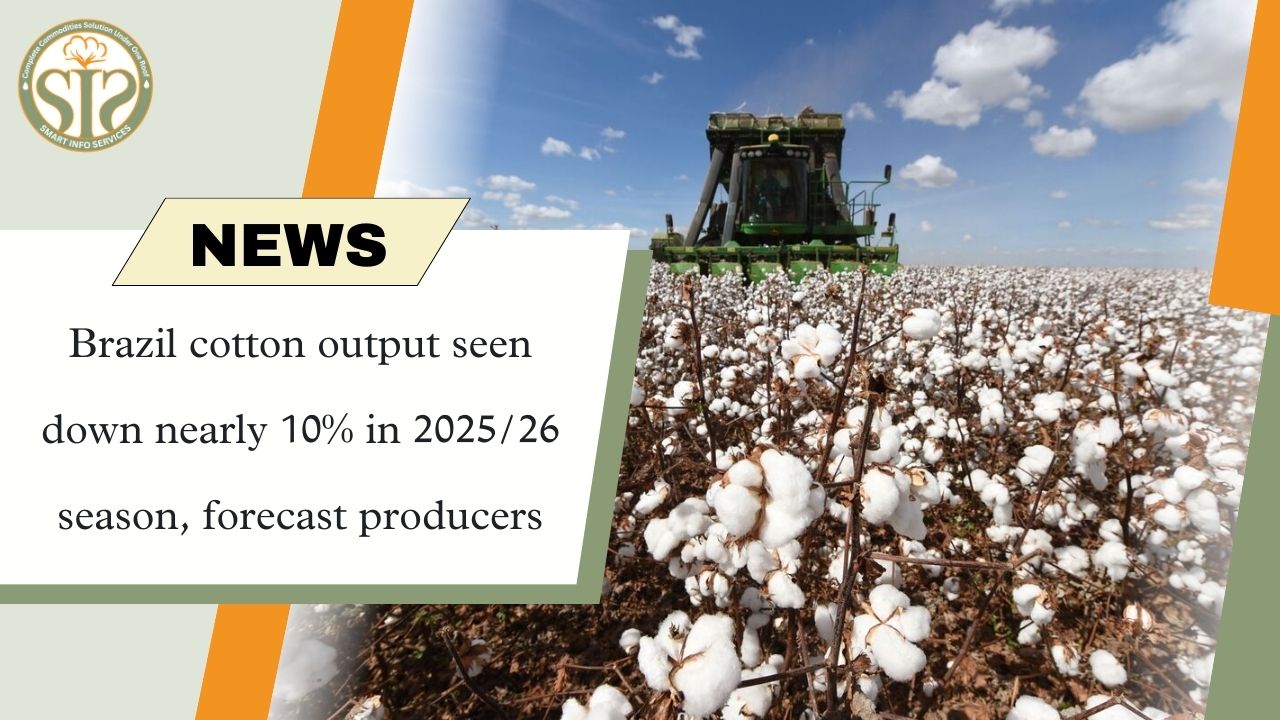
Brazil Cotton Output Seen Falling Nearly 10% in 2025/26 Season
Brazil’s cotton production is projected to decline by nearly 10% in the 2025/26 season, as both planted area and yields are expected to decrease, according to the first crop report by the Brazilian Cotton Producers Association (Abrapa).
Planted area is forecast to drop 5.5% year-on-year to 2.052 million hectares, while average yields are expected to fall 4.7% to 1,866 kg of lint per hectare. As a result, total lint production is estimated at 3.829 million tonnes, marking a 9.9% decline compared to the previous season.
Abrapa Executive Director Marcio Portocarrero stated that the reduction in area is a strategic decision. He highlighted that Brazil’s cotton sector is responding cautiously to global market conditions, including excess supply and increasing competition from synthetic fibres driven by lower oil prices.
He also noted that high interest rates and tighter credit availability have significantly raised production risks for farmers.
Independent consultant Pery Pedro indicated that the sharpest decline in cotton area is likely among smaller and medium-scale farmers, particularly those who do not consistently invest in cotton. In contrast, large-scale producers are expected to reduce their planted area by no more than 1%.
Pedro explained that many mid-sized farmers, typically cultivating around 3,000 hectares of soybeans, allocate part of their land to second-crop cotton but lack the infrastructure of larger operations. These farmers are more likely to shift away from cotton in favor of crop rotation to improve soil health, driven more by agronomic considerations than pricing factors.
He added that the reduction in cotton area is not directly linked to price trends. Although New York cotton futures—an international benchmark—declined by 8% in 2025, current price levels still offer adequate returns for producers to maintain their cotton operations.
Planting for the new season has already begun and usually accelerates in January, especially in regions where cotton is grown as a second crop. As of January 8, approximately 18% of the projected area had been planted, according to Abrapa.
Despite the lower production outlook, total cotton supply is estimated at 4.76 million tonnes, up 17.6% from the previous season. This increase is largely due to a significant rise in beginning stocks, which are expected to grow by 65.7% to 835,000 tonnes.
Exports are projected to reach 3.2 million tonnes, reflecting a 13% increase compared to the prior season.