Cotton Market in India: Trends Up, Challenges Persist
2026-04-13 11:45:53
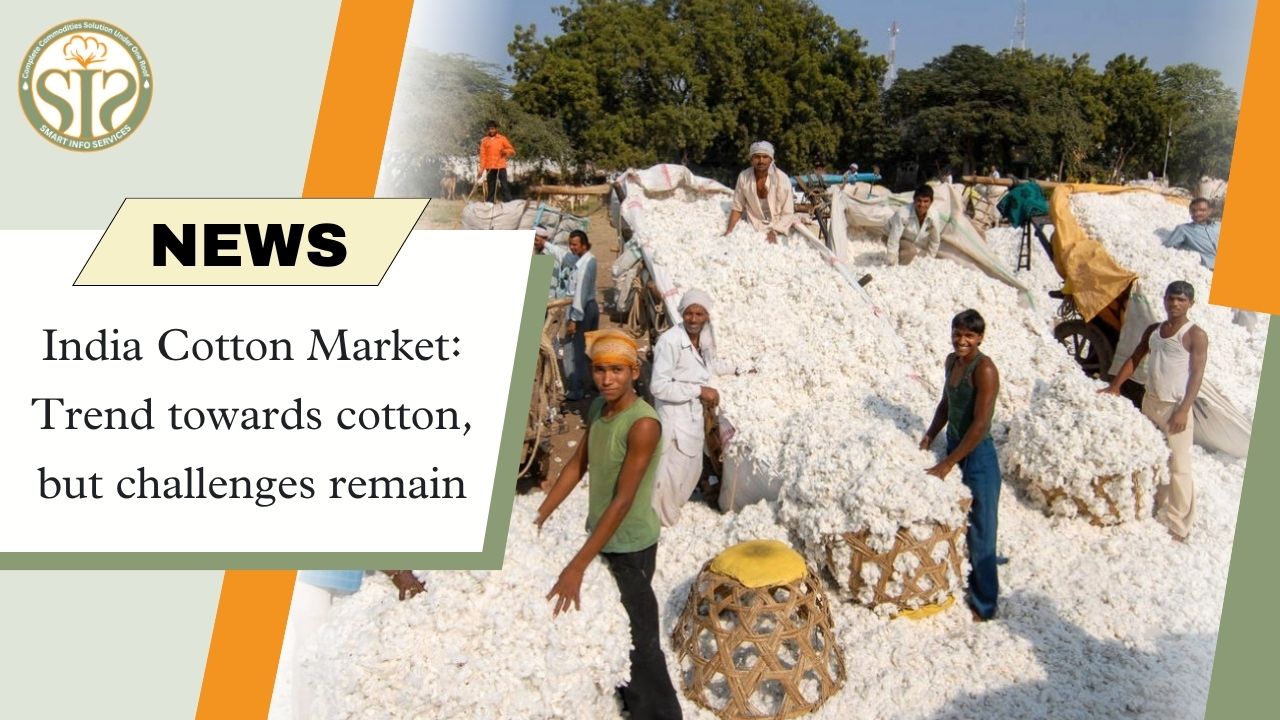
India Cotton Market: Trend towards cotton, but challenges remain
India's cotton market is going through many ups and downs during 2025–26. On one hand, there are signs of improvement in prices, on the other hand, structural and global challenges still remain.
The domestic market remained under pressure in 2025 as the government made cotton imports duty free from September to December 31. Due to this, both imported cotton and local arrivals increased, due to which farmers could not get better prices. However, after the implementation of 11 percent import duty from January 1, 2026, there was improvement in the market. International prices also strengthened, leading to domestic prices hovering around or above the minimum support price.
Recent global developments, particularly wars and rising crude oil prices, have supported the cotton market. As oil became expensive, the cost of man-made fibers like polyester and rayon increased, which increased the demand for cotton. Cotton prices increased by about 13 percent in the international market, which affected the Indian market as well.
Positive signs are also being seen on the export front. Farmers are expected to get better prices from the possible increase in cotton, yarn and textile exports. For this reason, farmers may lean towards increasing cotton cultivation in the coming season. According to the estimates of the US Department of Agriculture, the area of cotton in India may increase by about 3 percent in 2026-27 and a significant increase in production is also possible.
In India, cotton is cultivated at different times regionally. In North India (Punjab, Haryana, Rajasthan) sowing takes place during April–May and this region gives about 14 percent of the total production. Central India (Gujarat, Maharashtra, Madhya Pradesh) is the largest producing region of the country, whose share is about 55 percent and sowing takes place here in June-July. Sowing takes place in August–September in South India (Andhra Pradesh, Telangana, Karnataka, Tamil Nadu), where long variety fiber is produced.
The picture at the state level is mixed. In Punjab, cotton area is likely to increase due to government incentives, while in Haryana and Rajasthan, area may decrease due to pests, irrigation and alternative crops. Farmers in Gujarat may lean towards better profit-paying crops like groundnut and cumin, while the area in Maharashtra and Madhya Pradesh is expected to remain stable. Cultivation may increase in South India, especially in Telangana and Andhra Pradesh due to support price.
Changes in cotton production and demand are also being seen at the global level. Cotton area in the US is projected to grow by about 4 percent for 2026-27. Production is likely to increase in key states like Texas and Georgia.
However, the biggest challenge facing the cotton industry is competition from man-made fibres. The use of polyester has increased rapidly in the last few decades. Whereas in 1970, about 50 percent of clothes were made from cotton, by 2024 this share has dropped to less than 20 percent. In contrast, the use of polyester has been continuously increasing and now accounts for more than half of the total textile production.
In conclusion, the cotton market is currently showing signs of recovery, but long-term sustainability will require addressing challenges such as production costs, climate risks and competition from synthetic fibres.