


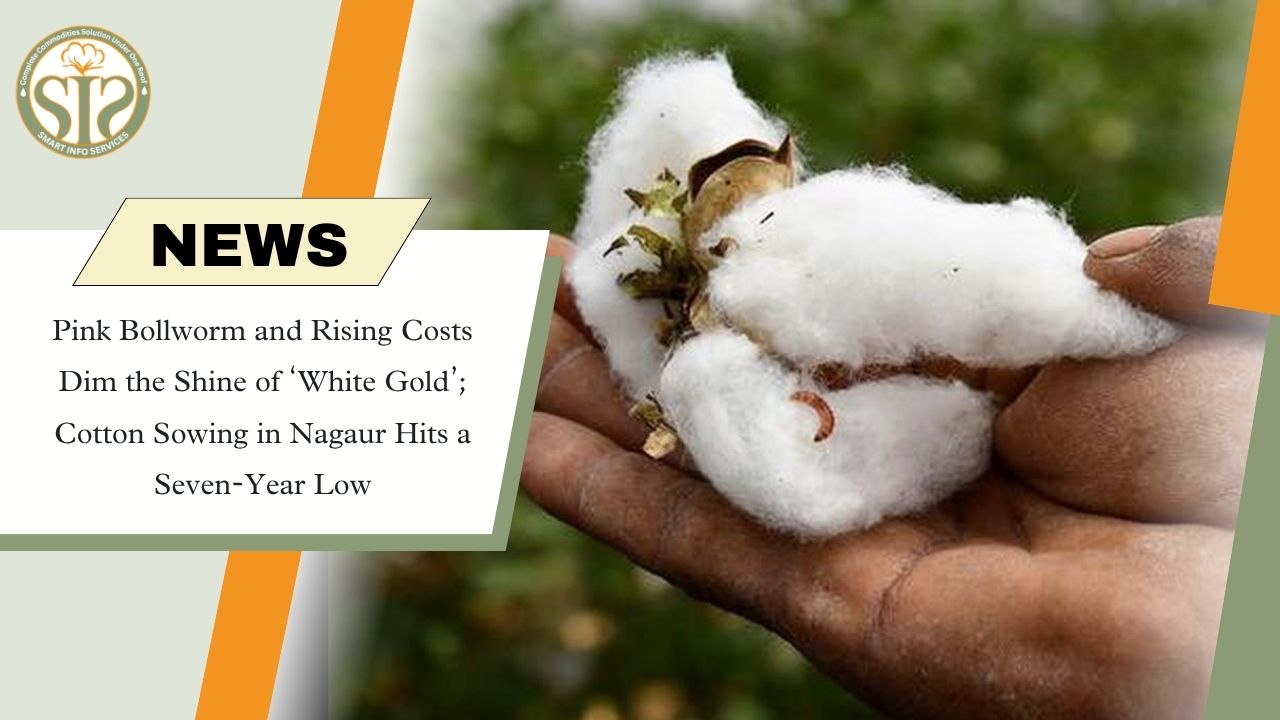
Pink Bollworm and Rising Costs Dim the Shine of ‘White Gold’; Cotton Sowing in Nagaur Hits a Seven-Year Low
Nagaur: Cotton, once considered the preferred cash crop for farmers in Rajasthan’s Nagaur district, is gradually losing its luster. Known as ‘White Gold,’ this crop is proving to be less profitable for farmers. Due to consistently declining yields, rising cultivation costs, the growing menace of the pink bollworm, and the failure to secure expected market prices, farmers are rapidly shifting towards alternative crops. This trend was clearly evident during the Kharif 2026 sowing season.
The Agriculture Department had set a target to sow cotton across 62,000 hectares in the district for the Kharif 2026 season; however, by the end of the season, sowing was completed on only 32,150 hectares. This figure represents approximately 52 percent of the set target and marks the lowest cotton acreage recorded in the district over the past seven years.
Agricultural experts attribute the decline in soil fertility and productivity to the long-term, continuous cultivation of cotton in Nagaur’s sandy loam soil. They note that cotton is primarily a crop suited for black soil; consequently, continuous cultivation in sandy loam areas has led to a steady drop in production. For this reason, farmers prioritized alternative crops like guar (cluster bean) this year. In the Kharif 2026 season, guar sowing was recorded across 124,250 hectares in the district.
According to farmers, the average cotton yield has currently dropped to just 1.5 to 2 quintals per bigha. While the gross income from cultivating cotton on approximately 10 bighas reaches around ₹1.20 lakh, the net profit remains minimal after deducting expenses for seeds, fertilizers, pesticides, irrigation, labor, and other farming costs. Thus, cotton cultivation is no longer as profitable for farmers as it used to be. Data from the past seven years confirms the declining acreage of cotton. Cotton sowing in the district was recorded at 56,143 hectares in 2020, 58,457 hectares in 2021, 74,557 hectares in 2022, 48,500 hectares in 2023, 59,302 hectares in 2024, and 37,250 hectares in 2025; by 2026, it had dropped to just 32,150 hectares—the lowest level in seven years.
In the initial years, Bt cotton had largely kept the pink bollworm infestation under control, but the pest has now begun to affect Bt varieties as well. Consequently, farmers' expenditure on pesticides is steadily rising. Although the government has fixed the Minimum Support Price (MSP) for medium-staple cotton at ₹7,710 per quintal for the 2026-27 season, farmers are unable to reap the expected benefits due to low yields and escalating production costs. This is why farmers in Degana and Merta—Nagaur's major cotton-producing regions—are rapidly shifting towards cultivating cluster beans (guar) and other alternative crops. Experts believe that unless effective control over the pink bollworm, cost reductions, and better market prices are ensured, cotton acreage in the district could shrink further in the coming years.
read more :- Telangana Kharif Sowing Picks Up