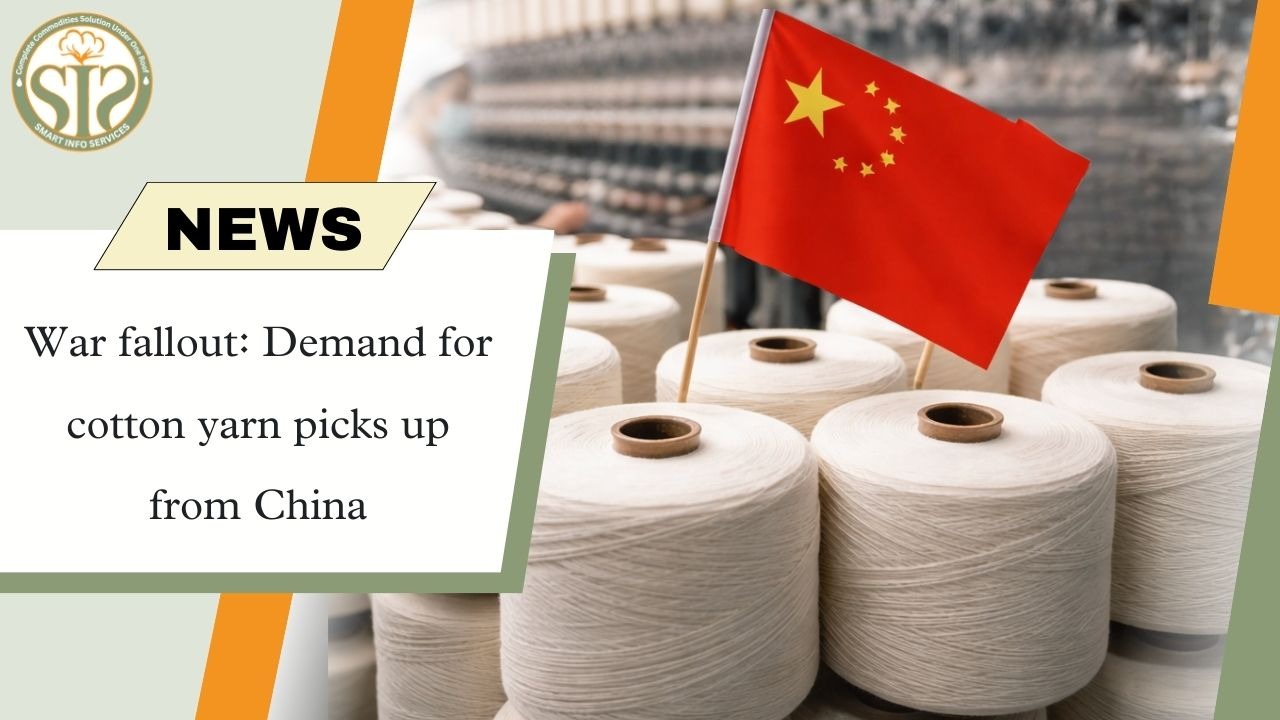
War fallout: Demand for cotton yarn picks up from China
Demand for Indian cotton yarn has picked up from countries such as China, Bangladesh and Vietnam among following the disruption in global logistics after the break-out of war in West Asia.
“There is a very good demand for cotton yarn from China. Due the disruption in the global supply chain, whatever cotton the Chinese buyers may have bought may not reach in time. So instead of buying cotton, they are buying cotton yarn from India to meet their immediate requirement,” said Vinay N Kotak, President, Cotton Association of India (CAI).
Kotak said the cotton imports are affected because of this disruption in supply chain. The freight rates have gone up and also the prices have moved up. Also, the transit time has increase substantially – may be by at least 10-15 days, he said.
To ease the cotton supply situation, China has increased the quota for imports compared to last year. On Monday, the National Development and Reform Commission (NDRC) of China has issued 3 lakh tonne of cotton sliding-scale duty quota to ease the current tight cotton supply situation. This year the quota is higher by 1 lakh tonne when compared with 2025.
Ramanuj Das Boob, a sourcing agent in Raichur said the demand for yarn is good from China and also from countries such as Bangladesh and Vietnam. Yarn prices have improved by ₹10-15 per kg on rising demand.
Further, the domestic prices are also seen improving on firming demand and tracking the global market. Cotton Futures on ICE are hovering around 68.78 cents per pound, an increase of 13 per cent over the past two weeks.
In the domestic market, the Cotton Corporation of India (CCI), currently the largest stock holder, has increased the prices by a total ₹1,200 per candy in last two days.
“There is a good demand for cotton due to better yarn prices,” Boob said.
Taking into account the emerging developments in the markets, CAI has revised upwards the domestic off-take of cotton by 10 lakh bales of 170 kg each to 315 lakh bales as of end-February, compared to end-January projections of 305 lakh bales.