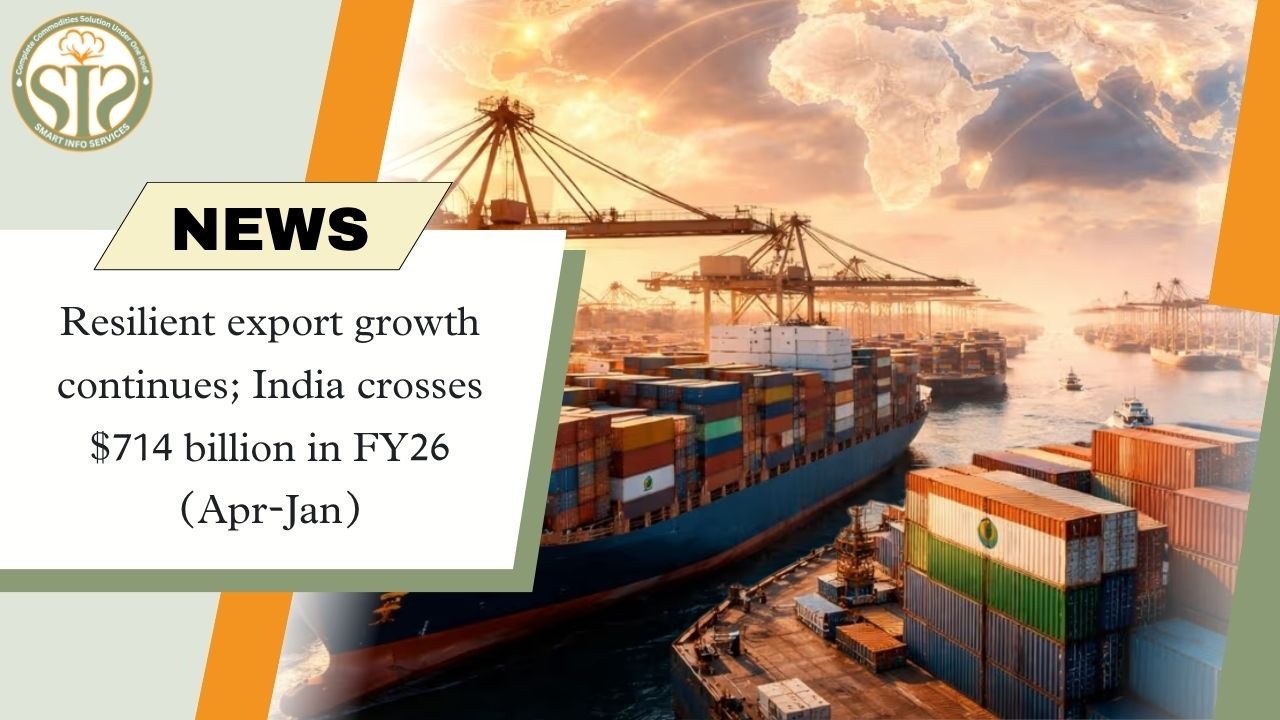
India’s total exports of goods and services reached USD 714.73 billion during April–January of FY 2025–26, registering a 5.26% increase compared to USD 679.02 billion in the same period last year. The growth highlights the resilience of India’s trade sector despite global economic uncertainty, supply chain disruptions, and volatile commodity prices.
Over the past few years, India’s exports have shown a steady upward trend. From USD 497.90 billion in 2020–21, exports rose to USD 828.25 billion in 2024–25, reflecting a compound annual growth rate (CAGR) of 6.9%. This sustained expansion underscores India’s strengthening position in global trade.
The government continues to support export growth through policy measures, financial incentives, and digital infrastructure. A key focus remains on empowering MSMEs by improving access to markets, finance, and logistics support.
The Foreign Trade Policy (FTP) 2023 emphasizes trade facilitation, export promotion, and digital integration. Schemes such as RoDTEP help offset embedded taxes, ensuring Indian products remain competitive in global markets.
Additionally, the Export Promotion Mission (EPM), with an outlay of Rs 25,060 crore for FY 2025–26 to FY 2030–31, aims to strengthen trade finance, logistics, and quality standards. A special ‘RELIEF’ scheme under EPM, implemented via ECGC, addresses risks arising from geopolitical disruptions.
India is also enhancing trade infrastructure and leveraging digital platforms such as Trade e-Connect and the Certificate of Origin system to streamline processes. The country currently has 19 Free Trade Agreements (FTAs) in place and is negotiating new ones with partners including the European Union (EU) and the United Kingdom (UK).