Natural coloured cotton: Challenges of shortage of funds and low yield
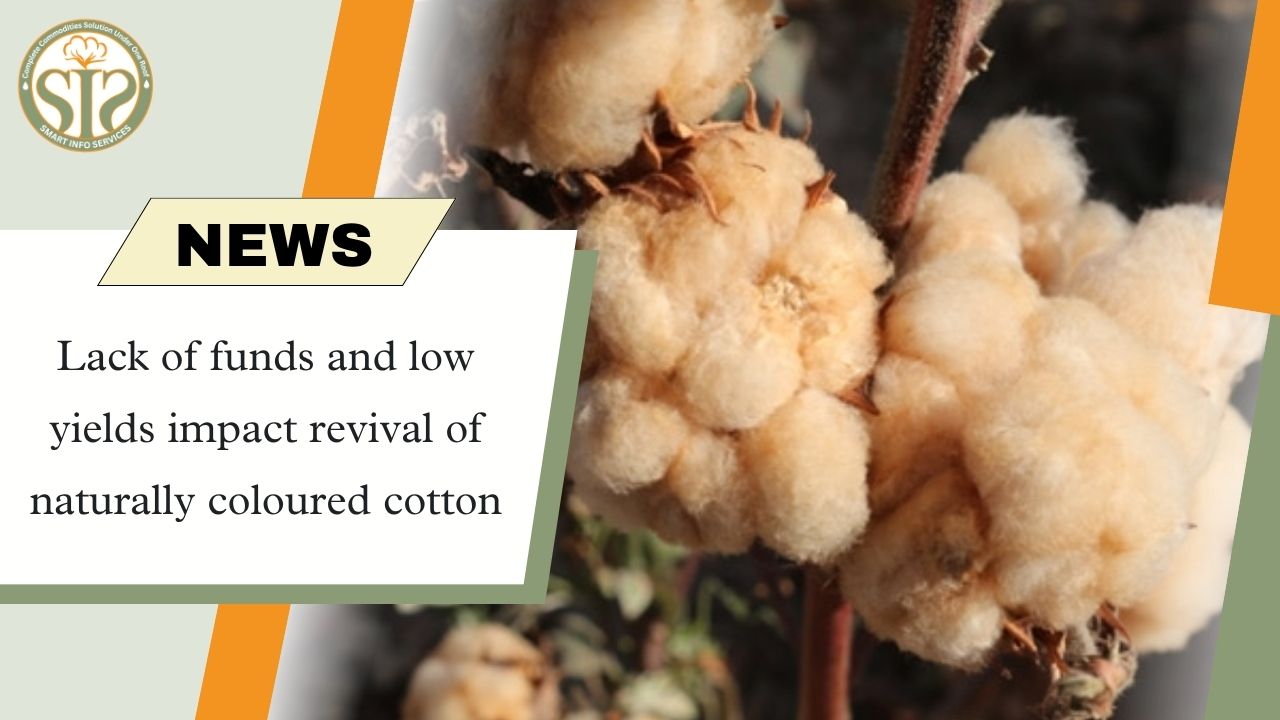
Lack of funds and low yields impact revival of naturally coloured cottonIndia's naturally coloured cotton, which was once commercially successful, is struggling to regain its popularity despite growing demand for sustainable textiles. Despite high pricing and environmental benefits, low yields are deterring farmers from adopting it. Government support, improved seed systems and market linkages are critical to realising its export potential and transforming India's textile sustainability paradigm.India's naturally coloured cotton, which was commercially flourishing in the 1940s, is struggling to make a comeback despite growing global demand for sustainable textiles and decades of government research efforts.This special crop is currently grown on only 200 acres in Karnataka, Maharashtra, Tamil Nadu and Andhra Pradesh, fetching a price of Rs 240 per kg, 50 per cent higher than regular cotton at Rs 160 per kg. However, farmers are hesitant to expand cultivation due to significantly low yields."The productivity of light brown cotton is very low, at 1.5-2 quintals per acre, while the productivity of normal cotton is 6-7 quintals per acre. This discourages farmers from expanding the acreage of this crop," Ashok Kumar, principal scientist at ICAR-Central Institute for Research on Cotton Technology (CIRCOT), told PTI.The annual production from these limited acres is a mere 330 quintals, underlining the challenge faced by this special crop, which can potentially transform India's textile sustainability paradigm.ICAR-CIRCOT is currently focusing on light brown cotton.Coloured cotton has ancient roots in Indian agriculture, with cultivation dating back to 2500 BC. Before Independence, red, khaki and brown varieties of Cocanada 1 and 2 were grown commercially in Rayalaseema in Andhra Pradesh, exported to Japan. Traditional varieties were also cultivated in Assam and the Kumta region of Karnataka.However, the emphasis on high-yielding white cotton varieties during the Green Revolution marginalised coloured cotton. The inherent limitations of this crop – low boll, low weight, low fibre, short fibre length and colour variations – made it economically unviable for large-scale cultivation.Indian agricultural institutions have developed improved varieties, including DDCC-1, DDB-12, DMB-225 and DGC-78 developed by the University of Agricultural Sciences, Dharwad. The Central Institute for Cotton Research, Nagpur developed Vaidehi-95, which is considered the most prominent among the 4-5 varieties available.Between 2015-19, ICAR-CIRCOT processed 17 quintals of cotton in demonstration batches, producing 9,000 metres of cloth, over 2,000 jackets and 3,000 handkerchiefs, proving it commercially viable.Its environmental benefits are significant. Traditional cotton dyeing requires about 150 litres of water per metre of fabric, while naturally coloured cotton eliminates this requirement, which can reduce toxic waste disposal costs by up to 50 per cent."Naturally coloured cotton has immense export potential. More government support is needed to increase production and value addition," said Kumar.Despite high pricing and environmental benefits, expansion faces hurdles such as lack of seed systems, susceptibility to pests and the need for high pesticides commonly used in cotton cultivation."Nobody is able to develop varieties due to low production and lack of market. Even textile mills are not willing to buy cotton in small quantities," said Kumar.The global market is seeing potential with growing demand for eco-conscious brands, especially in Europe, the US and Japan. Australia and China are investing heavily in research using conventional breeding and genetic engineering.read more :- Gujarat: Textile industry fears threat from cotton MSP hike