STAY UPDATED WITH COTTON UPDATES ON WHATSAPP AT AS LOW AS 6/- PER DAY
Start Your 7 Days Free Trial TodayUnited States and India Announce Framework for Historic Interim Trade AgreementThe United States and India are proud to announce a framework for an Interim Trade Agreement, marking a major milestone in strengthening their economic partnership. This framework advances ongoing negotiations toward a comprehensive U.S.-India Bilateral Trade Agreement (BTA) launched by President Donald J. Trump and Prime Minister Narendra Modi on February 13, 2025.The Interim Agreement reflects both nations’ commitment to reciprocal, balanced, and mutually beneficial trade, deeper market access, and resilient supply chains.Key Highlights:Tariff Reductions: India will cut or eliminate tariffs on U.S. industrial, food, and agricultural products.Reciprocal U.S. Tariffs: The U.S. will adjust tariffs on select Indian goods and remove duties on pharmaceuticals, gems, and aircraft parts under the agreement.Market Access: Both nations commit to sustained preferential access across key sectors.Non-Tariff Barriers: India will ease restrictions on U.S. medical devices, ICT goods, and agricultural products.Technology & Energy: India plans to purchase $500 billion in U.S. energy, aircraft, technology, and metals over five years, boosting trade in high-tech goods.Digital & Economic Security: The two countries will collaborate on digital trade rules, supply-chain security, and innovation.This framework underscores a shared vision for a modern, fair, and forward-looking trade partnership—paving the way for a landmark U.S.-India Bilateral Trade Agreement.read more :- India-EU FTA will increase competitiveness of Indian textiles: ICRA

India–EU FTA to put Indian textiles on par with competitors: ICRA Indian textile and apparel exports are expected to gain a significant competitive boost in the European market following the signing of the India–EU Free Trade Agreement (FTA). The agreement eliminates duties on Indian shipments, placing them on a level playing field with key competitors such as Bangladesh and Vietnam, according to an Investment Information and Credit Rating Agency (ICRA) report.EU import duties on Indian textiles are expected to fall to zero, addressing a longstanding tariff disadvantage that had limited India’s competitiveness. Historically, the EU’s import dependence on India has remained below 5 per cent, with China, Bangladesh, Turkey and Vietnam leading supplies dur to preferential trade access and lower tariffs.India’s apparel exports are estimated at over $16 billion in calendar year 2025 (CY2025), with nearly one-third going to the US and around 23 per cent to the EU, making Europe one of the largest export destinations for the sector. However, exports to the EU have remained largely flat in recent years due to sluggish retail demand, inflationary pressures and vendor diversification by global buyers, the report said.The FTA is expected to be particularly beneficial for apparel and home textile segments, which stand to gain from tariff-free access.Beyond sector-specific gains, the broader trade pact offers preferential zero-tariff access on 97 per cent of EU tariff lines covering 99.5 per cent of India’s export value, with a large portion of duties expected to be eliminated immediately upon enforcement.Over the medium term, the level playing field could also support MSME exporters and reinforce India’s role as a reliable sourcing destination for the EU market.read more :- CCI keeps cotton prices stable, weekly online auction continues
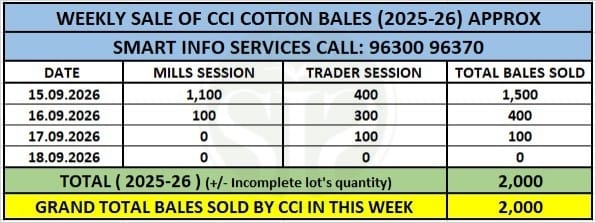
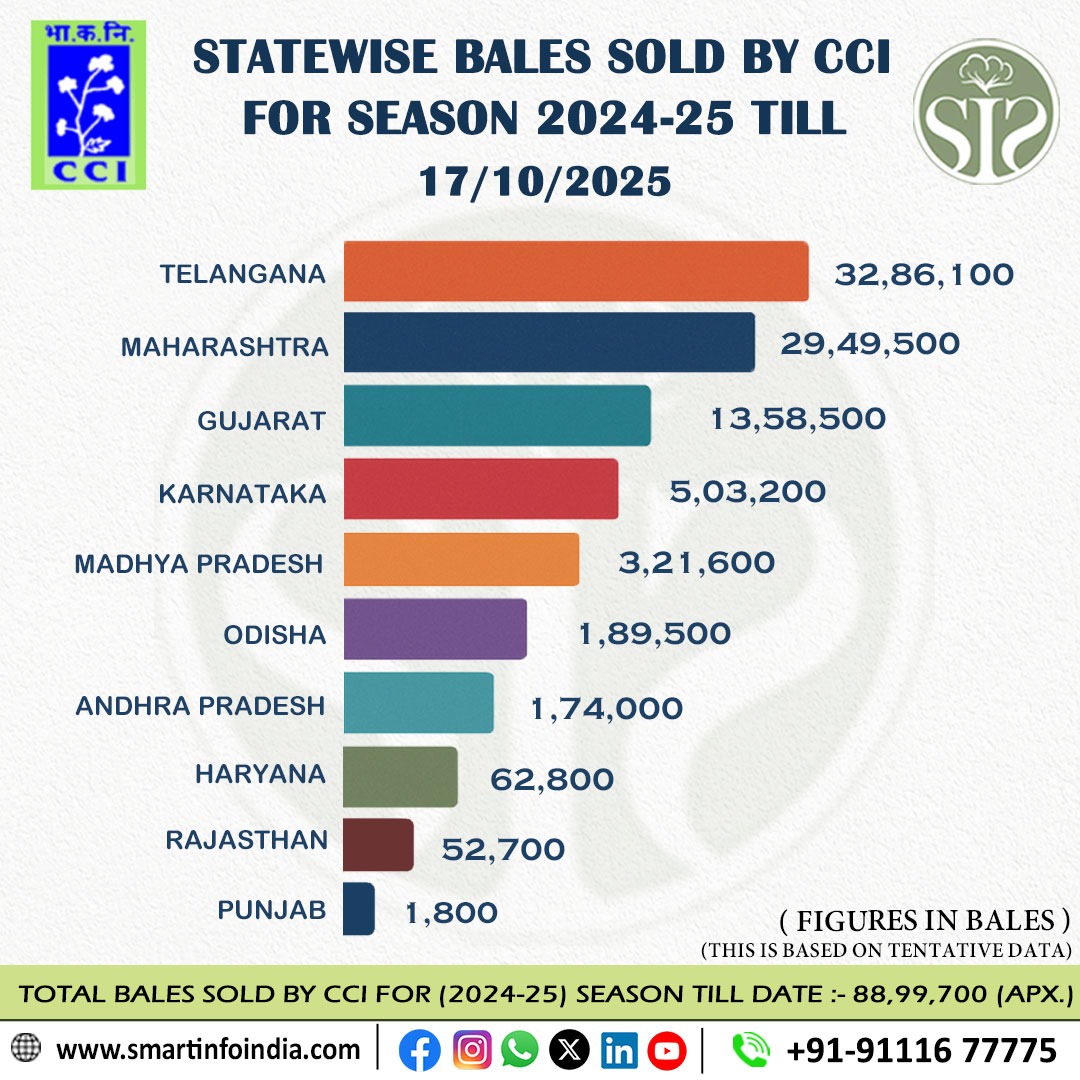
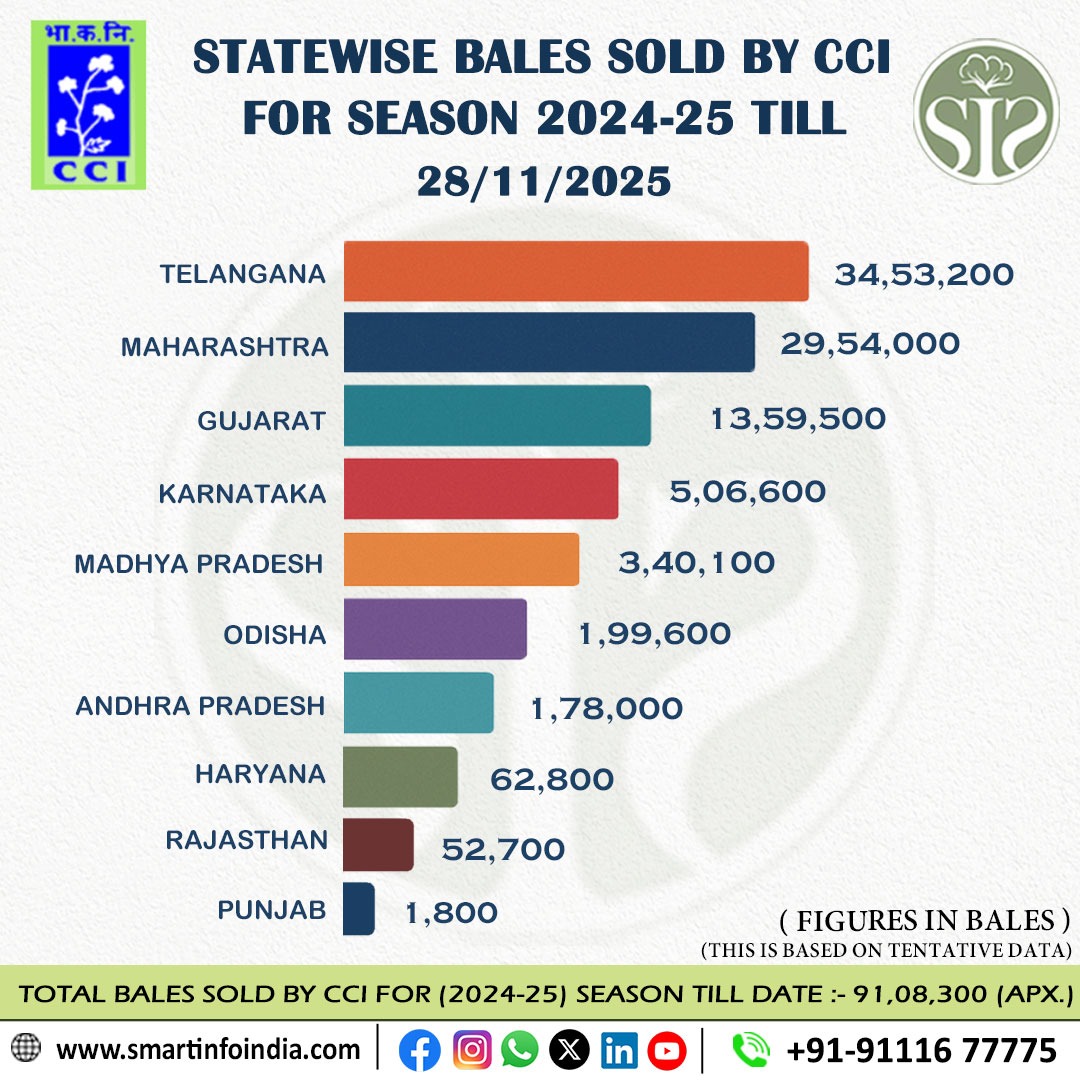
CCI Keeps Cotton Prices Unchanged; Weekly Sales Continue Through Online AuctionsThe Cotton Corporation of India (CCI) kept its cotton prices unchanged. During the week from 02 february 2026 to 06 february 2026, CCI conducted regular online auctions for mills and traders across various centers. These auctions resulted in total weekly sales of approximately 2,600 bales for 2025-26 and 900 bales for 2024-25 season, reflecting steady demand from both segments.Daily sales performance02 February 2026:CCI began the week with sales of 100 bales, all of which were purchased by mills. The entire quantity belonged to the 2024–25 season.03 February 2026:Total sales rose to 1,600 bales, including 1,500 bales bought by mills and 100 bales purchased by traders. All sales on this day were from the 2025–26 season.04 February 2026:Sales stood at 1,300 bales, comprising 1,000 bales from the 2025–26 season and 300 bales from the 2024–25 season. Mills accounted for 900 bales, entirely from the current season, while traders bought 400 bales, including the full quantity from the previous season.05 February 2026:A total of 500 bales were sold, all purchased by mills from the 2024–25 season, indicating continued mill demand for older-season cotton.06 February 2026:No bales were sold in the CCI online auction today for both the 2025–26 and 2024–25 seasons.Cumulative salesWith these transactions, CCI’s cumulative sales reached 3,61,900 bales for the 2025–26 season and 98,82,400 bales for the 2024–25 season, as the agency continues to offload stocks through its e-auction platform while maintaining stable prices.
On Friday, the Indian rupee fell 40 paise to close at 90.66 per dollar, compared to its opening price of 90.26 in the morning.At market close, the Sensex was up 266.47 points or 0.32 per cent at 83,580.40, and the Nifty was at 25,693.70, up by 50.90 points or 0.20 per cent. On a weekly basis (including Sunday's budget session), Nifty was up 1.47 per cent, the best since the week ended November 14 last year. read more :- Budget 2026–27: Employment and growth in the textile sector
Emphasis on making textile sector a major engine of growth and employment in Budget 2026–27The Union Budget 2026–27 reflects India's strong economic position and the government's confidence in long-term reforms amid global economic uncertainties. India remains the world's fourth largest and fastest growing major economy, driven by infrastructure and manufacturing led growth with an estimated growth rate of 7.2 per cent and capital expenditure of ₹12.21 lakh crore.The budget has made the textile sector the main pillar of inclusive growth and large-scale employment generation through labour-intensive manufacturing. The sector, hitherto viewed from a welfare perspective, has been placed at the center of the national industrial strategy, linking it to competitiveness, scale and export potential. Presently this sector contributes about 2.3 percent to the GDP and provides employment to more than 5.2 crore people.The 18 free trade agreements (FTAs) signed by the government have given India preferential access to global textile markets worth approximately $466 billion. Better access to key markets, including the US, is expected to lead to significant growth in textile exports, further strengthening India's position in global value chains.Domestically, Budget 2026 focuses on enhancing the competitiveness of the industry through relaxation of quality control mandates, GST reforms and resolution of inverted duty structure. Under the National Fiber Scheme, the availability of cotton, man-made and new-age fibers will be strengthened, which will stabilize raw material costs and increase certainty in export pricing.To modernize the industry, it has been announced to upgrade 200 textile industrial clusters across the country. The textile industry generates more employment per investment and is estimated to create 2 to 3 crore new livelihoods in the next five years through cluster-based expansion. Along with this, 15 lakh skilled workers will be trained under the Samarth 2.0 scheme.The budget also provides for an SME Development Fund of ₹10,000 crore, an improved TReDS platform and a faster payment mechanism to address the liquidity problems of MSMEs. By including the handloom and handicraft sectors in the reform process, sustainability, skill development and global market access are promoted, which is expected to strengthen India's textile ecosystem in the long term.read more :- New export opportunities for Odisha textiles from India-US trade agreement
India-US trade agreement opens new export avenues for Odisha's textilesThe India-US trade agreement will boost the Odisha textile industry, easing US tariffs to help handloom and apparel exports go global, creating jobs for weavers and pushing Sambalpuri and traditional textiles to international markets.The recent India-United States trade agreement has opened up new opportunities for Odisha, especially in the textile and apparel sector. From traditional handloom products to modern readymade garments, Odisha-made clothes are now set to reach wider international markets more easily, official sources said on Thursday.With the relaxation of import duties by the United States, exports from Odisha are expected to become more competitive. The move is likely to open new avenues of income for weavers and handloom artisans across the state. Chief Minister Mohan Charan Majhi said in a social media post that the traditional attire of Odisha is all set to emerge as a new trend in the global scenario.CM Majhi took to his personal 'X' handle and said, "Be it the handlooms of Odisha or the modern readymade garments; as a result of the India-US trade agreement, the craftsmanship of Odisha will now reach everywhere. Due to the relaxation in duties, exports will become easier, thereby opening new avenues of employment for our weavers and handloom artisans. The traditional attire of Odisha will now create a new trend in the global market."The reduction in tariff is expected to significantly increase exports of Odisha manufactured textiles and garments. Iconic handloom varieties like Sambalpuri along with other traditional textiles will get easier access to the US market, strengthening Odisha's presence in global fashion and trade."From 'field to fashion', Odisha's textile and apparel sector is going global. Low US tariffs open up high-value markets for local producers, empowering textile hubs across the state and transforming traditional craftsmanship into international success," the CM said in another post on 'X'.read more :- Cotton-soybean production in Devla decreased by 35%
Decline in cotton production: 35 percent decline in cotton, soybean production in DevlaWardha News: This year, one lakh sixty thousand quintals of cotton was sold in the market premises of Deoli Agricultural Produce Market Committee. This inflow occurred from 3 November 2025 to 31 January 2026. Last year, during the same period, 2 lakh 29 thousand quintals of cotton were sold. In comparison, 35 percent less cotton has been imported this year.Obviously, cotton production has reduced this year due to less arrivals in the market. Due to this, cotton farmers are in financial crisis. This year, Indian Cotton Corporation purchased 46 thousand 121 quintals of cotton. Initially farmers sold their cotton to the Cotton Corporation of India because traders were offering low prices, but due to the increase in the price of cotton, the Cotton Corporation of India stopped buying cotton.Traders purchased 24 thousand 44 quintals from Jai Bajrang Ginning, 26 thousand 684 quintals from Sanjay Industries, 10 thousand 43 quintals from Jai Bhavani Ginning Shirpur, 3 thousand 459 quintals from Madhu Industry, 2 thousand 60 quintals from Ashok Industries, 9 thousand 650 quintals from Deoli Agro, 12 thousand 497 quintals from Shri Krishna Ginning. And purchased 4 thousand 284 quintals of cotton. Quintal from Mohan Trading. isWhile talking to the traders, he told that less cotton is being sold in the market as compared to last year and the quality of cotton has also decreased as compared to last year. The arrival of cotton from outside the district has also reduced. Therefore, he predicted that this year's season would end soon.Purchase of 18 thousand quintals of soybean this yearDue to decrease in soybean production, only 18 thousand quintals of soybean were sold in the market this year. Out of this, 16 thousand 660 quintals of soybean were purchased by traders, while NAFED purchased 1 thousand 347 quintals of soybean. According to the Agricultural Produce Market Committee, 27,548 quintals of soybean were sold in the entire season last year. It is being told that this year the price of cotton has decreased from Rs 8 thousand 450 to Rs 8 thousand 50. Due to reduced arrival of soybean and cotton, the crowd in rural markets seems to be reducing. Due to this, consumer demand has spread in the market.read more :- Global cotton oversupply to continue in 2025/26: ICAC
Global Cotton Oversupply to Persist in 2025/2026 - ICACGlobal cotton fiber production should reach 26 million tonnes in 2025/2026, exceeding consumption by about 800,000 tonnes.China, India, and Brazil should continue to dominate global supply, while Asia should lead demand.Cotton prices should remain under pressure after the Cotlook A Index fell to its lowest average level since 2020/2021.The global cotton market has not exited its phase of oversupply. In a statement published on February 2, the International Cotton Advisory Committee said global cotton fiber production should reach 26 million tonnes in the 2025/2026 season.This volume represents a 1% increase from the previous season.Global cotton consumption should reach 25.2 million tonnes in 2025/2026. This level represents a 0.4% increase compared with the 2024/2025 season.According to the ICAC, China, India, and Brazil should continue to dominate global supply. “Consumption is also driven by China, ahead of India and Pakistan, which highlights the persistent predominance of Asia on both the supply and demand sides of the global market,” the organization said.Global cotton imports and exports could reach 9.7 million tonnes in 2025/2026. This volume represents a 5% increase from the previous season.The ICAC expects Brazil to retain its position as the world’s largest cotton exporter, ahead of the United States and Australia. The organization expects Bangladesh to rank as the world’s largest cotton importer, followed by Vietnam and China.According to the ICAC, this trend reflects “the ongoing evolution of global textile manufacturing chains and sourcing strategies.”Bangladesh benefits from competitive production costs and a network of nearly 4,500 factories. American and European Union retailers increasingly favor the country as a sourcing hub.Rapid expansion of Bangladesh’s spinning industry relies on large-scale cotton imports to support production growth.The ICAC said the Cotlook A Index declined for a third consecutive season. The index averaged 79.6 cents per pound in the 2024/2025 season.This level marked a 13.4% decline from the previous season. The index reached its lowest average level since the 2020/2021 season.Looking ahead to 2026, cotton prices will depend on several structural factors.“By 2026, cotton prices will depend not only on global economic growth and public policy stability, but also on producers’ ability to control rising input costs and cope with climate uncertainty, in a context where the sector adapts to rapidly changing market conditions,” the ICAC said in December in its review of the 2024/2025 season, which it described as an “adjustment season.”read more :- India-US trade deal will boost cotton industry: CAI
CAI Says India-US Trade Deal To Boost Cotton Industry.India’s cotton and textiles sector is poised to benefit significantly from the proposed India–United States trade deal, with industry representatives expressing optimism that improved market access and lower tariffs will stimulate demand and exports. Cotton trade bodies said the agreement could provide a timely boost to the sector, which has faced price volatility, rising input costs, and uneven global demand over the past year. The sector expects that greater certainty on tariffs and trade rules will encourage American buyers to place larger and longer-term orders. This could translate into improved capacity utilisation across spinning mills, weaving units, and garment factories, especially in key textile hubs across Gujarat, Maharashtra, Tamil Nadu, and Telangana. Industry participants noted that sustained demand from the US market would also help stabilise domestic cotton prices, benefiting both farmers and manufacturers.“This is an encouraging and forward-looking step for bilateral commerce, one that could pave the way for a deeper and more balanced trade partnership between India and the United States,” Cotton Association of India (CAI) President Vinay N. Kotak said in a statement.With global companies reassessing supply chains amid geopolitical and logistical risks, India is seen as a natural partner due to its large raw material base, skilled workforce, and expanding manufacturing capacity. Enhanced access to the US market could accelerate investments in modernisation, sustainability, and compliance with international standards.However, industry representatives cautioned that the final structure of the deal will be crucial. While tariff relief is expected to drive volumes, clarity on rules of origin, standards, and compliance requirements will determine the extent of the benefits. The cotton sector has urged negotiators to ensure that sensitive issues are addressed in a balanced manner to avoid unintended cost pressures on exporters.Beyond exports, the anticipated rise in demand could have positive spillover effects on employment and rural incomes. Cotton is a labour-intensive value chain, supporting millions of farmers, ginners, mill workers, and garment employees across the country. A sustained upswing in exports to the US could therefore contribute to broader economic resilience.Overall, cotton trade bodies believe the India–US trade deal represents a strategic opportunity. If implemented effectively, it could reinforce India’s position as a reliable supplier in global cotton and textile markets while supporting growth, jobs, and value addition across the sector.read more :- Rupee opened 09 paise stronger at 90.26 per dollar
Rupee opens 09 paise up at 90.26/USD Indian rupee opened higher at 90.26 per dollar on Friday versus Thursday's close of 90.35.read more :- Small spinning mills in trouble due to CCI's cotton price policy: Atulbhai Ganatra
Small spinning mills in India are in trouble as CCI's cotton price policy is causing them huge losses: Atulbhai GanatraMr. Atulbhai Ganatra, Chairman and Managing Director of Radha Lakshmi Group and a renowned cotton expert, told Indian media that small spinning mills across India are gradually closing down or switching to man-made fiber due to the current cotton pricing and sales policy of the Cotton Corporation of India (CCI).In Andhra Pradesh alone, more than 40 cotton spinning mills have closed in the last one year. According to Mr. Ganatra, the main reason for the closure of these mills is the expensive prices of cotton fixed by the CCI.“CCI is selling cotton with a delivery period of 60-90 days, which leads to additional costs like bank interest and other finance charges on mill buyers,” he said. “Smaller mills, which operate on very low margins, cannot afford such long delivery periods.”Mr. Ganatra urged CCI to take immediate corrective action:"I suggest that CCI gradually reduce cotton prices by ₹1,500–₹2,000 per candy and reduce the delivery period to just 15-20 days. This will help small mills to purchase cotton and continue their operations."He further said that there will be no loss to CCI by implementing these changes as the corporation will also save on bank interest, warehouse rent, insurance and expenses related to cotton shortage.read more :- Cotton prices rise in Brazil at the end of January
Late January lifts Brazil cotton prices as sellers hold firm Brazil’s domestic cotton prices have strengthened in late January as buyers showed greater willingness to trade while sellers held firm on quotations. This dynamic pushed spot market deals above export parity levels, even as international cotton prices softened and the US dollar weakened against the real, , as per the Centre for Advanced Studies on Applied Economics (CEPEA). At the same time, overall market liquidity remained subdued, as producers prioritised field activities, particularly cotton planting and soy harvesting. Trading volumes stayed thin toward the end of the month, reflecting a cautious approach from both sides of the market, the CEPEA said in its latest fortnightly report on the Brazilian cotton market.On a monthly basis, however, prices edged slightly lower. The CEPEA/ESALQ Index (payment in eight days) slipped 0.31 per cent between December 30 and January 30, closing at BRL 3.4754 per pound.Export parity values declined more sharply, with Free Alongside Ship (FAS) prices falling 2.59 per cent between January 19–26 to BRL 3.3872/pound ($0.6414/pound) at the port of Santos and BRL 3.3977/pound ($0.6434/pound) at Paranagua, reflecting weaker international benchmarks and a softer US dollar.read more :- Official investigation into alleged organic cotton scam begins in India
Fresh Official Probe Launched into Alleged Organic Cotton Fraud in IndiaAuthorities have launched a renewed investigation into possible fraud within India’s organic cotton sector following allegations of forged documentation and misuse of farmer identities in certification processes.The Agriculture Processing Export Development Agency (APEDA) and the Odisha State Organic Certification Agency (OSOCA) have initiated inquiries into reports that firms in the Kalahandi district of Odisha secured organic certification and represented conventionally grown cotton as certified organic. Local sources suggest that names of legitimate cotton farmers were used without proper consent to falsely label non-organic fibre as organic.The issue has drawn wider attention after local media reported that significant sums may have been misappropriated in connection with the alleged scheme, prompting concerns among policymakers, farmers and sustainability advocates alike.Organic cotton, prized for its reduced environmental impact and growing global demand, remains a relatively small portion of India’s vast cotton output but is strategically significant to the textile and apparel supply chain. Industry analysts say credible certification is critical for maintaining buyer trust and achieving export premiums in international markets.The probe comes against a backdrop of increasing scrutiny of supply chain transparency and compliance in textile raw materials. Studies have highlighted links between counterfeit certification and wider compliance risks, including labour abuses, adding pressure on regulators and brands to uphold due diligence standards.APEDA has previously defended its organic certification framework, emphasising that certification under the National Programme for Organic Production is monitored across states and subject to audits. Government sources have asserted that investigations are launched when substantive violations are reported, and penalties imposed where non-compliance is established.As the fresh inquiry progresses, stakeholders in the organic cotton value chain are awaiting further detail on the scope and findings of the investigations, which could have implications for certification integrity and export credibility in one of the world’s largest cotton-producing countries.read more :- Rupee higher 16 paise to close at 90.35 per dollar
The Indian rupee higher 16 paise to close at 90.35 per dollar on Thursday, compared to 90.51 in the morning.The Sensex touched an intra-day low at 83,152, and ended with a loss of 504 points or 0.6 per cent at 83,314. In the process, the Sensex snapped its 3-day winning streak, wherein the benchmark had gained 3,096 points.read more :-Big gift for cotton farmers, training to 5,000 women
Good news for cotton farmers: 5,000 women farmers in 9 districts to receive training.The Maharashtra government has taken a major step to help farmers. The state government has signed an agreement with Godrej Agrovet Limited. Under this agreement, more than 5,000 women farmers will be taught new and improved farming techniques. This agreement was made under the guidance of Chief Minister Devendra Fadnavis.Why are women farmers receiving special training?Chief Minister Devendra Fadnavis said that farmers are the backbone of Maharashtra's economy and women play a very significant role in agriculture. Women work in the fields and also manage their families. Therefore, the government wants women farmers to become strong and self-reliant.Which districts' women farmers will benefit?In the first phase of this scheme, Nagpur, Amravati, Yavatmal, Washim, Parbhani, Jalgaon, Beed, Akola, and Nanded districts have been included. These districts are known for cotton cultivation. More than 5,000 women farmers and 100 self-help groups from these districts will benefit from this scheme.What farming techniques will be taught?Women farmers will be taught Good Agricultural Practices (GAP) and Integrated Pest Management (IPM) techniques. This will reduce farming costs and lead to better yields. Farmers will be able to earn more and their farming will become more sustainable.How much land and how many people will be covered by the scheme?Under this program, women farmers cultivating approximately 50,000 acres of land will be included. The scheme will be expanded further in the next three years. In the future, more than 500 self-help groups will be included, and training will be provided for other crops like maize, in addition to cotton.What will be the responsibilities of Godrej and the government?Under this agreement, the Maharashtra State Rural Livelihoods Mission (MSRLM-Umed) will connect women farmers through self-help groups and the Krishi Sakhi network. Godrej Agrovet will provide training to farmers, demonstration plots for on-field learning, farmer schools, and safety kits. Initiatives Related to the International Year of Women FarmersThis scheme has been launched at a time when the United Nations has declared 2026 as the International Year of Women Farmers. This clearly shows that the Maharashtra government is fully committed to empowering women farmers.This partnership between the Maharashtra government and Godrej Agrovet is a new beginning for women farmers. Through this initiative, women will learn new technologies, improve their farming practices, and strengthen their families and villages. This scheme will prove beneficial for agriculture, women, and rural development—all three.read more :- Rupee opens 08 paise down at 90.51
Rupee opens 08 paise down at 90.51 The rupee opened at 90.51 against the US dollar after ending the previous session at 90.43.read more :- The rupee closed 02 paise lower at 90.43 against the dollar
On Wednesday, the Indian rupee closed 02 paise lower at 90.43 against the US dollar, compared to its opening level of 90.41.At close, the Sensex was up 78.56 points or 0.09 percent at 83,817.69, and the Nifty was up 48.45 points or 0.19 percent at 25,776.00. About 2626 shares advanced, 1413 shares declined, and 143 shares unchanged.read more :- India: New hub in trade with UK, EU and US
Continuous trade agreements with UK, EU and US: India becomes the new center of global tradeThe trade agreements signed by India with the United Kingdom (July 2025), the European Union (January 2026) and now the United States (February 2026) have signaled a sea change in the global trade landscape. With these agreements, India has emerged as the most attractive manufacturing and sourcing hub among emerging economies, especially in highly trade-sensitive sectors like textiles and apparel.The reduction in tariff on Indian goods to 18 percent under the latest India-US trade agreement has brought major relief to exporters. The US is the largest market for apparel exports to India and the industry believes that this tariff cut will give Indian suppliers an edge of about 2 per cent over competing countries. This is expected to reactivate stalled production capacities and generate new orders.The free trade agreement concluded with the European Union on 27 January 2026 is being considered as a structural change for the Indian textile industry. Till now, Indian apparel attracted 9 to 12 per cent duty in the EU, while many competing countries enjoyed duty-free access. With the abolition of tariffs, India's market share is expected to increase sharply in what is the second largest export market at over $4.5 billion annually.Earlier, under the India-UK FTA in July 2025, about 99 percent of Indian exports got duty-free access. India's share in Britain's $27 billion textile-apparel import market is currently 6.6 percent, which is expected to grow significantly in the coming years. Especially the export of technical textiles is expected to see a sharp rise by 2030.Apart from these three major agreements, India has also implemented FTAs with the European Free Trade Association (EFTA), Australia and New Zealand. The agreement with EFTA envisages $100 billion of investment and 1 million jobs over 15 years, while zero-tariff access with Australia and New Zealand is expected to directly benefit MSMEs and labour-intensive sectors.According to trade experts, the major reasons behind India's growing global acceptance are its large-scale manufacturing capacity, better compliance standards, emphasis on sustainability and the need for reliable alternative supply chains amid geopolitical uncertainties. The industry believes that India is no longer just a supplementary sourcing country, but is emerging as a major and long-term anchor in global supply chains.read more :- Surat textile export gets new impetus due to American tariff cut
Gujarat: Surat Textile Traders Eye Export Boost After US Tariff Cuts.The industrial heartbeat of Gujarat, Surat, is witnessing a surge of optimism following the United States' decision to slash total tariffs on Indian imports from 50 per cent down to 18 per cent. This move is expected to breathe new life into the textile and diamond industries, which had been reeling under punitive trade measures since mid-2025.In August 2025, the US had imposed two distinct 25% tariffs on India - one citing the trade deficit and another as a penalty for Russian oil purchases. However, following high-level discussions between Prime Minister Narendra Modi and Donald Trump, a compromise was reached.According to textile expert Ranganath Sharda, the 50 per cent tariff had essentially priced Indian fabrics out of the American market, allowing competitors like China, Bangladesh, and Vietnam to dominate."The reduced tariffs are expected to bring a significant boost. We anticipate the textile trade could grow exponentially as we regain our competitive edge in the US market," Sharda said.Trade analysts suggest that India's recent Free Trade Agreements (FTAs) with European nations played a role in "nudging" the US toward this decision. By diversifying its trade partners (including ongoing talks with the UK and Canada), India demonstrated that it has viable alternatives, prompting Washington to protect its own trade interests by easing restrictions.The tangible effects of this policy shift are expected to manifest on factory floors and in export ledgers within the next two to three months, potentially marking 2026 as a year of recovery for Gujarat's industries.read more :- Relief to Tamil Nadu's textile industry due to American tariff cut
US tariff cut a lifeline for TN textile industry, says association.The rollback of the 50% US tariff is a lifeline for the Indian textile industry, said the Tamil Nadu based Southern India Mills’ Association, (SIMA) on Tuesday.The sudden imposition of the 50% US tariff had posed an unprecedented challenge to the textile and clothing industry largely spread across Tamil Nadu’s districts of Coimbatore and Tirupur. Indian textile accounts for nearly 29% of total US textile and apparel imports.The abrupt tariff hike had not only disrupted India’s manufacturing value chain but has also adversely impacted US consumers and importers through higher costs and supply uncertainties, said exporters. Textile and clothing (T&C) exports to the US, amounting to around USD 11 billion, account for nearly 29% of India’s total T&C exports, underscoring the market’s critical importance to the sector.Exporters predominantly dependent on the US market, particularly those in Tamil Nadu, faced a severe crisis following the tariff hike, said chairman of SIMA, Durai Palanisamy on Tuesday. “Production levels declined by 30–70% across several units, rendering around 10 lakh workers jobless and prompting the Government to announce a relief package to mitigate the unforeseen disruption,” said Palanisamy.US buyers began shifting their sourcing to competing countries such as Pakistan, Bangladesh and Vietnam, posing a serious threat to India’s export competitiveness and market share in the US textile and apparel segment, exporters said.The SIMA chairman said that the 18% tariff is the lowest rate negotiated by any T&C export competing country with the United States, reflecting the Indian government’s strong diplomatic and trade efforts. He noted that India has successfully concluded trade agreements with three major global economies and markets – the US, the UK and European Union, apart from several other countries and is steadily moving towards securing preferential or free market access across most key international markets. Palanisamy thanked Prime Minister Narendra Modi and the Union minister of commerce and industry, Piyush Goyal for successfully concluding two landmark trade deals within a week, in addition to announcing “game-changing policy measures” for the textile industry in the recent Union Budget 2026–27.As the second-largest employment provider after agriculture, supporting over 110 million livelihoods, particularly the rural communities and women, the sector has traditionally depended heavily on the US market and was anticipating the early conclusion of a Bilateral Trade Agreement between the two Nations, which had been progressing on a fast track, said SIMA’s secretary general K Selvaraju. “The industry is now poised to achieve a sustained double-digit growth rate in the coming years, aligned with the Prime Minister’s vision of building a Viksit Bharat by 2047,” Selvaraju said. “With strong policy support, enhanced market access and continued investments, the textile and clothing sector aims to expand to a domestic market size of $1.8 Trillion and achieve export earnings of $600 Billion, positioning India as a global leader in the textile value chain.”read more :- Rupee opens 15 paise down at 90.41
| title | Created At | Action |
|---|---|---|
| US-India announce historic interim trade agreement | 07-02-2026 18:37:43 | view |
| India-EU FTA will increase competitiveness of Indian textiles: ICRA | 07-02-2026 18:04:54 | view |
| CCI keeps cotton prices stable, weekly online auction continues | 07-02-2026 01:28:05 | view |
| Rupee fell 40 paise to close at 90.66 per dollar | 06-02-2026 22:42:59 | view |
| Budget 2026–27: Employment and growth in the textile sector | 06-02-2026 20:41:09 | view |
| New export opportunities for Odisha textiles from India-US trade agreement | 06-02-2026 20:24:39 | view |
| Cotton-soybean production in Devla decreased by 35% | 06-02-2026 19:05:54 | view |
| Global cotton oversupply to continue in 2025/26: ICAC | 06-02-2026 18:47:35 | view |
| India-US trade deal will boost cotton industry: CAI | 06-02-2026 18:34:14 | view |
| Rupee opened 09 paise stronger at 90.26 per dollar | 06-02-2026 17:24:09 | view |
| Small spinning mills in trouble due to CCI's cotton price policy: Atulbhai Ganatra | 06-02-2026 00:43:37 | view |
| Cotton prices rise in Brazil at the end of January | 06-02-2026 00:34:40 | view |
| Official investigation into alleged organic cotton scam begins in India | 06-02-2026 00:24:47 | view |
| Rupee higher 16 paise to close at 90.35 per dollar | 05-02-2026 22:44:41 | view |
| Big gift for cotton farmers, training to 5,000 women | 05-02-2026 18:09:01 | view |
| Rupee opens 08 paise down at 90.51 | 05-02-2026 17:32:25 | view |
| The rupee closed 02 paise lower at 90.43 against the dollar | 04-02-2026 22:40:16 | view |
| India: New hub in trade with UK, EU and US | 04-02-2026 18:57:16 | view |
| Surat textile export gets new impetus due to American tariff cut | 04-02-2026 18:40:40 | view |
| Relief to Tamil Nadu's textile industry due to American tariff cut | 04-02-2026 18:30:36 | view |