STAY UPDATED WITH COTTON UPDATES ON WHATSAPP AT AS LOW AS 6/- PER DAY
Start Your 7 Days Free Trial TodayTN textile sector gets major boost with 55 MoUs worth Rs 913 croreCOIMBATORE: In a significant boost to Tamil Nadu's textile sector, 55 textile firms signed MoUs committing Rs 912.97 crore in fresh investments, paving a way for the creation of 13,080 new jobs.The MoUs were exchanged in the presence of Deputy Chief Minister Udhayanidhi Stalin at the International Textile Summit-360 held in Coimbatore on Thursday. Addressing the gathering, the Deputy Chief Minister stated that Tamil Nadu’s contribution to the country's textile sector is both immense and consistent."We account for 33 per cent of India’s textile business, 46 per cent of yarn production capacity and 70 per cent of cotton fabric printing capacity. More importantly, the textile sector provides livelihood to three million people, accounting for 25 per cent of India’s textile employment. Notably, 42 per cent of all women working in factories in the country are employed in Tamil Nadu,” Udhayanidhi said, adding that with various reforms and support extended by the Dravidian model government, the State is not a mere competitor in the global textile market, but is also setting new standards for others to follow.Declaring the state government’s commitment to the textile industry, he said that necessary amendments were being made to the six per cent interest subvention scheme to enable extension of benefits to both pre-spinning and post-spinning machinery used in the spinning mills. “The amendment will also allow the industry to apply under the scheme up to three times,” he said.Pointing out that major textile clusters such as Coimbatore, Tirupur, Erode, Karur, Salem, and Chennai have evolved into globally recognised hubs, Udhayanidhi Stalin said Madurai, Dindigul, and Virudhunagar are also emerging as key growth corridors for spinning, weaving, processing, garmenting, and value addition. These clusters set benchmarks in quality and innovation, he noted.Stating that the launch of the new integrated textile policy 2026 clearly reflects the government's focus on competitiveness, ease of doing business, sustainability and investment promotion, the Deputy Chief Minister said the textile sector will remain a key pillar for achieving the milestone of a $one trillion economy.“By moving up the value chain, adopting new technology and expanding global range, our industries will drive this growth very soon. From artificial intelligence-driven business models, smart automation, robotics and next-generation machinery, Tamil Nadu’s textile industry is transforming by embracing a future with confidence and global standards,” he said.The two-day summit brought together investors, policy makers, innovators and technology providers to foster strategic collaborations, technology partnerships and investment opportunities across the textile and handloom eco-system.read more :- The rupee opened 03 paise higher at 91.92 against the dollar.
Rupee opened 03 paise higher at 91.92/USDIndian rupee opened higher at 91.92 per dollar on Friday versus previous close of 91.95.read more :- Rupee rises 04 paisa to close at 91.95 per dollar
The Indian rupee on Thursday rise 04 paise to close at 91.95 per dollar, compared to its opening price of 91.99 in the morning.At close, the Sensex was up 221.69 points or 0.27 percent at 82,566.37, and the Nifty was up 76.15 points or 0.30 percent at 25,418.90. About 1640 shares advanced, 2424 shares declined, and 138 shares unchanged.read more :- Indian textile exporters suffer losses due to US tariffs
Indian textile exporters facing huge losses due to US tariffs: CITIIndia's textile and apparel exporters have reported a sharp deterioration in the business environment following the imposition of an additional 25 per cent ad valorem tariff and 25 per cent penalty on exports to the US, according to the second round of an industry survey conducted by the Confederation of Indian Textile Industries (CITI) in December 2025.With the US being India's largest textile and apparel export market, the cumulative 50 per cent additional tariff has severely reduced price competitiveness in the yarn, fabric, apparel and made-up segments.According to the survey, almost one-fourth of the respondents reported that their business has declined by more than 50 per cent during October-December 2025 compared to July-September 2025.The decline was primarily due to a sharp decline in order volumes, cited by 82.6 percent of respondents, a sharp increase in demand for discounts from US buyers by 73.9 percent, and a 48 percent increase in order cancellations or postponements.Export orders from India have also taken away as a result of the tariff impact. Nearly 60 percent of respondents said US buyers have shifted sourcing to competing countries such as Bangladesh and Vietnam, which continue to enjoy the benefits of tariffs or trade agreements. Industry sentiment remains pessimistic, with most respondents expecting business to decline by up to 50 per cent during January-March 2026 compared to the previous quarter if the current situation continues.While exporters are attempting to diversify markets, progress so far has been limited. Only 17 percent of respondents have successfully entered new markets, while 44 percent are in the process of exploring diversification.However, exports to alternative destinations account for less than 10 percent of the volume affected by US tariffs. The EU-27, UK, Australia and UAE were identified as key focus markets, although companies cited competitiveness challenges, lack of buyer access, payment risks and high logistics costs as key barriers.The industry has called for immediate and more effective policy support based on the findings. Key recommendations include expediting FTAs with EU-27 and expeditious implementation of India-UK CETA, extending existing credit and moratorium relief measures across the entire textile value chain till March 31, 2026, increasing interest subvention on exports from 2.75 per cent to 5 per cent and extending collateral-free loans under the Emergency Credit Line Guarantee Scheme (ECLGS).read more :- Budget 2026: Research-based policy for cotton
Budget 2026: Rebuilding cotton’s innovation pipeline - research must be the centre of policymakingBy Dr. M. RamasamiCotton occupies a critical place in India’s agricultural and industrial economy. It supports millions of farm households, feeds a globally competitive textile sector, and remains one of the country’s most widely cultivated commercial crops. Yet, despite this significance, cotton today faces a paradox; while production continues at scale, productivity gains have stagnated and cultivation risks have intensified.Though cotton anchors India’s agrarian economy, yet faces a critical paradox: while production scale remains vast, productivity has stagnated and farming risks have intensified. This stagnation mirrors a broader national challenge. With India’s R&D intensity hovering at just about 0.7% of GDP, long-gestation crops like cotton lack the deep, continuous investment required to sustain innovation pipelines.While India remains a top global producer, yields have flatlined amidst escalating pest and climate pressures. The defining crisis is the absence of new technology - earlier scientific gains have faded, leaving farmers to battle modern field realities with ageing, inadequate tools.Mechanization: the non-negotiable necessityOne of the clearest manifestations of this strain is visible in the economics of cotton harvesting. Unlike many other crops, cotton is harvested manually, often through multiple pickings across the season. Picking alone can account for roughly 30–35% of total cultivation costs, making labour the single largest cost component in cotton production.Further, a key bottleneck is trash content: machine-harvested kapas often carries 8–12% extraneous matter, compared to much lower levels in manual picking, while markets typically accept cotton with trash below about 2%. Without addressing this gap, mechanization may not help despite reducing dependence on manual labour. Field-level pre-cleaning technologies are therefore essential, enabling farmers to lower trash content at the farm gate and ensure that mechanization strengthens, rather than weakens, farm incomes.Thus, to ensure India’s cotton sector remains competitive, addressing these challenges such as pest resistance, climate resilience, or mechanization, requires sustained, long-term research commitment by the companies. This requires science-based, stable and predictable policy and regulatory frameworks.Cotton innovation involves multi-year trials, validation across regions, and coordination between breeders, engineers, agronomists, and regulators. Here, the issue of ease of research becomes central. When research pathways are unpredictable or approvals are prolonged, timelines stretch and costs escalate. Long-gestation research becomes harder to justify, particularly in a national context where overall R&D intensity is already constrained. The result is not a lack of ideas, but a thinning of serious, sustained research efforts precisely where they are most needed.Why Budget 2026 mattersAs India approaches Union Budget 2026, cotton offers a clear illustration of why agricultural research must be treated as strategic infrastructure rather than discretionary spending. Short-term measures, input support, procurement, or relief interventions, play an important role in stabilizing farm incomes. However, they cannot resolve productivity plateaus or structural cost pressures rooted in technological gaps. Those require patient investment in science.At this crucial juncture, two long-standing policy measures warrant immediate attention and swift action.First, the restoration of the 200% weighted tax deduction on R&D expenditure. Agricultural research involves high upfront costs, long timelines, and uncertain outcomes. Weighted tax incentives acknowledge this reality and help sustain investment in problem-solving science, particularly in crops like cotton where innovation cycles are inherently long.Second, GST rationalization for seeds. Seeds are the foundation of productivity, yet their current tax treatment adds avoidable cost to an essential input. Rationalization would ease the burden on farmers while improving liquidity for seed developers, indirectly strengthening the research-to-farm continuum. These measures are not demands in isolation; they are enabling signals that align fiscal policy with the realities of agricultural innovation.From managing risk to enabling resilienceCotton research is ultimately farm-level risk management. When innovation pipelines slow, farmers are forced into higher input use, delayed operations, and greater exposure to labour and market shocks. When science delivers on time, better pest solutions, mechanization-ready hybrids, or improved pre-cleaning—farmers gain stability and predictability.Cotton’s future will be determined less by acreage and more by how effectively seed research helps ensure raw material security for the textile sector in the wake of fast changing economic, ecological and geopolitical realities. Union Budget 2026 is a decisive opportunity: strengthen R&D incentives, rationalize input taxation, and make ease of doing research a policy priority to rebuilding the cotton innovation pipeline.read more :-Rupee open Falls 20 Paise to 91.99/USD
The Rupee opened 20 paise lower at 91.99 against the US dollar. Indian rupee opened at fresh record low 91.99 per dollar and crossed 92 mark in the opening trde on Thursday versus previous close of 91.79.read more :- Indian yarn increased the troubles of Bangladeshi textile industry
Bangladesh's textile industry in trouble due to Indian yarnDhaka (Bangladesh) – Bangladesh's domestic textile industry is facing a serious crisis due to increasing imports of Indian yarn. The influx of cheap yarn from India has threatened the survival of local spinning mills, raising fears of a massive employment crisis in the country.pressure on local industriesThe share of Indian yarn in the textile market of Bangladesh is continuously increasing. Since Indian yarn is cheaper than locally produced yarn, garment manufacturers in Bangladesh are increasingly opting for imports from India. As a result, local spinning mills are finding it difficult to sell their output, leading to increased inventories and huge financial losses.threat to employmentThe ready-made garment (RMG) sector plays an important role in the economy of Bangladesh. If local spinning mills are forced to close, millions of workers could lose their jobs. Bangladesh Textile Mills Association has expressed deep concern over the situation and urged the government to take steps to protect domestic industries.India's competitive edgeIndia is one of the largest producers of cotton and yarn in the world. Easy availability of raw materials and large scale production keeps Indian yarn highly competitive in global markets. Additionally, India's geographical proximity to Bangladesh keeps transportation costs low, further benefiting Indian exporters.Signs of trade conflict?Amid growing dissatisfaction and pressure from local entrepreneurs, the Bangladesh government may consider banning the import of Indian yarn. Reports suggest that a ban on import of yarn through some ports is being considered. If such measures are implemented, they could affect trade relations between the two countries.read more :- Rupee closed down by 19 paisa at 91.79 per dollar
On Wednesday, the Indian rupee fell by 19 paise to close at 91.79 per dollar, while in the morning it was 91.60.At close, the Sensex was up 487.20 points or 0.60 percent at 82,344.68, and the Nifty was up 167.35 points or 0.66 percent at 25,342.75. About 2844 shares advanced, 1226 shares declined, and 120 shares unchanged.read more :- India-EU FTA to boost textile exports and employment
India–EU FTA set to lift textile exports, MSMEs & jobsThe newly signed India–European Union (EU) Free Trade Agreement (FTA) will provide zero-duty access for textiles and clothing across all tariff lines, eliminating duties of up to 12 per cent. Once the agreement enters into force, it will open the EU’s import market, valued at ₹22.9 lakh crore (~$263.5 billion), to Indian exporters.Building on India’s current ₹3.19 lakh crore ($36.7 billion) in global textile and apparel exports, including ₹62.7 thousand crore ($7.2 billion) to the EU, such access would significantly expand opportunities, particularly in yarn, cotton yarn, man-made fibre apparel, ready-made garments, men’s and women’s clothing and home textiles. This would enable MSMEs to scale, generate employment, and reinforce India’s positioning as a reliable, sustainable, and high-value sourcing partner.The FTA corrects a long-standing tariff disadvantage faced by Indian exporters vis-à-vis competitors such as Bangladesh, Pakistan and Turkiye, the Ministry of Textiles said in a release.The EU is India’s second-largest export destination for textiles and apparel, after the US. The EU’s total global imports of textiles and apparel stood at $263.5 billion in 2024, while India’s textile exports to the EU have also shown positive growth in last 5 years. India’s textile exports to the EU are diversified across multiple value-added and labour-intensive segments. Ready-Made Garments (RMG) form the largest component, (~60 per cent) of exports followed by cotton textiles (17 per cent), man-made fibre and MMF textiles (12 per cent). Handicrafts (4 per cent), carpets (4 per cent), jute products (1.5 per cent), woollen (0.6 per cent), handloom (0.6 per cent) and silk products (0.2 per cent), form an important part of India’s textile exports to the EU, underscoring the labour-intensive sectors of textiles, apparel and handicrafts, artisanal and MSME-driven character of India’s textile trade with the European market. The textile sector employs around 45 million people directly in India. Improved access to the EU market is expected to boost production, capacity utilisation and employment across labour-intensive MSME clusters. The FTA will also encourage investment, technology transfer, and sustainability-linked up-gradation, particularly in MMF, technical textiles and green manufacturing aligned with EU standards. The India–EU FTA is expected to significantly strengthen the textile sector ecosystem by enhancing market access, improving competitiveness and supporting employment across key clusters. Beyond tariff reduction, the India–EU FTA provides comprehensive measures to address non-tariff barriers through strengthened regulatory cooperation, customs facilitation, transparency and predictable trade rules.Together with India’s FTAs with the UK and EFTA, the India–EU FTA opens up the European market for Indian businesses, exporters and entrepreneurs and is expected to further strengthen and accelerate the export diversification efforts of the Ministry of Textiles, the release added. read more :- Rupee opened 12 paise stronger at 91.60 per dollar
Rupee opens 12 paise up at 91.60/USD Indian rupee is trading higher at 91.60 per dollar against previous close of 91.72.read more :- High US tariffs: An eye on apparel sector's budget
Apparel sector has expectations from Union Budget amid higher US tariffsThe Indian textile and apparel sector, worst hit by tariffs imposed by US President Donald Trump last year, is pinning its hopes on the upcoming Union Budget, while exporters are accelerating efforts to diversify markets and products.The tariffs, announced in April and implemented from August 27, imposed duties of more than 60% on some categories, severely impacting India's competitiveness in its largest export market. As a result the region has lost market share in US exportsTiruppur Exporters Association (TEA) President KM Subramaniam said the key demands of the industry include introduction of Focus Market Scheme for the US, increasing interest subvention to 5% without value ceiling to support MSME exporters and more support for modernization and technology upgradation.In a letter to Union Finance Minister Nirmala Sitharaman, the South Gujarat Chamber of Commerce and Industry (SGCCI) has sought reduction of GST on chemicals used for man-made fibers like MEG, PTA and polyester staple fiber from 18% to 5%.SGCCI President Nikhil Madrasi has also sought enhanced benefits under the Duty Drawback Scheme, Remission of Duties and Taxes on Exported Products Scheme (RoDTEP) and additional benefits of tariff refund linked to direct exports to the US equal to the actual tariff paid.Sagar Shah, partner, tax and regulatory at EY India, said GST on key man-made fiber (MMF) raw materials should be reduced under Chapters 29 and 39 to correct the duty inversion. "This will ease accumulation of input tax credit, reduce capital costs and improve India's export competitiveness," he said.Industry bodies like Clothing Manufacturers Association of India (CMAI) have also urged the government to impose a uniform 5% GST on ethnic apparel priced below `10,000 to support domestic brands.America remains the largest market for Indian textiles and apparel, with exports worth about $10-12 billion annually. Of this, about $5 billion worth of products—mainly cotton textiles—are shipped from Tiruppur in Tamil Nadu. The share of man-made fiber (MMF) garments in exports is only 10%.Haresh Calcuttawala, founder and CEO of Trazix, said the impact of US tariffs in 2025 was relatively small. "The impact was about 6-8%, even though US exports declined by 16-18%. This was because US buyers had already placed a lot of orders. We had a strong order pipeline before the tariffs were implemented," he said.read more :- India-EU trade deal boosts textile and chemical stocks
India-E.U. KPR Mills, Welspun Living, other textile, pharma, chemicals stocks rise on trade dealsIndia-E.U. Trade agreement may increase India's exports to EU by $50 billionTariff cuts expected to benefit textile, pharma and chemicals sectorsFaster drug approvals and lower costs could help Indian pharma exports to EUIndia-E.U. The trade deal is likely to be announced later today, with analysts hoping the "mother of all deals" could bring some much-needed optimism to the domestic equity market. The discussion has led to strong gains in shares of KPR Mills, Welspun Living and Nitin Spinners, which are expected to benefit from the FTA.At present, India's exports to the EU constitute 17 percent of its total exports. According to MK Global, the bilateral agreement could increase India's exports to the EU. Medium-tech manufacturing results in about $50 billion."Improved import efficiency and higher FDI will support productivity gains and technology transfer, while greater regulatory certainty could aid IT services exports, where the E.U. already accounts for a third of demand," the brokerage said.As a result, key sectors that investors can look at to cash in on the optimism are the pharma, textiles and chemical sectors, coupled with a broader structural recalibration of India's exports. However, MK said that while the India-E.U. The deal may be well received by the market, a useful U.S.-India deal, rupee stability and less global noise will remain important.clothWhereas Indian exports textile and apparel to the European Union. Indian textile imports constitute about 38 per cent of the total. Which is only five percent of the total.Top suppliers to EU for textiles and apparel in CY24 are China (~28 percent), Bangladesh (22 percent), Turkey (~11 percent), Vietnam (~6 percent), India (~5 percent). Also, while India sees between 10-12 per cent tariff, Bangladesh, Vietnam, Ethiopia see 0 per cent tariff through FTAs."If the tariff is reduced from 10-12 per cent to 0 per cent, there will be a huge increase in India's price competitiveness as it will be at par with Vietnam and Bangladesh. India is well positioned to capture higher market share in knitwear, outerwear and trousers," MK said.Stocks to watch:If India reduces its import duty on vegetable textile fibre, paper yarn and woven fabrics, it will benefit Indian textile manufacturers, who will have lower input costs. On this front, the major beneficiaries will be Arvind, Vardhman Textiles and KPR Mills.Furthermore, if the E.U. By reducing duty on textiles to zero, India will be well placed to capture higher market share in knitwear, outerwear and trousers from Bangladesh and Vietnam, which will benefit KPR Mills.read more :- The rupee closed 03 paisa higher against the dollar at 91.72
On Tuesday the Indian rupee opened at 91.75 against the dollar and closed 03 paisa higher at 91.72.At close, the Sensex was up 319.78 points or 0.39 percent at 81,857.48, and the Nifty was up 126.75 points or 0.51 percent at 25,175.40. About 1901 shares advanced, 2209 shares declined, and 163 shares unchanged.read more :- "Trump's decision: 25% tariff imposed on South Korea"
Trump increases tariffs on South Korea to 25%Donald Trump declared that tariffs on various South Korean goods would rise from 15 percent to 25 percent.Trump Hikes Tariffs On South Korean Goods To 25%: United States President Donald Trump on Monday stated that he would raise tariffs on a wide range of South Korean goods — raising them to 25 percent from the previous 15 percent — punishing the East Asian country for ‘not living up to’ an earlier trade agreement with Washington.Trump Hikes Tariffs On South Korean Goods To 25%: What Did US President Say?Trump took to Truth Social on Monday and announced about the decision. “Because the Korean Legislature hasn’t enacted our Historic Trade Agreement, which is their prerogative, I am hereby increasing South Korean TARIFFS on Autos, Lumber, Pharma, and all other Reciprocal TARIFFS, from 15% to 25%,” he wrote.However, it is unclear whether the revised tariff rates have already come into force or if the Trump administration will impose them in the coming days.Trump Hikes Tariffs On South Korean Goods To 25%: South Korea Among Top US ImportersIt is to be noted that the East Asian country is one of America’s leading sources of imported goods. According to Commerce Department data, it exported nearly USD132 billion worth of products to US last year,The goods that South Korea majorly exports to the US include – automobiles and auto parts, semiconductors and electronics. Now, after the imposition of a tariff and an increase in duties, several sectors could now face higher prices.read more :- Big decline in cotton production in Maharashtra, Khandesh's ginning industry in crisis
Maharashtra: Cotton Production: Steep decline in cotton production! Ginning industry in Khandesh in crisis; 20 lakh bale target halvedJalgaon: Due to heavy rains during the Kharif season this year, cotton production has decreased, resulting in:Lower prices for traders and reduced cotton sales in the market. So far, the Cotton Corporation of India (CCI) has purchased 1.5 lakh bales of cotton. Private traders have purchased enough cotton to produce 3.5 lakh bales.It is expected that enough cotton will be purchased to produce 3 lakh bales by the end of March. As a result, instead of the target of 20 lakh bales, only 8 lakh bales of cotton will be produced this year, and the ginning and pressing industry is facing a crisis due to the shortage of cotton. The annual turnover of Rs. 375 crore will be reduced to only Rs. 200 crore this year.To avert a potential cotton crisis facing the country's textile mills and industries, the central government adopted a cotton import policy. Due to this policy, 40 lakh bales of cotton were imported into India. Previously, this import was only 10 lakh bales annually. However, on the other hand, domestic ginners were also expected to produce cotton bales.Ginners had hoped that approximately 20 lakh bales would be produced domestically. However, due to the cotton import policy, there is no market for Indian cotton this year, resulting in a lack of demand. Meanwhile, farmers have not brought their cotton to the market for sale at their own discretion.The CCI has started cotton purchase centers and has purchased up to 1.5 lakh bales of cotton so far. The CCI purchased cotton at a rate of Rs. 8,100, according to the central government's guaranteed price. However, cotton with higher moisture content was purchased at a lower price. On the other hand, private traders have offered prices ranging from Rs. 7,600 to Rs. 7,700 depending on the quality of the cotton. Despite this, farmers have not brought their cotton to the market for sale at their own discretion. Not the right price for exportsCotton has not reached the market in the required quantities. As a result, the target of producing two million bales is likely to be reduced to only eight hundred thousand bales. Farmers are not selling their cotton in the hope of higher prices. This is preventing the production of cotton bales.read more :- Jacid alert in cotton cultivation in 2026
Cotton Farmers Prepare for Return of Leafhoppers in 2026Cotton entomologists will spend this winter trying to figure out how the cotton leafhopper survives and are wondering when this new invasive pest will reappear in farmers' fields.The leafhopper, also known as the two-spotted cotton leafhopper, was found last summer in the Southeast and throughout the Cotton Belt as far west as South Texas, causing significant damage for some farmers in the Southeast.“There’s a lot we don’t know,” said University of Georgia Extension entomologist Phillip Roberts.“We had some damage, but farmers did a good job of mitigating the damage,” Roberts said. “We had some yield loss, but we were still picking good cotton into mid-November. If it comes back at the same time in ’26, we can manage it.”The leafhopper was detected in the Mid-South in mid-September, and by mid-November, it had spread to seven cotton-growing counties.“We probably have more than that now (mid-November),” said Mississippi State entomologist Whitney Crow, who is based in Starkville. “We still have a lot of unknowns, including how the leafhopper will handle the cold weather compared to other insects.”“We found the leafhoppers in late August and early September,” said Texas A&M AgriLife entomologist Tyler Mays, who is based in Hillsboro. “It came in on hibiscus plants from a big box store. We worked with the Texas Department of Agriculture and USDA APHIS to get the host plants removed in a timely manner.”“I feel a little better about it,” he added. “But we still have a lot of questions. We started from zero this year; we had some cotton loss but not a complete wipeout.” Timing was a factor.“It came in ’25 in the middle or end of the season, when we’re typically spraying for stink bugs,” he said. “Controlling the leafhoppers is a little more expensive with an extra product, but it doesn’t require an extra trip. An extra trip adds a lot to the cost. If it comes at the same time in ’26, we can manage it.”The cold weather helped.One reason Roberts felt a little better, although he acknowledges the ups and downs, is that South Georgia experienced a hard freeze before Thanksgiving, with temperatures dropping to 27 degrees, which was quite cold for that time of year.read more :- The rupee opened 19 paise higher at 91.75 against the dollar.
Rupee opened 19 paise higher at 91.75./USDIndian rupee opened 19 paise higher at 91.75 per dollar on Tuesday versus Friday's close of 91.94.read more :- State wise CCI Cotton Sales – 2025-26
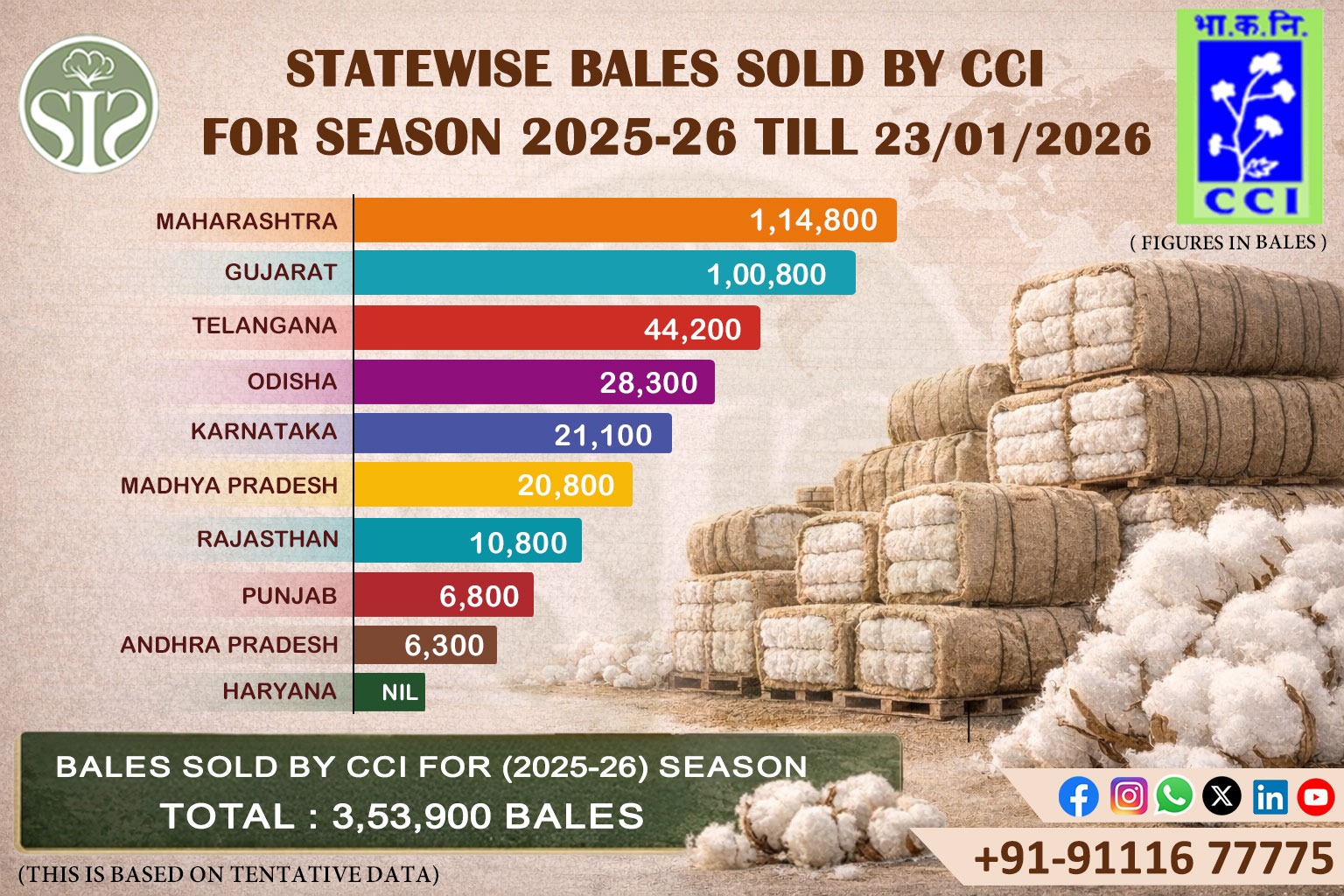
State-wise CCI Cotton Sales Details – 2025-26 SeasonThe Cotton Corporation of India (CCI) has increased cotton prices in Maharashtra by a total of ₹100 per candy for the 2025-26 season. So far, approximately 3,53,900 cotton bales have been sold by CCI during the 2025-26 season. Sales are highly concentrated in a few major cotton-producing states, emerging as the leading contributors.The CCI has sold a total of approximately 98,81,400 bales during the 2024-2025 season.
Meeting held for textile industry on cotton and EPFThe South India Spinners Association (SISPA), in association with Recycle Textile Federation (RTF), organised a panel discussion on “Current Cotton Scenario, Latest Schemes on EPF & New Labour Codes” recently in Coimbatore in which more than 100 members of SISPA and RTF participated.The sessions were on the cotton scenario, latest updates in Employees’ Provident Fund (EPF), Employees’ State Insurance Corporation (ESIC) schemes, Labour Codes and Factories Act.The discussions on cotton highlighted the prevailing cotton market situation, including availability, price trends, and quality aspects. The participants were advised to closely monitor arrivals, MSP operations, and market movements while planning procurement strategies.On the schemes under EPF, the panellists highlighted the recent updates and schemes and provided clarifications on compliance requirements, online processes, and benefits available to employers and employees. On the benefits of the ESIC, including medical coverage and employee welfare measures, the discussions were on the benefits of SPREE and Amnesty Scheme – 2025. The participants received practical guidance on coverage, contribution norms, and claim procedures.The salient features of the new Labour Codes were also explained at the event with focus on their implications for the textile industry. The industry was asked to prepare for implementation by reviewing internal HR policies, registers, and compliance systems. Key compliance expectations under the Factories Act were also discussed.S. Jagadesh Chandran, secretary, SISPA, highlighted the relevance of such interactive discussions in the present industry context. R. Arun Karthik, president of the SISPA, spoke on the prevailing cotton market scenario, emerging statutory challenges, and the continuous efforts of SISPA to safeguard the interests of member mills. M. Jayabal, chairman, Recycle Textile Federation, explained the importance of compliance and the benefits available to members.read more :- CCI: Cotton purchase figure reached 10 lakh quintals
CCI bought 10 lakh quintals of cottonYavatmal: This season, huge fluctuations are being seen in the market price of cotton, while Cotton Corporation of India (CCI) has purchased up to 10 lakh quintals of cotton in the district under the Market Intervention Scheme.Although the arrival from CCI has decreased this year compared to last year, farmers in the district have so far sold about 1.3 lakh quintals of cotton. Out of this, 10,19,784 quintals of cotton were purchased by CCI, while 3,90,686 quintals of cotton were purchased by private traders.Currently, the price of cotton in the open market is around Rs 8200 per quintal, which is about Rs 330 more than the CCI rate. Because of this, many farmers are preferring to sell cotton to private traders instead of government procurement. Because of this, the pace of purchases from CCI has slowed down.CCI is making purchases at different purchase centers in the district and registration has been done in the names of about one lakh 33 thousand farmers. Of these, 58 thousand farmers have received permission (token) to sell cotton and the remaining farmers are still waiting.If we look at the purchase according to taluka, there will be 9 lakh quintals in Yavatmal, 69 thousand in Kalamb, 52 thousand in Ghatanji, 1 lakh in Pandharkavda, 1.25 lakh in Maregaon, 57 thousand in Jhari, 50 thousand in Darwa, 29 thousand in Ner, 14 thousand in Arni, 3 thousand in Digras, 29 thousand in Pusad and 38 thousand quintals in Mahagaon. Cotton has been purchased. According to experts, increasing the pace of government procurement and timely payment of money to farmers can reduce the pressure on the open market. Otherwise, farmers will once again have to bear the brunt of price fluctuations.read more :- 3.53 lakh bales of CCI sold through online auction
| title | Created At | Action |
|---|---|---|
| Big boost to TN textile sector with 55 MoUs worth Rs 913 crore | 30-01-2026 18:05:27 | view |
| The rupee opened 03 paise higher at 91.92 against the dollar. | 30-01-2026 17:24:49 | view |

| Rupee rises 04 paisa to close at 91.95 per dollar | 29-01-2026 22:44:28 | view |
| Indian textile exporters suffer losses due to US tariffs | 29-01-2026 18:58:06 | view |
| Budget 2026: Research-based policy for cotton | 29-01-2026 17:54:53 | view |
| Rupee open Falls 20 Paise to 91.99/USD | 29-01-2026 17:30:08 | view |
| Indian yarn increased the troubles of Bangladeshi textile industry | 29-01-2026 00:30:45 | view |
| Rupee closed down by 19 paisa at 91.79 per dollar | 28-01-2026 22:42:37 | view |
| India-EU FTA to boost textile exports and employment | 28-01-2026 18:33:53 | view |
| Rupee opened 12 paise stronger at 91.60 per dollar | 28-01-2026 17:25:53 | view |
| High US tariffs: An eye on apparel sector's budget | 27-01-2026 23:36:01 | view |
| India-EU trade deal boosts textile and chemical stocks | 27-01-2026 23:19:11 | view |
| The rupee closed 03 paisa higher against the dollar at 91.72 | 27-01-2026 22:40:40 | view |
| "Trump's decision: 25% tariff imposed on South Korea" | 27-01-2026 19:44:31 | view |
| Big decline in cotton production in Maharashtra, Khandesh's ginning industry in crisis | 27-01-2026 19:30:04 | view |
| Jacid alert in cotton cultivation in 2026 | 27-01-2026 17:57:59 | view |
| The rupee opened 19 paise higher at 91.75 against the dollar. | 27-01-2026 17:28:36 | view |

| State wise CCI Cotton Sales – 2025-26 | 24-01-2026 22:25:23 | view |
| Meeting on cotton and EPF for textile industry | 24-01-2026 18:33:13 | view |
| CCI: Cotton purchase figure reached 10 lakh quintals | 24-01-2026 18:17:57 | view |