STAY UPDATED WITH COTTON UPDATES ON WHATSAPP AT AS LOW AS 6/- PER DAY
Start Your 7 Days Free Trial TodayIndian rupee opens 07 paise lower at 90.25 against US dollarIndian rupee opened with marginal losses at 90.25 per dollar on Wednesday versus previous close of 90.18.read more :- Rupee rise 07 paisa to close at 90.18 per dollar
The Indian rupee on Tuesday rise 07 paise to close at 90.18 per dollar, compared to its opening price of 90.25 in the morning.At close, the Sensex was down 250.48 points or 0.30 percent at 83,627.69, and the Nifty was down 57.95 points or 0.22 percent at 25,732.30. About 1870 shares advanced, 1942 shares declined, and 158 shares unchanged.read more :- Gujarat's textile industry: engine of employment and sustainable development
Gujarat's textile industry has emerged as a key driver of development through job creation and sustainable growth.The second day of the Vibrant Gujarat Regional Conference (VGRC) in Rajkot focused specifically on the textile industry. The state's textile sector is a crucial source of development as it generates new employment opportunities and is a sustainable industry.Experts discussed this topic in detail and shared their views during a seminar, the Chief Minister's Office said in a press release.The textile industry is not just a sector producing textile products, but a driving force behind Gujarat's economic transformation. Through new technologies, job creation, and sustainable development, this industry is making a significant contribution to the development of the state and the country.At the VGRC, experts shared their insights on new aspects of this industry, technologies, and how to increase textile exports globally.Prominent figures present at the seminar included Updeep Singh, Resident Director of Welspun Group; Prashant Agarwal, Joint Managing Director of Wazir Group; D.S. Patel, Scientist at the Cotton Research Center, Navsari University; Ashwin Chandra, Chairman of CITI; and Vinay Kotak, President of the Cotton Association of India.Speaking at the event, these prominent individuals stated that the textile industry in Gujarat has witnessed remarkable development.The release stated, "This industry has carved a niche for itself in the global market. To remain globally competitive in the textile industry, it has become crucial to develop capabilities in innovative technologies and new designs. Today, fashion plays a very important role in the textile industry, but to keep pace with the ever-changing fashion trends, the use of innovative technologies is essential."Globally, the textile industry is estimated to be worth approximately USD 900 billion. To meet the growing demand for textiles over time, it will be necessary to adopt innovative technologies, while also prioritizing design and quality. Cotton is produced in 11 states of India, with Gujarat, Maharashtra, Rajasthan, Punjab, and Haryana leading in production. Gujarat, in particular, produces a significant amount of cotton.The release further states that today, farmers in Gujarat have been able to significantly increase their production through the use of BT cotton. This high-quality cotton also fetches them better prices. The development of the textile sector cannot be achieved by the government alone; farmers, companies, and the government must work together for the development of this sector. Only then will cotton production increase, and we will succeed in doubling farmers' incomes.The industry is moving forward today through innovative technology, innovation-driven production methods, and eco-friendly manufacturing. The textile industry makes a significant contribution to the state's GDP and export sector. It also promotes small and medium enterprises, thereby increasing employment. The industry has strengthened the employment structure in both the handicraft and machinery sectors. Training and skill development programs have also been implemented for workers and artisans.Sustainable development and innovative technology have encouraged the sector to adopt environmentally friendly practices. New technologies such as recycling, water conservation, and energy saving are being used. Global competition, raw material prices, and changing market demands are challenges for the industry; however, new production methods, digitalization, and new marketing strategies will further strengthen the industry, the release added.read more :-Budget 2026: Demand to remove cotton import duty





Budget 2026: Textile industry body seeks permanent removal of cotton import duty; flags cost pressure, ex.The Confederation of Indian Textile Industry (CITI) has urged the government to permanently remove the 11 per cent import duty on cotton in the Union Budget 2026, warning that the levy is aggravating cost pressures and hurting the global competitiveness of domestic textile and apparel manufacturers, PTI reported.A CITI delegation met Union Agriculture Minister Shivraj Singh Chouhan last week, seeking his intervention for the permanent removal of the import duty on cotton of all varieties, the industry body said on Monday.India’s textile industry — the country’s second-largest employment generator — depends on stable access to high-quality cotton. Against a persistent demand–supply gap, the government had extended the import duty exemption on cotton until December 31, 2025, a move that was welcomed by textile associations.However, with no further notification issued, the 11 per cent duty was reinstated from January 1, 2026. CITI said the move would adversely impact the competitiveness of India’s textile and apparel sector.The minister assured the delegation that the concerns raised would be carefully examined during the review process, CITI said.The industry body also flagged a steady decline in domestic cotton production, which it said is projected to fall to its lowest level in nearly two decades this year, intensifying concerns over supply shortages.CITI argued that reimposing the import duty would further aggravate cost pressures for manufacturers. It pointed out that over the past decade, India’s average cotton imports stood at around 20 lakh bales, accounting for about 6.8 per cent of average domestic production.Imports, the industry body said, are largely quality- and specification-driven, catering to specialised requirements and back-to-back export orders, and do not displace domestic cotton.CITI also highlighted that competing textile-exporting countries such as Bangladesh and Vietnam allow duty-free cotton imports, giving them a structural cost advantage in global markets.The demand comes at a time when the textile and apparel sector — one of India’s largest sources of employment and livelihoods — is facing fresh headwinds from a 50 per cent US tariff effective August 27, 2025. Cotton-based products dominate India’s textile exports.The US is India’s single-largest textile and apparel export destination, accounting for nearly 28 per cent of total export revenues. Exports to the US were valued at close to $11 billion in FY2024-25, according to industry data.read more :- The rupee opened 09 paise lower at 90.25/USD.
The rupee opened 09 paise lower at 90.25 per dollar.Indian rupee opened lower at 90.25 per dollar on Tuesday versus previous close of 90.16.read more :-INR Gains 05 Paise, Closes at 90.16 per Dollar
The Indian rupee on monday higher 05 paise to close at 90.16 per dollar, while it opened at 90.21 in the morning.At close, the Sensex was up 301.93 points or 0.36 percent at 83,878.17, and the Nifty was up 106.95 points or 0.42 percent at 25,790.25. About 1365 shares advanced, 2561 shares declined, and 158 shares unchangedread more :- Rupee opens 05 paise down at 90.21
The Rupee opened 05 paise lower at 90.21 against the US dollar. Indian rupee opened lower at 90.21 per dollar on Monday versus Friday's close of 90.16.read more :- State-wise CCI cotton sales details (2024-25)
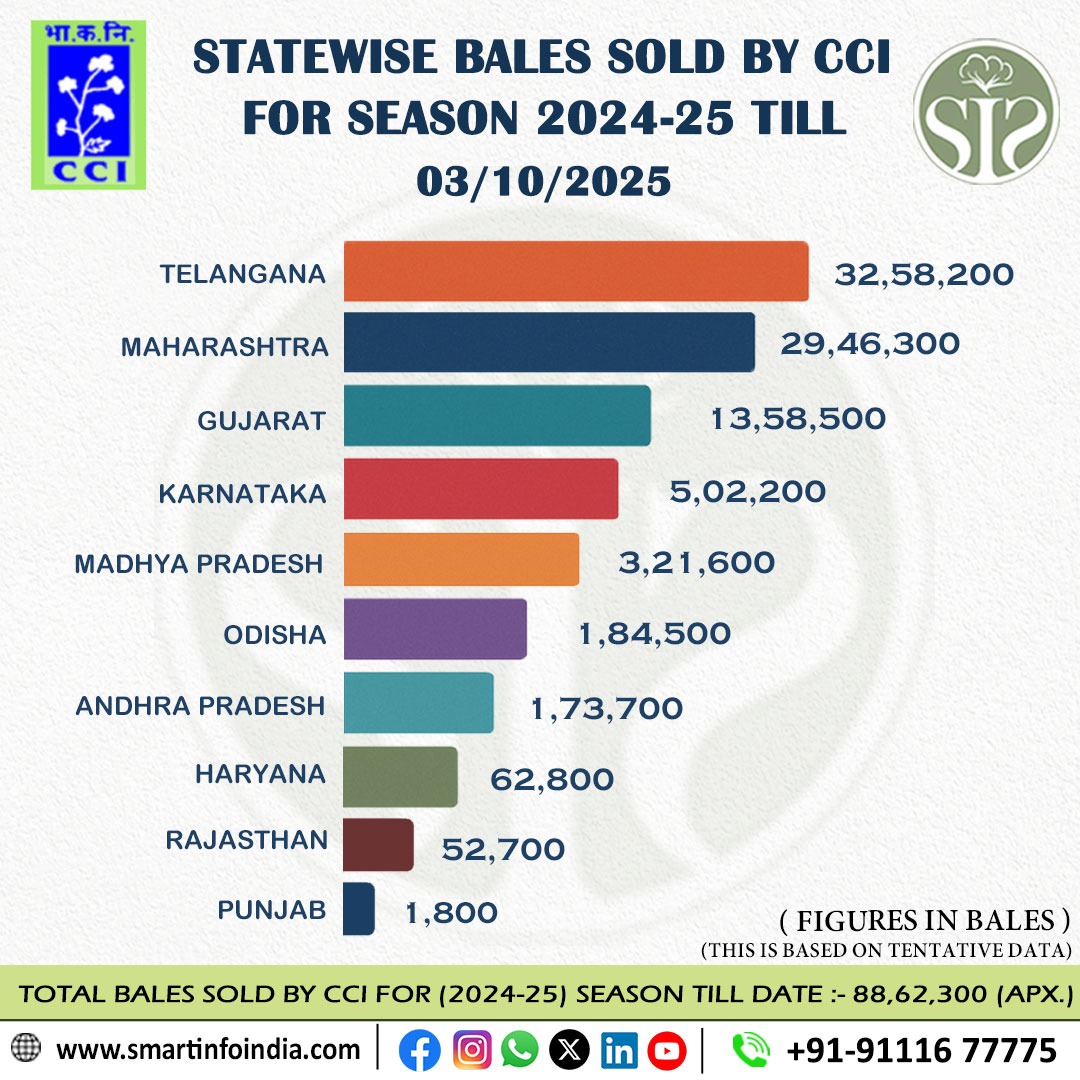
State-wise CCI Cotton Sales Details – 2024-25 SeasonThe Cotton Corporation of India (CCI) increase its cotton prices by up to ₹800 - ₹1200 per candy this week and sold approximately 98,53,300 bales for the season 2024-25. This represents around 98.53% of the total cotton procured so far this season.A state-wise breakdown of sales indicates strong activity from Maharashtra, Telangana, and Gujarat, which together account for over 83.92% of the total sales to date.This data underscores CCI’s proactive efforts in stabilizing the cotton market and ensuring steady supply across key cotton-producing states.read more:- US Supreme Court will take important decision on Trump tariffs and voting rights
US Supreme Court to Rule on Donald Trump Tariffs and Major Cases Including Voting Rights Act and Colorado ConvUS Supreme Court plans rulings for January 14 as Donald Trump's tariffs remain undecidedThe US Supreme Court will rule on Donald Trump's global tariffs, presidential powers, the Voting Rights Act, and Colorado's conversion therapy ban on January 14, impacting law and the global economy.The US Supreme Court is expected to issue its next rulings on January 14 as several major cases remain pending including the legality of US President Donald Trump's sweeping global tariffs.The court indicated on its website on Friday (January 9) that it could release decisions in argued cases when the justices take the bench during a scheduled sitting next Wednesday (January 14). The court does not announce in advance what cases will be decided.The justices issued one ruling on Friday in a criminal case.The challenge to Trump's tariffs marks a major test of presidential powers as well as of the court's willingness to check some of the Republican president's far-reaching assertions of authority since he returned to office in January 2025. The outcome will also impact the global economy.During arguments in the case heard by the court on November 5, conservative and liberal justices appeared to cast doubt on the legality of the tariffs, which Trump imposed by invoking a 1977 law meant for use during national emergencies. Trump's administration is appealing rulings by lower courts that he overstepped his authority.Trump has said tariffs have made the United States stronger financially. In a social media post on January 2, Trump said a Supreme Court ruling against the tariffs would be a "terrible blow" to the United States.Trump invoked the International Emergency Economic Powers Act to impose so-called "reciprocal" tariffs on goods imported from individual countries - nearly every foreign trading partner - to address what he called a national emergency related to US trade deficits.He invoked the same law to impose tariffs on China, Canada and Mexico, citing the trafficking of the often-abused painkiller fentanyl and illicit drugs into the United States as a national emergency.The challenges to the tariffs in the cases before the Supreme Court were brought by businesses affected by the tariffs and 12 US states, most of them Democratic-governed.read more :-CCI increases cotton prices by ₹800-₹1200, weekly volume 2.23 lakh bales
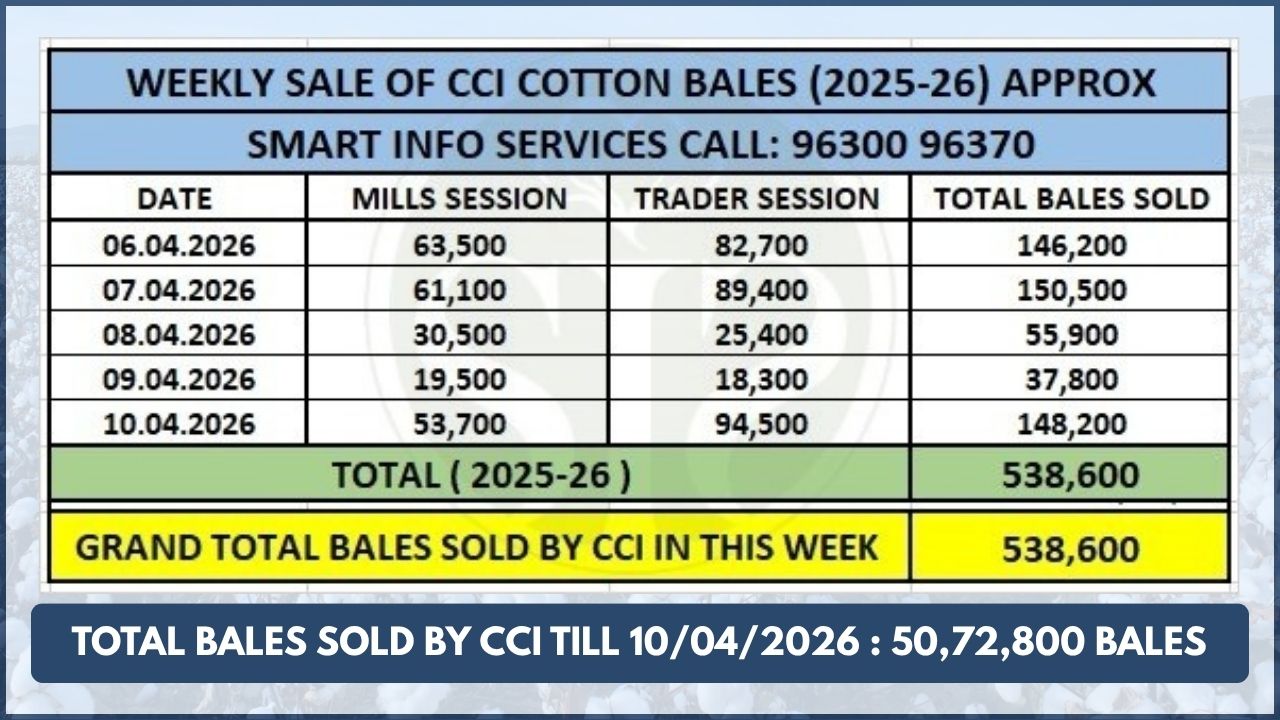
CCI Increased its prices by ₹800 - ₹1200 per candy this week, Weekly Volume at 2.23 Lakh BalesThe Cotton Corporation of India (CCI) increase its cotton prices by up to ₹800 - ₹1200 per candy during the current week, CCI has now sold 98.53% of the cotton procured during the 2024–25 season through e-auctions.During the week from 05 January 2026 to 09 January 2026, CCI conducted regular online auctions for mills and traders across various centers. These auctions resulted in total weekly sales of approximately 2,23,100 bales.Day-Wise Sales Report05 January 2026The week began on a strong note with the highest sales recorded at 94,000 bales. Of these, 44,400 bales were purchased by mills, while 49,600 bales were bought by traders.06 January 2026CCI sold 42,000 bales on this day, with mills lifting 26,300 bales and traders purchased 15,700 bales.07 January 2026Total sales stood at 57,900 bales. Mills accounted for 12,900 bales, while traders purchased 45,000 bales.08 January 2026Sales dropped to 21,300 bales, comprising 10,400 bales purchased by mills and 10,900 bales by traders.09 January 2026The week concluded on a modest note with 7,900 bales sold. Of this, mills purchased 3,000 bales, whereas traders bought 4,900 bales.With these weekly sales, CCI’s total cotton sales for the ongoing season have reached approx 98,53,300 bales, representing 98.53% of its total procurement under the 2024–25 season.
Global Cotton Yarn Market to Reach $140.1 Billion by 2032, Fueled by Rising Textile DemandJanuary 2026 — The global cotton yarn market is poised for steady growth over the next decade, according to a recent report titled “Cotton Yarn Market by Type (Carded Yarn, Combed Yarn, Others), by Application (Apparel, Home Textiles, Industrial Textile, Others): Global Opportunity Analysis and Industry Forecast, 2023–2032.”The report reveals that the cotton yarn market was valued at $91.4 billion in 2022 and is projected to reach $140.1 billion by 2032, registering a compound annual growth rate (CAGR) of 4.4% during the forecast period from 2023 to 2032.Key Drivers of GrowthDemand for cotton yarn continues to be driven by the thriving apparel, home textile, and industrial textile sectors. Economic expansion in emerging markets, advancements in textile manufacturing technologies, and evolving sourcing strategies are further contributing to market growth.However, the report cautions that raw cotton price volatility—influenced by weather patterns, crop yields, and global demand—could impact profit margins for manufacturers. Despite these challenges, emerging economies with rising disposable incomes and expanding populations present substantial growth opportunities. Manufacturers focusing on regional consumer preferences and trends are expected to gain a competitive edge.Asia-Pacific Leads the MarketRegionally, Asia-Pacific dominated the global cotton yarn market in 2022, accounting for more than two-fifths of total revenue, and is expected to maintain its leadership through 2032. The region is also projected to record the highest CAGR of 4.7% during the forecast period.The strong growth trajectory in Asia-Pacific is attributed to its large population base, expanding middle class, and rising demand for textiles and apparel. The region’s well-established textile manufacturing infrastructure and cultural affinity for cotton-based products further reinforce its market dominance.read more :- INR Drops 28 Paise, Closes at 90.16 per Dollar
The Indian rupee on Friday lower 28 paise to close at 90.16 per dollar, while it opened at 89.88 in the morning.At close, the Sensex was down 604.72 points or 0.72 percent at 83,576.24, and the Nifty was down 193.55 points or 0.75 percent at 25,683.30. About 918 shares advanced, 2889 shares declined, and 131 shares unchanged.read more :- Big decision today on Trump tariffs
Trump Tariffs: Major Decision on Trump Tariffs in US Supreme Court Today! $17.55 Trillion at Stake.Today is a crucial day in the United States. The Supreme Court could rule on Trump's mega-tariff policy – the very tariffs that Trump himself calls his favorite word. The court will decide whether the government has the authority to impose such heavy tariffs under the IEEPA (International Emergency Economic Powers Act), and if not, whether the government will have to refund importers. This is not just a legal battle, but a decision that will have a significant impact on America's trade policy, fiscal situation, and global markets.What's at Stake?There are two major questions in this case: Can the Trump administration impose tariffs under the IEEPA? If the court rules that this method was incorrect, will the government have to refund importers?However, experts believe that the court's decision will not be an all-or-nothing outcome. That is, neither complete authority will be granted, nor will all power be taken away – a middle ground is likely. There is also a possibility that the court will grant the government limited authority under the IEEPA and also limit the refunds to be returned.What is the White House thinking?US Treasury Secretary Scott Bessent has clearly stated that they are anticipating a mixed decision. According to him, "Our tariff collection will continue, there is no doubt about that. The real danger is that the president's power will be diminished – in both national security and negotiations." Trump primarily used the IEEPA to curb the import of fentanyl.Bessent says that even if the court stops the tariffs, the administration has at least three other avenues under the 1962 Trade Act through which most tariffs can continue. However, if the government has to issue refunds, it could put pressure on efforts to reduce the fiscal deficit.What are the market and economists saying? Interactive Brokers' senior economist, Jose Torres, believes that if the court removes the tariffs, the administration will find another way. Trump's agenda is very strong, and he wants to push it forward at all costs. Torres said that his clients also believe the administration has several backup options.Prediction market Kalshi's opinion: Only a 28% chance that the court will rule in Trump's favor. CNBC also quoted analysts as saying that whether the court blocks or limits the tariffs, the White House will find a workaround.Impact of Tariffs - Analysts SurprisedMany analysts expected that the tariffs would increase inflation and worsen the trade deficit. But the opposite happened—almost no impact on inflation, the trade deficit is at its lowest level since 2009, and the October trade gap reached a record low—which is completely contrary to analysts' forecasts.read mare :- The government has launched a district-based textile scheme for export champions.
Government Launches District-Based Textile Scheme to Create Export ChampionsLaunched at the National Conference of Textile Ministers in Guwahati, this initiative adopts a district-level, sector-specific approach to develop 100 high-potential districts into global export champions and upgrade 100 aspirational districts into self-reliant hubs.The government on Thursday unveiled the District-Led Textile Transformation (DLTT) scheme, a strategic initiative designed to catalyze inclusive and sustainable growth in India's textile landscape.The Ministry of Textiles launched the initiative at the National Conference of Textile Ministers in Guwahati."By shifting to a sector-specific, district-level approach, the Ministry aims to transform 100 high-potential districts into global export champions and elevate 100 aspirational districts into self-reliant hubs," the Ministry of Textiles said.The Ministry analyzed all districts using a data-driven scoring methodology based on three key parameters: export performance, MSME ecosystem, and workforce presence.This was then formulated into a two-pronged strategy, where districts were categorized into Champion Districts and Aspirational Districts. The scheme follows a tailored implementation framework based on the district's category.The initiative also emphasizes the Purvodaya convergence in the Eastern and North-Eastern regions.These regions have been prioritized for tribal belt development, connectivity improvements, and Geographical Indication (GI) tagging to position unique cultural handicrafts in premium global markets.Through the strategic convergence of government resources and collaborative partnerships with industry and academia, the program aims to strengthen textile clusters and systematically build successful models to maximize impact across districts, the Ministry said.read more :- INR Opens Stronger by 14 Paise at 89.88
The rupee opened 14 paise higher at 89.88 against the dollar.Indian rupee opened 14 paise higher at 89.88 per dollar on Friday against previous close of 90.02.read more :- Bangladesh considers tariff on Indian cotton yarn
Bangladesh considers tariffs on Indian cotton yarn importsNEW DELHI : Bangladesh is mulling tariffs on Indian cotton yarn imports, with the Bangladesh Trade and Tariff Commission discussing this on January 5, Indian yarn industry executives said on Wednesday, citing Bangladeshi trade reports, against the backdrop of deteriorating bilateral relations.Bangladesh tariffs on Indian yarn could hit domestic prices, mills, and farmers, analysts said.Levies by Bangladesh, the world’s largest importer of raw cotton, on yarn imports from India, its largest supplier, could weaken domestic prices, hitting mills and farmers here, analysts said.India has been sheltering former Bangladesh PM Sheikh Hasina since she fled Dhaka in mid 2024 following student-led protests, and a harsh crackdown by security forces that killed hundreds but only served to intensify the agitation against her. She has been sentenced to death, in her absence, by a Bangladesh tribunal.Meanwhile Dhaka has grown closer to both Beijing and Islamabad, several of its leaders, including its interim head of government Mohammed Yunus, have made intemperate comments about India, and New Delhi has condemned a string of recent murders of Hindus in Bangladesh, while the interim government of the neighbouring country continues to press for an extradition of its toppled leader, to which India has remained non-committal.The latest spat between the two countries involved the participation of a Bangladesh cricketer in the Indian Premier League. After protests in India forced the Indian cricket board to ask the team that signed him on to release him, Dhaka said it would not travel to India for a major cricket tournament, citing security concerns.The strained ties could impact trade with India, which was Bangladesh’s third-biggest trading partner in 2024. This may impact goods worth around $770 million, amounting to nearly 42% of Bangladesh’s exports to India, according to a May 2025 analysis of the Global Trade Research Initiative.“Bangladesh is considering imposing duties on Indian yarn. Last year, it restricted yarn imports. This will impact markets in India,” said Atul Ganatra, a former president of the Cotton Association of India.In April last year, Bangladesh banned import of yarns from India via land ports through a notification by the National Board of Revenue. This came barely days after the country announced a ban on the import of several Indian commodities, including newsprint, cigarette paper, duplex board, potatoes, powdered milk and components for television sets and radios. In May 2025, India imposed curbs on imports of ready-made garments and processed foods from Bangladesh.In its January 5 meeting, the Bangladesh Trade and Tariff Commission reviewed cotton and cotton yarn imports from India and discussed a specific proposal to impose tariffs, said Amrit Kota of Gayatri Impex Ltd, a Mumbai-based exporter of yarn.India exported cotton yarn valued at $3.57 billion in 2025, of which Bangladesh was the largest recipient, accounting for about 45.9% of its total yarn shipments. India is the largest supplier of cotton yarn to Bangladesh, which feeds its large spinning industry, while China is the top exporter of finished fabric to the country.
Giriraj Singh, Mohan Yadav participate in National Textile Ministers' Conference in GuwahatiGuwahati: Union Textiles Minister Giriraj Singh and Madhya Pradesh Chief Minister Mohan Yadav participated in the National Textile Ministers' Conference 2026 in Guwahati on Thursday.On the occasion, Singh and Yadav, along with Union Minister of State for Textiles Pabitra Margherita, inaugurated a handloom and handicrafts exhibition showcasing India's art, traditions, and craftsmanship.In a post on the social media platform X, Singh said the exhibition offers a powerful glimpse into India's heritage and reflects the vision of strengthening tradition while ensuring continuous development."Today, during the National Textile Ministers' Conference in Guwahati, inaugurated the Handloom and Handicrafts Exhibition along with the Hon'ble Chief Minister of Madhya Pradesh, Dr. Mohan Yadav, and the Hon'ble Minister of State for Textiles, Shri Pabitra Margherita. This exhibition offers a powerful glimpse into India's art, tradition, and craftsmanship. Our vision is clear – to ensure that India's heritage remains strong while development continues in a sustainable manner," Singh wrote on X.According to an official statement, Chief Minister Yadav will also hold discussions with the Assam government on the exchange of wildlife between the two states.He said that Madhya Pradesh and Assam had previously discussed the reintroduction of wild buffaloes, which have become extinct in Madhya Pradesh, and also the possibility of bringing rhinos to the state.Yadav further stated that following a request from Assam's Chief Wildlife Warden, an agreement has been reached to transfer tigers and crocodiles from Madhya Pradesh to Assam."Proposals related to the exchange of wildlife have been sent to the central government," he said.The Chief Minister also said that cooperation between the two states in eco-tourism and wildlife tourism is expected to increase, and these issues will be discussed with Assam Chief Minister Himanta Biswa Sarma. The two-day National Conference of Textile Ministers in Guwahati is focusing on investment promotion, job creation, innovation, skill development, and production aligned with market demand.The conference is also discussing traditional handlooms and handicrafts, modern textiles, technical textiles, apparel, and export potential.During the conference, Yadav will present Madhya Pradesh's textile policy and investment opportunities, while the event will also provide states with an opportunity to share best practices and explore partnerships in the textile sector.read more :-500% tariff warning: Panic in Dalal Street
500% US Tariff Threat Rocks Dalal StreetExport-oriented textile and shrimp stocks witnessed heavy selling pressure on January 8 after US President Donald Trump approved a bipartisan sanctions bill. The bill proposes imposing a massive 500 percent tariff on countries, including India, that continue to trade with Russia.(SIS)These stocks have remained volatile since Trump returned to power and increased tariffs on Indian imports to 50 percent, citing New Delhi's purchase of Russian oil.Republican Senator Lindsey Graham said the bill would give the US an opportunity to put additional pressure on countries "fueling Putin's war machine" by buying Russian oil. He said the legislation, backed by Trump, could be brought to a bipartisan vote as early as next week, even as diplomatic efforts to end the Ukraine war continue.(SIS)According to the US Congress website, the proposed Sanctioning of Russia Act of 2025 also seeks to penalize individuals and entities and increase duties on all goods and services imported from Russia into the US by at least 500 percent, signaling a massive escalation in economic pressure.Graham said the bill would empower the US president to take action against countries buying discounted Russian oil, which Washington believes is helping to finance Moscow's war efforts. "This bill will allow President Trump to punish countries that buy cheap Russian oil, which is fueling Putin's war machine," he said, naming China, India, and Brazil as potential targets.(SIS)This development comes at a time when the long-pending India-US trade agreement remains in limbo despite several rounds of talks between officials from both countries.(SIS)read more :- INR Drops 07 Paise, Closes at 90.02 per Dollar
The Indian rupee on thursday lower 07 paise to close at 90.02 per dollar, while it opened at 89.95 in the morning.At close, the Sensex was down 780.18 points or 0.92 percent at 84,180.96, and the Nifty was down 263.90 points or 1.01 percent at 25,876.85. About 974 shares advanced, 2870 shares declined, and 137 shares unchanged.read more :- Garment exporters under pressure from US tariffs, AEPC chief seeks relief and budget support
| title | Created At | Action |
|---|---|---|
| The rupee opened 07 paisa lower against the dollar at 90.25 | 14-01-2026 17:31:17 | view |
| Rupee rise 07 paisa to close at 90.18 per dollar | 13-01-2026 22:50:24 | view |
| Rupee rises 07 paisa to close at 90.18 per dollar | 13-01-2026 22:45:58 | view |
| Gujarat's textile industry: engine of employment and sustainable development | 13-01-2026 19:08:42 | view |
| Budget 2026: Demand to remove cotton import duty | 13-01-2026 18:20:30 | view |
| The rupee opened 09 paise lower at 90.25/USD. | 13-01-2026 17:21:30 | view |
| INR Gains 05 Paise, Closes at 90.16 per Dollar | 12-01-2026 22:47:41 | view |
| Rupee opens 05 paise down at 90.21 | 12-01-2026 17:28:16 | view |
| State-wise CCI cotton sales details (2024-25) | 10-01-2026 22:05:38 | view |
| US Supreme Court will take important decision on Trump tariffs and voting rights | 10-01-2026 18:38:42 | view |
| CCI increases cotton prices by ₹800-₹1200, weekly volume 2.23 lakh bales | 10-01-2026 00:49:31 | view |
| Global cotton yarn market to reach $140.1 billion by 2032 | 10-01-2026 00:38:58 | view |
| INR Drops 28 Paise, Closes at 90.16 per Dollar | 09-01-2026 22:43:08 | view |
| Big decision today on Trump tariffs | 09-01-2026 19:07:56 | view |
| The government has launched a district-based textile scheme for export champions. | 09-01-2026 18:30:00 | view |
| INR Opens Stronger by 14 Paise at 89.88 | 09-01-2026 17:27:50 | view |
| Bangladesh considers tariff on Indian cotton yarn | 09-01-2026 01:32:52 | view |
| Giriraj Singh, Mohan Yadav attend Guwahati Textile Ministers Conference | 09-01-2026 00:00:28 | view |
| 500% tariff warning: Panic in Dalal Street | 08-01-2026 23:46:25 | view |
| INR Drops 07 Paise, Closes at 90.02 per Dollar | 08-01-2026 22:43:44 | view |