STAY UPDATED WITH COTTON UPDATES ON WHATSAPP AT AS LOW AS 6/- PER DAY
Start Your 7 Days Free Trial TodayThe Rupee opened 15 paise lower at 90.41 against the US dollar.Indian rupee opened lower at 90.41 per dollar on Wednesday versus previous close of 90.26.read more :- Rupee higher 04 paise to close at 90.26 per dollar
The Indian rupee higher 04 paise to close at 90.26 per dollar on Tuesday, compared to 90.30 in the morning.At close, the BSE Sensex stood at 83,739.13, up 2,072.67 points or 2.54 per cent, while the NSE Nifty 50 settled at 25,727.55, up 639.15 points or 2.55 per cent.read more :- Relief to textile sector due to removal of American tariff
Trump’s Tariff Removal: Major Impacts on Indian Textiles✅ Tariffs reduced — U.S. import duty on Indian goods (including textiles) cut to ~18% from higher levels (25–50%).✅ Boost to exports — Indian textiles now more price-competitive in the U.S. market.✅ Stock surge — Shares of Gokaldas Exports, KPR Mill, Welspun, and Trident jumped 10–20% after the announcement.✅ Higher U.S. orders expected — Lower tariffs likely to revive demand and export volumes from American buyers.✅ Industry relief — Textile associations say this move restores competitiveness and saves jobs in export hubs.✅ Positive investor sentiment — The deal signals improved India-U.S. trade relations, boosting market confidence.✅ Still not duty-free — Tariffs are lowered, not eliminated — India still faces competition from Bangladesh, Vietnam, and EU-FTA countries.✅ Overall effect: Strongly positive — Expected to lift textile exports, profits, and employment in the coming quarters.read more :- Boost to textile sector in Budget 2026, focus on cotton mission
Budget 2026 lifts textiles support with focus on Cotton Mission, technology upgrades.Budget 2026 has raised support for the textile sector, with higher allocation for the Ministry of Textiles and a renewed focus on the Cotton Mission and technology upgrades. The government aims to improve productivity, stabilise raw material supply and support exporters facing tariff pressure through schemes such as ATUFS, technical textile incentives and new textile parks.Textiles get higher Budget support in 2026 as Cotton Mission, technology upgrades take focus. As exporters suffer with new tariff constraints and global uncertainty, the Union Budget 2026 puts textiles back on the table. Higher spending, a renewed Cotton Mission and more support for technology upgrades suggest the government is finally trying to fix long-standing issues in the sector. After months of lobbying by industry bodies and concerns over the impact of US tariff actions under President Donald Trump, the government has chosen to lean on domestic strengths. The focus is clear: raise productivity, improve value addition and help textile manufacturers stay competitive across cotton, man-made fibre apparel and technical textiles. The nearly seven per cent rise in the Textiles Ministry’s allocation underscores that intent.As anticipated, the Budget has increased funding for the Ministry of Textiles by close to seven per cent. For the industry, this matters as much for what it signals as for the absolute number. At a time when global demand remains uneven and cost pressures persist, the higher outlay suggests policy continuity rather than short-term firefighting.Executives say the move offers some reassurance after a tough year marked by volatile cotton prices, weak export orders and thinning margins, particularly in apparel. The expectation now is that this additional spending will translate into smoother implementation of existing schemes rather than new headline announcements.Cotton Mission moves to the centre of policy.The Cotton Mission has emerged as a central pillar of the government’s textile strategy in Budget 2026. The renewed focus makes it clear the government knows raw materials remain one of the textile sector’s biggest problems. For exporters, support that helps them become more efficient may work better in the long run than short-term incentives.ATUFS funding likely to increaseA key positive for manufacturers is the expected rise in funding under ATUFS, the Amended Technology Upgradation Fund Scheme. The scheme has played a major role in helping spinning, weaving, processing and garment units modernise.Another push for technical textilesThe Budget also reinforces the long-term bet on technical textiles as a growth driver. Expanded duty exemptions on specialised machinery are expected to lower entry barriers and attract fresh investment. This push is part of India’s bigger plan to cut import dependence and build strength in exports where global demand is growing.For states and local economies, especially tier-2 and tier-3 cities where textiles are already strong, this could bring fresh investment and more jobs.Why this Budget matters for textiles?Budget 2026 positions textiles as a long-term manufacturing priority, not a sector getting temporary support. The focus is on stronger raw material access, better technology and solid infrastructure - the basics needed to compete globally.read more :- Announcement of establishment of textile mills in Odisha cotton belt
Odisha To Set Up Textile Mills In Cotton Belt, Announces CM Mohan Majhi.Bhubaneswar: The Odisha government will set up textile mills in the State’s cotton-producing districts, Chief Minister Mohan Charan Majhi announced on Sunday. The CM’s announcement signals a policy push to retain value addition and jobs within the state’s agrarian hinterland.Speaking during a visit to Sonepur, Majhi said western Odisha—particularly districts such as Bolangir, Kalahandi and Sonepur—would be prioritised for textile-led industrialisation, addressing a long-pending demand of cotton farmers and local industry.Despite producing lakhs of quintals of cotton annually, Odisha lacks adequate processing capacity, forcing farmers to send raw cotton to other states for ginning and manufacturing. This has resulted in lower returns and limited local employment. Textiles have been identified as one of the state’s 16 priority sectors, the Chief Minister said, adding that industrialisation would be expanded across all 30 districts. “Roadshows have been conducted and investors have shown interest. Textile mills will be set up in cotton-producing regions through a transparent process,” he said.The move is part of the government’s ‘Field to Fashion’ initiative, aimed at integrating cotton cultivation with garment manufacturing within the state. Officials said the plan is expected to generate large-scale employment, curb migration from western Odisha and strengthen farmer incomes. Currently, thousands of tonnes of cotton from Odisha are exported to other states and overseas markets, including Bangladesh. The proposed mills are expected to anchor a local textile value chain and give a significant boost to the State’s industrial landscape.read more :- The rupee opened 01 rupee 21 paise higher at 90.30 against the dollar.
Rupee opened 01 rupee 21 paise higher at 90.30/USDIndian rupee opened higher at 90.30 per dollar on Tuesday versus previous close of 91.51after blockbuster Modi-Trump dealread more :- Tamil Nadu: Textile industry gets relief from budget, import duty becomes cause for concern
Tamil Nadu textile industry welcomes budget reforms, raises concerns over import dutyChennai, Feb 2: Tamil Nadu's textile and apparel industry, the cornerstone of India's export sector, has widely welcomed the initiatives in the Union Budget to emphasize infrastructure, skill development and export facilitation. The industry appreciated schemes like National Fiber Scheme, Mega Textile Park and Samarth 2.0, which were considered important for modernizing and upgrading the textile skills ecosystem.However, the industry has warned that if the 11 per cent import duty on cotton is maintained, the impact of these reforms may be limited. Industry leaders from Tamil Nadu and other major textile manufacturing centers say timely availability of quality cotton is extremely essential to secure export orders and maintain employment in the value chain.South India Mills Association President Durai Palanisamy said it is necessary to remove import duty on all types of cotton to overcome the shortage of quality cotton and meet export commitments. He pointed out that domestic cotton prices in India are already about five per cent higher than international levels, while 15 per cent higher than Brazilian cotton.He also said that this price gap could widen in the coming months and seriously impact the financial viability of the entire textile value chain. Durai pointed out that the textile and apparel sector provides direct employment to about 35 million people and about 75 percent of India's total exports come from Tamil Nadu.M. Jaipal, President of Recycled Textile Federation, also expressed disappointment over the import duty and high GST rate (18 percent), which needs to be reduced to 5 percent. He said that without these measures, the availability of raw materials at globally competitive prices will be limited.Meanwhile, Apparel Export Promotion Council Chairman A. Sakthivel appreciated the emphasis on liquidity and business convenience in the budget. He said customs reforms and simplified documentation will reduce transaction costs and increase operational efficiency. He suggested that combining these steps with the review of cotton import duty would strengthen India and Tamil Nadu's position as a global textile hub.read more :- CITI: FY27 budget to boost textile exports
FY27 budget will boost textile exports: CITINew Delhi: The Confederation of Indian Textile Industries (CITI) has welcomed the Union Budget presented by Finance Minister Nirmala Sitharaman for the financial year 2027 (FY27), saying that it will prove to be important for increasing the global competitiveness of the textile and apparel sector, promoting exports and protecting employment. The organization said the budget is a testament to the government's commitment to making the region more resilient to global challenges and economic instabilities.Commenting on the Budget, CITI Chairman Ashwin Chandran said the measures announced will future-proof the textile and apparel industry as well as strengthen its contribution to the Grow India mission. He expressed his gratitude to the Prime Minister, Finance Minister and Textiles Ministry and said that these initiatives will take the industry forward towards innovation, sustainable production and more employment generation.Several important announcements have been made in the Budget, including National Fiber Mission, Mahatma Gandhi Gram Swaraj Initiative, Tex-Eco Initiative, Mega Textile Park in challenge mode, Modernization of Traditional Clusters, Textile Expansion and Employment Programme, National Handloom and Handicraft Programme, and Samarth 2.0 Skill Development Scheme. Chandran said these initiatives will help local manufacturers become more efficient, innovative and sustainable and increase India's presence in global markets.However, he also said that there was no direct announcement of removal of import duty on cotton-based products to increase cost competitiveness. This is important as these products account for about 60 percent of India's total textile and apparel market. Along with this, Chandran also stressed the need for a dedicated scheme to provide direct investment support to MSMEs to adopt sustainable production models, which will also help in availing the benefits of the upcoming India-EU Free Trade Agreement (FTA).CITI also welcomed the proposals of increasing the export realization period for exporters from six months to one year, logistics reforms through freight corridors, simplification of export-import processes and formation of a high-level committee on banking for a developed India. Chandran said the organization will continue to work closely with the government to achieve the $350 billion textile and apparel industry and $100 billion export target by 2030.The textile and apparel industry is the second largest generator of employment and livelihood in the country and contributes significantly to the GDP and total exports of the country. The US 50 per cent tariff, effective from August 27, 2025, has adversely impacted the sector, as the US is India's largest textile export market. India's textile and apparel exports to the US stood at about $11 billion in fiscal year 2024-25, which was about 28 percent of the total exports of the sector.read more :- Rupee higher 25 paise to close at 91.51 per dollar
The Indian rupee on Monday higher 25 paise to close at 91.51 per dollar, while it opened at 91.76 in the morning.At close, the Sensex was up 943.52 points or 1.17 percent at 81,666.46, and the Nifty was up 262.95 points or 1.06 percent at 25,088.40. About 1919 shares advanced, 2166 shares declined, and 159 shares unchanged.read more :- New schemes for textile sector and MSME
Labour-intensive textile sector, MSMEs to get new schemesM. Soundariya PreethaCOIMBATORELabour-intensive textile and apparel and Micro, Small and Medium-scale Enterprise (MSME) sector impacted by geopolitical developments in the last two years received a boost from the Budget with new schemes and higher allocations.Jump in allocationThe textile sector will see almost a 25% jump in budgetary allocation for 2026-2027 from the current financial year while the MSME sector will see doubling of allocation.Union Finance Minister Nirmala Sitharaman said Central Public Sector Enterprises would establish high technology tool rooms in two locations as digitally enabled automated service bureaux that locally design, test and manufacture high-precision components at scale and at lower cost.A Scheme for Enhancement of Construction and Infrastructure Equipment would be introduced to boost local manufacturing of high-value and technologically-advanced equipment.A sum of ₹10,000 crore would be allocated during the next five years for a scheme for container manufacturing.For the ‘labour-intensive textile sector’, the government proposed comprehensive measures that would include a special programme to promote sports goods, a National Fibre Scheme for man-made fibre, silk, wool, etc., mega textile parks developed on challenge mode for value addition to technical textiles, a Textile Expansion and Employment Scheme to modernise traditional clusters with capital support for machinery, technology upgradation and common testing and certification centres.A National Handloom and Handicraft programme would ensure targeted support for weavers and artisans. Mahatma Gandhi Gram Swaraj initiative would boost khadi, handloom and handicraft, Tex-Eco Initiative would promote globally competitive and sustainable textiles and apparel and Samarth 2.0 would upgrade the textile skilling ecosystem.Under rejuvenation of legacy industrial clusters, the budget proposed a scheme to revive 200 legacy industrial clusters, create dedicated ₹10,000 crore SME Growth Fund to create future champions and top up the Self-Reliant India Fund set up in 2021 with ₹2,000 crore to enable micro units access risk capital.Settlement platformThe TReDS (Trade receivables discounting scheme) would be a mandatory transaction settlement platform for all purchases from MSMEs by CPSEs. A credit guarantee support mechanism would be introduced through CGTMSE for invoice discounting on TReDS platform; GeM would be linked with TReDS and TReDS receivables would be introduced as asset-backed securities, helping develop a secondary market.read more :- Budget relief for textile sector of South Gujarat
Budget gives hope to textile sector of South Gujarat.Surat: India's largest hub for man-made fabrics (MMF), Surat, with a production capacity of 6 crore metres a day, is expected strengthen the city's position as the country's textile capital and drive economic growth across South Gujarat.The Budget also underlined the importance of the City Economic Region (CER) and Surat Economic Region (SER). The SER, covering Surat, Bharuch, Navsari, Tapi, Dang and Valsad districts, is one of the major CERs. The SER, a high-growth zone, accounts for nearly 25% of Gujarat's GDP despite occupying only 10.8% of the state's area, anchored by Surat.Under NITI Aayog's G-HUB initiative, the region is being developed into a globally competitive, diversified economic hub with a projected size of $1.3 to $1.5 trillion by 2047, focusing on high-value manufacturing, tourism and services."Surat is the largest textile cluster in India, but it does not have a centre of excellence. This Budget announced a centre of excellence at all major textile clusters. The FM announced cluster-specific technology upgradation support in her speech, and it will benefit our region," said Nikhil Madrasi, president, Southern Gujarat Chamber of Commerce and Industry (SGCCI)."The FM announced the establishment of a Textile University in an industrial area, and we hope it will come to the city. In addition, for micro and small enterprises, the limit under the CGTMSE scheme increased to Rs 10 crore per unit, which earlier was Rs 5 crore," said Ashok Jirawala, vice-president, SGCCI.read more :- Gram Swaraj and textile promoted in Budget 2026
Union Budget 2026: Gram Swaraj, fibre scheme anchor integrated textile pushThe Union Budget 2026-27 on Sunday placed the labour-intensive textile sector at the centre of India’s growth and employment strategy, announcing a sweeping set of initiatives aimed at strengthening the entire value chain — from natural fibres and traditional crafts to technical textiles and future-ready skills.Presenting the Budget, Finance Minister Nirmala Sitharaman announced a National Fibre Scheme to promote self-reliance across natural fibres, man-made fibres and new-age textile materials, signalling a move to build depth across the entire value chain rather than focusing on select segments.Budget 2026 Highlights: Here's the fine printTo address employment and competitiveness, the government will roll out textile-specific employment schemes with an emphasis on technology upgradation and targeted support for small and medium enterprises, Sitharaman said.At the heart of the push is the Mahatma Gandhi Gram Swaraj Initiative, which will strengthen khadi, handloom and handicrafts. The programme will support global market linkages and branding of Indian textile products, while streamlining training, skilling and quality standards to help artisans and weavers compete more effectively in domestic and international markets.To boost employment, the Budget proposed a Textile Expansion and Employment Scheme, under which traditional textile clusters will be modernised through capital support for machinery, technology upgradation, and the creation of common testing and certification facilities aimed at raising productivity and job creation.The Budget also proposes to integrate handloom and handicraft programmes under a national framework to provide targeted support to traditional artisans, improve market access and ensure better alignment with contemporary demand.Underscoring the push for sustainability, Sitharaman announced eco-initiatives aimed at encouraging environmentally responsible production practices across the textile ecosystem.As part of its skilling push, the government will launch Samarth 2.0, an upgraded version of the existing scheme, to modernise the textile skilling ecosystem and align training with evolving industry needs.The finance minister also said that mega textile parks will be taken up in challenge mode, with a sharper focus on attracting investments in technical textiles, a segment seen as critical for exports and industrial diversification.The integrated package reflects the government’s attempt to position textiles as a growth and employment engine while balancing modern manufacturing, sustainability and traditional strengths.read more :- Rupee opened 23 paise stronger at 91.76 per dollar
Rupee opens 23 paise up at 91.76/USD Indian rupee is trading higher at 91.76 per dollar against previous close of 91.99.
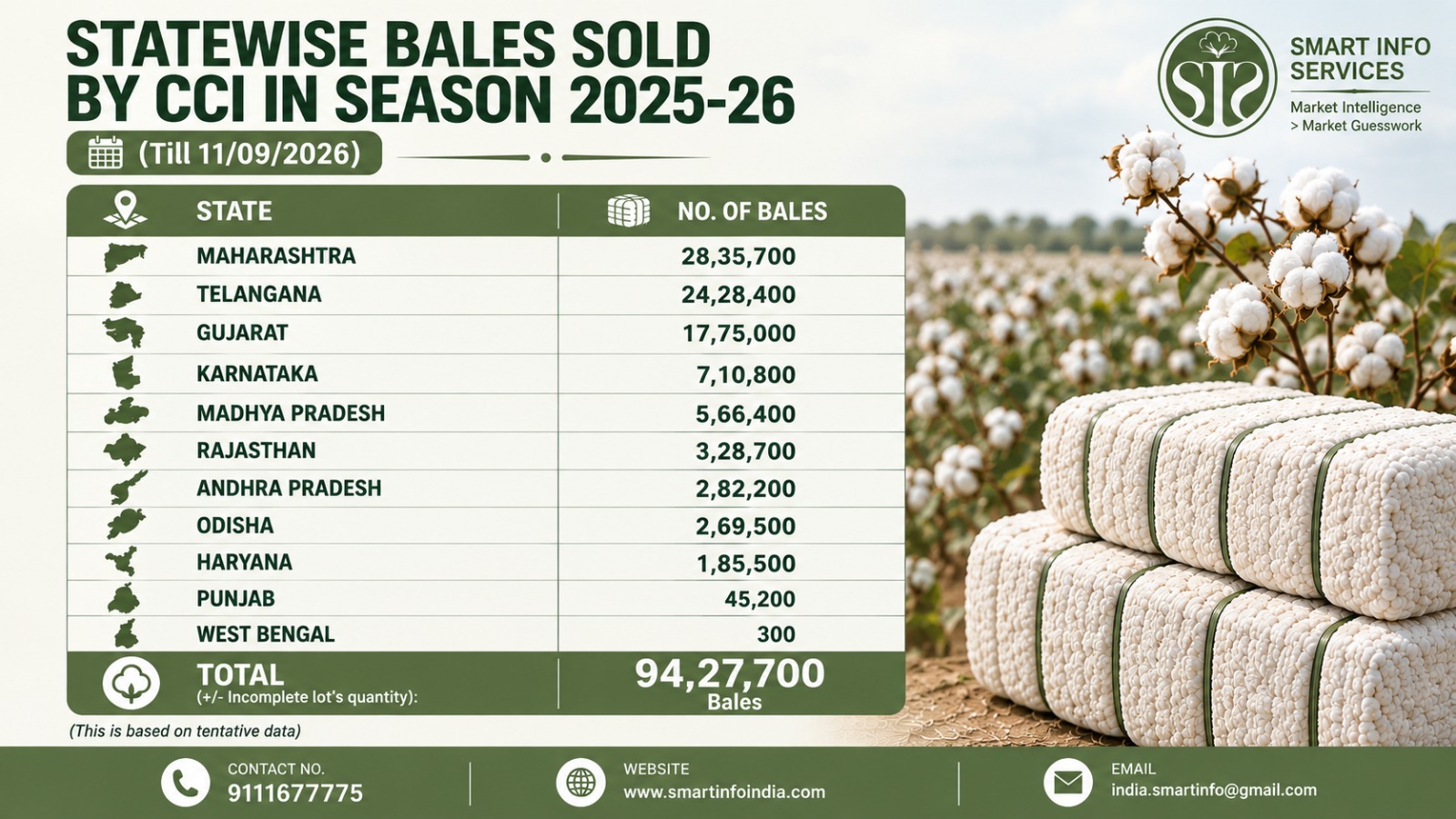
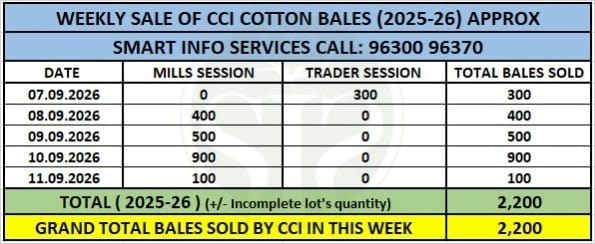
State-wise CCI Cotton Sales Details – 2025-26 SeasonThe Cotton Corporation of India (CCI) kept its price unchanged during this week for the 2025-26 season. So far, approximately 3,59,300 cotton bales have been sold by CCI during the 2025-26 season. Sales are highly concentrated in a few major cotton-producing states, Maharashtra and Gujarat emerging as the leading contributors.
History will be made on 1st February! NSE, BSE, MCX and NCDEX will remain open on Sunday on Budget Day; Know the timingThe Union Budget 2026 will be presented on Sunday, February 1, when stock and commodity markets will be open. NSE, BSE, MCX and NCDEX will remain open at normal timings in special trading sessions. This will be the second time in independent India that markets will remain open on Sunday on Budget Day.The Union Budget 2026 will be presented this time on Sunday, February 1. Generally the markets are closed on Sundays, but due to the budget, the stock market as well as the commodity markets will remain open, so that investors and traders can immediately react to the decisions related to the budget. For this reason, it has been decided that the Multi Commodity Exchange of India (MCX) will remain open as a special trading session on 1 February. Trading on this day will be as per normal market timings and live trading can be done.Not only MCX, but the agricultural commodities exchange National Commodity and Derivatives Exchange (NCDEX) will also be open for trading on this day. That means traders trading in agri commodities will also be able to trade on Sunday. Both the exchanges had already given information about this through the circular issued on January 16, so that investors could make their trading strategy in advance. The special thing is that this has happened earlier also. When the Budget 2025 was presented on Saturday, MCX and NCDEX were still open. That is, keeping the commodity market open on the budget day is now becoming a normal practice.MCX trading timings on 1st February 2026Multi Commodity Exchange of India (MCX) will be open for trading as per normal timing on the day of Union Budget 2026. The pre-open session on MCX will run from 8:45 am to 8:59 am. After this, normal trading will take place from 9 am to 5 pm. Additionally, the client code modification session will be open from 9am to 5:15pm.Trading schedule on NCDEXNational Commodity & Derivatives Exchange (NCDEX), the exchange related to agricultural commodities, will also be open for trading as per normal timing on Sunday. The pre-open session on NCDEX will start at 9:45 am, while normal trading will run from 10 am to 5 pm. Here also the facility of client code modification will be available till 5:15 pm.Why is it special to open the market on Sunday?This will be the second time in the history of independent India that the stock markets will be open for trading on Sunday. Earlier this had happened on 28 February 1999, when the markets were opened during the government led by Atal Bihari Vajpayee.This time Finance Minister Nirmala Sitharaman is going to present the ninth consecutive Union Budget.Finance Minister Nirmala Sitharaman is going to present her ninth consecutive Union Budget this time. She will give the budget speech at 11 am. Double digit growth in government capital expenditure (capex) is expected in this budget.NSE and BSE will also remain openNot only commodities, but equity exchanges NSE and BSE will also remain open as per normal trading timings on February 1. Investors and traders will be able to react to budget-related decisions on the same day. Traditionally, the amount of discussion about Budget Day does not have a big impact on the stock market. According to the data of last 15 years, the average movement of Nifty on the budget day has been only 0.19%. However, in the week after the Budget, the market has given almost seven times more returns than on Budget Day.read more :- Demand of MP MSMEs on GST, textile and tech
Industries of MP, MSMEs demanded GST relief, incentives related to textile production and promotion of tech in the budgetIndore: Industries and MSMEs of Madhya Pradesh have raised expectations from the upcoming Union Budget. They are demanding faster access to government schemes, easier GST compliance and targeted sectoral support to strengthen manufacturing and exports.Industry representatives said that despite the existence of several central and state schemes, processing delays, documentation requirements and slow disbursement of funds are hampering their impact on MSMEs. Easier processing and faster approvals still remain key demands.The textile sector has demanded special intervention to promote cotton-based manufacturing and exports. Madhya Pradesh Textile Mills Association has sought a new Production Linked Incentive (PLI) scheme for cotton garments and made-ups with lower investment limit and higher product coverage.The association has also demanded refund of input tax credit on capital goods and services in the textile value chain. MC Rawat, secretary of MP Textile Mills Association, said there is a need for a cotton price stabilization fund with five per cent interest subvention for end users to protect mills from price volatility."To ensure stability in yarn prices, margin money for cotton finance should be reduced from 25% to 10% and stock limit should be increased from three months to nine months so that mills can purchase enough cotton during the season," Rawat said.Industry bodies have also stressed the need for technology-driven growth. “The budget should focus on adoption of artificial intelligence, automation support and technology upgradation so that MSMEs can improve productivity and compete at the global level,” said Yogesh Mehta, president of the Association of Industries of Madhya Pradesh.Skill development has emerged as another priority area for the industry. “Skill development remains another major focus area, with industries demanding more funding for industry-linked training programs to bridge the gap between shop-floor needs and workforce capabilities,” said Gautam Kothari, president, Pithampur Industrial Association.Industrialists have also pointed out operational and cost related challenges. Virendra Porwal, an industrialist, said that allotment of industrial land through auction should be stopped as it increases the cost of the project rapidly. He also pointed out the frequent technical glitches on GeM and tender portals, which lead to delays in procurement and payment.Industries have sought further reforms in power tariff, including a cap of Rs 6 per unit, decentralization of industrial approvals at the district level, streamlining the renewal fee charged by the health and safety department to a 10-year validity and removal of double levy of maintenance charge and property tax by multiple authorities.Industry bodies said a reformed Budget focusing on taxation, power cost, land policy, skill development and technology adoption can significantly strengthen Madhya Pradesh's MSME ecosystem and improve its global competitiveness.read more :- Cotton duty exemption ends, Tamil Nadu's spinning mills in trouble
Cotton import duty exemption ended, prices increased, Tamil Nadu's spinning mills in troubleTamil Nadu has about 46% of India's spinning mills, of which about 1,000 units operate from Coimbatore, Tiruppur, Madurai and Dindigul districts. There are about 400 medium sized spinning mills in Coimbatore and Tirupur alone.At the beginning of the current crop season (November), cotton prices were between Rs 53,000 and Rs 54,000 per candy. To ease supply constraints, the central government had waived 11% import duty on cotton from August to December, allowing mills to meet their raw material requirements through imports. However, this discount ended on 31 December, leading to a steady increase in the price, reaching ₹56,000 per candy on 15 January.Indian Spinning Mills Owners Association vice-president P Prabhu attributed the sudden price hike to non-extension of duty waiver. Pointing out that the Cotton Corporation of India was selling cotton at a premium of Rs 800 to Rs 1,200 per candy, he said good quality cotton was in short supply. Although yarn prices had increased by Rs 8-10 per kg, he said spinning mills were incurring losses due to weak market demand.“Indian cotton prices are higher than international prices, which are around Rs 52,000–53,000 per candy, making it difficult for domestic mills to compete globally.” Representatives of the textile industry have demanded from the Center to extend the exemption in cotton import duty for another three months, so that artificial increase in prices can be prevented. He has also sought the intervention of the state government to put pressure on the Center on this issue.He also reiterated his long-standing demand that the Cotton Corporation of India should open a warehouse in Coimbatore, which could reduce transportation costs by Rs 3-4 per kg.read more :- CCI keeps cotton prices stable, weekly sales continue through online auction
CCI Keeps Cotton Prices Unchanged; Weekly Sales Continue Through Online AuctionsThe Cotton Corporation of India (CCI) kept its cotton prices unchanged during the week ended January 30, 2026, while continuing sales through online auctions for mills and traders. The auctions, conducted between January 27 and January 30, covered cotton from both the current 2025–26 season and limited stocks from the previous season.Daily sales performanceOn January 27, CCI opened the week with sales of 2,900 bales, comprising 2,800 bales from the 2025–26 season and 100 bales from the 2024–25 season. Mills accounted for 1,500 bales, all from the current season, while traders purchased 1,400 bales, including 100 bales from the previous season.Sales moderated on January 28, with 1,700 bales sold, entirely from the current season. Mills bought 1,200 bales, while traders purchased 500 bales.On January 29, total sales stood at 700 bales, all of which were bought by traders.Total sales on January 30 reached 200 bales, with the entire quantity purchased by mills for the season 2025-26.Cumulative salesWith these transactions, CCI’s cumulative sales reached 3,59,300 bales for the 2025–26 season and 98,81,500 bales for the 2024–25 season, as the agency continues to offload stocks through its e-auction platform while maintaining stable prices.read more :- Rupee fell 07 paise to close at 91.99 per dollar
The Indian rupee on Friday lower 07 paise to close at 91.99 per dollar, while it opened at 91.92 in the morning.At close, the Sensex was down 296.59 points or 0.36 percent at 82,269.78, and the Nifty was down 98.25 points or 0.39 percent at 25,320.65. About 2319 shares advanced, 1716 shares declined, and 149 shares unchanged.read more :- CITI welcomes FY26 Economic Survey, emphasizes on T&A support
CITI welcomes FY26 economic survey, seeks targeted support for T&AThe Confederation of Indian Textile Industry (CITI) has welcomed the Economic Survey for the financial year 2026 (FY26) and the roadmap it outlines to sustain India’s growth momentum amid continuing global headwinds. CITI looks forward to the upcoming Union Budget translating the Survey’s vision into concrete support for the textile and apparel sector.While raising its growth forecast for India, the Economic Survey said that “sustained reforms across five pillars – Ease of Doing Business, R&D and innovation, Skilling, Infrastructure & Logistics, and Scaling up of MSMEs – will remain critical in positioning industry as a key engine of future growth.”“The Economic Survey for the FY26 clearly shows the path that will achieve the twin objectives of a Viksit Bharat (developed India) and improve the quality of life of the Indian people, who make up almost 18 per cent of the global population," CITI chairman Ashwin Chandra said commenting on the Economic Survey.“The Survey’s observations on global trade dynamics, the need for increasing manufacturing and export competitiveness, easier credit access for MSMEs, skill development, and innovation, especially, hold great relevance for the textile and apparel sector as the industry seeks to futureproof itself,” Chandran added. The CITI Chairman said a growth-oriented Union Budget, aligned with the Economic Survey’s recommendations, will strengthen India’s position as a globally competitive and sustainable hub for textiles and apparel, which, in turn, could provide a fillip to inclusive growth and create more jobs. India has set itself a target to create a $350 billion textile and apparel industry by 2030, including achieving exports of $100 billion within that period.“In the Budget context, the textile and apparel industry expects it to include specific measures that will enhance the global competitiveness and innovation capacity of the sector,” the CITI chairman pointed out. “We anticipate that the Budget will prioritise improved access to raw materials and introduce enhanced support systems, enabling MSMEs to secure affordable credit and advance their sustainability efforts,” he added.The second-biggest generator of jobs and livelihoods, besides being a significant contributor to exports and the GDP, India’s textiles and apparel sector has been adversely affected by the 50 per cent US tariff on Indian goods, effective August 27, 2025.The US is the single-largest market for India’s textile and apparel exports. At nearly $11 billion in the FY25, India’s textile and apparel exports to the US accounted for around 28 per cent of the country’s overall exports of these items.read more :- Big boost to TN textile sector with 55 MoUs worth Rs 913 crore
| title | Created At | Action |
|---|---|---|
| Rupee opens 15 paise down at 90.41 | 04-02-2026 17:24:07 | view |
| Rupee higher 04 paise to close at 90.26 per dollar | 03-02-2026 22:50:54 | view |
| Relief to textile sector due to removal of American tariff | 03-02-2026 18:49:35 | view |
| Boost to textile sector in Budget 2026, focus on cotton mission | 03-02-2026 18:38:25 | view |
| Announcement of establishment of textile mills in Odisha cotton belt | 03-02-2026 18:26:25 | view |
| The rupee opened 01 rupee 21 paise higher at 90.30 against the dollar. | 03-02-2026 17:32:39 | view |
| Tamil Nadu: Textile industry gets relief from budget, import duty becomes cause for concern | 02-02-2026 23:30:34 | view |
| CITI: FY27 budget to boost textile exports | 02-02-2026 23:08:39 | view |
| Rupee higher 25 paise to close at 91.51 per dollar | 02-02-2026 22:38:57 | view |
| New schemes for textile sector and MSME | 02-02-2026 18:55:32 | view |
| Budget relief for textile sector of South Gujarat | 02-02-2026 18:42:11 | view |
| Gram Swaraj and textile promoted in Budget 2026 | 02-02-2026 18:07:23 | view |
| Rupee opened 23 paise stronger at 91.76 per dollar | 02-02-2026 17:33:49 | view |
| State-wise CCI Cotton Sales Details – 2025-26 Season | 31-01-2026 23:03:17 | view |
| History on February 1: NSE-BSE will remain open on Sunday on Budget Day, know the timing | 31-01-2026 19:12:35 | view |
| Demand of MP MSMEs on GST, textile and tech | 31-01-2026 18:48:46 | view |
| Cotton duty exemption ends, Tamil Nadu's spinning mills in trouble | 31-01-2026 18:33:32 | view |
| CCI keeps cotton prices stable, weekly sales continue through online auction | 31-01-2026 00:42:17 | view |
| Rupee fell 07 paise to close at 91.99 per dollar | 30-01-2026 22:41:12 | view |
| CITI welcomes FY26 Economic Survey, emphasizes on T&A support | 30-01-2026 19:49:17 | view |