Filter

Recent News

Serious crisis facing Maharashtra farmers: cotton houses expecting price hike, but now market committees blow

Serious crisis facing Maharashtra farmers: cotton houses expecting price hike, but now market committees blowWardha News : Agricultural Produce Market Committees have announced cotton purchase ban. It is not known when this market will start later. The question of the farmers is that where should we sell this home made cotton?Eknath Chowdhary, Wardha: Last year, the price of cotton which reached Rs 14 thousand per quintal, has been lying in the houses of the farmers for eight months in the hope of increase. The rates of 8 thousand have also come down to 7 thousand 200 rupees. While all this is happening, market committees have announced cotton purchase ban from today, Monday. It is not certain when this market will start later. In such a situation, the question has arisen in front of the farmers that what should be done with the cotton kept in the house.Due to the deepening drought crisis on soybean, farmers have increased the sowing of cotton. On an average, cotton was cultivated in 4 thousand 197 hectares in the state. Area under cotton increased in Yavatmal, Amravati, Akola, Buldhana, Washim, Wardha, Chandrapur and Nagpur districts of Vidarbha. Behind this increase was the higher rates received in the previous year. The hope of the farmers that they would get at least ten thousand rupees per quintal turned out to be false. Instead of increasing the prices fell to around Rs.600. To facilitate the season, farmers sold cotton with a fall in this price. Farmers are still storing cotton at home as production costs are becoming difficult. Cotton is safely stored in the fields of many people in the villages. Farmers expect cotton prices to rise in October with the 2014 elections.As soon as the market committee announced to stop cotton procurement, farmers of Vadgaon in Wardha district brought their cotton in trucks to the Selu market on Fridays and Saturdays. Cotton was sold at the price that could be obtained. These farmers have got a price of Rs.7200. Farmer Sunil Parse has accused the government of forgetting the bonus given to the farmers. Farmers cannot sell their goods throughout the year. As an alternative, farmer leader Shailesh Agarwal has written a letter to the Chief Minister and the Deputy Chief Minister, demanding that the government start a guaranteed price buying and selling center which will remain open throughout the year.Cotton was cultivated in six acres. The crop saved from heavy rains yielded 25 quintals of cotton. Cotton was stored in a room so that the price would go up. There was a shortage of money at the time of sowing. Bought seeds and fertilizers on credit of six months as there would be loss on selling cotton. Sowing requirement met. But, the question of the next crop plan has arisen. The rates have not increased yet. Funds are needed for expenses such as spraying, dredging and weeding. The Agricultural Produce Market Committees have announced a ban on the purchase of cotton. It is not known when this market will start later. Tarachand Ghumde, a farmer from Rehki in Selu taluka, has asked where should we sell this cotton at home?The monsoon session of the Vidhansabha is starting today from Monday. In this session, the government with three engines will have to face the questions of the opposition. Till now, Deputy Chief Minister Ajit Pawar, who has spoken on the issues of cotton growers, is now in power, so attention is being paid to what his role will be. Former minister Anil Deshmukh had assured the workers during his visit to Wardha that he would enter the house only after bearing the pain of the cotton farmers. Everyone's eyes are fixed on how aggressive Uddhav Thackeray's Shiv Sena is on the issue of farmers. Farmers have expressed hope that this crisis of cotton should be resolved at least during the session.The monsoon session of the Vidhansabha is starting today from Monday. In this session, the government with three engines will have to face the questions of the opposition. Till now, Deputy Chief Minister Ajit Pawar, who has spoken on the issues of cotton growers, is now in power, so attention is being paid to what his role will be. Former minister Anil Deshmukh had assured the workers during his visit to Wardha that he would enter the house only after bearing the pain of the cotton farmers. Everyone's eyes are fixed on how aggressive Uddhav Thackeray's Shiv Sena is on the issue of farmers. Farmers have expressed hope that this crisis of cotton should be resolved at least during the session.

Pakistan: The spot price in the cotton market increased by Rs 300 per head.

Pakistan: The spot price in the cotton market increased by Rs 300 per head.LAHORE: The spot rate committee of the Karachi Cotton Association (KCA) on Monday hiked the spot rate by Rs 300 per head and closed it at Rs 17,300 per head.The local cotton market remained stable and the trading volume was satisfactory. Cotton analyst Naseem Usman told the Business Recorder that the new cotton crop rate in Sindh is between Rs 17,200 and Rs 17,400 per head. The rate of footi in Sindh is between Rs 7,300 to Rs 7,600 per 40 kg.The rate of cotton in Punjab is between Rs 17,600 to Rs 17,700 per head and the rate of cotton is between Rs 7,200 to Rs 8,000 per 40 kg. Cotton rates in Balochistan range from Rs 17,200 to Rs 17,300 per head, while footy rates range from Rs 7,200 to Rs 7,700 per 40 kg.Around 7,000 bales of Tando Adam were sold between Rs 17,400 to Rs 17,800 per head, 3,000 bales of Shahdad Pur, 1600 bales of Mir Pur Khas were sold between Rs 17,300 to Rs 17,800 per head, 32,00 bales of Sanghar were sold . 17,300 to Rs 17,600 per head, Hyderabad 400 bales at Rs 17,500 per head, Miyan Channu 200 bales, Haroonabad 1000 bales, Pir Mahal 200 bales and Lodhran 200 bales at Rs 18,000 per head.The spot rate committee of the Karachi Cotton Association increased the spot rate by Rs 300 per head and closed it at Rs 17,300 per head. The rate of polyester fiber decreased by Rs 5 per kg and is available at Rs 345 per kg.

Remove 11 per cent import duty imposed on cotton, industry confederation urges Centre.

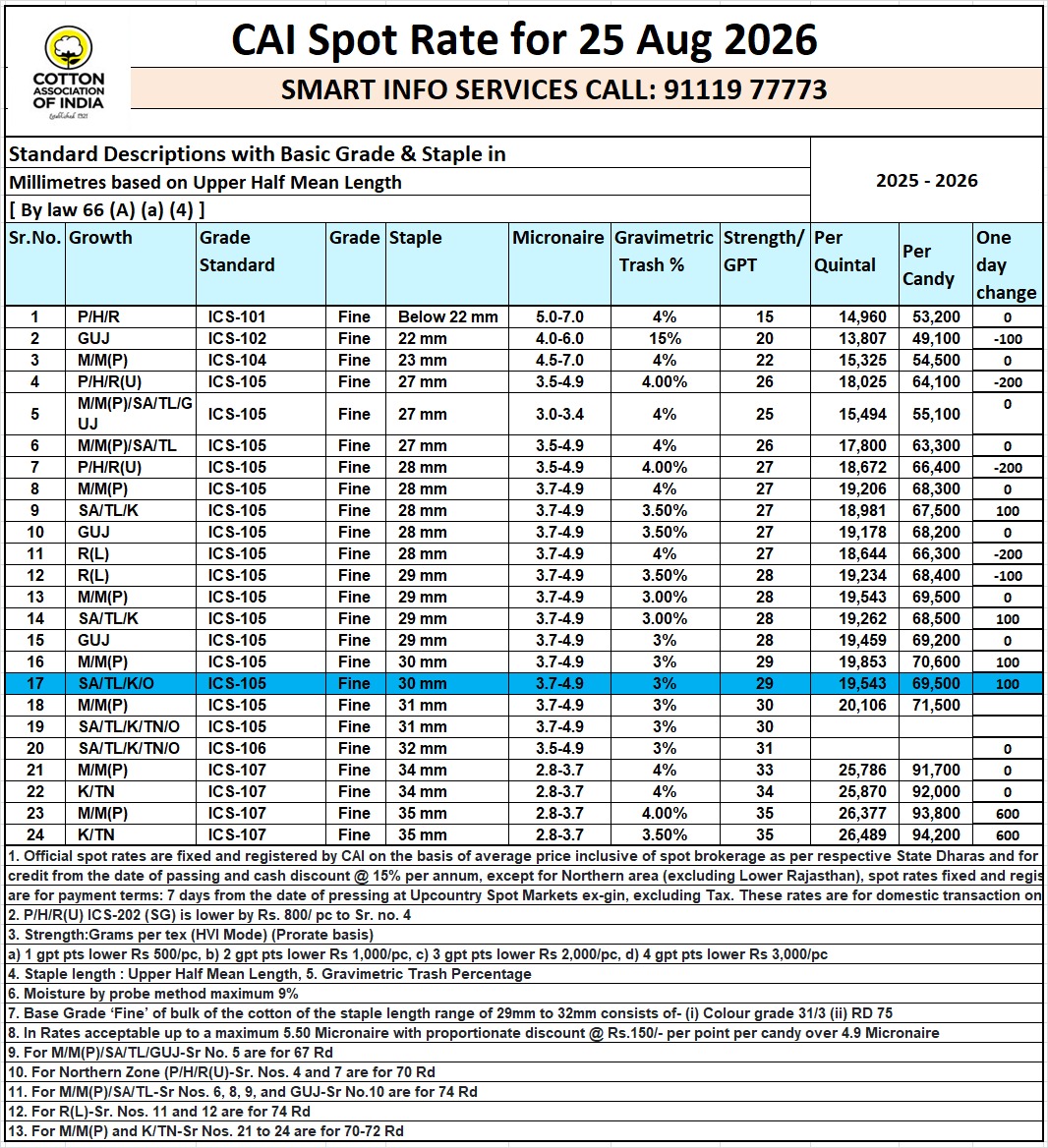
Remove 11 per cent import duty imposed on cotton, industry confederation urges Centre.Coimbatore: The Confederation of Indian Textile Industry (CITI) and the Southern India Mills Association (SIMA) have urged the Center to remove the 11% import duty imposed on cotton, resolve QCO (Quality Control Order) issues and make the raw material available internationally. has demanded.Further, they have demanded the state government to limit the maximum tariff for power demand for HT textile industrial units to 20% or recorded demand, whichever is higher.Addressing media persons, T Rajkumar, President, CITI and Ravi Sam, President, SIMA said that the Indian textile and clothing industry provides employment to over 11 crore people, brings in $44 billion in foreign exchange and over Rs 25,000 crore GST revenue is facing an unprecedented financial crisis.“The impact is an 18% decline in total T&C exports, a 50% decline in yarn exports and a 23% decline in cotton textile exports as compared to last year. High volatility in cotton prices and trade speculation has resulted in huge working capital loss in the spinning sector as cotton prices have fallen from Rs 63,000 per candy of 356 kg in April to Rs 56,000 per candy in July. With the current cotton prices, mills are making a loss of Rs 10-20 per kg of yarn,” he said.Other demands include suspension of fixed charges for LT III-B units and exemption from peak hour charges.

Pakistan Weekly Cotton Review: Bullish trend continues

Pakistan Weekly Cotton Review: Bullish trend continuesKarachi: The cotton market is in a bullish trend. To keep cotton prices stable, the Trading Corporation of Pakistan (TCP) will buy cotton at a rate fixed by the government. APTMA has demanded the government to fix electricity rates separately for export industries.Separately, the Lahore High Court (LHC) has set aside the textile sector's stay order on energy charges.The local cotton market saw an increase of Rs 400 per head in the price of cotton last week. Textile mills continued to buy cotton, while ginners also continued to sell cotton in large quantities due to a better supply of footy. As a result, the business volume improved significantly.Although the government has asked the ginners to buy cotton from cotton farmers at the rate of Rs 8,500 per 40 kg, but the ginners say that if the government takes cotton and cottonseed from them at this rate, they will intervene to buy from the farmers. Are ready. rate announced by the government.At present, there is positive news regarding cotton production. In the first picking itself, 15 to 20 maunds of flowers are being harvested per acre. Looking at this, it can be said that if the weather conditions are favourable, then the production of cotton will exceed one crore bales.The rate of cotton in Sindh is between Rs 17,200 to Rs 17,400 per head. The rate of footi is between Rs 7,000 to Rs 7,400 per 40 kg. The rate of cotton in Punjab is between Rs 17,600 to Rs 17,800 per head, while the rate of foot is between Rs 7,200 to Rs 8,300 per 40 kg. Cotton rates in Balochistan range from Rs 17,200 to Rs 17,300 per head and cotton between Rs 7,200 to Rs 7,700 per 40 kg. The prices of cottonseed, khal and oil are relatively stable. The spot rate committee of the Karachi Cotton Association kept the rate of cotton unchanged at Rs 17,000 per head.Naseem Usman, president of the Karachi Cotton Brokers Forum, said that the price of cotton remained stable in the international cotton market. According to the USDA's weekly export and sales report for the year 2022-23, 23,100 bales were sold.Bangladesh topped the list by purchasing 18, 200 bales. Vietnam was second with 5,600 bales. Honduras was third with 3,200 bales. Taiwan bought 2,000 bales and ranked fourth. Turkey bought 1,900 bales and ranked fifth. Pakistan bought 6,600 bales and ranked sixth. 51,000 bales were sold for the year 2023-24. China topped the list by purchasing 36,000 bales. Honduras was second with 9,800 bales. Pakistan bought 2,500 bales and stood third.The meeting was also informed that 28 ginning factories are functioning in Multan division, and harvesting of early sown cotton is underway. The secretary directed all the ginning factories to make daily reports of cotton arrivals, stock position and quality of the crop in their factories.DG Agriculture (Pest Alert) Punjab Rana Fakir Ahmed said the overall health of the cotton crop was good in Multan division but whitefly attack was observed in Khanewal, Miyan Channu and Vehari, while thrips attack was observed in Lodhran . However, the attack was still below the economic threshold.With regard to energy tariffs, Pakistan competes with mills in India, Bangladesh and Vietnam for the export of textile products. Now the cost of one unit of electricity in these countries is only 7 to 9 cents.The textile industry has asked the government to allocate a separate power tariff category for the export industry, barring cross-subsidies, stranded costs and increased system losses, to achieve the export target of $50 billion in the next 4 years.Sajid Mehmood said, the action plan to revolutionize the agriculture sector under the leadership of the army and to reform the agriculture sector on modern lines by moving away from the traditional methods of farming is wonderful, which will prove to be an important milestone in the country's economy. Head of Agricultural Technology Transfer Department, Central Cotton Research Institute, Multan said in his statement.The commencement of work on several projects using new agricultural technology will be a very welcome milestone for the development of agriculture and will also increase productivity.According to the report, 44 lakh acres of land has been identified across the country for the implementation of agriculture projects. In this, 13 lakh acres are in Punjab, 13 lakh acres in Sindh, 11 lakh acres in Khyber Pakhtunkhwa, while 7 lakh acres are in Balochistan. While in Punjab eight lakh twenty four thousand seven hundred and twenty eight acres of land has been digitized, on which modern farming is to be done. This will increase the yield of cotton like other agricultural products.

Spinning mills in Tamil Nadu will stop production and sale of yarn from July 15.

Spinning mills in Tamil Nadu will stop production and sale of yarn from July 15.A major crisis is brewing in spinning mills of Coimbatore as industry associations have decided to stop production and sale of yarn from July 15 due to heavy losses incurred by them. This was decided at an emergency meeting of MSME Spinning Mills Associations held on Wednesday.For the first time in the last 20 years, export of yarn and textiles have declined by around 28 per cent. Today, cotton price per candy (356 kg) is ₹58,000; price of 40’s yarn is ₹235 per kg and clean cotton cost is ₹194 per kg, says a joint statement issued by S Jagaesh Chandran, Hony Secretary, South India Spinners Association (SISPA) and G Subramaniam, President, India Spinning Mill Owners Association (ISMA), both based in Coimbatore.As per guidelines of South Indian Textile Research Association, the minimum conversion cost of cotton to yarn should be ₹2 per kg. In today’s situation, the conversion cost from cotton to yarn is only ₹1. This means, spinning mills incur a loss of ₹40 per kg. A mill having about 10,000 spindles would produce 2,500 kg of yarn per day, which is incurring a loss of ₹1,00,000 per day.The reason for the crisis is due to 11 per cent import duty on cotton, the price of domestic cotton is 15 per cent higher. India has lost many international orders and is unable to compete with neighbouring countries in the export of yarn, fabric and clothing.Over the past several months, banks’ interest rates have gradually increased from 7.5 per cent to 11 per cent. As a result, the cost of yarn production has increased from ₹5 to ₹6 per kg.Tamil Nadu Generation and Distribution Corporation (TANGEDCO) increased Retail Tariff Petition for Low Tension Consumers (LT & LT-CT) and High Tension Consumers (HT), Multi Year Tariff and tariff increased during peak hours (Time of the Day - TOD), the production cost of spinning mills has gone up by ₹6, the statement said.The Centre has provided short-term loans under the Emergency Credit Line Guarantee Scheme (ECLGS) to revive and rehabilitate the industry. However, entrepreneurs who availed this loan have used it to tide over the crisis and for payment of bank dues, electricity charges, labour wages, ESI and PF. The repayments for the ECLGS loan started and this has become an additional burden on the spinning mills and this also increased the cost of production by ₹5 per kg.There is unrestricted import of yarn and fabrics from countries like China, Vietnam and Bangladesh. Due to this, the entire textile value chain of the country has been greatly affected, the statement said.The two associations appealed to the Centre to immediately withdraw the 11 per cent import duty imposed on cotton and reduce the interest rates of the banks to the previous level of 7.5 per cent. The outstanding short-term loan of ‘Emergency Credit Line Guarantee Scheme (ECLGS) be restructured and provide fresh ECLGS loan as given earlier. Provide a six month holiday period and seven years repayment period at a lower rate of interest.The Centre should extend the term loan by two year moratorium and restructure the existing term loan as given in the past. There should not be any stringent rules by the Reserve Bank of India (RBI) in moratorium for the spinning sector.Further, no subsidy or concession should be encouraged by any State Government to increase the spinning capacity, they said.The Minimum Support Price (MSP) operation has to be extended to Cotton Yarn. The MSP has to be fixed at atleast Rs. 2.25 Paisa per count per kg. From January 1, the associations requested that all types of fabrics manufactured in India should print the precise weight on the fabric.“We request the Government of Tamil Nadu should cancel the amendment immediately,” the statement said.At present, TANGEDCO is charging 90 per cent of Maximum Demand charges or Recorded demand, whichever is higher. Considering the Extra Ordinary situation of the Spinning Industry, the associations requested the State government to direct the TANGEDCO to collect 20 per cent of Maximum Demand Charges or recorded demand.In India, the capacity of spinning mills is already very high. The Centre should immediately formulate a One Country - One policy for the textile industry, the statement said. 

Pakistan: Strong trend in cotton market.

Pakistan: Strong trend in cotton marketLAHORE: The local cotton market remained stable on Thursday with satisfactory trading volume.Cotton analyst Naseem Usman said that the rate of new cotton crop in Sindh is between Rs 16,800 to Rs 16,900 per head. The rate of footi in Sindh is between Rs 6,600 to Rs 7,200 per 40 kg.In Punjab, cotton rates range from Rs 17,300 to Rs 17,500 per head and cottonseeds range from Rs 7,200 to Rs 8,000 per 40 kg. Cotton rates in Balochistan range from Rs 16,900 to Rs 17,000 per head, while footy rates range from Rs 6,800 to Rs 7,300 per 40 kg.The federal government has finally decided to intervene in the cotton market and has directed the Trading Corporation of Pakistan (TCP) to buy cotton to stabilize the falling prices and ensure the minimum support price.According to a national daily, Punjab Agriculture Secretary Iftikhar Ali Sahu chaired a meeting on crop management and monitoring and said that TCP will soon start ensuring better compensation for cotton growers and the government will maintain the minimum support price mechanism. will fulfill its commitment.It is to be noted that the government had announced Rs 8,500 per 40 kg support price for cotton in March when cultivation began and the move was appreciated in the farming community and the textile sector, but since then, it has As the minimum support price has failed to ensure. It is now being sold at a minimum of Rs 6,500 per 40 kg.Prices are also falling as this year's cotton crop has produced on a large scale and the target is likely to be met.Representatives of the Pakistan Cotton Ginners Association (PGCA) told the Agriculture Secretary that early cotton harvesting, sown in February, is underway, and production numbers look good so far with nearly 60 factories operating in the province and yarn ginning reaching a record number. Has been factory.Dr. Anjum Ali, Director General, Agricultural Extension, Punjab, echoed the sentiment and said that though there have been some reports of thrips attacks, it has not yet reached the economic threshold level (ETL) and agricultural extension and pest alert teams are active. their efforts to control it.Around 800 bales of Mir Pur Khas were sold between Rs 16,900 to Rs 17,000 per head, 1800 bales of Shahdad Pur were sold between Rs 16,900 to Rs 17,100 per head, 3600 bales of Tando Adam, 1200 bales of Sanghar, 600 bales of Shah 16,800 to 17,000 per head of Pur Chakkar, 600 bales of Hyderabad, 600 bales of Kotri at Rs 16,900 to 17,000 per head, 1400 bales of Nawab Shah were sold at Rs 17,000 to 17,050 per head. 1,000 bales of Chaudagi were sold at Rs.16,950 to Rs.17,000 per head, 400 bales of Jhola at Rs.16,900 per head, 400 bales of Winder at Rs.16,975 to Rs.17,000 per head, 600 bales of Miyan Channu were sold. 200 bales of Sahiwal, 800 bales of Pir Mehal, 600 bales of Chichavatni, 200 bales of Mongi Bangla were sold at the rate of Rs.17,500 per head, 400 bales of Jahanian were sold at the rate of Rs.17,400 per head, 1200 bales of Layya were sold Gone. 17,500 to Rs 17,600 per head, 200 bales of Tounsa, 400 bales of Sadiqabad at Rs 17,500 per head, 1600 bales of Vehari at Rs 17,400 to 17,700 per head, 1200 bales of Burewala were sold at Rs 17,400 per head. 800 bales of Mana, Khanewal were sold at Rs.17,500 to 17,600 per head.The spot rate remained unchanged at Rs 17,000 per head. Polyester fiber was available at Rs 350 per kg.

Copyright© 2023 | Smart Info Service
Application Download