STAY UPDATED WITH COTTON UPDATES ON WHATSAPP AT AS LOW AS 6/- PER DAY
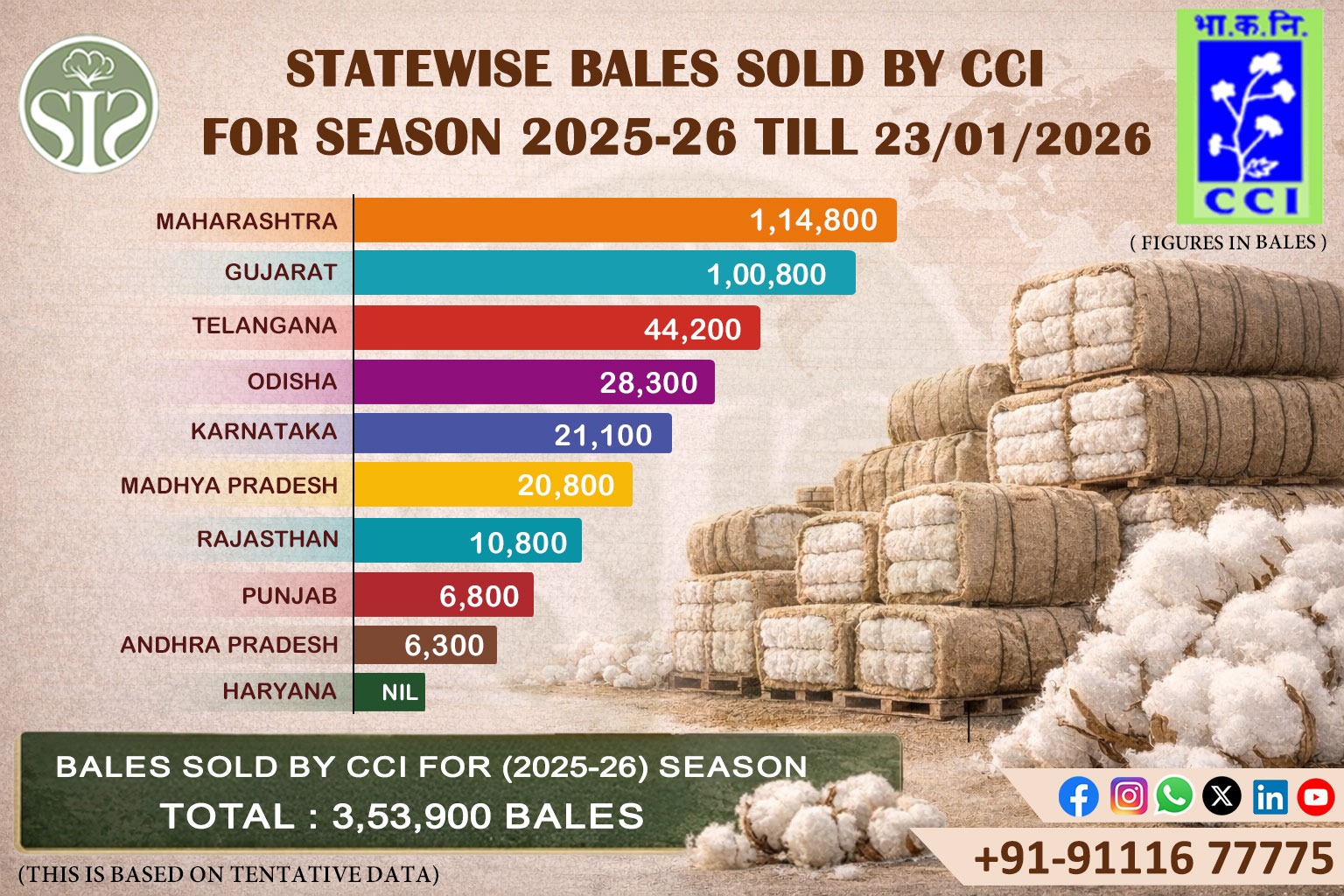
Start Your 7 Days Free Trial TodayState-wise CCI Cotton Sales Details – 2025-26 SeasonThe Cotton Corporation of India (CCI) raised its cotton prices by upto ₹600-₹1,000 per candy during this week . CCI has sold approximately 57,59,000 cotton bales for the 2025-26 season. Sales are highly concentrated in a few major cotton-producing states, Maharashtra, Telangana and Gujarat emerging as the leading contributors.
Maximum selling price declared for BT cotton seedsThe central government has fixed the maximum selling price of Bt cotton seeds for the 2026-27 season. This decision has been taken on the basis of the recommendations of an expert committee.The government has used its powers under the Essential Commodities Act, 1955 and the Cotton Seed Prices (Control) Order, 2015 to control the prices of seeds.This pricing will be applicable on standard seed packet of 475 grams, which contains 5-10% non-Bt seeds (refugia). The purpose of refugia is to slow the development of resistance in pests and maintain the effectiveness of crops over a longer period of time.Through this step, the government is trying to balance the prices of seeds, ensure access to farmers and maintain monitoring on the use of biotechnology.read more :- Agri-input dealers strike in Maharashtra on 27th April
Agri-input dealers in Maharashtra have announced a strike for April 27.The Maharashtra Fertilizers, Pesticides and Seeds Dealers Association (MAFDA) and the All India Dealer Association (AIDA) have declared a one-day statewide shutdown. The organizations have warned that if their demands are not addressed, they may even resort to an indefinite strike.Dealers and manufacturers argue that the increased surveillance and regulations being imposed by the government could make it difficult to conduct business. According to Vineet Kasliwal, General Secretary of the association, a new government resolution (GR) has designated 23 different levels of officials as Quality Control Inspectors, who will be responsible for inspecting agri-input units.A senior industry official, speaking on the condition of anonymity, stated that the increased number of inspectors would lead to frequent sampling at both the company and dealer levels, which could adversely affect the 'Ease of Doing Business.' He suggested that instead of increasing physical inspections, the focus should be on strengthening laboratory testing, digital traceability, and audit systems.Vijay Thakur, President of the Organic Agro Manufacturers Association (OAMA), described this as a collective step taken to safeguard the dignity of agri-entrepreneurs.It is reported that approximately 85,000 agri-input shops across the state have extended their support to this strike.Dr. Suhas Buddhe, a representative of the agri-input industry, stated that there is a need for a balanced, transparent, and fair regulatory framework that takes into account the interests of both the farmers and the stability of the industry.read more :- Odisha approves ₹124 crore cotton-to-yarn unit
Odisha Approves ₹124 Crore Unit to Strengthen Cotton-to-Yarn IntegrationTaking a significant step toward strengthening the textile value chain within the state, the Odisha government has approved an investment of ₹124 crore (approximately US$ 13.17 million) for the establishment of a yarn manufacturing unit in the Balangir district. This project will be developed by Shri Ambika Cotspin Private Limited, a 27-year-old textile company.According to experts, this new unit will help better integrate the processes ranging from cotton ginning to yarn production within the state. Currently, despite rising cotton production in several districts, a significant portion of raw cotton is shipped outside the state due to a lack of adequate downstream processing infrastructure.Odisha's Chief Secretary, Anu Garg, stated that this project will bolster the state's 'Farm-to-Fabric' strategy and ensure that the value generated from locally produced cotton remains within the state's economy.The trend of investment in the state's textile sector is steadily accelerating, with several major companies establishing their projects across various districts. For instance, the Epic Group plans to set up a sustainable manufacturing unit in Khordha with an investment of ₹220 crore (US$ 23.37 million), while MAS Holdings is investing approximately US$ 140 million in Bhuinpur.Furthermore, Hindalco Industries has announced plans to set up a unit worth ₹100 crore (US$ 10.62 million) in Keonjhar. Meanwhile, Sonaselection India Limited is also establishing a garment manufacturing unit in Khordha with an investment of ₹130 crore (US$ 13.81 million), which will be linked to Khordha Alphatex Private Limited's technical textile project worth ₹180 crore (US$ 19.12 million).In addition to these projects, more than 33 textile and apparel companies—including Page Industries, KPR Mills, Technosport, First Step Baby Wear, Sportking, Adarsh Knitwear, Anubhav Apparels, and Trimetro Garments India Private Limited—have committed to investing in Odisha.read more :- Surge in Indian Cotton Yarn Exports Amidst War
Indian Cotton Yarn Exports Gain Momentum Amid Global ConflictRajkot/Ahmedabad: The ongoing conflict in the Middle East has disrupted global supply chains and fuel supplies, placing increased pressure on numerous factories across India. However, for the cotton yarn industry, this situation appears to be transforming into an opportunity, as demand from China has surged rapidly.India, the world's second-largest cotton producer, has emerged as a key supplier to China. The war has disrupted trade routes and caused delays in cotton shipments from the U.S. and Brazil, compelling China to seek alternative sources. Consequently, yarn imports from India have risen. Furthermore, with the Rupee depreciating by approximately 7% against the Yuan, Indian products have become more affordable for Chinese buyers.(sis)According to Ripal Patel, Managing Director of Fiortex Cotspin—a spinning mill based in Gujarat—the company's export order book has witnessed a 40% increase, and production has now reached 100% capacity. Orders extending through June have already been booked.According to industry experts, since November, India has been shipping approximately 1,500 containers of cotton yarn to China every month—up from a previous volume of 300 containers—marking a fivefold increase. The impact on polyester supplies has further bolstered the demand for cotton.(sis)However, while mills in Gujarat are benefiting from a geographical advantage, units in Tamil Nadu are facing competitive challenges due to higher transportation costs.Read More :- Cotton Prices Rise Over 8.5% in April Amid Lower Production Outlook
Cotton Becomes Expensive in April; Prices Jump 8.5%Prices of cotton have surged by more than 8.5% in April, driven by concerns over reduced production and rising demand from textile mills. The widely used Shankar-6 variety, primarily grown in Gujarat, has reached ₹60,500 per candy, marking a sharp increase compared to last month.According to the Committee on Cotton Production and Consumption, India’s cotton output for the current marketing season ending September 30 is estimated at around 291 lakh bales—about 0.42% lower than the 2024–25 season.(sis)At the same time, domestic consumption is on the rise. Textile mills are projected to use 312 lakh bales this season, up from 306 lakh bales last year, further tightening supply conditions.Industry leaders have raised concerns over the supply gap. Durai Palanisamy, Chairman of the Southern India Mills Association, emphasized the urgent need to review import duties on cotton, citing shortages that are impacting the textile sector, the country’s largest consumer of the fibre.Adding to the bullish sentiment, global cotton prices are also climbing. Nishanth Asher, Secretary of the Indian Cotton Federation, noted that cotton futures for July have increased significantly—from around 64.5 cents per pound in December 2025–January 2026 to nearly 79.8 cents. This marks a notable rise compared to the 64–70 cent range seen over the past three years.(sis)Globally, production is expected to fall short by 1.5 to 2.5 million bales from earlier estimates. Lower rainfall in key producing countries such as the United States and Brazil is likely to impact output, though projections remain tentative.Additionally, rising crude oil prices are influencing fibre economics. Polyester, which is derived from petrochemicals, has become more expensive amid geopolitical tensions, prompting a shift in demand toward cotton. Even marginal changes in demand are contributing to the upward pressure on prices.(sis)Overall, a combination of lower output, rising global prices, and increasing textile demand is supporting the current rally in cotton prices.Read More :- Textile Industry Seeks Duty-Free Cotton Imports Amid Price Surge
Textile Industry Seeks Duty-Free Cotton Imports Amid Price SurgeIndia’s textile industry has urged the government to remove the 11% import duty on cotton as domestic prices continue to rise in line with global trends. Industry stakeholders believe that allowing duty-free imports is crucial to maintaining export competitiveness and stabilising the textile value chain.Cotton prices have increased sharply in recent weeks, putting pressure on the entire ecosystem, from spinning mills to garment exporters.(sis) Exporters, especially those operating under long-term contracts, are facing margin erosion as they have limited ability to pass on rising input costs.K. Selvaraju, Secretary General of the Southern India Mills Association (SIMA), stated that the steep rise in cotton prices is impacting all segments, with garment manufacturers being the most vulnerable due to their dependence on fabric inputs.(sis)The situation is further complicated by weak global demand, particularly due to geopolitical tensions in West Asia. While yarn exports have remained relatively stable, the broader textile export sector continues to face challenges.India’s cotton production is estimated at 290 lakh bales, falling short of the domestic demand of around 330 lakh bales. To bridge this gap, the industry has proposed duty-free imports from May to October, covering the lean supply period.(sis)Stakeholders maintain that this move will not harm farmers, as most cotton stocks are sold by March. With supply constraints and price volatility rising, the industry is calling for immediate government intervention to prevent further disruption.Read More :- The rupee opened at 94.21 down 10 paise.
The rupee opened at 94.21/USD, a decline of 10 paise.On Friday, the Indian rupee opened at 94.21 against the dollar—a decline of 10 paise—whereas it had closed at 94.11 on Thursday.Read More :- The rupee opened at 94.00 recording a decline of 21 paise.
The rupee opened at 94.00/USD, down 21 paise.On Thursday, the Indian rupee opened at 94.00 against the dollar—a decline of 21 paise—whereas it had closed at 93.79 on Wednesday.Read More :- Continuous rise in cotton prices intensifies pressure on the market.
Cotton prices continue to rise.The Shankar 6 variety, widely grown in Gujarat, reached ₹60,500 per candy on Tuesday (April 21), about 8.5% higher than a month ago.According to the Indian Cotton Production and Consumption Committee, the country's production in the current cotton season (ending on September 30) is estimated to be around 291 lakh bales, which is about 0.42% less than the 2024-25 season. On the other hand, domestic consumption is likely to increase to 312 lakh bales, compared to 306 lakh bales last year.South India Mills Association President Durai Palanisamy said that in view of the shortage of cotton in the country, it is necessary to immediately review the import duty, so that the pressure on the textile industry can be reduced.According to Indian Cotton Federation Secretary Nishant Asher, global cotton futures prices are also seeing a rise. Prices for July delivery rose from 64.5 cents a pound to about 79.8 cents. Over the past three years the range has typically been between 64–70 cents.Global production is also expected to be 1.5–2.5 million bales lower than earlier estimates. Production may be affected due to less rainfall in major producing countries like America and Brazil, although the situation is not completely clear yet.Additionally, rising crude oil prices are making polyester costlier, shifting some demand in the textile industry towards cotton, further supporting prices.read more :- Delay in Cotton-Soybean Insurance Payments; Farmers Concerned
Doubt over cotton and soybean crop insurance: Farmers worried over delay in payment, demand clarity before new seasonDespite suffering huge losses to the cotton crop in the last Kharif season, farmers have not yet received the insurance amount. Due to this, thousands of farmers are raising the question that when will they get cotton crop insurance and how much compensation will they receive.The farmers who got crop insurance in Akola district have not yet got complete relief. Especially in the case of soybean insurance, compensation has been sanctioned only to farmers of two revenue divisions—Kurum and Lakhpuri, due to which the rest of the farmers are feeling deprived.1,31,415 farmers of the district had got soybean crop insured, but after getting limited benefits, now the farmers are eyeing cotton crop insurance. However, no clear announcement has been made yet regarding cotton insurance, due to which there is confusion.In the last Kharif season, 30,030 farmers of the district had insured cotton crops in about 28,101 hectare area. If seen at the taluka level, 3,372 farmers in Telhara, 7,558 in Akot, 2,479 in Balapur, 1,436 in Patur, 7,890 in Akola, 3,426 in Barshitakli (rainfall zone) and 3,869 in Murtijapur had got insurance.Last year, there was widespread damage to the cotton crop due to heavy rains and floods during the monsoon. In such a situation, farmers hope that they will get appropriate compensation in the form of insurance.Now that there is less than one and a half months left for the beginning of the new Kharif season, farmers are facing financial crisis due to delay in the insurance amount. If there was timely payment, farmers could prepare for seeds, fertilizers and other agricultural operations.Farmers demand that cotton crop insurance should be announced as soon as possible and fair compensation should be given to all eligible farmers. After limited profits in soybean insurance, concerns about cotton insurance have increased further. In such a situation, the administration is expected to take quick decisions and provide relief to the farmers.read more :- CCI's Cotton Sales Accelerate Amid Strong Demand; Prices Rise
Amidst strong demand, CCI sold more than half of the cotton in 2025-26, prices continuously increasedDespite rising prices, state-run Cotton Corporation of India (CCI) has sold more than half of the cotton it purchased in the 2025-26 season due to strong demand from mills and traders.CCI procured 105 lakh bales (170 kg each) of cotton this season, up from 100.16 lakh bales last year. According to Chairman and Managing Director Lalit Kumar Gupta, more than 55 lakh bales of cotton had been sold till Monday. He said the steady offtake in the last two months reflects strong demand from mills and traders, even as global prices have risen.On Tuesday, CCI increased the selling price of cotton by ₹200 per candy (356 kg), taking the total increase this week to ₹800. Last week also the prices were increased by ₹1,500 per candy. Overall, prices have increased by more than ₹6,000 this season.Gupta said that from a low of around ₹55,000 per candy, the current prices have reached around ₹61,000 per candy. Despite this, he said CCI's prices are still the most competitive compared to the global market.International cotton prices have increased by more than 25 percent, while domestic prices have increased by 15-20 percent. Despite this, domestic rates are still 2-3 per cent lower than global prices, which are around ₹63,500-64,000 per candy.CCI's price revisions are in line with global market trends. International prices have registered an increase of about 30 percent since the beginning of March. Cotton futures on the Intercontinental Exchange (ICE) rose from about 62 cents a pound in early March to above 80 cents, hitting around 81 cents a pound for July delivery on Tuesday.Despite continuous price increases, CCI sales remain strong and its stock has come down to below 50 lakh bales. According to Gupta, demand from mills is still strong and yarn orders are booked for the next 3-4 months, hence mills will continue to procure as per their requirements.read more :- The rupee opened at 93.70 down 21 paise.
The rupee opened at 93.70 against the dollar, a decline of 21 paise.On Wednesday, the Indian rupee opened at 93.70 against the dollar—a decline of 21 paise—whereas it had closed at 93.49 on Tuesday.Read More :- Rupee fell 19 paise to close at 93.49 per dollar
The Indian rupee lower 19 paise to close at 93.49 per dollar on Tuesday, compared to its opening price of 93.30 in the morning.At close, the Sensex was up 753.03 points or 0.96 percent at 79,273.33, and the Nifty was up 211.75 points or 0.87 percent at 24,576.60. About 2407 shares advanced, 1702 shares declined, and 148 shares unchanged.read more :- Relief for Farmers: Green Signal for Sale of BT Cotton Seeds in Kharif 2026
Approval Granted for Sale of BT Cotton Seeds for Kharif 2026Sri Ganganagar. The State Government has formally granted approval for the sale of BT cotton hybrid seeds within the state for the Kharif 2026 season. Under this decision, 34 authorized companies will be permitted to supply seeds in accordance with prescribed terms and conditions.According to Agriculture Commissioner Naresh Kumar Goyal, a complete ban has been imposed on the sale of seeds susceptible to Whitefly and Cotton Leaf Curl Virus in the districts of Sri Ganganagar, Hanumangarh, and Bikaner, in an effort to control the impact of these diseases.He further stated that companies are mandated to sell seeds strictly at prices fixed by the Central Government, and it will be mandatory to affix a QR code on every seed packet. With the convenience of farmers in mind, priority ranging from 15 to 20 percent will be accorded to the cooperative sector regarding seed supply.read more :- The rupee opened at 93.30 recording a decline of 18 paise.
The rupee opened at 93.30/USD down 18 paise.On Tuesday, the Indian rupee opened at 93.30 against the dollar a decline of 18 paise whereas it had closed at 93.12 on Monday.Read More :- Preparations for Cotton Sowing Underway in Alwar; Bumper Yield Expected
| title | Created At | Action |
|---|---|---|
| State-wise CCI Cotton Sales Report – 2025–26 Season Overvie | 25-04-2026 15:31:55 | view |
| Maximum Price Fixed for BT Cotton Seeds | 25-04-2026 12:54:02 | view |
| Agri-input dealers strike in Maharashtra on 27th April | 25-04-2026 12:19:54 | view |
| Odisha approves ₹124 crore cotton-to-yarn unit | 25-04-2026 12:03:18 | view |
| Surge in Indian Cotton Yarn Exports Amidst War | 24-04-2026 16:23:49 | view |
| Cotton Prices Rise Over 8.5% in April Amid Lower Production Outlook | 24-04-2026 16:12:34 | view |
| Cotton Price Surge: Textile Industry Demands Duty-Free Imports | 24-04-2026 15:59:12 | view |
| The rupee opened at 94.21 down 10 paise. | 24-04-2026 09:23:10 | view |
| The rupee opened at 94.00 recording a decline of 21 paise. | 23-04-2026 09:22:14 | view |
| Continuous rise in cotton prices intensifies pressure on the market. | 22-04-2026 12:21:58 | view |
| Delay in Cotton-Soybean Insurance Payments; Farmers Concerned | 22-04-2026 11:25:32 | view |
| CCI's Cotton Sales Accelerate Amid Strong Demand; Prices Rise | 22-04-2026 11:15:32 | view |
| The rupee opened at 93.70 down 21 paise. | 22-04-2026 09:23:11 | view |
| Rupee fell 19 paise to close at 93.49 per dollar | 21-04-2026 15:43:56 | view |
| Relief for Farmers: Green Signal for Sale of BT Cotton Seeds in Kharif 2026 | 21-04-2026 12:54:30 | view |
| The rupee opened at 93.30 recording a decline of 18 paise. | 21-04-2026 09:26:02 | view |