Filter

Recent News

Experts discuss technical textile opportunities, need for cotton productivity improvement

Experts Highlight Cotton Productivity and Technical Textile OpportunitiesThe Gujarat Chamber of Commerce and Industry (GCCI) hosted the Textile Conclave 2025, where professionals talked about the need to increase cotton productivity and technical textile potential.The head of the GCCI Textile Task Force, Saurin Parikh, discussed the value of technical textiles in industries like fashion, construction, healthcare, and agriculture. He emphasised that in order to fully realise this industry’s potential, cooperation, innovation, and policy assistance are required.The textile conference, according to GCCI President Sandeep Engineer, offers a forum for in-depth debate and discussion of the demands and problems facing the textile sector. In order to create high-performance materials, experts stated that technological textiles require innovation and research and development. They also emphasised the significance of Government regulations and industry cooperation in promoting development.The mission for cotton productivity of the Central Government was also highlighted by experts.  Over the course of five years, the mission seeks to increase India’s cotton yield from 461 kg/ha to the global average of 850 kg/ha while encouraging the production of extra-long staple cotton types. According to experts, seed improvement is necessary. Participants included industry executives from the spinning, weaving, processing, clothing, and machinery manufacturing sectors.read more :-Indian Rupee higher 15 Paisa, Ends at 87.21 per Dollar

Buy cotton: White gold will be ruined; Cotton storage increased in anticipation of price rise*

Cotton Storage Grows as Price Surge LoomsCotton purchase: Cotton is also not getting guaranteed price, CCI has given 15th date for registration and due to public holiday on 14th and 15th, the last date will be 13th March.Some farmers have stored cotton in anticipation of price rise. The central government has declared a minimum support price of Rs 7521 per quintal for cotton this year. In fact, its price in the open market ranges from Rs 7,000 to even less in villages. (Buying cotton)CCI started procurement at 9 centers in the district to provide support price security to the farmers. For some reason, the center remained closed for longer than expected and procurement was slow. (Buying cotton)Apart from this, there is also looting in the purchase of cotton in the village. CCI has been reducing the grade of cotton purchased for the last two months. So cotton is being bought at Rs 7,421, which is Rs 100 less than the guaranteed price. (Buying cotton)Skin disordersFarmers are storing cotton in the hope of price rise. However, these cotton pests are causing problems like rashes and itching on the skin of the family members. So it has no value in the market and if it is stored it is causing health problems. In such a situation, the farmer is caught in double trouble.No storage space .The center was started there after CCI signed an agreement with some ginning companies of the district. However, there is no storage space for cotton due to non-lifting of bales and sacks at some centers and cotton harvesting problems are also coming up. It is reported that it has been agreed that till the CCI actually makes the purchase, OTAI will be made available.read more :-Indian rupee opens 3 paise lower at 87.36 against US dollar


Shock to Punjab's cotton belt: 71 percent decline in cotton production, many reasons including lack of quality seeds

Punjab Cotton Production Plummets 71% Due to Seed ShortageAccording to the report of the Cotton Association of India, cotton production and cultivation area in Punjab is continuously decreasing. The Malwa region, which is known for cotton production, has been particularly affected. Farmers are now turning to other crops like paddy and wheat, causing a setback to crop diversification efforts.The cotton producing belt of Punjab has suffered a massive decline of 71 percent in cotton production in the last five years. Along with this, the area under cotton cultivation has also come down to half.Farmers are moving away from cotton cultivation due to pink bollworm infestation, lack of quality seeds and pesticides. The state government has now demanded the Center to provide BG3 seeds so that cotton cultivation can be revived.Latest statusDecline in production: From 7.73 lakh bales in 2020-21 to 2.20 lakh bales in 2024-25.Reduction in cultivation area: From 2.52 lakh hectares to 1 lakh hectare.Government demand: Provide BG3 seeds from the Centre.Concern: Farmers turning to paddy and wheat, which will increase pressure on groundwater level.Status of other states: Cotton production in Haryana and Rajasthan is better than Punjab.Setback to diversification effortsAccording to the report of the Cotton Association of India, cotton production and cultivation area in Punjab is continuously decreasing. The Malwa region, which is known for cotton production, has been particularly affected. Farmers are now turning to other crops like paddy and wheat, causing a setback to crop diversification efforts.The state government has urged the central government to provide BG3 variety of seeds, which can help reduce the infestation of pink bollworm. According to the agriculture department, if the pink bollworm continues to affect cotton cultivation, farmers will completely switch to paddy cultivation, putting further pressure on groundwater levels.Haryana and Rajasthan aheadHaryana and Rajasthan are ahead of Punjab in cotton production. In 2024-25, Haryana cultivated cotton in 4.76 lakh hectares and produced 9.75 lakh bales, while Rajasthan cultivated it in 6.62 lakh hectares and produced 19.76 lakh bales.read more :-Cotton imports increase despite pressure on Indian cotton prices

Cotton imports increase despite pressure on Indian cotton prices

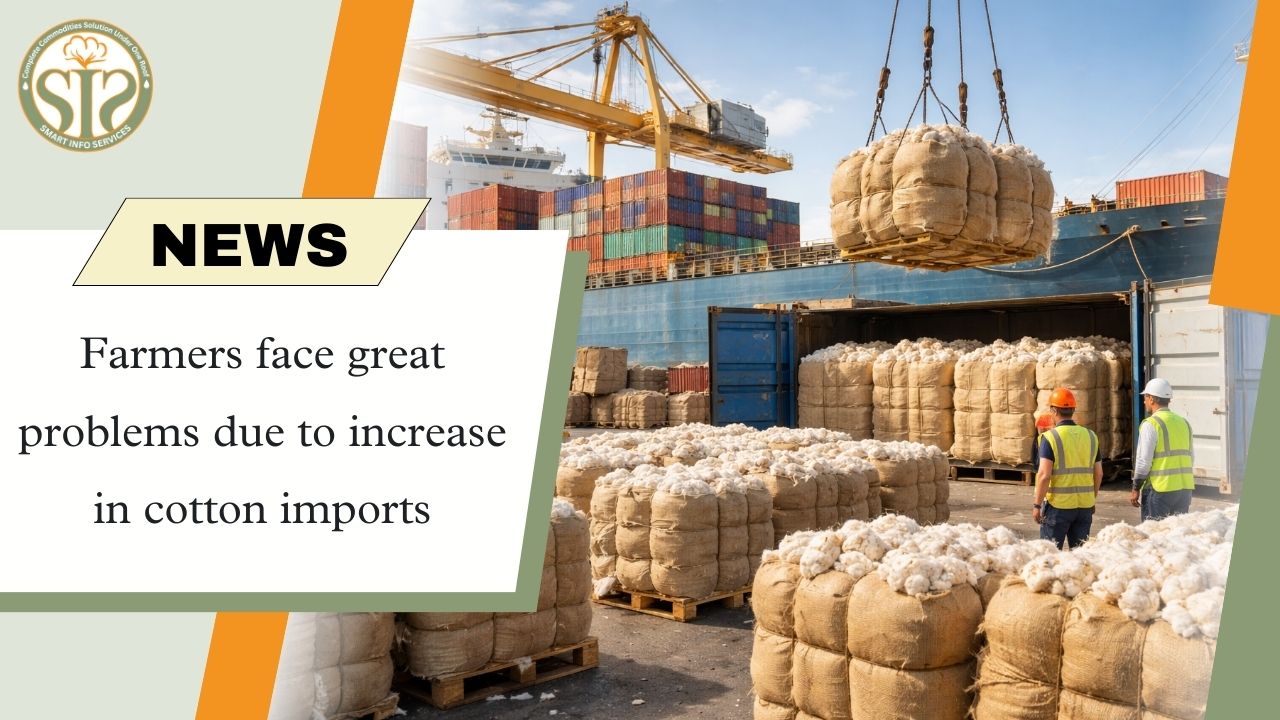
Indian Cotton Imports Grow Despite Price StrainIncreasing import of raw and waste cotton in the last seven months has brought to fore the urgent need for measures to improve cotton productivity in India.Cotton imports were to the tune of $104 million in August 2024, $134.2 million in September 2024, $127.71 million in October, $170.73 million in November, and $142.89 million in December, 2024. In January this year, it stood at $184.64 million.Comparably, the imports were $74.4 million in August 2023, $39.91 million in September 2023, $36.68 million in October 2023, $30.61 million in November 2023, and $29.47 million in December 2023. In January 2024, the imports were $19.62 million.Meanwhile, the Cotton Corporation of India (CCI) has procured close to 100 lakh bales of Indian cotton that has come into the market since the beginning of the new season on October 1, 2024. In the peak cotton arrival season in December 2024, the CCI bought almost 60% of the daily arrivals at the minimum support price (MSP). The price of the Shankar 6 variety of cotton on Saturday was ₹52,500 a quintal.Jaipal, a cotton farmer in Telangana, said at the beginning of the season that farmers are not happy because yield is less. “International cotton prices are weak and mills are able to buy from there,” he said.Kurbur Shanthakumar, president of Karnataka State Federation of Farmer Associations, said the cost of production per quintal is ₹9,000 and the MSP is ₹7,235. But, brokers were buying in the open market at only ₹5,000 to ₹5,500 per quintal.The Union Budget announced in February has a Cotton Mission aimed at improving productivity.For the Indian textile industry, international cotton prices are weak and with export demand looking up for garments and home textiles, there is a need for the textile industry to be internationally competitive. More than 60% of garments exported are cotton-based. Extra Long Staple cotton can be imported duty free and exporters can import cotton without duty under Advance Authorisation. The mills seem to have imported cotton as international cotton prices were lower than Indian prices and the imports have not disturbed the local market, industry sources said.“Brazil is an aggressive seller [in the international market]. Australia, the U.S., Africa, and Brazil were all comfortably placed in prices till a few days ago. Indian cotton prices were higher compared with these countries. The Indian textile mills took a calculated risk and imported in spite of 11% duty as Indian cotton and yarn are relatively over priced. The Indian government and textile industry should look at boosting demand so that textile exports increase and cotton prices remain in parity for the producers and processors. It is also very critical to maintain ‘fibre security’ for the mills by increasing cotton productivity and area,” Manish Daga, president of the All India Cotton Farmers Producers Organisations Association, said.read more :-Rupee Declines by 38 Paise, Opening at 87.26 vs US Dollar

Insurance claim to Haryana cotton farmers was Rs 281 crore, but govt, firm reduced it to Rs 80 crore

Haryana Cotton Farmers' Insurance Claim Slashed from Rs 281 Crore to Rs 80 Crore by Govt and CompanyAn alleged "fraud" by way of denying the insurance claims of cotton farmers in Bhiwani and Charkhi Dadri districts during the Kharif 2023 season had been brought to the attention of the government by some farmer activists.The activists, who submitted a complaint to the state government, alleged that the farmers had been assessed a total insurance claim of Rs 281.5 crore in Bhiwani district on the basis of the Crop Cutting Experiment (CCE).However, the insurance firm later approached higher authorities to challenge the insurance amount, which referred the matter to the State Technical Advisory Committee (STAC).The STAC took a decision to approve technical yield assessment for cotton crop insurance claims.Based on this technical assessment, the insurance claim was reduced to just Rs 80 crore.More shockingly, the activists alleged that this STAC was a defunct body when it called a meeting and took the decision. Dr Ram Kanwar, a farmer activist, alleged that the matter of insurance claims was referred to the STAC, an advisory body whose term had expired on August 1, 2024.However, the Director of Agriculture, Rajnarayan Kaushik, and the Joint Director (Statistics), Rajiv Misra, allegedly convened a meeting of this defunct committee on August 20, 2024, and took a decision to approve technical yield assessment for cotton crop insurance claims.Thus, he alleged, the body was not authorised to take any decision after its term had expired on August 1, 2024.Kanwar said that the matter regarding the settlement of cotton crop insurance claims under the Pradhan Mantri Fasal Bima Yojana (PMFBY) for Kharif 2023 for two districts - Bhiwani and Charkhi Dadri districts has taken serious connotations with the denial of about Rs 200 crore of claims of the farmers in the wake of a decision taken by a redundant body.They have submitted the complaint to the chief minister for action against the officials responsible for the alleged fraud with the farmers and to ensure the insurance claims of the farmers.Dayanand Punia, a farmer activist in Siwani tehsil of Bhiwani district, informed that as per the CCE, 34 villages in Siwani block were set to get insurance claims for cotton loss, but the technical assessment showed that about 20 villages had no insurance claim.Punia said that they would not tolerate this injustice regarding the crop insurance of their cotton fields for the year 2023."Despite having insured their crops, the Agriculture Department conducted village-wise crop cutting surveys and determined the per-acre compensation for each village. However, the insurance company, in collusion with the government, rejected the department's report," he alleged.Punia further alleged that the insurance firm claimed that satellite reports did not show any significant crop damage and termed it a scam."We will stage a demonstration at the Siwani office in SDM Office on March 10," he said.Kanwar said that as per government guidelines, the claims should be settled based on Crop Cutting Experiments (CCEs) conducted by state officials. However, the company allegedly refused to honor these claims and instead pushed for an alternative method—technical yield assessment—which is only permitted for wheat and paddy, not for cotton.The complaint further states that the District Level Monitoring Committee (DLMC) of Bhiwani, headed by the Deputy Commissioner, had also rejected the objections raised by the insurance company and directed it to release payments within seven days. "Instead of complying with the DMLC, the insurance firm challenged the decision before the Director of Agriculture and Farmers' Welfare," he stated. The Director, Agriculture Rajnarayan Kaushik, however, did not respond to the calls and messages for his version.read more :- Vidarbha farmers demand HTBt cotton seeds to improve yield

Vidarbha farmers demand HTBt cotton seeds to improve yield

To increase production, farmers in Vidarbha want HTBt cotton seeds.Nagpur : Farmers from across Vidarbha, especially Yavatmal, have urged the govt to make available the latest Herbicide-Tolerant BT cotton (HTBt) seeds to improve the crop yield in the coming season. The farmers claimed that over the years, pests have evolved and are now immune to the Bt cotton variety and pose a major threat to the crops.The farmers were speaking at a gathering organised by the National Farmers Empowerment Initiative on Thursday. Addressing the media, a group of cotton farmers of Vidarbha put forth the demand, saying that the pink bollworm, a major threat to cotton crop, has become resistant to the Cry1Ac toxin produced by the Bt cotton."Bt cotton has been a huge help to us for many years now, but we need the latest research and innovations in terms of cotton seeds," Ganesh Nanote, a cotton farmer from Akola, said. Nanote said that other cotton-producing countries, like the USA, Brazil and Australia have already adopted the HTBt cotton, and Indian farmers too deserve the same opportunity.Farmer leader Milind Damble said that Yavatmal's soil has a high limestone content, which makes agriculture a difficult task. "A majority of farmer suicides are caused because the ryots are not able to produce enough yield," he said.Damble further highlighted the water scarcity in the district saying that in the winter months, they receive water only two to three days a month. "The situation eases up a little during the monsoon, from June when we get water 15 - 17 days," he said. "Due to the evolved bollworm, we have to spray pesticides on our crops, and it takes 10 men to tend to just one hectare of land," he said. Damble added that if HTBt cotton is introduced, then the requirement of labour per hectare will fall to just two.Vidya Warhade, a farmer, said that while cotton is their main crop, they also grow vegetables and other crops to supplement farm income. "The current yield of cotton is not enough for us to sustain. We need to implement measures that will help us increase cotton yield," she said.Another farmer from Yavatmal, Prakash Puppalwar, said that cotton is a global commodity and has high export potential. "For us to stand ahead or at least be at par with the other competitors across the globe, the govt must take some progressive steps," he said.The farmers have demanded that the policymakers interact with them directly to better understand the grassroots level issues rather than relying on third parties for the same.read more :-Rupee Holds Steady at 87.11 vs Dollar

Copyright© 2023 | Smart Info Service
Application Download