Filter

Recent News

Cotton Faces Outside Pressure on Friday

On Friday, Cotton Will Face External Pressure Cotton futures posted losses on Friday, with front months down 11 to 16 points at the close. March was down 103 points this week. The outside markets were pressure factors to close out the week. Crude oil futures were down $2.18/barrel, with the US dollar index $0.276 higher. CFTC data via the weekly Commitment of Traders report showed a total of 3,095 contracts trimmed by the spec traders from their net short in cotton futures and options as of 2/18 to 57,386 contracts.  The Friday morning Export Sales report showed upland cotton bookings totaling 312,452 RB in the week of 2/13, a 4-week high. Vietnam was the buyer of 109,400 RB, with Pakistan at 64,800 RB. Export Shipments totaled 298,278 RB, a MY high. Vietnam was also the largest destination of 85,100 RB, with 49,700 RB to Pakistan. Combined shipped and unshipped sales have totaled 9.443 million RB, which is down 10% from last year. That is also 92% of USDA’s forecast, matching the average sales pace for this time of year. USDA will release their initial arm chair estimates for the 2025 cotton crop in their Outlook Forum next week. A survey of analysts by Bloomberg shows an average of 10 million planted acres for cotton this year, with a range of 8.8 to 10.8 million acres and down from 11.2 million last year. ICE cotton stocks were unchanged on 2/20 at 1,732 bales of certified stocks. The Seam tallied 4,747 bales in February 20 online sales, with an average price of 59.07 cents/lb. The Cotlook A Index was back down 110 points on Thursday at 78.30 cents/lb. The USDA raised their Adjusted World Price (AWP) again on Thursday by 68 points to 54.67 cents/lb.read more :-Indian Rupee lower 16 Paisa, Ends at 86.71 per Dollar

Farmers advised to start early cotton sowing

Farmers are encouraged to begin planting cotton early.FAISALABAD  -  The agriculture experts have advised the farmers to commence early sowing of cotton crops by availing special incentives package announced by the government for cultivation of cotton on five acres or more land.A spokesman for Agriculture (Extension) Department said that Chief Minister (CM) Punjab Maryam Nawaz introduced a special package to encourage early cotton cultivation. Under this program, the farmers would receive Rs.25,000 if they cultivated cotton on five acres of their land. This amount would be transferred directly into their accounts via CM Punjab Kisan Card, he added. He said that the agriculture department also issued comprehensive recommendations for early cotton sowing and balanced application of fertilizers and other agrochemicals so that the growers could get maximum yield with minimum input cost.He said that the span from February 15 to March 31 is considered most suitable for early cotton cultivation due to temperature conditions. Hence, the farmers are advised to start early sowing of cotton crops immediately and complete it timely for getting bumper production. He said that growers should use seed of only approved and certified triple-gene cotton varieties otherwise they may have to face financial loss due to application of glyphosate which can kill non-triple-gene plants. He said that 2.5 feet space between the rows and 1.5 to 2 feet space between the plants are imperative for proper plant growth. The growers should also use 4 to 6 kilograms seed per acre if they want to get 50 to 60 maunds production, he added.About use of agrochemicals, he said that fertilizers play a pivotal role in increasing soil fertility if it were used proportionately because excessive use can cause destruction to the crop, he added. He advised that the farmers should apply 2 bags of DAP, 4.25 bags of Urea and 1.5 bag of SOP or 1.25 bag of MOP per acre for weak soil. In medium soil, the suggested fertilizer ratio is 1.75 bag of DAP, 3.75 bags of Urea and 1.5 bag of SOP or 1.25 bag of MOP per acre whereas for fertile soil, the advised quantity included 1.5 bag of DAP, 3.25 bags of Urea and 1.5 bag of SOP or 1.25 bag of MOP per acre, he added. He said that all phosphorus and potassium-based fertilizers along with one-fourth of the nitrogen fertilizer should be applied during land preparation while the remaining nitrogen fertilizer should be added in 4 to 5 installments throughout the growth period.He also advised the growers to use organic manure and green manure along with chemical fertilizers to improve soil fertility and maximize crop production. He also urged farmers to take advantage of the early sowing period and prioritize cotton cultivation on maximum space of their land after harvesting canola, mustard and sugarcane crops. The growers could obtain better yield and maximum profits by enhancing production of their crops if they truly acted upon recommendations and suggestions of the agriculture experts, he added.read more :-Rupee opens 10 paise higher at 86.55 against US dollar

BTMA urges Bangladesh government to stop Indian yarn imports through land ports

The government of Bangladesh is urged by BTMA to prohibit the importation of Indian yarn via land ports.The Bangladesh Textile Mills Association (BTMA) recently requested the government to stop yarn imports from India through land ports as the domestic yarn sector is struggling to survive due to smuggling through these routes.Imports from India may continue through seaports, as they are equipped with adequate testing facilities and there is little scope of yarn being smuggled, BTMA president Showkat Aziz Russell told a press conference. But the land ports are ill-equipped to curb smuggling, he noted.Yarn imports from India are allowed through sea ports and four land ports: Benapole, Sonamsjid, Bhomra and Banglabandha.Though yarn imports through these ports were allowed in January 2023 to meet the sudden surge in demand following the pandemic, domestic media outlets reported that the huge volume of imports has become a threat to the domestic spinning sector.India accounted for over 95 per cent of those imports due to the price factor.For instance, traders open letters of credit (LCs) to import two tonnes of yarn but eventually import 10 tonnes through five trucks taking advantage of weak monitoring at land ports, the BTMA president said.In addition to this, challenges such as a loss of working capital due to the depreciation of the local currency against the US dollar, inadequate gas supplies, and lower investment inflow due to political uncertainty have plunged the domestic yarn sector into crisis.When millers had made a similar request in the past, former finance minister M Saifur Rahman had stopped the import of yarn through land ports. But this government has not responded to such a request, he observed.Many yarn mills are running at half their capacity, while some have fully closed due to the gas and US dollar crisis, he said, adding that as imports of yarn from India continue to grow over the next three to four months, Bangladesh stands to lose more jobs and value addition.Russell also demanded that the government include representatives from BTMA, the Bangladesh Garment Manufacturers and Exporters Association and the Bangladesh Knitwear Manufacturers and Exporters Association on the board of directors of the state-owned gas transmission and distribution company Titas and Bangladesh Petroleum Corporation.This would ensure that unwanted decisions by the government do not affect the country's economic lifeline, i.e., the textile and garment sectors, he added.read more :-Indian rupee open 9 paise up at 86.85 against the US dollar

Cotton apparel exports for India, Vietnam increase as US, EU increase orders

India and Vietnam ship more cotton clothing as US and EU orders rise.In 2024, retailers in the United States and the European Union (EU) placed more orders for cotton clothing from Vietnam rather than Bangladesh and China. India also benefited during this time, growing by 20 per cent year over year from April to December of the current fiscal year.Last year, China’s market share in the US fell from 21.8 per cent to 20.8 per cent, a 1 per cent decrease from 2022. In the US, a one per cent market share is equivalent to over US $ 794 million (Rs. 6,900 crore) in sales, according to Prabhu Dhamodharan, Convenor of the Indian Texpreneurs Federation (ITF).Each competing country gained between 0.2 per cent and 0.6 per cent from this China Plus One move, which divided China’s lost share across other nations. According to him, India’s market share increased by 0.2 per cent, reaching 5.9 per cent at present.Data issued by the Ministry of Commerce & Industry indicates that exports of cotton yarn, textiles, made-ups, and handloom items from India increased by 11.98 per cent in December 2024 compared to December 2023, according to the Cotton Textiles Export Promotion Council (Texprocil).Indian cotton yarn, fabrics, makeup, and handloom goods saw a 2.82 per cent increase between April and December 2024. Over the first nine months of the current fiscal year, the apparel industry grew by 11.5 per cent.According to Dhamodharan, the US Government has imposed new tariffs on small packages coming from China. E-platform businesses will face difficulties as a result, which will reduce the competitiveness of small-parcel exports from China.He added that India is seeing a spike in enquiries and that apparel exporters are seeing an improvement in order visibility from the US, which will “open up big opportunities for India to bet on e-commerce fashion exports.”He said that Indian apparel exporters are seeing an increase in enquiries and improved order visibility as a result of brands launching new product categories that were not previously produced in India.However, Vietnam has started purchasing more cotton from the US than India. “Indian cotton costs more than those in the United States. Vietnam also purchases from West Africa and Brazil”, according to an insider.Vietnam is not purchasing since the price of the Intercontinental Exchange (ICE) is between 66 and 68 US cents per pound. Another industry expert added that limited amounts of yarn had been imported into India, but that it too does not apply customs duties.The current price of cotton benchmark futures is 67.4 US cents a pound, or US $ 534 (Rs. 46,375) a candy of 356 kg. Benchmark cotton Shankar-6 is sold in India for US $ 616.55 (Rs. 53,550) per candy.read more :-Sensex, Nifty End Lower Market Shows Mixed Advance-Decline Trend

Cotton Prices Rise as CCI Plans to Buy Over 100 Lakh Bales at MSP

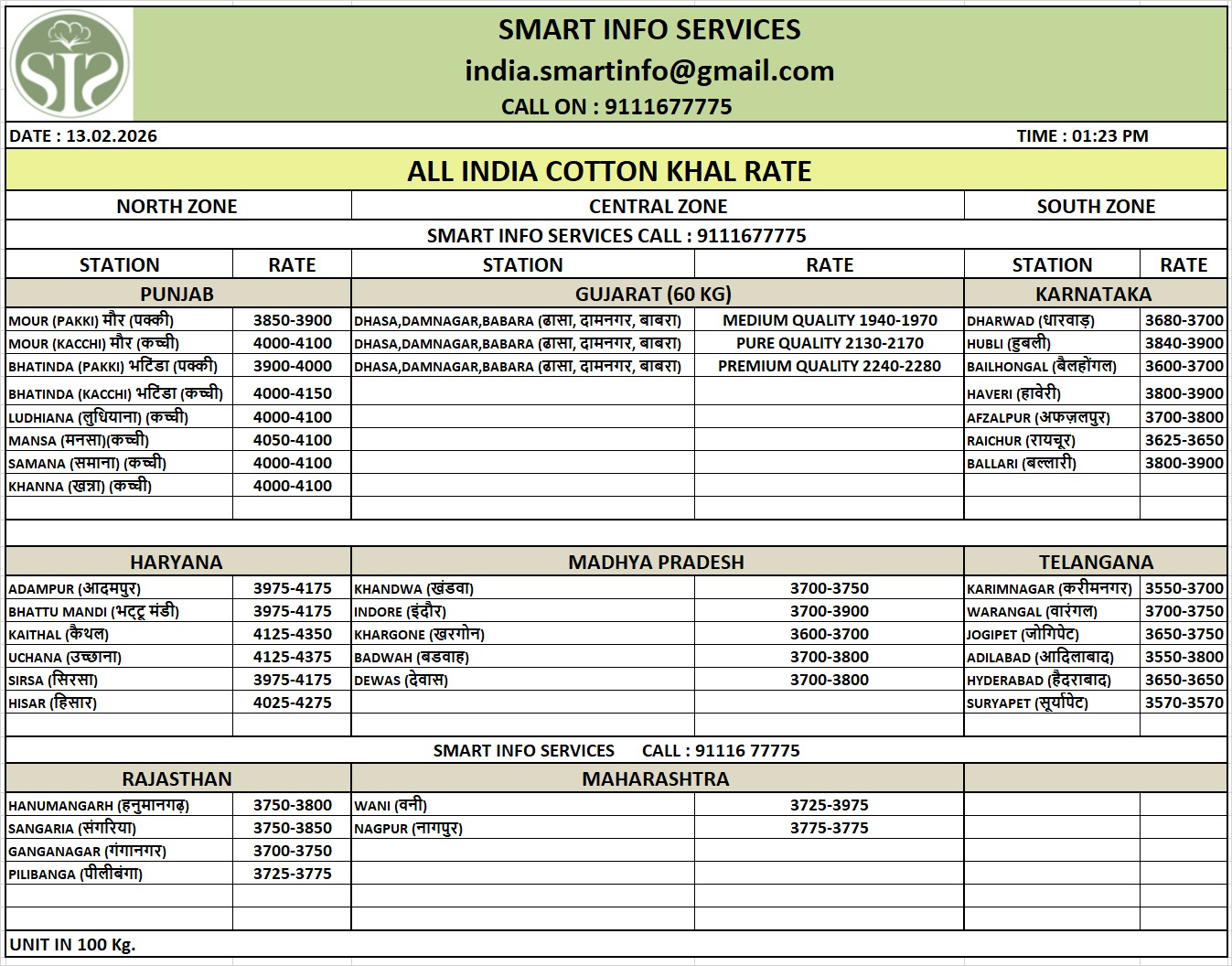
As CCI prepares to purchase more than 100 lakh bales at MSP, cotton prices rise. Cottoncandy prices increased by 0.41% to settle at ₹54,370, supported by expectations of significant procurement by the Cotton Corporation of India (CCI), which is likely to buy over 100 lakh bales at the Minimum Support Price (MSP) this season. The Cotton Association of India (CAI) estimates a decline in India’s cotton output for the 2024-25 season to 301.75 lakh bales from 327.45 lakh bales in 2023-24 due to lower yields in Gujarat, Punjab, and Haryana. Despite the lower output, the quality of cotton remains strong. As of January 2025, total cotton supply is projected at 234.26 lakh bales, including 188.07 lakh bales from fresh pressings, 16 lakh bales from imports, and 30.19 lakh bales as opening stock. India's domestic consumption is retained at 315 lakh bales, while exports are projected to decline to 17 lakh bales from 28.36 lakh bales in 2023-24. Brazil's cotton production for 2024-25 is expected to rise by 1.6% to 3.76 million tons, with a 4.8% increase in the planting area, reflecting strong supply. The U.S. balance sheet shows minor changes, with domestic mill use reduced by 100,000 bales, while global cotton consumption sees marginal increases, driven by higher demand in Bangladesh, Pakistan, and Vietnam. Technically, the market is witnessing short covering, with open interest dropping by 1.94% to 253 contracts. Cottoncandy finds support at ₹54,260, with a break below potentially testing ₹54,160. On the upside, resistance is seen at ₹54,480, and a move above this level could push prices toward ₹54,600.read more :-India's T&A exports overtook total merchandise shipments in January

Copyright© 2023 | Smart Info Service
Application Download