Filter

Recent News

Weak rupee helps cotton rate firm up over MSP

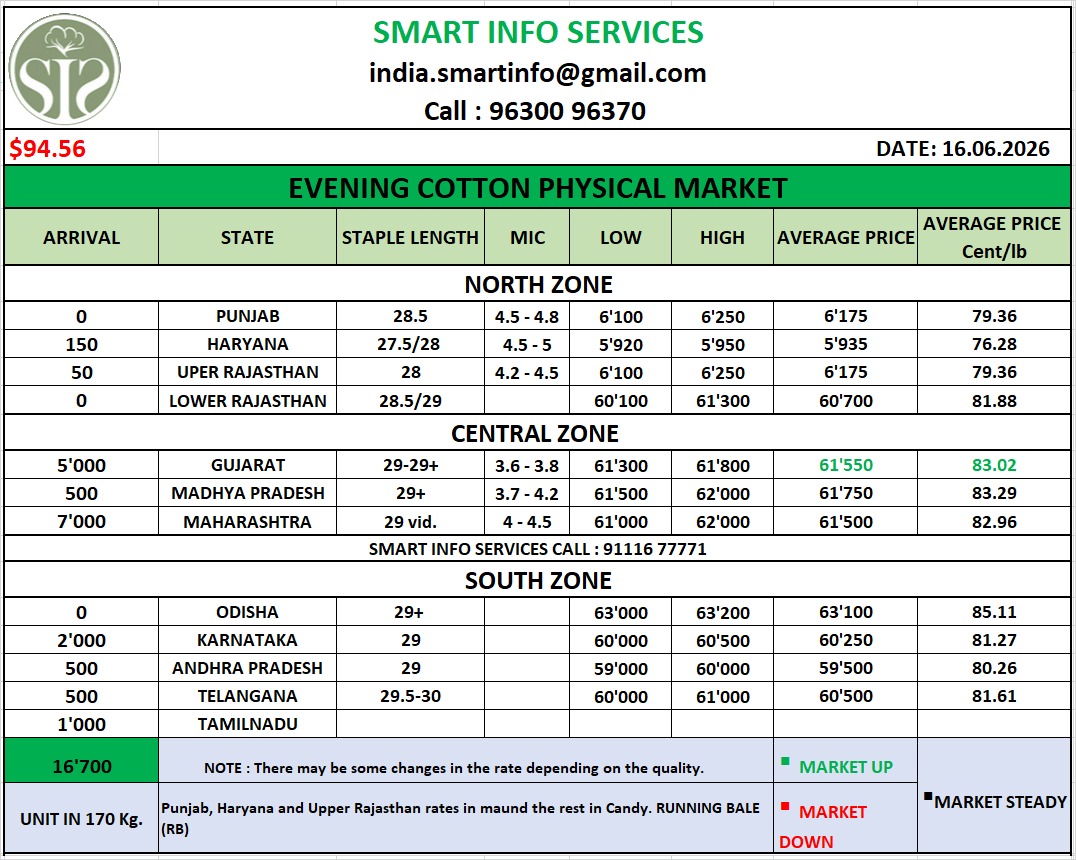
Weak rupee helps cotton rate firm up over MSPNagpur: After a dull start to the cotton buying season, farmers have some hope as the market prices hover in the range of ₹7,000 to 7,200 a quintal, which is marginally above the minimum support price (MSP) of ₹7,020 per quintal for long staple cotton.Traders say the rates are likely to remain in the same range this season considering a 10% jump in global stocks.Experts say it’s the weaker rupee against dollar which is keeping a tab on cotton prices. The rate fetched by cotton growers in the country are pegged at international price of lint (processed cotton with seeds removed) quoted in dollars per pound.While cotton farmers in Vidarbha are complaining of low yield on account of erratic rains, the global outlook shows a higher stock internationally which can be signs of bearish rates ahead.“At present lint is in the range of 94 to 95 cents a pound, which translates to ₹7,200 a quintal. Even in 1995 lint was around 95 pounds on average and cotton fetched ₹2,500 to ₹2,600 a quintal. This was because the greenback cost was less at that time. At present, dollar is worth over ₹83, thus keeping cotton rates up,” said Vijay Jawandhia, a veteran farm activist. In 2021, lint had touched $1.70, fetching over ₹12,000 a quintal for farmers in India, he added.A report released by the international cotton advisory committee (ICAC) says the current price forecast predicts the rates to be in the range of 72.33 cents to 104.12 cents with a midpoint of 86.23 cents per pound. The report also says that the global reserves of cotton are at the highest level. With an increase in global production of 3% and consumption projected to fall by 0.43%, the global stocks may jump by 10%. The December futures for cotton also ended below 80 cents, says the report released early this month.Manish Jadhav, a cotton farmer from Yavatmal, said selling stocks in the market fetches only ₹6,800 a quintal. Soyabean, the second major crop is being sold at ₹4,800 a quintal as against MSP of ₹4,300.

Pakistan selective buying on cotton market

Pakistan selective buying on cotton marketThe local cotton market on Monday remained steady and the trading volume remained low.Cotton Analyst Naseem Usman told Business Recorder that the rate of cotton in Sindh is in between Rs 15,200 to Rs 18000 per maund. The rate of Phutti in Sindh is in between Rs 5,500 to Rs 7,200 per 40 kg. The rate of cotton in Punjab Rs 16,000 to Rs 18,000 per maund and the rate of Phutti in Punjab is in between Rs 6,500 to Rs 8,200 per 40 kg.The rate of cotton in Balochistan is Rs 17,000 to Rs 17,500 per maund while the rate of Phutti is in between Rs 7,500 to Rs 8,800 per 40 Kg.600 bales of Layyah were sold at Rs 16,000 per maund BCI, 600 bales of Tando Adam were sold at Rs 16,400 per maund, 200 bales of Mehrab Pur were sold at Rs 17,200 per maund, 400 bales of Saleh Pat were sold at Rs 15,500 per maund BCI, 400 bales of Khair Pur were sold at Rs 15,500 per maund, 600 bales of Tando Adam were sold at Rs 16,400 per maund, 200 bales of Rahim Yar Khan were sold at Rs 17,400 per maund, 200 bales of Obaro were sold at Rs 17,700 per maund, 600 bales of Layyah were sold at Rs 16,000 per maund, 1200 bales of Khair Pur were sold at Rs 15,500 per maund, 200 bales of Fort Abbas were sold at Rs 17,000 per maund, 200 bales of Sadiqabad, 200 bales of Rahim Yar Khan and 200 bales of Liaquat Pur were sold at RS 17,800 per maund.The Spot Rate remained unchanged at Rs 17,500 per maund. The rate of Polyester Fiber was increased by Rs 5 and was available at Rs 355 per kg.

Global cotton production likely to decline by 4.7% in 2023-24 season

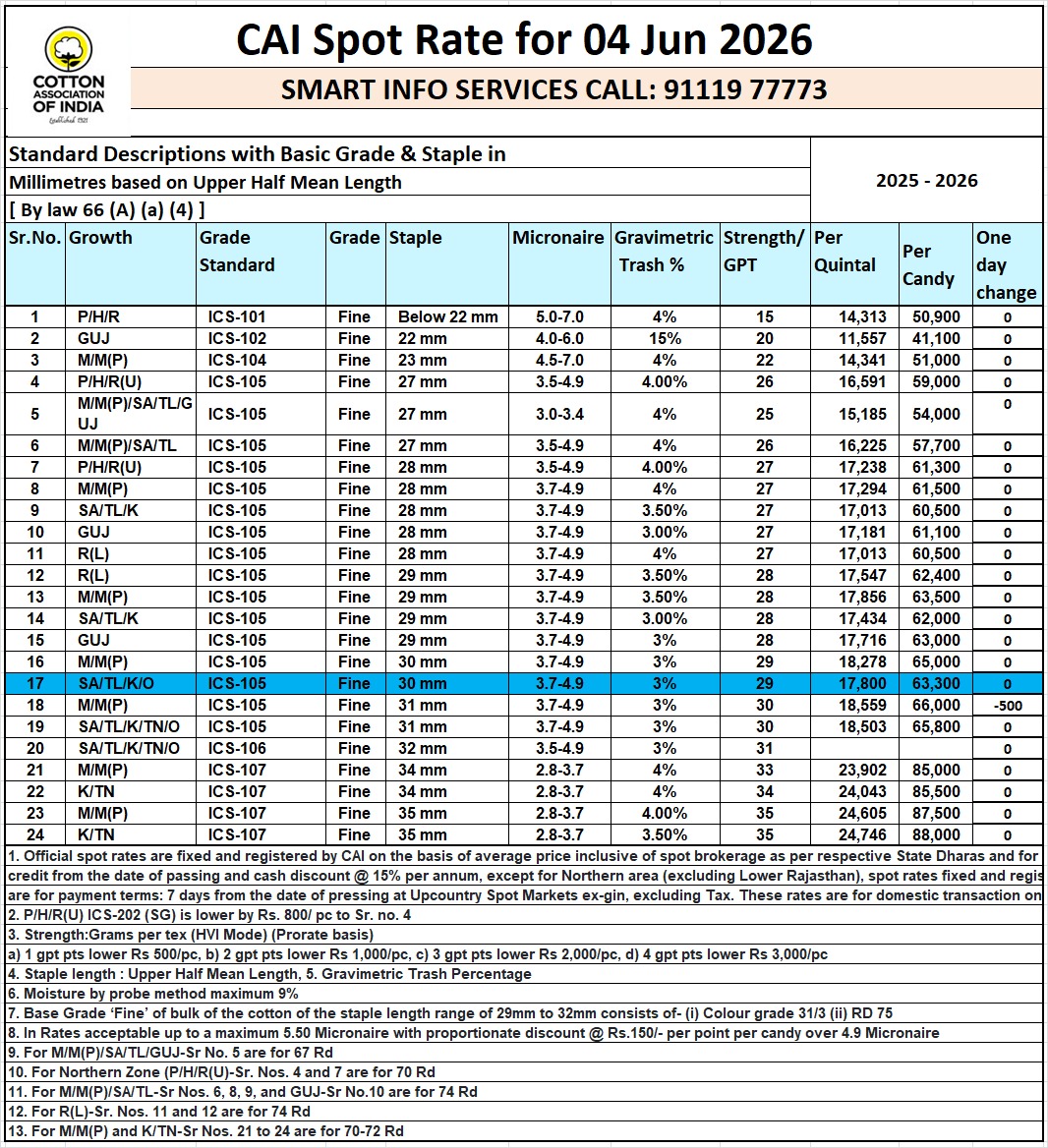
Global cotton production likely to decline by 4.7% in 2023-24 seasonGlobal cotton production is likely to decline by 5 million bales (217.7 kg) this season (October 2023-September 2024) as production in China, the US, Australia and India is affected.However, industry experts and analysts have said that cotton prices are likely to decline in the current quarter, but are expected to rise from at least the second quarter of 2024.However, lower cotton production is unlikely to impact the textile industry as it is moving towards alternatives such as synthetic and blended fibres. “We expect global (cotton) production to reach 112.1 million bales in the 2023-24 season, lower than the estimated production of 117.6 million bales in the 2022-23 season, indicating a decline of 4.7 per cent year-on-year . Our outlook for the global production outlook is driven by an expected decline of 12.1 per cent year-on-year (y-o-y) in mainland China and the US due to a sharp decline in planted area and adverse weather conditions. Due to which production has been affected. Estimates,” said research agency BMI, a unit of Fitch Solutions.Brazil will partially offsetAdditionally, Australian production is projected to decline by 12.1 percent and Indian production will contract by 1.9 percent this season. But Brazilian output will partially offset declines elsewhere, with our forecasts indicating growth of 21.6 percent year-on-year.“The global market will face a supply shortage this year. But demand is sluggish as the US, Europe and other developed countries are going through financial problems. People there are not spending much on clothes,” said Anand Popat, a Rajkot-based cotton, yarn and cotton waste trader.“Production in India is less than 295 lakh bales (170 kg each). But the carryover stock of 25-30 lakh bales from the last season will help overcome any shortfall. Cotton consumption is also down as mills are shifting towards polyester blends,” said Ramanuj Das Boob, a sourcing agent for multinational companies based in Raichur, Karnataka.“The textile industry is clearly moving towards synthetic and blended fibers both in the country and abroad. The move is accelerating with higher prices of cotton and artificial fibers such as man-made fibers and cellulosic fibres, which are taking up more space in the market,” said Prabhu Dhamodharan, convener of the Indian Textiles Federation (ITF).technological advancement for protection“Quick change” will keep cotton prices under control. "Recent advances in technology are making synthetic fibers more functional, making them stronger competitors to cotton," he said.Despite lower production, BMI cut its average price forecast for 2023 to 84 US cents per pound from 86.5 cents, slightly above the year-to-date average of 83.8 cents. “Looking out to 2024, we maintain our average annual price forecast at 88 cents, which represents a 4.1 percent increase year-over-year (primarily due to lower supply),” the research agency said.Providing further support to global prices, it is expected that global consumption will reach 116.4 million bales in 2023-24, representing a year-on-year increase of 5 percent and, importantly, global production. Causes loss of balance.Current priceCurrently, cotton prices on the Intercontinental Exchange, New York, for delivery in March 2024 are quoted at 81.74 cents (₹53,800 per candy 356 kg) - the lowest in three months. In India, the benchmark Shankar-6 cotton price in Rajkot is ₹57,050 per candy.“Cotton (unprocessed cotton) prices in the domestic market are at ₹7,200-300 per quintal, while cottonseed prices are at ₹3,200-300 per quintal,” Das Boob said. If seed prices fall further, the Center may consider Minimum Support Price (MSP) procurement.This year the MSP of cotton has been fixed at Rs 6,620 for the medium staple variety. The arrivals are likely to increase after Diwali and will remain stable for two months thereafter. “We expect cotton prices to remain around Rs 57,000-59,000 per candy, although heavy arrivals and sluggish demand may put pressure on rates,” said a Raichur-based sourcing agent.Although the harvest is low, the quality of arrivals is excellent, Das Boob said.Caution on fiber selectionPopat said his own estimate of the cotton crop is not less than 315 lakh bales (170 kg each) and with the carryover stock of 27 lakh bales, the domestic demand can be easily met.Dhamodharan cautioned that spinning mills and textile manufacturers in the southern region are thinking twice about relying solely on cotton, due to its price fluctuations and persistent volatility. “They are now more open to mixing in different fibers, which allows them to adapt quickly to any market fluctuations,” he said.The ITF convener said it is the "right time" for the Indian government to bring the "right balance" to the ecosystem. "We expect production to decline by 12.3 percent during the 2024-25 season, which will support prices in the second half of 2024," BMI said.


Bangladesh: Import of cotton and yarn, falling demand, low gas supply, high US dollar price are responsible for this.

Bangladesh: Import of cotton and yarn, falling demand, low gas supply, high US dollar price are responsible for this.Bangladesh's cotton and yarn imports declined in the first nine months of 2023 as falling demand in global and local markets, irregular gas supply and the US dollar crisis hit textile millers.According to Bangladesh Textile Mills Association (BTMA) data, the country's cotton imports for making yarn declined 28 per cent year-on-year to 9.87 lakh tonnes in January-September.In the same period a year ago, traders had imported 13.66 lakh tonnes of cotton.Similarly, yarn imports fell 26 per cent to 6.29 lakh tonnes in the nine months to September from 8.51 lakh tonnes a year ago.The decline in imports of cotton and yarn by textile mills comes at a time when export receipts by the readymade garment industry, which generates more than 80 per cent of the country's earnings from the external sector, have slowed down.In October, apparel shipments declined 14 percent year-on-year. Overall, apparel sector earnings rose nearly 6 percent to $38.7 billion in January-October. According to Bangladesh Garment Manufacturers and Exporters Association, it stood at $36.6 billion during the same period in 2022.A Matin Chowdhury, managing director of New Asia Group, a vertically integrated apparel manufacturing unit, said the decline in global demand has resulted in a 25 to 30 per cent decline in demand."There has also been significant disruption in production due to irregular gas supply. Local demand has also declined due to the current economic situation."Choudhary, who is also a former BTMA president, blamed the high prices of gas and cotton for the rising losses of textile mills and the high dollar price for the sharp depreciation of the taka.In January, the government raised the retail price of gas by 14.5 per cent to 178.9 per cent to ease its unsustainable subsidy burden amid a tight fiscal situation.And central bank data shows the taka has lost nearly 30 percent against the US dollar since January last year, making imports costlier.According to industry operators, local spinning and weaving mills meet about 90 percent of the textile raw material requirement for export-oriented knitwear, which is now the largest export earner in the apparel industry, and 40 percent of the demand for knitted fabrics. completes.BTMA Chief Executive Officer Mansoor Ahmed said export-oriented mills were facing difficulty in accessing the Export Development Fund (EDF) for importing cotton and yarn due to dollar shortage.Bangladesh Bank has increased the interest rate on loans given from its funds with the aim of making borrowing costlier in order to save foreign currencies. Foreign exchange reserves have fallen by about 25 percent since the start of the Russia-Ukraine war.Ahmed said the problem of domestic market oriented spinning mills is more serious as they have to depend on banks to buy raw materials from foreign markets."The rising value of the dollar has increased the cost of imports."BTMA president Mohammad Ali Khokon said many local market-oriented mills have suspended production due to shortage of raw materials."Export orders for clothing have fallen."He said that the market is not going to return to normal before March next year.“We have to stay afloat till then. So, we need support from the government and banks.”Mohammad Hatem, executive president of Bangladesh Knitwear Manufacturers and Exporters Association, said the cotton import data reflects the current situation of the sector."The decline in imports is natural."He said most knitwear factories are running at 50-60 per cent capacity as buyers are placing fewer orders."So, our consumption has declined. There is no sign of improvement in order flow either."Matin said the coming days were going to be "extremely challenging."“We are getting a disappointing picture in terms of gas supply,” he said, citing media reports."We are really concerned about the energy issue. Also, the demand is not increasing despite the overall capacity expansion."

Spinning mills in Tamil Nadu to go on strike from November 7

Spinning mills in Tamil Nadu to go on strike from November 7G. Arulmozhi, president of the open-end spinning mills’ association said that with the high costs of cotton waste along with steep power and labour costs, the mills are unable to operateOpen-end spinning mills in Tamil Nadu that supply yarn to producers of mops, mats, kitchen towels, lungis, etc. will shut operations from November 7 to 30. Similarly, master weavers in Tiruppur and Coimbatore districts have announced a strike from November 5.G. Arulmozhi, president of the open-end spinning mills’ association, told presspersons in Coimbatore on Saturday November 4, 2023, that open-end spinning mills, numbering almost 600 in Tamil Nadu, produce yarn worth ₹60 crores a day. “For the past six months, the mills are operating at just 50% of their capacity. Since we are incurring losses if we run the mills, we have decided to stop production,” he said.According to Mr. Arulmozhi, the main raw material for the mills is cotton waste that comes from regular textile mills. “The price of cotton is ₹160 a kg and the price of waste cotton should have been ₹97 a kg. But it is ₹115 a kg now. Waste cotton prices should decline by ₹20 a kg. Yarn is sold at ₹140 to ₹150 a kg, which was the price prevailing five years ago. In the past five years, costs of power, labour, and raw materials have increased multi-fold,” he said.Open-end spinning mills in Panipat, Haryana, he pointed out, are able to sell yarn at 30% lower prices compared to those in Tamil Nadu. The power costs in Tamil Nadu will force the closure of the textile industry if the government does not reduce the rates, he added.The Central government should control or stop the export of waste cotton, remove the import duty on cotton and relax quality control norms for synthetic fibres. The State government should remove peak hour charges for LT CT electricity consumers and revise the fixed charges. It should support the textile industry with a special status to revive textile activities in Tamil Nadu, Mr. Arulmozhi said.

200 textile factories closed in Bangladesh

200 textile factories closed in BangladeshOwners have announced temporary closure of about 200 export-oriented garment factories in Ghazipur, Savar, Ashulia and Mirpur in Dhaka amid workers' agitation over wage hike. They fear that if the factory is kept open, the workers' protest may spread further.On Wednesday, workers protested by blocking the road in Mirpur of the capital. Some workers protested in Savar. But the situation was calm in Ghazipur.Meanwhile, bosses told the Minimum Wage Board yesterday they would be proposing a new wage. The previous proposal will be cancelled. The new proposal will increase salaries, but by how much has not been disclosed.It was decided in the board meeting yesterday chaired by Pay Board Chairman Liaqat Ali Mollah that the pay rate will be finalized in the second week of this month. The new pay structure will come into effect from December 1.Sirajul Islam, representative of the workers' side in the wage board, told Prothom Alo, 'There was a good discussion. 'The owner has become more flexible than before.'On the other hand, factory owners' representative and former BGMEA president Siddiqur Rahman told reporters, 'The wages will increase with the proposal we had given earlier. How much will it increase, I will discuss with the owners and tell in the next meeting.While the Wage Board meeting was going on at Segunbagicha in the capital, the owners were holding a meeting at the Uttara office of BGMEA, an organization of textile factory owners. It was decided in the meeting that closure of the factory due to workers' protest would be under Section 13(1) of the Labor Act. According to this section the owner can close the factory due to illegal strike. In the event of such a strike, the workers participating in the strike will not receive any salary.Source: Bangladesh News Paper

Copyright© 2023 | Smart Info Service
Application Download