Filter

Recent News

Monsoon surplus reached 7% in the last week of July.

Monsoon surplus reached 7% in the last week of July.Monsoon onset over Kerala was delayed by 8 days. Soon after, Cyclone Biperjoy stalled the progress of the monsoon over the south peninsula and further into northeast India. June ended with a rainfall deficit of 10%.In the last week of June, the monsoon advanced rapidly and covered the entire country on July 2, much ahead of schedule. A persistent low pressure area and depression developed over west central Bay of Bengal and moved inland. Heavy rain was witnessed in parts of Rajasthan, Gujarat and Mumbai.Monsoon rains remained high during July. Monsoon surplus reached 7% in the last week of July. The ongoing rain activities over the northwest and central parts of the country have reduced considerably during the last 10 days. The 7% surplus has now been consumed. Going forward, we expect monsoon rains to turn negative.The effect of El Nino will be seen during August and September. The axis of the Monsoon trough has shifted towards the foothills of the Himalayas, causing obstruction in the Monsoon conditions. We do not expect any significant rain activity over Northwest Central and South Peninsula for at least next week. There is no sign of any significant development over the Arabian Sea or the Bay of Bengal. This is a matter of concern for many states in the North West, Central and South Peninsula.Models are indicating a positive IOD during the second half of August and September. This can reduce the harsh effect of El Nino to some extent. Monsoon is looking very likely to end with below normal rainfall.

*India defers cotton quality control order for 3 months*

*India defers cotton quality control order for 3 months*The Government of India has postponed its decision to implement the Cotton Bales (Quality Control) Order, 2023 by three months.A gazette order issued by the Ministry of Textiles late on Tuesday said the order would be implemented from November 27 instead of August 28.The decision to postpone the implementation was taken following a request from textile organizations and trade unions during a meeting with textile ministry officials over the weekend.The order, known as the Cotton QCO (Quality Control Order), was notified by the Union Ministry of Textiles on February 28 and was to come into force 180 days after its publication in the Gazette. This applies to processed cotton (counted) and unprocessed or raw cotton (cotton).The QCO specifies 8 percent moisture content for cotton bales, orders ginning mills to test at least 5 percent of bales, and restricts garbage content in bales to below 3 percent.The QCO will also apply to imported cotton. The Tamil Nadu Spinning Mills Association (TASMA) had urged the Center to postpone the order till a consensus is reached among all stakeholders.The Cotton Association of India (CAI) urged Commerce and Textiles Minister Piyush Goyal to postpone the QCO for "minimum one or two years".CAI president Atul Ganatra said ginners would find it difficult to ensure 8 per cent moisture in cotton bales as it would be 10-12 per cent in lint (processed cotton) and 15-25 per cent in cotton (raw cotton) during October-December . ,He pointed to the lack of adequate infrastructure to test cotton bales, and also expressed the difficulty in meeting the limits on waste content in cotton.The Karnataka Cotton Association (KCA) demanded a meeting between the Ministry of Textiles and ginners to clear and clarify "all confusion" around QCO.It wanted the QCO to be postponed till proper testing infrastructure is available, as few laboratories are accredited by the National Accreditation Board for Testing and Calibration Laboratories (NABL).It called for enforcement of quality standards in Agricultural Produce Marketing Committee (APMC) yards, which are procurement centers for cotton.
*Pakistan: Strong trend in cotton market*

*Pakistan: Strong trend in cotton market*LAHORE: The local cotton market remained firm on Wednesday with satisfactory trading volume.Cotton analyst Naseem Usman said that the rate of new cotton crop in Sindh is between Rs 17,800 to Rs 18,000 per head. The rate of footi in Sindh is between Rs 7,300 to Rs 8,000 per 40 kg.The rate of cotton in Punjab is between Rs 17,900 to Rs 18,400 per head and the rate of cotton is between Rs 7,600 to Rs 9,000 per 40 kg. Cotton rates in Balochistan range from Rs 17,800 to Rs 17,900 per head, while footy rates range from Rs 8,000 to Rs 8,500 per 40 kg.About 200 bales of Sanghar, 400 bales of Chowdagi, 200 bales of reed at Rs.17,800 per head, Tando Adam 2800 bales at Rs.17,800 to Rs.17,900 per head, 1400 bales of Shahdadpur were sold at Rs.17,800 per head. 18,000 per head, 200 bales of Badin, 600 bales of Mirpur Khas, 400 bales of Sarhari, 1000 bales of Daur at Rs.17,800 per head, 2300 bales of Fakir Wali at Rs.17,900 to Rs.18,100 per head. 1800 bales of Vehari were sold at the rate of Rs.18,200 to Rs.18,400 per head, 200 bales of Kacha Kaho were sold at the rate of Rs.18,100 per head, 1400 bales of Chichavatni were sold at the rate of Rs.17,900 to Rs.18,250 per head, Layya 1400 bales were sold. Selling at Rs.17,900 to Rs.18,000 per head, 200 bales of Pir Mahal, 200 bales of Toba Tek Singh, and 200 bales of Mungi Bangla were sold at Rs.18,250 per head.The spot rate remained unchanged at Rs 17,935 per head. Polyester fiber was available at Rs 350 per kg.

Punjab: There may be a major reduction in cotton yield due to pest attack

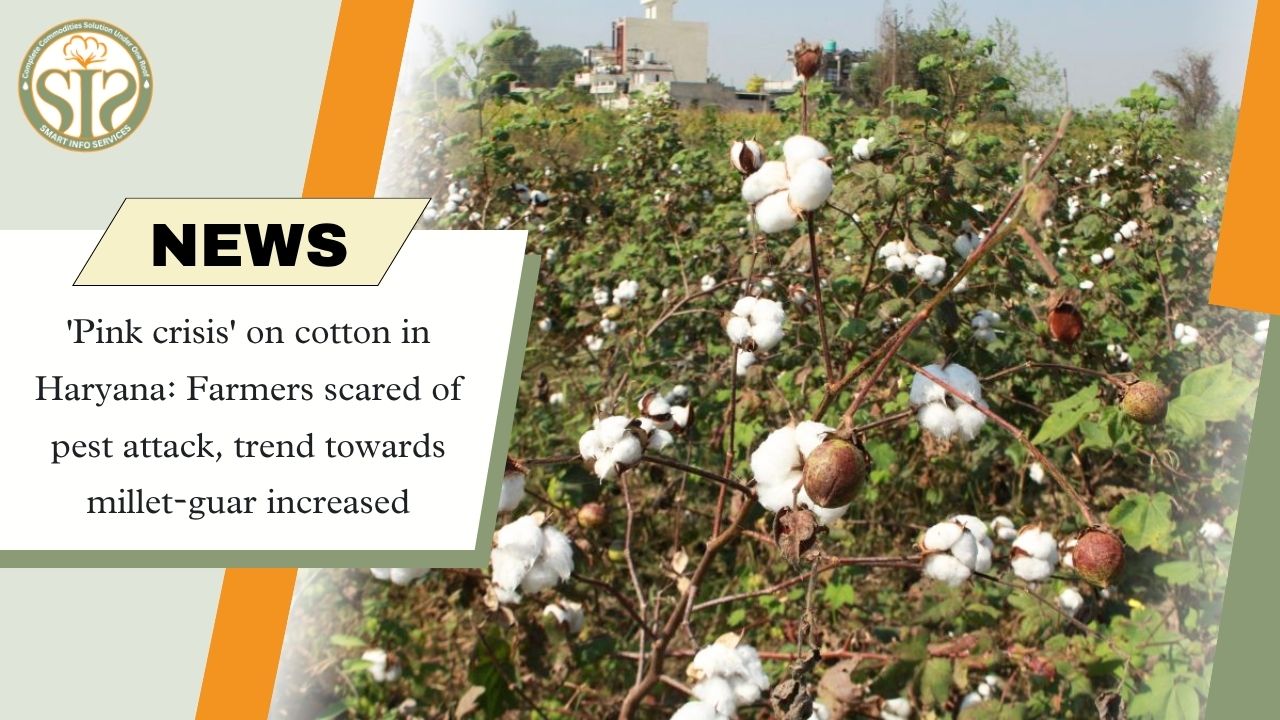
Punjab: There may be a major reduction in cotton yield due to pest attackBathinda: With the cotton marketing season for 2022-23 almost over, cotton (raw cotton) arrives. Nearly a third have been recorded in Punjab. Previous year, 2021-22. Both record the advent of the Punjab State Agricultural Marketing Board (PSAMB), which Various crops in the mandis, and cotton-trading body the Indian Cotton Association Limited (ICAL), have also reported the same.According to PSAMB, cotton arrivals in the 2022-23 marketing season till August 5 this year have been recorded at 8.7 lakh quintals, while for the entire 2021-22 it was 28.89 lakh quintals. ICAL records arrival of 2.52 lakh bales (1 bales 170 kg as against 7.19 lakh bales till August this year, cotton area in Punjab to remain almost the same in 2021-22 at around 2.5 lakh ha, usually cotton arrivals 31 July By almost ends August and September are negligible.In the past, there has been an outbreak of pests like white fly and pink bollworm. This was cited as the main reason behind the big drop in production. Poor seed and fertilizer quality is also being seen as a reason. Farmers also claim that the pesticides supplied to them are of poor quality and have failed to control the pest attacks. In view of the transition, the sowing of the crop has come down from below 2 lakh hectares in the last few years to 1.75 per cent, reported consistently for two lakh hectares in the 2023-24 season. This also happened when the state government was giving more emphasis on the crop. Diversification and cotton was being looked at as an option. The bad days for water-drinking paddy co-cotton really began in 2015, when a whitefly attack was first reported on the crop, destroying nearly half the crop. Thereafter, the acreage of cotton began to decline and farmers' production continued. Some people are facing miseries with few exceptions. years thereafter. Even cotton prices are crashingPsychological barrier of Rs 10,000 per quintal (very high). minimum support price) failed to enthuse growers. “We were growing cotton for a long time, but frequent pest attacks forced us to switch to paddy.The cotton belt which includes Bathinda, Mansa, Fazilka and. Muktsar is the major cotton producing district of Punjab. To make matters worse, even the latest cotton crop on 1.75 lakh hectares faced problems of its own kind. Firstly, there was an attack of pests on the crop at an early stage of the season. Parts of Bhathida, Mansa and Fazilka later caused problems for the farmers due to heavy rains. An official in the Punjab agriculture and farmers' welfare department, who did not wish to be named, said efforts were being made to protect the crop from the pest attack. Farmers are being advised to use the spray when needed.

Copyright© 2023 | Smart Info Service
Application Download