Filter

Recent News

The Cotton Spin: A Calculation for the 2022 Cotton Crop...Approximately

The Cotton Spin: A Calculation for the 2022 Cotton Crop...ApproximatelyA discrepancy remains between projected US cotton exports (12.6 million) and current total commitments (13.2 million).The USDA's May WASDE report showed a slight change in the world balance sheet for old crop cotton. This is expected as we enter the final quarter of the 2022/23 marketing year.The biggest month-on-month change was an increase of half a million bales in Central Asian production. With fewer exports, this effectively increased Central Asian closing stocks by 880,000 bales. Due to several expected adjustments (discussed below), the U.S. The ending stocks were tightened by 600,000 bales month-on-month. Australian ending stocks were 200,000 bales lower due to an increase in their exports, while Brazilian ending stocks were 250,000 bales lower due to a decrease in their exports. In the end, sugar production increased by 200,000 bales, but this was offset by a 450,000-bale decrease in their imports.In summary, we saw a lot of offsetting adjustments in a handful of countries, resulting in a modest net increase of 620,000 bales of worldwide ending stock month-over-month. I consider this adjustment value to be neutral.Unlike foreign adjustments, the U.S. The old crop cotton balance sheet was changed more significantly than the April estimates. On the production side, 2022 US cotton harvested acreage is set to drop by 130,000 acres, effectively pushing US abandonment to a record 46.9%. The average yield per acre was increased by several pounds. The effect on US 2022 cotton production was a 210,000-bale cut month-to-month. This adjustment was much expected because it represents a reconciliation of the USDA's long-term estimate of 14.68 million bales of 2022 production, with 14.5 million bales graded and counted in 2022.On the demand side, US exports were increased by 400,000 bales to better match the current level of total export commitments. This adjustment was also expected.The bottom line of all these adjustments made the U.S. Old crop carry-out tightened to 4.1 to 3.5 million bales. Levels and adjustments have historically been bullish, although the market appeared to be expecting them.Is there anything left for the 2022/23 balance sheet? The production question must be settled. However, a discrepancy remains between forecasted US exports (12.6 million) and current total commitments (13.2 million). This discrepancy can be resolved either by raising the export forecast, or by reducing total commitments (i.e. through cancellation or rollover into the next marketing year), or both.👇🏻👇🏻👇🏻👇🏻https://smartinfoindia.com/newsdetails/2441

Cotton prices fall as farmers start selling stocked cotton

Cotton prices fall as farmers start selling stocked cottonMay arrivals at nine-year high; Daily arrivals above 1 lakh balesCotton prices have declined by nearly nine per cent in the past two weeks as growers have started bringing back their produce held over the past few months to Agricultural Produce Marketing Committee (APMC) yards.“Farmers in various states have changed their mind and want to sell their stocked cotton (seed cotton). Cotton arrivals are at a new high in May and are expected to continue till the end of June.“The daily arrival of cotton has increased to one lakh bales (170 kg each) in the last few days. The demand for yarn is negligible and its exports have been affected by the bearish trend. Fabric demand is also sluggish,” said Ramanuja Das Bubb, who sources cotton from Raichur, Karnataka, for spinning mills, multinationals and exporters.Panic?Cotton arrivals so far this month are at a nine-year high of 1,82,572.67 tonnes (10.73 lakh bales), according to data from Agmarknet, a unit of the agriculture ministry. In 2014, when India produced a record high crop of 398 lakh bales, arrivals during the same period were 2,36,800.48 tonnes (13.93 lakh bales)."The daily arrival of cotton last week was 90,000-110,000 bales per day, taking the total arrival to 7 lakh bales," Popat said.“Panic has spread in the market. There is no demand for yarn or cloth. No one is buying cotton either. Production seems high,” said Sachin Jhanwar, a yarn processor.Indian Texpreneurs Federation (ITF) convenor Prabhu Dhamodharan said, "Cotton prices are softening in line with the same trend, due to continued sluggish demand across the value chain."expect moreProcessed cotton (lint) is currently priced at Rs 56,900 per candy (356 kg) as compared to Rs 62,200 two weeks back. On the Multi Commodity Exchange, the June cotton contract is currently trading at ₹58,120 per candy.Cotton prices at Rajkot APMC are trading at Rs 7,175 per quintal, down from Rs 7,950 two weeks back. On the Intercontinental Exchange (ICE), New York, cotton July contracts were trading at 84.27 US cents per pound (₹56,625 a candy).Cotton growers had held on to their produce this year and stored it in backyards and on rooftops in anticipation of a rise in prices. Even when the prices were at Rs 8,000 per quintal against the minimum support price of Rs 6,080, they were not ready to sell as they got more than Rs 10,000 in the previous season.Growers in Karnataka and Maharashtra held back their produce for the first time, apart from farmers in Gujarat, who usually hold back their produce for the short arrival season that begins in April."Cotton prices in India have come down to Rs 57,000, while in China it is Rs 67,000," Jhanwar said.difficult to predict“There is some parity in prices for exports. It will now accelerate. So far 11.50 lakh bales of cotton have been exported and from this season till September, exports are expected to fall to a 19-year low of 23 lakh bales.“Since last week, the ICE market is consolidating despite the fall in Indian cotton prices on a daily basis. Bearish trend remains on MCX as well.Jhanwar said, “If the situation has to be changed, we will have to try to increase the export to 30-35 lakh bales.”“Across the value chain, textile companies are operating at low capacity utilization levels. Thereafter, cotton prices will align with real demand factors such as apparel exports," Dhamodharan said.“Given the current arrival trends, it is difficult to judge the crop based only on arrivals in APMC yards and cotton held back by farmers in Maharashtra and Gujarat,” Das Bub said.He said this would also make it difficult to estimate the quantity of cotton coming in as ginners and traders have a huge stock of 30-35 lakh bales.MNCs manufacture goodsThe Committee on Cotton Production and Consumption, a body of all stakeholders, has estimated the current season (October 2022-September 2023) at 327.23 lakh bales, but a section of the trade pegs it at over 340 lakh bales. Is. However, the Cotton Association of India, a body of traders, pegged it at less than 300 lakh bales in its latest estimate done this month.Jhanwar said many had stock of cotton and yarn which was more than a year old. “Since last year, I have a good amount of yarn and one lakh bales of cotton,” he said.Das Bub and Popat said that at present multinational trading companies are buying cotton. “Spinning mills have cotton stock for 45 days. Cash-rich mills have a stock of 70-90 days.“Situation looks favorable for these trading firms who had sold in the futures market and are now covering the stock. The fall in prices is also helping them.sowing can increase"In the next three months, we can see some volumesCotton is being imported from Australia, Brazil and the US," said Das Bub.Jhanwar said, "This week the market movements will be important and then the focus will be on the US."Despite falling prices, cotton sowing will increase this year, although millers are likely to see a reduction in production in the coming months, Das Boob said.👇🏻👇🏻👇🏻👇🏻https://smartinfoindia.com/newsdetails/2438

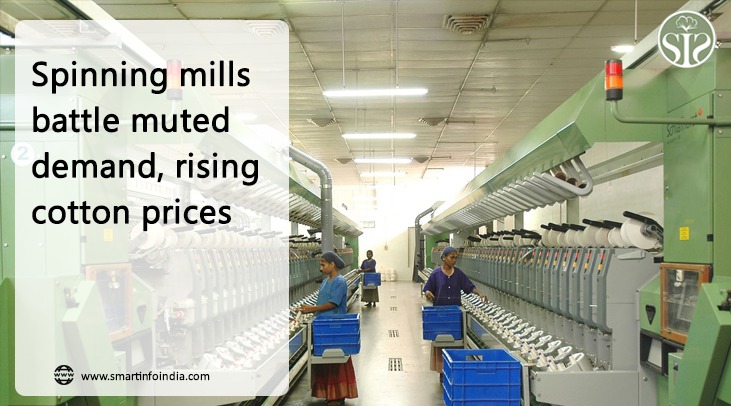
The spinning mills in Tamil Nadu are facing a severe crisis, jeopardizing the employment prospects of lakhs of workers. Here are the main points:

The spinning mills in Tamil Nadu are facing a severe crisis, jeopardizing the employment prospects of lakhs of workers. Here are the main points:1. The spinning sector is an important part of the textile value chain and is the most capitalization-intensive industry after agriculture.2. It plays an important role in providing employment opportunities in rural areas for women and migrant workers.3. Spinning serves as the core industry of the entire textile industry, therefore it is the core industry that functions across the value chain.4. Due to the global economic slowdown, yarn and fabric exports are declining, as a result of which exporters are selling their surplus yarn in the domestic market.5. The excess supply of yarn has created a mismatch of demand and supply, due to which the spinning mills are forced to sell their products at very low prices.6. As a result, spinning mills are suffering economic losses and are operating at low utilization as profitability has come down.7. Also, traders are not tempted to buy yarn from Tamil Nadu factories due to very low prices for importing yarn and fabric from countries like China, Vietnam and Bangladesh.8. Factories are finding it difficult to meet monthly financial concepts, complying with legal restrictions such as payment of loan to bank lenders, payment of interest, electricity charges, worker wages, payment of GST and eligibility norms Used to be.9. Due to these adverse factors, there has been huge cash loss, in which the price of yarn has come down by about Rs.20 to 25 per kg.10. To mitigate the crisis, factory owners have taken a tough decision, they have decided to run their factories only at 50% capacity.11. Also, the general increase in interest rates in banks from 7.75% to 10.75%, increases the burden on the spinning mills.12. The recent Tamil Nadu power tariff hike has increased the production cost by Rs 6 per kg of yarn.13. Other factors driving higher production costs include inflation, machinery expenses, electricity prices, labor migration, and other indirect costs.14. The ongoing conflict between Ukraine and Russia has also impacted production costs, adding to the strategic challenges of Pivot factories and their inability to service bank loans.15. In light of these critical circumstances, a humble request is made that the Government of India may take necessary steps to safeguard and support the security of the Axis region.It is clear from the above points that the spindle factories in Tamil Nadu are facing difficult conditions, which clearly shows the urgency of government intervention, to protect the industry and protect the jobs of countless workers.

Copyright© 2023 | Smart Info Service
Application Download