Filter

Recent News

Anti-dumping duty on viscose from Indonesia almost unlikely

Anti-dumping duty on viscose from Indonesia almost unlikelyThe Union finance ministry may not impose anti-dumping duty (ADD) on viscose staple fiber (VSF) from Indonesia, as it could lead to shortage of a key raw material for India's textile industry.The commerce ministry's Directorate General of Trade Remedies (DGTR) had in December recommended a duty of $0.512/kg on these imports, as part of a government initiative to enhance the quality of textiles. However, about a dozen members of Parliament, including those from the ruling party, recently wrote to Finance Minister Nirmala Sitharaman to raise the import price of viscose fiber by up to β‚Ή40 per kg.β€œThe DGTR had recommended anti-dumping duty only on VSF imports from Indonesia. We import from two-three countries including Indonesia, Austria, and China. Anti-dumping duty was recommended only in the case of Indonesia as the investigation revealed injury to the domestic industry."Dropping the move to impose duty would provide relief to domestic garment manufacturers, who were facing the prospect of business disruption, reduced competition and economic losses. β€œThe Finance Ministry takes into account the recommendation of the DGTR and also the public interest. The finance ministry has not announced the fee, and the period in which a decision was expected to come is now over. Therefore, there is no possibility of anti-dumping duty on VSF. Duty was limited to Indonesia as there was a huge surge."The MPs wrote to Sitharaman that viscose-blended cotton is the future and forms an important raw material for the spinning and weaving industry, apparel, accessories and technical textile production. He also pointed to problems with VSF availability. β€œIn this financial year, the domestic VSF demand was 700,000 tonnes, and the availability was only 540,000 tonnes. This move (proposition of ADD on VSF) may increase the import price of viscose fiber by up to Rs 40 per kg.The government is focusing on quality, but that does not mean it is not considering maintaining availability. He said, 'I am not refusing imports, but substandard imports should not be encouraged. But at the same time, assured availability of raw materials also needs to be guaranteed."The imposition of a fee on VSF was recommended amid quality improvement efforts and is no longer expected. β€œThe industry understands that there is a need for quality, but the government must realize that our buyers cannot be affected. There is stiff competition from Bangladesh and Vietnam, and if buyers get a better deal, they will not buy from India. This cannot be achieved by force. The government should take an interim step where there can be a voluntary approach for a year," he said.πŸ‘‡πŸ»πŸ‘‡πŸ»πŸ‘‡πŸ»πŸ‘‡πŸ»https://smartinfoindia.com/hi/news-details-hindi/Today-policy-trad-announced-foreign-msme-goverments-exports

Egypt to set up new textile factory to boost spinning and weaving sector

Egypt to set up new textile factory to boost spinning and weaving sectorMansour Abdel-Ghani, spokesman for the Ministry of Public Trade Sector, announced that the garment factories will be opened in July for the state project to develop the spinning and weaving sector. Abdel-Ghani said that Mahmoud Esmat, Minister of the Public Trade Sector, is following the project on a day-to-day basis.He said that the garment factory project is being implemented by a holding company for cotton, spinning, weaving and fabric. It aims to maximize the yield of long-staple and extra-long Egyptian cotton, and add transformational industries such as oil presses, sorghum and others.Hisham Tawfiq, Minister of the Public Enterprises Sector, announced in 2018 that a comprehensive development plan is underway for the spinning and weaving industry within the ministry's companies, which will be implemented over three years. Tawfiq said the plan would include the development of cotton spinning companies through weaving, dyeing and processing.The minister informed that the company's development plan aims at increasing the operating capacity in a single shift and increasing the number of work shifts, which will lead to increased production capacity. The company would expect major investments especially for the dyeing and processing phases. During his meeting with the company's board of directors and employees' representatives, Taufiq stressed the need to improve the costing and pricing system for products, develop an effective marketing plan, and open new export markets.  He suggested increasing awareness among the workers about the objectives of the development plan, which reflects positively on the performance of the company and the employees. β€œWe have to promote the textile and clothing industry to compete in the global market,” he said.πŸ‘‡πŸ»πŸ‘‡πŸ»πŸ‘‡πŸ»πŸ‘‡πŸ»https://smartinfoindia.com/hi/news-details-hindi/Import-duty-concession-extension-custom-textile-gujrat-sgcci-finance-ministry

Extension of concession in customs duty on import of textile machinery

Extension of concession in customs duty on import of textile machineryThe concessional customs duty for major textile machinery was to expire on March 31, 2023, after which a customs duty of 8.25 per cent was to be levied on these machinery. However, the Union Finance Ministry through a notification extended the validity of the concessional customs duty till March 2025.The move came after the Southern Gujarat Chamber of Commerce and Industry (SGCCI) and Federation of Gujarat Weavers Association, and other textile industry bodies, on March 13 requested Union Textiles Minister Piyush Goyal and Union Finance Ministry officials to increase the concessional customs duty Is.Welcomes extension of concessional customs duty on textile industry machinery. Welcoming the move, Himanshu Bodwala, President, SGCCI said, β€œWe are very satisfied with this decision… This move is expected to attract huge investment in the textile industry and help the textile industry reach its export target of USD 250 billion by 2030. will gain help in.Describing the number of machines used by the weaving industry in Surat over the years, Ashish Gujrati, president of the Pandesara Weavers Cooperative Society Limited, said, β€œIn 2002, there were 10,000 high-speed weaving machines in Surat. Today Surat has over 80,000 waterjet weaving machines, 30,000 rapiers with Jacquard machines and 10,000 airjet and projectile machines. The total number of high-speed machines in India is 2,50,000 machines. About 50 percent of the total high-speed machines in India are in Surat.In its representation to Goyal, SGCCI had stated that the Indian textile industry is fragmented and 97 per cent of the downstream industry is being produced by MSMEs which are decentralized across India. The knitting and weaving sector produces 97 per cent of the clothing in India in a decentralized manner. At present the domestic market for the textile industry is about US$ 100 billion and exports are US$ 44 billion.πŸ‘‡πŸ»πŸ‘‡πŸ»πŸ‘‡πŸ»πŸ‘‡πŸ»https://smartinfoindia.com/hi/news-details-hindi/Spot-rate-pakistan-market-cotton-trading-pakistan-firm-local-naseem-usman

The state government gave subsidy and the central government increased the price

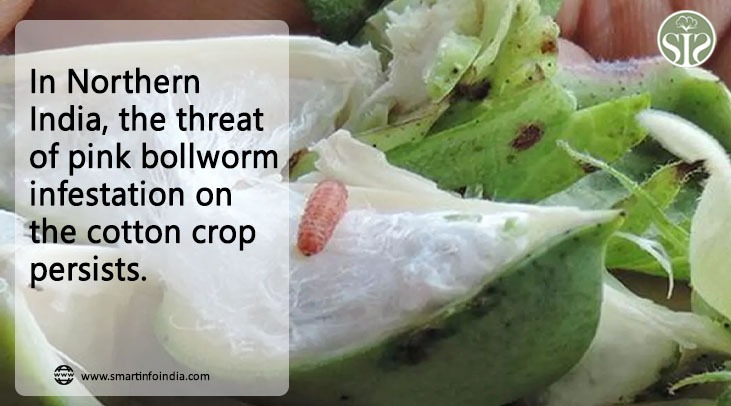
The state government gave subsidy and the central government increased the priceThe problems of the cotton farmers of Punjab are not taking the name of ending. In the entire season, sometimes due to crop failure and sometimes due to low price, the farmer is troubled. Now that the government of Punjab has announced a 33% subsidy on Bt cotton seeds to promote crop diversification, the central government has raised the price of Bollgard-II (BG-II) seeds by Rs 43 for a 450-gram packet is, and its price is being taken from Rs.810 to Rs.853.Two packets of BG-II seed are required for one acre of land. It is expected to offer 33% subsidy to farmers who have seed complaints up to 5 acres, as beneficiaries will have to buy only certified varieties and upload bills on a portal to receive the amount in their bank. The market of those who sell spurious seeds without bills will be snatched away.Spurious seeds and fertilizers were behind the frequent pest attacks on the cotton crop. β€œThe subsidy will absorb the 5.3% increase in price in Punjab, but it will be difficult for the state agriculture department to increase the area under cotton,” claim farmers who have suffered two consecutive crop failures and They have very little purchasing power left. The state government has set a target of covering 3 lakh hectares under cotton, for which it is all set to provide canal water to cotton growers from April 1.In the last two years, Punjab cultivated cotton in 2.5 lakh hectares each and produced 29 lakh quintals last season, while this season the production is expected to be only 8 to 9 lakh quintals. In the year 2019-20, the production was around 50 lakh quintals. In 2015 the pest attack started reducing the acreage along with the yield. Earlier, many farmers obtained Bt cotton seeds from Gujarat or approached direct marketers from various companies who made tall claims that the seeds were resistant to whitefly and pink bollworm.A farmer from Bathinda said: β€œAfter two years of loss due to natural calamity or pest attack, we have decided to return to paddy cultivation. We cannot take more risks.” Director Agriculture Gurvinder Singh said, β€œEven though the Center has increased the price of BG-2 cotton, the subsidy from the Punjab government will nullify the effect. The subsidy is aimed at weeding out spurious seeds from the market. We hope to increase the area under cotton from 2.5 lakh hectares to 3 lakh hectaresπŸ‘‡πŸ»πŸ‘‡πŸ»πŸ‘‡πŸ»πŸ‘‡πŸ»https://smartinfoindia.com/hi/news-details-hindi/China-standards-improve-chinacottonassociation-cotton-production-manufacturers-companies-industrial-
China unveils its cotton production standards to improve quality

China unveils its cotton production standards to improve qualityWang Jianhong, vice chairman and secretary general of the China Cotton Association (CCA), said the CCA and other industry organizations have launched the Cotton China Sustainable Development Program (CCDS) to build China's own cotton certification system to drive the industry forward. Wang pointed out that cotton growers in the southern Xinjiang region have been "very active".CCDS has also launched an industrial standard for sustainable cotton production based on factors covering environmental protection, occupational health and social responsibility. The new program has employed two companies, one of which is SGS, a leading global testing and certification company, to carry out online and offline review and certification work on 1.2 million mu (80,000 ha) of cotton farms. Wang revealed that this accounts for about 2 percent of China's total cotton fields.A total of six Chinese cotton manufacturers were awarded the first prize for the CCDS to issue sustainable cotton production certificates during a clothing exhibition in Shanghai on Tuesday. The six companies include China National Cotton Group Xinjiang Cotton Limited Company, Xinjiang Lihua Group, Hubei Yinfeng.Wang said that before China established its own industrial standards, the BCI was the leading group for sustainable cotton standards in Xinjiang. After its exit, the CCA has taken initiatives to "fill the gap". "We think we should play a bigger role than BCI to push China's cotton industry towards high quality and sustainable development," Wang said.Wang also emphasized that the CCDS project aims to help domestic textile and clothing companies maintain their export market share in a challenging global market. "Many textile and clothing companies in China rely heavily on overseas markets for revenue. I think it would be a pity if they lose those markets."Wang also said that the CCA will further enhance communication with global cotton industry bodies, including the US, to promote cooperative mechanisms, including mutual recognition of cotton industry standards, so that cotton trade between China and overseas can continue. "Actually it suits the interests of the cotton industries in both China and the US, because China has a very complete fabric and clothing supply chain that cannot be easily replaced by other countries," he said.Complying with China's sustainable cotton production standards would not be too difficult for most domestic cotton growers who have considerable experience in meeting BCI standards. And few companies are willing to pay additional costs to meet such standards for the sake of brand reputation and long-term growth. "China's cotton production and consumption is ranked No. 1 globally, and the quality of Xinjiang cotton is no less than cotton grown.πŸ‘‡πŸ»πŸ‘‡πŸ»πŸ‘‡πŸ»πŸ‘‡πŸ»https://smartinfoindia.com/hi/news-details-hindi/Goverment-cotton-mills-chiefministerbvasavarajbommai-previous-agricutural-production-save

Previous governments did not have the understanding to save cotton mills on the basis of local agricultural production: Chief Minister Basavaraj Bommai

Previous governments did not have the understanding to save cotton mills on the basis of local agricultural production: Chief Minister Basavaraj BommaiKarnataka Chief Minister Basavaraj Bommai launched a mega textile park, which will come up on 1,000 acres of land near Kalaburagi under the PM-Mitra scheme and generate one lakh direct jobs and two lakh indirect jobs. Recalling the olden days, he said that β€œDavanagere was known as the Manchester of Karnataka. There were other cities like Kalaburagi, Raichur, Hubli and Belagavi where cotton mills were processing raw cotton produced by farmers in the state and making cloth. Now all the cotton mills are closed due to wrong policies. The then governments did not have the spirit to protect the industry based on local agricultural production.He was addressing a public meeting at PDA Engineering College Auditorium in Kalaburagi on Tuesday after inaugurating the Central Government's Mega Textile Park allotted to Kalaburagi in Karnataka under the PM-MITRA (Prime Minister's Mega Integrated Textile Region and Apparel) scheme. The textile park is one of the seven such parks given by the central government to seven states. Pointing to the widespread migration from the Kalyana Karnataka region to big cities like Hyderabad and Mumbai in search of livelihood options, Mr. Bommai said the 1,000-acre mega textile park near Kalaburagi is expected to address the issue.β€œPeople from this region travel hundreds of kilometers to find work in Hyderabad, Mumbai and other cities to take care of their families. The Mega Textile Park being set up at Kalaburagi will effectively address this issue of migration by generating approximately one lakh direct employment and two lakh indirect employment. Highlighting the importance of Mega Textile Park in employment generation, he said that textile industry is the third major industry in the country after energy and coal industries in terms of employment generation.β€œWe could have thought of giving Kalburgi some other industry. But, we chose to give this Textile Park as it is one of the major industries along with energy and coal which generate large scale employment. With the commencement of this textile park, there will be a rapid change in the lives of the people. Expressing optimism for the development prospects of Kalaburagi, the Chief Minister said the city would become an investment hub not just for Karnataka but for the whole of India because of its strategic location and connectivity."In 10 years from now, Kalaburagi will become a major investment hub in South India due to its strategic location and its road, rail and air connectivity. It will be the city of the future not only for Karnataka but for India. Central Textile and Commerce and Industry Minister Piyush Goyal, who was supposed to attend the meeting, could not attend as he was busy with other work in New Delhi. However, he sent a video message wishing success to the Textile Park and the message was played in the meeting.Memorandum of Understanding (MoU) was signed with nine private companies in cotton processing and textile business with an expected investment of β‚Ή2,000 crore, including β‚Ή500 crore each from Himatsingka and Shade Exports. Union Minister of State for Railways and Textiles Darshana V. Jardosh, Union Minister of State for Chemicals and Fertilizers, New and Renewable Energy Bhagwant Khuba, Minister for Large and Medium Enterprises Murugesh Nirani, Minister for Handlooms and Textiles Shankar Patil Munankoppa and Lok Sabha member Umesh Jadhav from Kalaburagi were present on the occasion. Among the dignitaries present were.πŸ‘‡πŸ»πŸ‘‡πŸ»πŸ‘‡πŸ»πŸ‘‡πŸ»https://smartinfoindia.com/hi/news-details-hindi/Cotton-agriculture-department-seeds-sale-spurious-punjba-farmers

Copyright© 2023 | Smart Info Service
Application Download