STAY UPDATED WITH COTTON UPDATES ON WHATSAPP AT AS LOW AS 6/- PER DAY
Start Your 7 Days Free Trial TodayIndian cotton imports from Brazil have risen 10-fold this season as shipments hit record levels.Cotton imports from Brazil have risen 10-fold in terms of both volume and value this season (2024-25 ending in September), the central government told the Lok Sabha on Tuesday. Imports from the US have doubled during this period as shipments to the country, especially for the extra long staple variety, have reached record levels to meet demand.Union Minister of State for Agriculture and Farmers Welfare Ram Nath Thakur gave details of cotton imports for the period 2019-20 and 2024-25 (up to May 31, 2025) in a written reply in the Lok Sabha on Tuesday.India's imports from Brazil rose from 67,805 bales (170 kg) worth ₹152 crore in 2023-24 to 6,54,819 bales worth ₹1,620 crore by end-May 2024-25.Cotton exports from the US rose from 2,68,728 bales worth ₹1361 crore in 2023-24 to 5,25,523 bales worth ₹1,802 crore by end-May 2024-25.Overall, 27 lakh bales were imported till May 31, while 15.19 lakh bales were imported for the entire 2023-24 season. Imports from Australia also increased significantly to 5.13 lakh bales as against 3.58 lakh bales in 2023-24.Pradhan Mantri Fasal Bima YojanaResponding to a separate question on settlement of claims under Pradhan Mantri Fasal Bima Yojana (PMFBY) in the last five years, Chauhan informed that 4,992.79 lakh farmer applications have been enrolled during 2020-21 to 2024-25 (up to Kharif 2024). Claims worth ₹86,306.61 crore have been paid to 1,423.22 lakh farmer applications across the country during the same period. Apart from this, ₹5,405.2 crore (5.9 per cent) are pending for payment.He informed that during Kharif 2023 to Kharif 2024, about 69 per cent of the claims have been settled within 30 days of reporting of yield by the States/notification of crop loss by the State or intimation by farmers.read more :- Rupee open Declines 30 Paise to 87.12 per Dollar
Rupee sinks to 4-month low of 87.12 as Trump talks of 25% duty on Indian goodsThe rupee opened at 87.12 against the US dollar, hitting over a four-month low. It had ended the previous session at 86.82.read more :- Change in monsoon: Heavy rain expected in Terai areas
Break-in-Monsoon Conditions Likely: Heavy Rainfall Along Foothills ExpectedAs anticipated, the remnants of Typhoon Wipha have evolved into a significant monsoon system over the Bay of Bengal. After moving through eastern and central India, the system has weakened into a feeble low-pressure area currently positioned over North Madhya Pradesh and East Rajasthan. It is expected to dissipate over the hills of Uttarakhand in the next 2–3 days.Between 29th and 31st August 2025, this low-pressure system and the associated convergence zone will bring heavy rainfall to West Madhya Pradesh, East Rajasthan, and parts of Gujarat. Following this, the system will curve northward toward the Himalayan foothills, weakening and eventually merging with the larger monsoon flow. The monsoon trough will also shift northward along the foothills, stretching from Punjab and Haryana through West Uttar Pradesh, Nepal border regions, Bihar, Sikkim–Sub-Himalayan West Bengal, Arunachal Pradesh, and Assam & Meghalaya.This marks the onset of a Break-in-Monsoon — a phase where the monsoon trough shifts entirely to the Himalayan foothills. During this period, rainfall becomes concentrated along these regions, while much of the rest of the country experiences a lull in monsoon activity. Notably, rainfall along the foothills occurs in narrow, east–west aligned zones (300–400 km wide), though the eastern stretches—particularly Sikkim, North Bengal, and Northeast India—tend to receive more consistent and widespread rain.Elsewhere, the monsoon weakens significantly. While Tamil Nadu and Coastal Andhra Pradesh may see isolated showers, the West Coast typically remains dry. Heavy rains over Bihar and the adjoining plains raise the risk of flooding, especially due to swollen rivers originating in Nepal and Tibet. The Brahmaputra River may also rise, increasing flood risk across Assam and Northeast India.A return to normal monsoon conditions will depend on the formation of a new system over the Bay of Bengal. Such systems help realign the monsoon trough southward and restore widespread rainfall activity across the country. However, a prolonged break can disrupt the seasonal rhythm, potentially affecting crops and water availability.Forecast Summary (Next 24 Hours):Very heavy rain likely over East Rajasthan and adjoining West Madhya PradeshLight to moderate rain, with a few heavy spells, expected in Delhi, Haryana, Uttar Pradesh, Bihar, and nearby regions.read more :- Rupee higher 01 Paisa Against Dollar, Closes at 86.82
The Indian rupee ended 01 paisa higher on tuesday at 86.82 to the dollar, while it opened at 86.83 in the morning.At close, the Sensex was up 446.93 points or 0.55 percent at 81,337.95, and the Nifty was up 140.20 points or 0.57 percent at 24,821.10. About 2399 shares advanced, 1451 shares declined, and 141 shares unchanged.read more :- Kharif sowing 2025 reaches 829.64 lakh hectares; rice rises by 29 lakh hectares, oilseeds and cotton decline
Kharif sowing 2025: Area increased, rice increased, oilseeds-cotton decreasedKharif sowing has increased by 31.73 lakh hectares over last year, with rice and pulses registering the highest increase. However, despite overall positive trends, oilseeds and cotton acreage have seen a decline.Kharif sowing for the 2025-26 season in India has made promising progress, with total acreage under cultivation increasing significantly over the same period last year. According to the latest data released by the Ministry of Agriculture and Farmers Welfare, the total acreage under Kharif crops as on July 25, 2025 was 829.64 lakh hectares, an increase of 31.73 lakh hectares over last year.Among all crops, rice has recorded the highest increase. Rice area has reached 245.13 lakh hectares, about 29 lakh hectares more than in 2024-25. This significant increase reflects favourable monsoon conditions and timely sowing in major rice producing states.Pulses have also seen a marginal increase in area, with the total area increasing to 93.05 lakh hectares from 89.94 lakh hectares last year. This increase is mainly due to increased sowing of moong and moth, although sowing of traditional pulses like tur and urad has recorded a marginal decline.Coarse cereals have also seen positive growth, with the total area reaching 160.72 lakh hectares, 5.75 lakh hectares more than last year. Maize has contributed significantly to this increase, registering an increase of 6.66 lakh hectares. This trend may indicate a change in farmers' preferences due to better market prospects and adaptability to changing weather conditions.In contrast, oilseed acreage declined to 166.89 lakh hectares, down by 3.83 lakh hectares from the previous year. The biggest decline was recorded in soybean, the major oilseed crop, with acreage falling by about 4.7 lakh hectares.Sugarcane acreage remained relatively stable with a marginal increase, while jute and mesta acreage witnessed marginal decline. Cotton sowing also declined by 2.37 lakh hectares from the previous season.Despite some crop-specific constraints, the overall trend of kharif sowing is positive, indicating improvement in agricultural activity. Although total acreage remains lower than the five-year average of 1,096.65 lakh hectares, the year-on-year improvement raises hopes of a promising crop season.read more :- Odisha Tex 2025: Textile Industry Hub of Eastern India
Odisha Tex 2025 establishes the region as the hub of textile industry in eastern India.Odisha is going to become the textile hub of eastern India,” declared Hon’ble Chief Minister Shri Mohan Charan Majhi while inaugurating Odisha Tex 2025, the largest textile and apparel industry event of eastern India, organised by the Government of Odisha in Bhubaneswar.The landmark event was a watershed moment for India’s textile sector, attended by over 650 delegates including global brands, leading textile and apparel companies, investors, technology providers, startups and senior government officials. Odisha Tex 2025 showcased the state’s growing strength in the textile and apparel sector and its commitment to create a world-class ecosystem for manufacturing, innovation and job creation.The event saw several strategic investment commitments from leading textile and apparel companies, promising to make Odisha a hub for apparel and technical textiles. A total of 33 MoUs were signed, leading to investments worth ₹7,808 crore and employment for over 53,300 people.Page Industries, First Step Baby Wear, KPR Mills, Sportking, Adarsh Over 160 companies actively participated in the summit, including reputed companies like Knitwear, Anubhav Apparels, Bon & Co. and B.L. International. Together, these companies represent the entire spectrum of India’s textile value chain, from yarn and fabric to readymade garments and technical textiles.Key announcements and policy highlights– Launch of six state-of-the-art textile and footwear parks with plug-and-play facilities for global-scale manufacturing.– Launch of modern labour hostels to enhance industrial sustainability.– MoU for skill development, which will help youth, especially women, to acquire expertise in automated apparel, textile machinery and wearable technologies.“Hon’ble Chief Minister Shri Mohan Charan Majhi announced that the employment cost subsidy under the Odisha Technical Textiles and Apparel Policy 2022 will be increased from ₹5000 to ₹6000 per month for each male employee and from ₹6000 to ₹7000 per month for each female employee.”“The Hon’ble Chief Minister also announced that Odisha Tex will be an annual event that will showcase Odisha’s rich handloom heritage and the State’s entry into the modern textile, apparel and technical textiles ecosystem.”The Chief Minister said, “Odisha offers the most attractive incentive package in the country under its Industrial Policy Resolution 2022 and Odisha Apparel and Technical Textiles Policy 2022, supported by excellent infrastructure and governance.”Chief Minister Majhi said, “Odisha Tex 2025 is not just an event; it is a declaration that Odisha is poised to lead the textile revolution of Eastern India.” He further added, “With world-class infrastructure, progressive policies and skilled workforce, we are creating unmatched opportunities for investors and livelihoods for our people.”Hon’ble Minister for Handloom, Textiles and Handicrafts Shri Pradeep Bala Samanta said: “Our commitment is to strengthen Odisha’s rich handloom heritage while promoting modern textile investments. By prioritising the development of a strong textile ecosystem, empowering traditional weavers and enhancing market access, the Government ensures inclusive growth. We congratulate investors for partnering with us by signing MoUs and shaping Odisha’s textile future.”With its resounding success, Odisha Tex 2025 has firmly established Odisha as the next big textile destination in India, and has garnered national and global attention for its integrated and sustainable approach to textile development.read more :- Rupee open Declines 18 Paise to 86.83 per Dollar
Rupee opens 18 paise down at 86.83 as dollar index surgesThe currency opened at 86.83 against the US dollar after ending the previous day at 86.65.read more :- Rupee fell 18 paise to close at 86.65
The Indian rupee on monday lower 18 paise to close at 86.65 per dollar, while it opened at 86.47 in the morning.At close, the Sensex was down 572.07 points or 0.70 percent at 80,891.02, and the Nifty was down 156.10 points or 0.63 percent at 24,680.90. About 1206 shares advanced, 2767 shares declined, and 152 shares unchanged.read more :- APEDA Refutes Misleading Allegations on Organic Cotton Certification Under NPOP
APEDA rejects allegations on organic cotton certificationIn a decisive and forward-looking move, the Union Cabinet chaired by Prime Minister Narendra Modi has approved the long-awaited Research Development and Innovation (RDI) Scheme with a staggering outlay of ₹1 lakh crore. The scheme is poised to redefine India’s innovation, research, and technology ecosystem by providing long-term, affordable financing to the private sector — enabling the nation to stake its claim as a global innovation and product powerhouse by 2047.The RDI Scheme has been carefully structured to address one of India’s long-standing challenges: the lack of private-sector-led investment in high-impact research and innovation. By offering low or nil-interest, long-tenure loans and risk capital, the scheme directly incentivizes the private sector to invest in sunrise domains and strategic sectors that are critical for India’s economic and technological sovereignty.According to the government’s official statement, the scheme will:✅ Encourage private-sector innovation in sunrise sectors with strategic importance✅ Support technology acquisition of high strategic relevance✅ Finance transformative projects up to higher levels of Technology Readiness (TRL)✅ Facilitate a Deep-Tech Fund of Funds to build a robust technology venture ecosystemThe RDI Scheme’s governance structure will be anchored by the Anusandhan National Research Foundation (ANRF), with its Governing Board chaired by the Hon’ble Prime Minister. The scheme will be implemented through the Department of Science and Technology (DST), with oversight by an Empowered Group of Secretaries led by the Cabinet Secretary — ensuring that the program stays mission-aligned and results-focused.Industry Leaders Applaud a Landmark ReformIndustry captains and technology pioneers have welcomed this path-breaking step as a historic opportunity for India’s R&D landscape.Ashok Chandak, President of IESA and SEMI India, described the scheme as a landmark step in India’s journey toward becoming a global innovation hub. “By unlocking ₹1 lakh crore of long-term capital for sunrise and strategic sectors, this initiative will catalyze private-sector-led innovation in areas critical to India’s economic and technological sovereignty — including semiconductors, deep-tech, and electronics,” Chandak stated.He highlighted that IESA has already started collaborating with the ANRF, DST, and MeitY to advance the RDI mission. According to Chandak, IESA will play a proactive role by: Implementing identified high-impact R&D opportunities in semiconductors, electronic systems, and embedded technologies Facilitating collaboration between startups, academia, and industry to accelerate technology readiness Enabling industry sponsorships and funding high-impact R&D projects Supporting commercialization pipelines and deep-tech venture growth“The RDI scheme has the potential to transform India’s innovation landscape — and IESA is committed to being a strategic enabler in this journey,” Chandak affirmed.Translational Research to Power a Product NationDr. Ajai Chowdhry, Founder of HCL and Chairman of the EPIC Foundation, hailed the Cabinet’s decision as a crucial milestone to fulfill India’s Viksit Bharat 2047 aspirations: “This initiative will be a crucial step towards achieving technology sovereignty and realising the vision of Viksit Bharat by 2047. I warmly welcome the Union Cabinet's approval of the Research Development and Innovation (RDI) Scheme with a substantial outlay of ₹1 lakh crore, a milestone I've eagerly anticipated for the past 2-3 years,” he said. “Covid-19 catapulted us to the top league of connected nations. We made the right choices and the world watched us do that. Recently, Operation Sindoor has taught us another valuable lesson: we need belief in our own capabilities, invest in secure and indigenous infrastructure, become a product nation, and lead with conviction, not dependency,” Dr. Chowdhry added.He underscored that placing the scheme under DST, with the Prime Minister personally chairing the ANRF’s Governing Board, sends a powerful policy signal of India’s unwavering commitment to homegrown, secure, and scalable innovation.read more :- Desi cotton: New hope for Punjab farmers
Unravelling the Bt bind: Desi cotton weaves a new future for Punjab farmersAfter years of struggling with pest-infested Bt cotton and shrinking profits, a section of farmers in Punjab are turning back to a traditional crop with a modern promise — indigenous desi cotton — to overcome an economic crisis following dismal cotton seasons since 2021.Once sidelined by genetically modified varieties, desi cotton is now being revived with institutional support, scientific backing, and farmer-led trials. The state’s agriculture department has begun actively promoting desi cotton this kharif season, marking a major shift in crop strategy aimed at restoring sustainability and profitability to Punjab’s cotton belt.Bt cotton, introduced in 2005 in Punjab, has dominated for nearly two decades. However, this kharif season, the state has begun promoting desi cotton in an organised manner for the first time in years.Progressive farmers and agricultural experts say desi cotton is commercially viable, especially in the medical sector, and intercropping with vegetables can further support farmers financially until new pest-resistant hybrids are introduced following ongoing scientific trials.Charanjeet Singh, deputy director (cotton) in the state agriculture department, said around 2,200 hectares are currently under recommended varieties of desi cotton this season, with plans to boost acreage further next year.He explained that since 2021, Punjab has seen a decline in cotton sowing due to repeated pest attacks on Bt cotton and other factors. As a result, many farmers in the southeastern districts began shifting away from the traditional cash crop.“Last year, we observed that some farmers were still sowing desi cotton in small patches. There was no focused attention on the varieties, but they continued cultivating it as a sustainable crop,” he said.“Impressed by their confidence in desi cotton — thanks to low input costs and negligible pest attacks — we submitted a report to the Punjab Agricultural University (PAU),” Singh added.“During field visits, indigenous cotton was spotted after several years,” Kumar said. “A new variety, PBD 88, has completed the first phase of trials and is being sown in farmers’ fields in semi-arid south Malwa. It is likely to be released next kharif season.”Kumar added that these varieties show natural resistance to whitefly and the leaf curl virus, two major threats to cotton crops in the region.Ravi Kant Geaidher, a progressive cotton grower from Nihal Khera village in Fazilka, said he has been sowing desi cotton on 2 to 6 acres of his family’s 10-acre farm for almost two decades.“When Bt cotton was profitable, many farmers switched to hybrids and abandoned local varieties,” said Geaidher. “But desi cotton is highly suitable for intercropping. I earn an average of ₹35,000 per acre additionally by sowing vegetables like phoot kakri and banga, both from the cucumber family.”Geaidher, who works closely with PAU on seed trials, said that desi cotton’s resistance to pests and soil-enriching intercropping make it a strong alternative for regions with brackish groundwater, where other crops struggle to survive.“The only drawback is that desi cotton bolls need to be harvested faster than Bt cotton,” he noted. “But in the southwest region, increasing area under high-yield desi varieties could revive the traditional cotton economy,” he added.read more :- Rupee opened 04 paise higher at 86.47 against dollar
Rupee opens 4 paise up at 86.47 dollar as dollar index easesThe currency opened at 86.47 against the dollar after closing the previous session at 86.51. read more :- "2024-25: State-wise CCI cotton sale details"
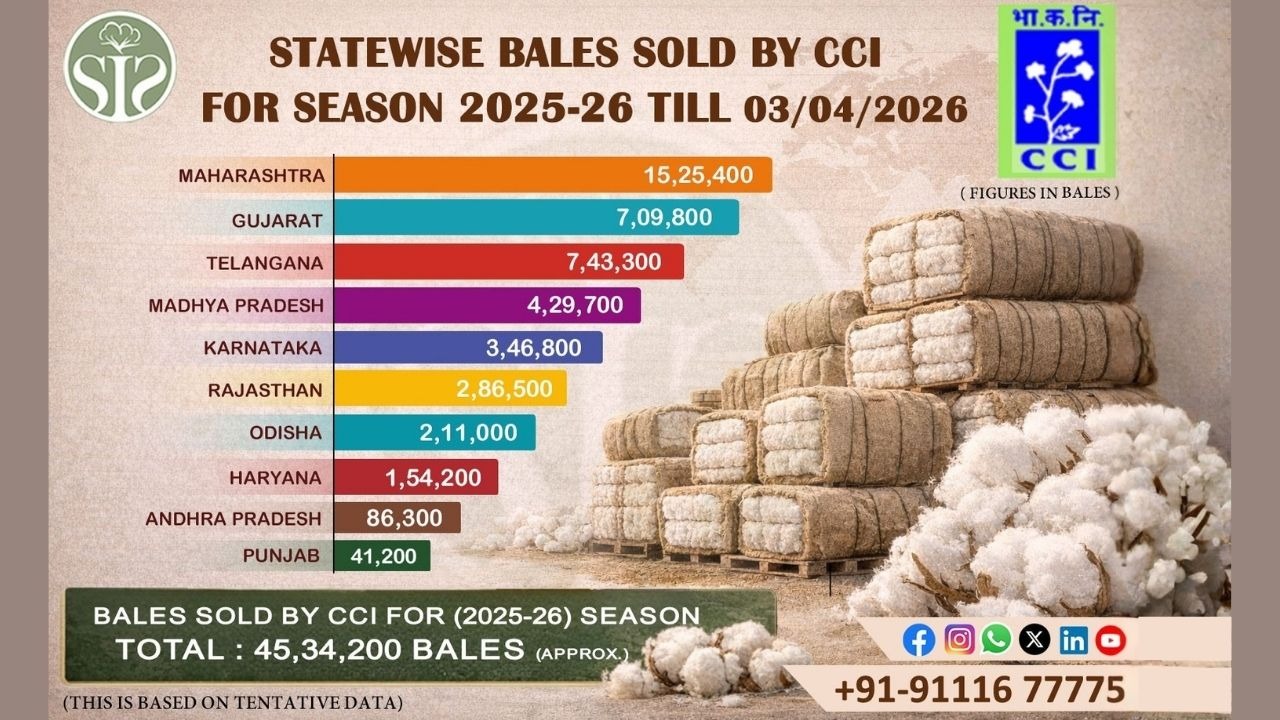
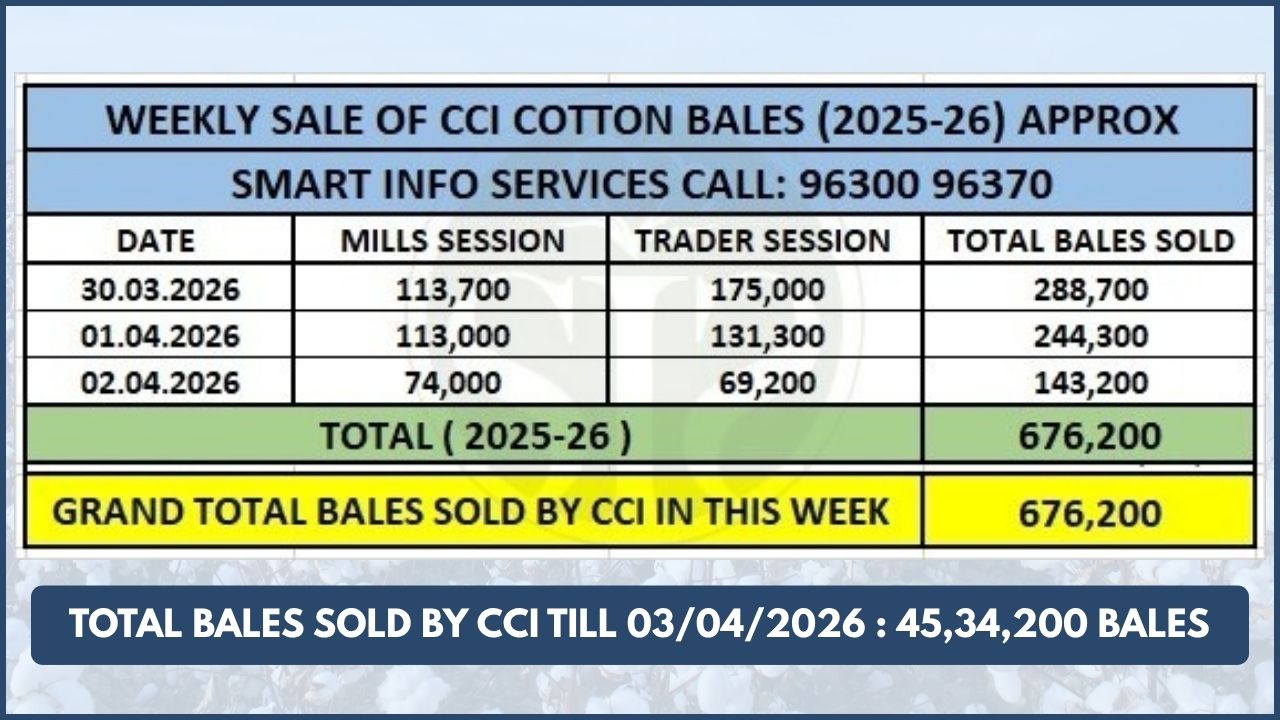
State-wise CCI Cotton Sales Details – 2024-25 SeasonThe Cotton Corporation of India (CCI) made no changes in per candy price this week. Following the price revision, CCI sold approximately 31,200 bales during the week, bringing the total cotton bales sales for the 2024-25 season to approximately 70,48,300 bales. This represents around 70.48% of the total cotton procured so far this season.A state-wise breakdown of sales indicates strong activity from Maharashtra, Telangana, and Gujarat, which together account for over 83.72% of the total sales to date.This data underscores CCI’s proactive efforts in stabilizing the cotton market and ensuring steady supply across key cotton-producing states.
Decline in cotton production in KhandeshJalgaon : Cotton production is low in Khandesh this year. Due to shortage of cotton, the production of cotton bales is slow, and it appears that the processing industry in Khandesh will produce about 18 lakh cotton bales (one bale is equal to 170 kg of cotton) this season (by the end of September 2025).Every year 22 to 23 lakh cotton bales are produced in Khandesh during the cotton season. But production has been continuously decreasing in the last few years. In Jalgaon district, cotton productivity is decreasing due to low cotton cultivation and diseases in 2024. It is also certain that cotton production will also be low.Because the cotton season of 2024-25 will end in September 2025. Currently cotton is not arriving. There is the biggest slowdown in the cotton processing industry. Some factories are closed. The cotton processing industry in Khandesh is running fast in the post-Diwali period. But this year the process was slow due to low supply of cotton.Last year, there were continuous rains in October and before that, which affected the cotton crop. This led to a decrease in cotton production. In 2024, cotton sowing also decreased in Jalgaon in about 66 thousand hectares. The total cotton cultivation in Jalgaon was 5 lakh 11 thousand hectares. The target of cotton production could not be achieved due to less cotton being received by the producers and other institutions.There is no arrival of cotton at present. In November and December, an average of 18 thousand quintals of cotton used to arrive per day. This was till mid-June. Now, since there is no cotton in every village, there is not much purchase from the villages. Farmers do not have cotton stock. Therefore, cotton production will not reach 18 lakh bales this year.Frequently Asked Questions (FAQ):1. Why did cotton production decrease in Khandesh this year?Cultivation and production decreased due to the impact of rain and disease.2. How many bales of cotton will be produced?It is estimated that 18 lakh bales will be produced, but that too may remain incomplete.3. How are cotton processing industries being affected?Factories are running slow or closed due to insufficient cotton supply.4. Why are farmers running out of cotton stock?Farmers are running out of stock due to low production.5. When did this problem start being felt?This problem became serious in 2024, when sowing decreased and this problem arose due to winter rains.
Maharashtra: Cotton acreage increased in Dariyapur taluka; Rs 4,000 spent per acre on weedingAfter the rains in the last few days in Dariyapur, farming work has started rapidly. Weeding of cotton is going on rapidly with the help of furrows. For this, the practice of gutdari of women laborers has started on a large scale. Weeding of cotton is being done at the rate of Rs 3 to 4,000 per acre. Cotton has been cultivated in 50,875 hectares in Dariyapur taluka. Cotton crop is seen as a cash crop for farmers. This year the area of cotton has increased compared to last year. Weedicides are available for other crops. However, out of 78,000 hectares suitable for sowing in Dariyapur taluka, 73,995 hectares have been cultivated. Soybean has been sown in 11,745 hectares in the taluka. Arhar is followed by green gram in 8,872 hectares, while moong has been sown in only 135 hectares. Due to this, cotton cultivation is currently becoming expensive and difficult for the producing farmers. The cost is becoming a headache. Weeding work has to be done due to the growth of weeds in the cotton crop. Due to this, weeding work is being done by women laborers in cotton. For this, the cost of weeding has to be paid in lump sum at the rate of Rs 4,000 per acre. Apart from this, there is a separate cost for weeding, farmer Nilesh Pundkar told. A female laborer weeding the cotton crop in a field in Dariyapur taluka.Cotton crop has the highest cost; spraying is also expensive Although cotton is seen as a cash crop for farmers, apart from this, weeding, fertilizer-watering, spraying work has to be done regularly. Because of this, the cost of cotton crop is higher than other crops. Due to this, some farmers are leaning towards soybean, pigeon pea and green gram crops. Laborers have to be found. Since weedicides also have an effect on crops for some time, weeding of cotton crop and cutting of weeds near trees is done by employing laborers for this. Work has gained momentum by employing laborers for this. Women have to be paid 300 to 350 rupees per day as wages. Apart from this, farmers also have to provide facilities like vehicles and drinking water in jars to the laborers for commuting to the fields.
Herbicide tolerant cotton not a panacea, only ecological disaster.Contrary to false projections by international companies, HT cotton demands indiscriminate spraying of glyphosate herbicide for weed control which can lead to ecological disasters of creating monster weeds (herbicide-resistant weeds) and endanger the whole agricultural crop production systems in IndiaOnce the world’s largest cotton producer and exporter, India has witnessed a significant drop in cotton production due to sharp decline in its area of cultivation over the last five years.During the period between 2020-21 and 2024-25, country’s CAGR (compound annual growth rate) for area and production of cotton recorded a negative growth of (-) 4.12 per cent and (-) 3.70 per cent respectively. Cotton production, during this phase, fell from 352.48 lakh bales to 306.92 lakh bales.The reason for decline in area of cultivation is primarily attributed to failure of Bt cotton against pink bollworms & other insects-pests which make it economically less attractive compared to the low-risk and highly remunerative crops like maize, rice, sugarcane etc. Further, climate change induced irregularity of monsoon has also added to the instability of cotton yield.Despite declaration of minimum support price (MSP), price volatility in the cotton market further compounds the problem. Farmers are compelled to sell at prices below the MSP due to lack of 'legal guarantee' which disincentivises cotton cultivation. Adding to the problem, sharp increase of inputs prices of Bt cotton seeds, pesticides and labour without any significant yield gains during the last decade has made cotton an economically unviable option for farmers in the agriculturally progressive zones.This crisis of cotton production has presented MNCs an opportunity in pressuring Indian policymakers to seek legalisation of HT cotton (herbicide tolerant) hybrids with false promises to double cotton production. However, the approval of HT cotton directly cannot increase yield in absence of improved high yielding varieties (HYVs) /hybrids as compared to readily-available cereals, rice, maize and cash crops like sugarcane.Farmers are already facing serious problems of higher tolerance shown by American pink bollworm and others insects-pests created due to introduction of Bt cotton in 2002 which covered over 95 per cent areas of cotton cultivation in India by 2013. Bt cotton is now also affected by a new pest, tobacco streak virus (TSV), causing a disease known as cotton necrosis. TSV is an emerging issue in India and causing significant yield losses in cotton crop.To boost cotton production in India, the goal should be development of climate- resilient HYVs/hybrids with improved resistance against insects-pests as successfully done in the cereals crops. On policy decisions fronts, the emphasis should be directed towards self-sufficiency through development of Indian HYVs/ hybrids with total legal ban on GM crops including Bt cotton and providing remunerative MSP with legal guarantee to farmers as incentives to grow more cotton.read more :- CCI hikes cotton prices, 70% purchases made through e-bidding
CCI Boosts Cotton Prices, sold 70% of 2024–25 Procurement via E-BiddingThe Cotton Corporation of India (CCI) conducted online bidding for cotton bales throughout the week, with significant trading activity observed across both the Mills and Traders sessions. Over the course of five days, CCI prices are unchanged.As of now, CCI has sold approximately 70,48,300 cotton bales for the 2024–25 season, representing 70.48% of its total procurement for the season.Date wise weekly Sales Summary :21 July 2025:The highest daily sales of the week were recorded on this day, with 6,000 bales sold from the 2024–25 season.Mills session : 3,100 balesTraders session : 2,900 bales22 July 2025:A total of 2,200 bales were sold from the 2024–25 season.Mills session : 800 balesTraders session : 1,400 bales23 July 2025:Sales amounted to 2,800 bales, all from the 2024–25 season.Mills session: 800 balesTraders session: 2,000 bales24 July 2025:A total of 4,300 bales were sold from the 2024–25 season.Mills session : 700 balesTraders session : 3,600 bales25 July 2025:The week concluded with sales of 15,900 bales.Mills session: 13,600 balesTraders session: 2,300 balesWeekly Total:CCI achieved total sales of approximately 31,200 bales for the week, underscoring its strong market engagement and the growing efficiency of its digital transaction platform.read more :- INR Gains 06 Paise, Closes at 86.51 per Dollar .



| title | Created At | Action |
|---|---|---|
| Indian cotton imports from Brazil increased 10 times | 30-07-2025 18:16:33 | view |
| Rupee open Declines 30 Paise to 87.12 per Dollar | 30-07-2025 17:44:51 | view |
| Change in monsoon: Heavy rain expected in Terai areas | 29-07-2025 23:21:25 | view |
| Rupee higher 01 Paisa Against Dollar, Closes at 86.82 | 29-07-2025 22:44:37 | view |
| Kharif sowing 2025 reaches 829.64 lakh hectares; rice rises by 29 lakh hectares, oilseeds and cotton decline | 29-07-2025 20:11:37 | view |
| Odisha Tex 2025: Textile Industry Hub of Eastern India | 29-07-2025 19:03:31 | view |
| Rupee open Declines 18 Paise to 86.83 per Dollar | 29-07-2025 17:27:33 | view |
| Rupee fell 18 paise to close at 86.65 | 28-07-2025 22:41:50 | view |
| APEDA Refutes Misleading Allegations on Organic Cotton Certification Under NPOP | 28-07-2025 19:07:44 | view |
| Desi cotton: New hope for Punjab farmers | 28-07-2025 17:53:21 | view |
| Rupee opened 04 paise higher at 86.47 against dollar | 28-07-2025 17:26:39 | view |
| "2024-25: State-wise CCI cotton sale details" | 26-07-2025 22:13:15 | view |
| Maharashtra: Production of cotton bales reduced in Khandesh | 26-07-2025 20:31:11 | view |
| Cotton cultivation increased in Dariyapur, weeding cost ₹4,000 per acre | 26-07-2025 20:07:20 | view |
| Herbicide-resistant cotton: not a panacea, but an environmental crisis | 26-07-2025 18:16:24 | view |
| CCI hikes cotton prices, 70% purchases made through e-bidding | 26-07-2025 01:01:51 | view |