Filter

Recent News

GST Simplification Plan: 12% & 28% Slabs May Be Removed

Proposal to Remove 12% and 28% GST Slabs Gains Support, Tax Structure May Be SimplifiedIn a major move towards simplifying India’s tax system, a proposal to abolish the 12% and 28% GST slabs has received support from a Group of Ministers (GoM). If implemented, the GST structure would largely be streamlined into two main slabs—5% and 18%.The proposal was discussed in a recent GoM meeting, where state finance ministers agreed in principle to rationalize the current four-tier GST system. The panel, headed by Samrat Chaudhary, recommended reducing the slabs to make the system more efficient and easier to comply with.Two-slab system in focusUnder the proposed structure, essential goods would be taxed at 5%, while most standard goods and services would fall under the 18% bracket. However, luxury and sin goods may continue to attract a higher tax rate of around 40%.According to estimates, nearly 99% of items currently taxed at 12% could be moved to the 5% slab, while around 90% of goods in the 28% category may be shifted to 18%. This restructuring is expected to simplify taxation and reduce confusion for both consumers and businesses.Luxury goods to remain highly taxedThe GoM has also suggested retaining a higher tax rate of 40% for luxury cars and certain demerit goods. Finance ministers from several states, including Uttar Pradesh, Rajasthan, West Bengal, Karnataka, and Kerala, have backed the proposal, stating that it would improve transparency and potentially expand the taxpayer base.Government’s stanceUnion Finance Minister Nirmala Sitharaman emphasized that rationalizing GST rates would benefit the general public by making the tax system more transparent and efficient. She noted that lowering tax rates on several items could help reduce prices and provide relief to consumers.If approved, the proposed changes could mark one of the most significant overhauls of the GST framework since its introduction, aiming to boost compliance, ease of doing business, and overall economic efficiency.read more:- Rupee fell 26 paise to close at 87.26

CCI: Ready to deal with MSP hike

CCI said, ready to deal with any possibility of increase in MSPAmid concerns that cotton prices will come under pressure after the removal of import duty till September 30, state-run Cotton Corporation of India (CCI) said it is fully prepared to intervene in the market during the new season starting from October."We are ready. We are fully prepared to deal with any possibility of increase in operations," CCI Chairman-cum-Managing Director Lalit Kumar Gupta told BusinessLine. "On behalf of the government, we can assure farmers that they should not panic and there should be no distress sale," he said.Gupta said the duty cut has been done on the demand of the industry and the recommendation of the ministry and stakeholders, but it will not affect the interests of farmers as there is no arrival of cotton at present. He said, "This step will help the industry when there is no arrival." Boost to textile industryAccording to the textile industry, the duty cut on cotton imports will increase the competitiveness of Indian exporters, who are facing a 50 per cent duty in the US, their biggest market. Domestic cotton prices are currently 10-12 per cent higher than global prices. However, farmers and farmer groups have expressed concern that the removal of duty will hit their income.CCI had procured about one-third of the crop at minimum support price (MSP) during 2024-25, which brought stability to the market as raw cotton prices remained below the MSP level during most marketing seasons. Gupta said that out of the 1 crore bales (170 kg each) procured during the current 2024-25 season, CCI currently has a stock of 27 lakh bales. "Our target is to sell the stock completely before the new season," he said.Following the duty cut, which made cheaper cotton available to Indian textile mills, CCI has reduced the minimum price for its cotton sales by ₹1,100 per candy (356 kg). "We have corrected the prices," Gupta said. He further added that this was done in response to the market.On Wednesday, CCI had reduced the selling price by ₹500 per candy, and by ₹600 on Tuesday. Going forward, the pricing of CCI cotton will be based on day-to-day market conditions, he said.Higher MSPFor the 2025-26 cotton season, the government has announced an 8 per cent increase in MSP for medium staple variety to ₹7,110 per quintal and for long staple to ₹8,110 per quintal. With the correction in prices, the gap between the market price and MSP would have increased."Our role in the market will be much more important to protect farmers. Right now, we anticipate that procurement may exceed last year's level. We are prepared to deal with any situation, more than any previous year. We have no infrastructure limitations or constraints," Gupta said. He further added that during the Covid period, CCI had procured 2 crore bales of cotton.Farmers across the country have sown cotton in about 107.87 lakh hectares (lh) this year, which is about three per cent less than last year's 111.11 lh till August 19. This decline has been seen mainly in top producing states like Gujarat and Maharashtra, where a section of farmers are turning to alternative crops like groundnut, maize and pulses. However, southern states like Karnataka, Telangana and Andhra Pradesh have seen an increase in acreage. According to the trade, the crop condition is good, and higher yields are expected to compensate for the decline in acreage. According to the third advance estimate, cotton production during 2024-25 stood at 306.92 lakh bales.Further, Gupta said that due to late rains across the country, cotton arrivals may get delayed, which will start in October and improve from November. He also said that MSP procurement will be a paperless process during 2025-26, as CCI will soon launch a new mobile app through which farmers can self-register and book slots to bring their produce to procurement centres.read more :- Textiles, diamonds and chemicals MSMEs most affected by US tariffs: Crisil

Textiles, diamonds and chemicals MSMEs most affected by US tariffs: Crisil

MSMEs in textiles, diamonds and chemicals to be most hit by US tariffs: CRISIL IntelligenceThe imposition of higher tariffs by the US will significantly impact the micro, small and medium enterprise sector, which accounts for around 45% of India's exports, while MSMEs in textiles, diamonds and chemicals are likely to be the most hit, a report by CRISIL Intelligence said.The US levies ad valorem duty of 25% on Indian goods. However, it has imposed an additional 25% tariff which will be effective from August 27 this year. This brings the total tariffs to 50%, which will have a meaningful impact on several sectors in India, the report said.Textiles, gems and jewellery, which account for 25% of India's exports to the US, are likely to be most affected. The MSMEs have more than 70% share in these sectors and will be hit hard, the report said.Another sector which is likely to face the heat is chemicals, where MSMEs have a 40% share.The gems and jewellery sector at Surat in Gujarat, which dominates diamond exports, will feel the tariff shock, the report said. Diamonds account for over 50% of the country's gems and jewellery exports, and the US is a major consumer, according to the report.In chemicals too, India faces competition from Japan and South Korea which are subject to lower tariffs.In steel, the US tariffs are expected to have a negligible impact on the MSMEs as the units are mostly engaged in re-rolling and long products. The US primarily imports flat products from India.In the textiles sector, the ready-made garments are expected to lose ground in the US compared with peers like Bangladesh and Vietnam which face lower tariffs.read more :- INR Up 07 Paise, Opens at 87.00

India's current account deficit to double in FY26 Q2: ICRA

India's current account deficit to double in Q2 FY26 amid rising imports: ICRA.According to the Investment Information and Credit Rating Agency (ICRA), India's current account deficit (CAD) is projected to double to $13-15 billion in the second quarter (Q2) of FY26, up from an estimated $6-8 billion in Q1 FY26.Meanwhile, ICRA in its August 2025 report said India's current account deficit is likely to remain stable at 0.6 per cent of GDP in FY26, in line with FY25, although risks remain due to tariff-related developments.ICRA's estimate comes after India's merchandise exports recorded a 7.3 per cent annual growth in July 2025 to $37.2 billion, following a marginal 1.7 per cent growth in Q1 (Q1) of FY26. In contrast, merchandise imports witnessed a broader and relatively sharper growth of 8.6 per cent in July 2025, reaching $64.6 billion.However, India's exports to the US grew in double digits for the seventh consecutive month in July 2025, taking the country's share to nearly 22 per cent from 19 per cent a year ago. The report further said that given the uncertainty over possible storage and duties in some categories, growth is likely to remain slow in the near term.According to the Ministry of Commerce and Industry, India's merchandise trade includes export of ready-made garments of all types of textiles, engineering goods, petroleum products, electronic goods, drugs and pharmaceuticals, gems and jewellery, and a wide range of other items.read more :- Textile mills welcome withdrawal of import duty on cotton.

Textile mills welcome withdrawal of import duty on cotton.
Textile mills welcomed the removal of import dutyTextile mills across the country, and mainly those in the southern States, have welcomed the Union government’s decision to withdraw the 11 % import duty on cotton till September 30.The duty came into effect on February 2, 2021 when India produced 350 lakh bales of cotton annually as against the local demand of 335 lakh bales. The production now is 294 lakh bales as against the demand of 318 lakh bales.According to the Southern India Mills’ Association, the government exempted all varieties of cotton from import duty from April 14, 2022 to September 30, 2022, later extending the exemption until October 31, 2022. This relief supported the industry in capitalising the pent-up demand in the post-COVID period, enabling it to achieve a business size of $ 172 billion, including $ 45 billion in exports.Since domestic production of Extra-Long Staple (ELS) cotton stood at five lakh bales compared with the annual requirement of 20 lakh bales, the government exempted ELS cotton from import duty with effect from February 20, 2024. The industry has been urging the government to remove the import duty ideally, or at least during the off-season (April 1 to September 30) for all varieties of cotton.S.K. Sundararaman, chairman of the Association, said the duty exemption will throw opportunities to increase exports. Though direct exporters can take advantage of Advance Authorisation Scheme and import duty free cotton, the predominantly MSME and fragmented nature of the industry requires imported cotton to cater to the nominated business and also meet the long-term contracts in the domestic and export marketsDuty exemption during off-season till 2030 is essential as the Mission for Cotton Productivity with the budget outlay of ₹5,900 crores will take five to seven years to reach self sufficiency in cotton, he added.The Confederation of Indian Textile Industry (CITI) chairman Rakesh Mehra said India’s textile sector is dominated by cotton and the cotton value chain contributes to around 80% of total textile exports. India aims to more than double textile and apparel exports to $100 billion by 2030.The duty exemption also covers cotton in transit, as the taxable event for determining the rate of duty is the date of filing of the Bill of Entry, after the goods have entered the Indian port. In cases where the Bill of Entry has been filed in advance (as permitted by Customs for faster clearance prior to the arrival of goods), the same can be withdrawn and re-filed afresh at the earliest, that is, before the Out-of-Charge Order is issued for the imported cotton, he said.read more :- Rupee open Declines 21 Paise to 87.17 per Dollar

Brazil cotton sales pick up; ICAC sees higher 2025/26 output

Brazil cotton sales jump; ICAC forecasts production growth in 2025/26Insights:▪️Brazil's cotton market saw higher liquidity in mid-August as prices eased to May levels, boosting domestic sales.▪️The CEPEA/ESALQ Index fell 2.9 per cent to BRL 4.0140/lb by Aug 15.▪️Harvest progress lagged, with 33.56 per cent complete by Aug 7, below averages.▪️Globally, ICAC projects 2025/26 output at 25.91m tons, up 1.55 per cent, with consumption at 25.56m tons, slightly below supply.Liquidity in Brazil’s domestic cotton market increased in mid-August, with more trades of term contracts as both buyers and sellers sought to close deals. Prices eased slightly due to lower export parity, returning to levels last seen in May 2024, making domestic sales more attractive, according to Centre for Advanced Studies on Applied Economics (CEPEA).The CEPEA/ESALQ Index (payment in 8 days) dropped 2.9 per cent between July 31 and August 15, closing at BRL 4.0140 per pound on August 15.According to Abrapa, 33.56 per cent of Brazil’s 2024/25 cotton crop had been harvested by August 7. In Mato Grosso, the country’s top producer, the harvest reached 27 per cent, while in Bahia it stood at 40.56 per cent, CEPEA said in its latest fortnightly report on the Brazilian cotton market.Conab data showed 29.7 per cent of the national crop was harvested by August 2, lagging behind 36.7 per cent a year earlier and the five-year average of 46.1 per cent. In Mato Grosso, 20.9 per cent was harvested, well below the 31.8 per cent recorded last year and the 41.4 per cent five-year average.Globally, the International Cotton Advisory Committee (ICAC) projects cotton acreage in 2025/26 at 31.3 million hectares, with average yields of 827 kilos per hectare. World production is expected to reach 25.912 million tons, a 1.55 per cent increase from the previous season.Consumption is estimated at 25.564 million tons, 0.26 per cent higher than in 2024/25, though still 1.34 per cent lower than global supply.read more :- India removes duty on cotton imports from US

Related News

Youtube Videos

साप्ताहिक कपास बाजार में तेज़ी 😱 CCI ने बेचे 2 लाख+ बेल्स | Weekly Cotton Market 25 July 2026
साप्ताहिक कपास बाजार में तेज़ी 😱 CCI ने बेचे 2 लाख+ बेल्स |...
आज देशभर में रुई के भाव 😱 Cotton Market Rate Today #kapasbajar
आज देशभर में रुई के भाव 😱 Cotton Market Rate Today #kapasba...
जानिए आज का कपास बाज़ार? 😱 Cotton Market Rate Today #kapasbajar
जानिए आज का कपास बाज़ार? 😱 Cotton Market Rate Today #kapasba...
ऐसा रहा आज कपास बाज़ार 😱 राजस्थान कपास बुआई | Cotton Market 22 July
ऐसा रहा आज कपास बाज़ार 😱 राजस्थान कपास बुआई | Cotton Market...
कपास बाज़ार में आज क्या हुआ? 😱 Cotton Market Rate 21 July 2026
कपास बाज़ार में आज क्या हुआ? 😱 Cotton Market Rate 21 July 2...
कैसा रहा आज का कपास बाज़ार? 😱 Cotton Market Rate Today | 20 July 2026
कैसा रहा आज का कपास बाज़ार? 😱 Cotton Market Rate Today | 20...
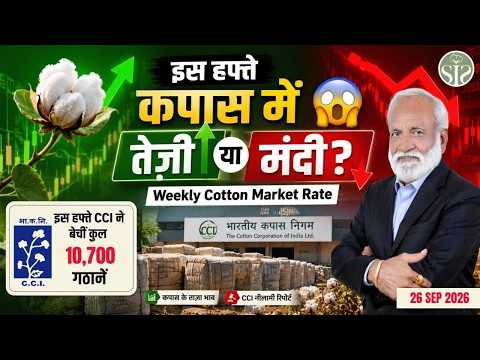
इस हफ्ते कपास में तेज़ी या मंदी? 😱 CCI ने बेचीं 3.18 लाख गांठें | Weekly Cotton Market
इस हफ्ते कपास में तेज़ी या मंदी? 😱 CCI ने बेचीं 3.18 लाख गा...
Cotton rate today: आज के कपास के भाव 🤔 #kapas  #youtube
Cotton rate today: आज के कपास के भाव 🤔 #kapas #youtube
रुई बाज़ार में आज तेज़ी का रुख 😱 CCI ने बेचीं 40,000+ गठानें #kapas
रुई बाज़ार में आज तेज़ी का रुख 😱 CCI ने बेचीं 40,000+ गठानें...
ऐसा रहा आज कपास बाज़ार 😱  राजस्थान कपास बुआई | Cotton Market 15 July
ऐसा रहा आज कपास बाज़ार 😱 राजस्थान कपास बुआई | Cotton Marke...
कपास की कीमतों में उछाल 😱 Cotton market rate today #kapasnabhav
कपास की कीमतों में उछाल 😱 Cotton market rate today #kapasna...
CCI Update: आज कितनी रुई गठानें बिकीं? 😱 Cotton market price today
CCI Update: आज कितनी रुई गठानें बिकीं? 😱 Cotton market pric...
साप्ताहिक कपास बाजार में तेज़ी 😱 Weekly cotton market review #kapas
साप्ताहिक कपास बाजार में तेज़ी 😱 Weekly cotton market review...
जानिए आज का कपास बाज़ार 😱 Cotton market rate today #kapas
कपास की कीमतों में उछाल 😱 Cotton market rate today #kapas
Application Download
Whatsapp Contact