STAY UPDATED WITH COTTON UPDATES ON WHATSAPP AT AS LOW AS 6/- PER DAY
Start Your 7 Days Free Trial TodayMaharashtra: Farmers' organization seeks PM's intervention to lift CCI's ban on cotton procurementNagpur : The Council for Protection of Farmers' Rights-Kisan Bharti has urged Prime Minister Narendra Modi to intervene to direct the Cotton Corporation of India (CCI) to withdraw its restrictive cotton procurement rules that impact the state's farmers.In his appeal to the PM, CPFR-Kisan Bharti President Barrister Vinod Tiwari said that the CCI's recent move – limiting cotton procurement to just 7 quintals/acre, almost half the previous limit of 13 quintals/acre – has exacerbated the hardships faced by millions of cotton farmers in Maharashtra and neighboring Telangana.Tiwari said, "This absurd reduction in the limit, made after the yield survey this Kharif season, has forced farmers to sell nearly 80 percent of their produce to private traders at very low prices. This has exacerbated the already severe hardship on the farms." Given the reduction, farmers have no option but to sell their cotton stock at around ₹6,500/quintal or less, which is about 25% less than the MSP of ₹8,110/quintal.The worst affected are farmers who produce more than 5 quintals/acre, who, due to restrictions, cannot sell their entire produce to CCI and, therefore, sell it to any private buyer at a much lower rate and well below the MSP.He said, “The crisis is being exacerbated by CCI's stringent moisture requirements of 8-12%, which are difficult to maintain. Given fog, intermittent rains, and the drop in winter temperatures, cotton naturally has a high moisture level. Despite drying in the open for several days, farmers report moisture levels of 20% or more, and their stock is simply rejected at CCI procurement centers.” Citing an example, CPFR-Kisan Bharti stated that in Yavatmal district alone, 236,752 farmers cultivated cotton on 825,932 acres, yielding approximately 3.3 million quintals.However, of this huge quantity, the CCI purchased barely 7,921 quintals, and private traders purchased approximately 115,000 quintals at low prices—exposing the gap between government promises and ground reality.Farmers lamented that the CCI's onerous rules are pushing them directly into the clutches of private traders, who bargain hard to obtain cotton stocks at low prices.CPFR-Kisan Bharti stated that barely a few of the 27 procurement centers announced by the CCI are operational, leading to long queues, increased transportation costs, and logistical problems for already distressed farmers.Tiwari said, “Our demand is to increase procurement to at least 12 quintals/acre, reduce the moisture limit to 22% due to natural calamities, and open more procurement centers to speed up the process.”Since the CCI is the nodal agency for MSP procurement, it is expected to protect the interests of farmers, not punish them for things beyond its control. Therefore, the PM should immediately direct the CCI to provide necessary assistance to farmers before taking any drastic action, he said.read more :- “CCI keeps prices stable, sells 92% of cotton in e-auction”

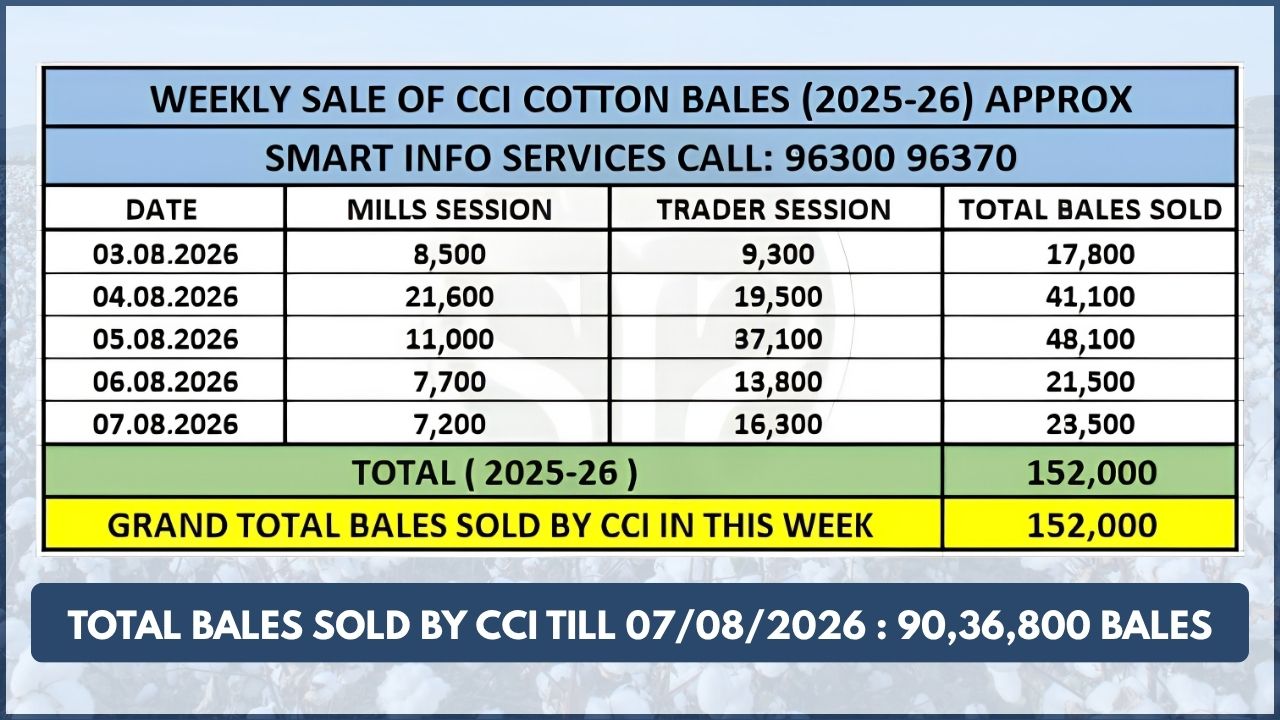
The Cotton Corporation of India (CCI) kept its prices unchanged this week and sold 92.26% of its 2024-25 cotton procurement through e-auctions.During the entire week from 01 December to 05 December 2025, CCI conducted online auctions at its mills and trader sessions, achieving total sales of approximately 1,18,000 bales. Weekly Sales Performance01 December, 2025: The highest sales of the week were recorded on this day with 42,800 bales, including 21,600 bales purchased by mills and 21,200 by traders.02 December, 2025: CCI recorded sales of 33,000 bales, including 22,700 bales bought by mills and 10,300 bales taken by traders.03 December, 2025: On this day total sales reached at 16,600 bales, with mills buying 13,000 bales and traders purchasing 3,600 bales.04 December, 2025: A total of 2,400 bales were sold, all of which were purchased exclusively by traders.05 December, 2025: This week closed with total sales of approx 23,200 bales purchased by mills and traders.CCI sold a total of approximately 1,18,000 bales during the week, taking its cumulative sales to 92,26,300 bales for the season, which is 92.26% of its total purchases for 2024-25.
Cotton prices in Punjab surpass ₹7,500, with CCI's bumper purchases transforming the market environment.Chandigarh: This year, cotton prices (both cotton and desi) were falling below the Minimum Support Price (MSP). Initially, when cotton began arriving in the mandis, private traders were buying it between ₹5,700 and ₹6,800 per quintal. These prices were significantly lower than the MSP, causing concern among farmers.Due to the CCI's active involvement, cotton prices have improved significantly. Today, data from the Punjab Mandi Board confirms that the average price of cotton has exceeded ₹7,500 per quintal, very close to the MSP of ₹7,710 per quintal. Meanwhile, desi cotton prices have also seen a significant jump. This is a major relief for farmers who previously felt compelled to sell their crop at lower prices. Thanks to the Mann government's initiatives, they are now receiving fair value for their hard work.Despite heavy rains and floods in some parts of Punjab this year, cotton arrivals have exceeded last year's by 100,000 quintals. This demonstrates that farmers continue to have confidence in the Mann government's policies for cotton cultivation. As a result of the state government's proactive approach, according to Mandi Board data, while CCI purchased only 170 quintals of cotton during the same period last year, this time, following government pressure, CCI has ensured the purchase of over 35,348 quintals. This large-scale procurement has created a positive market environment and prevented prices from falling.Punjab farmers should not face the problem of selling their produce below the MSP. Of the 230,423 quintals of cotton purchased as of December 1st, over 60% was initially sold below the MSP, but this trend has completely reversed since CCI's entry.This initiative clearly shows that the government is ready to take immediate and effective steps to protect the interests of farmers even in times of crisis. The government is committed to the dignity and prosperity of farmers!read more :- “2025/26: Brazil cotton exports to jump 10%”
*Brazil’s Cotton Exports Expected to Rise 10% in 2025/26, Exporters’ Group Says*Brazil’s cotton exports are projected to grow about 10% in the 2025/26 season, reaching roughly 3.2 million metric tons compared with the previous cycle, according to the president of Brazil’s cotton exporters association (Anea).Anea president Dawid Wajs told Reuters that the increase will be supported by Brazil’s strong competitiveness in global markets, a broader base of international buyers, and higher demand from India.India’s purchases have surged after New Delhi suspended cotton import tariffs until December 31, Wajs said. So far this season, India has accounted for around 16% of Brazil’s cotton exports.Through October, Brazil’s cotton exports totaled about 677,000 tons—down 7% year-on-year due to a delayed harvest, Anea data showed. However, shipments have accelerated in recent months and are expected to keep rising as the country works through substantial stockpiles.Official government figures released Thursday showed cotton exports jumped 34.4% in November from a year earlier, reaching approximately 402,000 tons.read more :- Rupee fell 13 paise to close at 89.98 per dollar
On Friday, the Indian rupee fell 13 paise to close at 89.98 per dollar, compared to its opening price of 89.85 in the morning.Closing Bell: Sensex closes 447 pts higher, Nifty ends near 26,200 after RBI rate cut; financials, IT gainread more :- Trump tariffs: Trade talks crucial, US delegation to visit India next week
Trump tariffs: US team expected in India next week as trade pact talks enter crucial phaseA delegation of US officials is expected to visit India next week for another round of discussions on the proposed bilateral trade agreement, according to government sources. The dates are currently being finalised, and both sides are working to close the first tranche of the pact, which has become a priority amid widening trade tensions.“The team is likely to come next week. Dates are being finalised, and discussions are on,” one source told news agency PTI.This will be the second visit by US negotiators since Washington imposed a 25% tariff — along with an additional 25% penalty — on select Indian goods entering the American market, citing India’s purchases of Russian crude oil. The first round of consultations was held on September 16, followed by Commerce and Industry Minister Piyush Goyal’s visit to the US on September 22. Goyal was accompanied by then special secretary Rajesh Agrawal, who now serves as India’s commerce secretary.The US negotiating team will be led by Brendan Lynch, who is overseeing the discussions on behalf of Washington.Next week’s visit is considered particularly important because Agrawal recently said that India remains optimistic about securing a framework trade deal with the US before the end of the year—one that would address the tariff burden currently affecting Indian exporters. While he acknowledged that a full-fledged Bilateral Trade Agreement (BTA) would take longer, Agrawal emphasised that the framework pact aims to tackle the immediate challenge of reciprocal tariffs.India and the US are currently engaged in two simultaneous negotiations:A framework deal focused on tariff-related issues.A broader, comprehensive Bilateral Trade Agreement.The BTA was formally initiated in February after leaders of both countries instructed their teams to negotiate the proposed agreement. The first tranche was initially targeted for completion by the fall of 2025, and six rounds of talks have taken place so far. The overarching goal of the agreement is to more than double bilateral trade to USD 500 billion by 2030, up from the present USD 191 billion.Goyal had earlier travelled to Washington in May for discussions with US Commerce Secretary Howard Lutnick as part of the ongoing effort to accelerate negotiations.The US continues to be India’s largest trading partner for the fourth consecutive year in 2024–25, with trade valued at USD 131.84 billion. It accounts for nearly 18% of India’s goods exports and over 10% of total merchandise trade.However, the recent tariff escalation has begun to bite. India’s exports to the US fell for the second straight month in October, dropping 8.58% to USD 6.3 billion, while imports rose 13.89% to USD 4.46 billion, according to commerce ministry data.Next week’s talks are expected to focus heavily on mitigating these impacts and charting the path toward a workable interim agreement.read more :- Ghatanji cotton auction at Rs 7,385, arrival of 3,000 quintals
*At the Ghatanji Agricultural Produce Market Committee, cotton from 200 carts was auctioned for ₹7,385, with an arrival of 3,000 quintals.*On December 4th, Agricultural Produce Market Committee Chairman Nitin Kothari and Board of Directors and Agricultural Produce Market Committee Secretary Kapil Channavar inaugurated the auction-based cotton procurement at the Late Sureshbabu Lonkar Cotton Yard.Present on the occasion were Agricultural Produce Market Committee Directors Sanjay Gode, Nandkishore Dambhare, Chandrakant Ingle, Chandraprakash Khartade, Hanuman Meshram, Ashish Bhoyar, Akbar Tanwar, Arvind Jadhav, Ramesh Dambhare and the entire staff, Agricultural Produce Market Committee Secretary Kapil Channavar, private cotton buyer traders Vivek Rungtha, Ram Chaudhary, Hanuman, Adte Bharat Potraje, Monu Pandey, Avinash Bhure, Umesh Bonde, Arvind Jadhav, Kishore Uplenchwar, Anil Hatware, Vijay Hivarkar, Ganesh Jadhav, and others. Ramesh Deshmukh, Sameer Nagaria, Rajesh Ghode, all Agricultural Produce Market Committee employees, and farmers from the taluka were also present.Contact the Agricultural Produce Market Committee if you have any problems. If you experience any problems after bringing your cotton to the market, contact the Agricultural Produce Market Committee administration. Farmers should bring their agricultural produce to the Market Committee yard and not sell it to village buyers, said Committee Secretary Kapil Channavar.Farmers should take advantage of the committee. On this occasion, Agricultural Produce Market Committee Chairman Nitin Kothari and Market Committee Secretary Kapil Channavar appealed to farmers not to sell their cotton to traders who buy from the village. Farmers should sell their produce only at the Agricultural Produce Market Committee, bring cotton for sale, and cooperate with the administration.read more :- Kurnool's poor harvest has had a severe impact on the cotton industry.
*Andhra Pradesh : Cotton Mills Going Through Crises Due To Poor Harvest In Kurnool District.**KURNOOL:* Cotton supply has sharply declined in the Adoni area of Kurnool district, creating a severe crisis in the 30 to 35 cotton-based units in the region. This year, farmers around Adoni had cultivated cotton over 5.42 lakh acres, expecting a yield of 8–10 quintals per acre. However, due to unfavourable weather conditions, particularly heavy rainfall during September and October, their yield fell by about 50 per cent.The situation worsened with Cotton Corporation of India (CCI) officials rejecting the produce of many farmers due to high moisture content – more than 12 per cent –poor quality and size of cotton seeds. CCI offered a maximum price of ₹8,279 per quintal. It initially accepted from each farmer only 4 to 6 quintals of cotton, instead purchasing their entire stock. Traders took advantage of this by buying cotton at lower prices than this amount.After the district collector’s intervention, CCI increased the limit to 10 quintals per farmer. Most farmers had already sold their produce to traders by then. Cotton mills in the area are now facing severe difficulties, as production and fresh arrivals remain limited. Each mill requires around 50,000–60,000 quintals of cotton per day to operate efficiently. For each cotton machine to function to the best of its capacity, at least 2,000 quintals of cotton is needed as raw material.Many cotton mill owners warn that without sufficient supply, their machines will have to remain idle, leading to recurring expenses that are financially harmful. “Around 8 to 10 cotton units are on the verge of closure. If cotton supply to the mills does not improve, we may have to shut down,” said a unit owner on condition of anonymity. The district collector recently visited some cotton mills in Adoni. He instructed officials that if the CCI rejects stocks due to moisture or quality issues, they should support farmers by allowing them to sell their produce directly to cotton mills. Farmers are hesitant about selling their piled-up cotton stocks over pricing issues, owing to quality issues being raised by mill owners.read more :- Cotton farmers protest against MSP at CCI Guntur on December 10
*A.P. cotton farmers demand MSP, plan protest at CCI Guntur on December 10.*Cotton farmers in Andhra Pradesh are set to stage a protest at the Cotton Corporation of India (CCI) office in Guntur on December 10, demanding immediate procurement of cotton at the Minimum Support Price (MSP) declared by the government. Organised by the CPI’s frontal organisation Andhra Pradesh Farmers’ Association (AIKES), the protest will highlight the severe losses incurred by the farmers during this year’s kharif season due to cyclones, heavy rains, floods, droughts, and pest attacks.The expected yields of 10 quintals per acre have dropped to 3 quintals to 4 quintals, with damaged bolls and discoloured cotton aggravating the situation.Procurement centres set up by the Central government have reportedly created hurdles, citing high moisture content and imposing restrictive measures, forcing many farmers to sell away their produce to private traders at ₹5,000 to ₹6,000 per quintal, far below the MSP of ₹8,110. The farmers’ association demands relaxation of CCI norms, immediate purchase of the produce at MSP, input subsidies and crop insurance for losses, implementation of Dr. M.S. Swaminathan Commission recommendations, raising MSP to ₹12,000, waiver of GST on farm inputs, government-funded transport, establishment of procurement centres in all cotton-growing constituencies, disposal of 2.5 lakh bales held in CCI warehouses, and a bonus of Rs.3,000 per quintal.The association has urged all affected farmers to participate to ensure the protest’s success.read more :- The rupee opened 13 paise higher at 89.85 against the dollar.
The rupee opened 13 paise higher at 89.85 against the dollar. The Indian rupee opened at 89.85 against the dollar on Friday, compared to its previous close of 89.98.read more :- The rupee rose 43 paise to close at 89.98 per dollar.
On Thursday, the Indian rupee closed 43 paise to close at 89.98 per dollar, after opening at 90.41 in the morningThe Sensex opened on a weak note, declining 156.83 points to 84,949.98. The Nifty too eased 47 points to 25,938.95. Both indices later recouped losses, with the Sensex trading 369.80 points higher at 85,476.62 and the Nifty at 26,096.25, up 110.25 points.The rupee fell 28 paise to a fresh low of 90.43 against the US dollar in early trade. A weakening currency typically dampens market sentiment as it prompt foreign investors to turn cautious.read more :- Punjab cotton crisis: 60% of crop sold at throwaway prices
*Punjab Cotton Crisis: 60% of Crop Sold Below MSP as Farmers Face Losses*Punjab’s cotton growers are once again facing a cotton crisis. According to Mandi Data, in the current 2025 cotton season, about 61% of the cotton arriving at state mandis was sold below the Minimum Support Price (MSP).It is in spite of a fixed MSP being at INR 8,010 per quintal for the staple cotton variety commonly grown in Punjab. In many cases, cotton fetched as little as INR 3,000 per quintal—a crushing blow for farmers who were hopeful for fair returns.This year’s arrival numbers create worry. Only 2.3 lakh quintals of cotton reached the mandis, compared with 5.4 lakh quintals last year; a sharp decline shows that many farmers may have stopped cotton cultivation altogether.A main reason for the crisis is the state procurement agency, Cotton Corporation of India (CCI), purchased only a small fraction – about 35,348 quintals out of the mandi arrivals. The vast majority, nearly 1.95 lakh quintals, went to private traders, who seized the opportunity to purchase at reduced prices.This season CCI began a new digital procurement procedure via the so-called “Kapas Kisan” app. Only farmers whose Aadhaar details and land records were verified and whose cotton met moisture and quality criteria became eligible for MSP procurement. Many farmers struggled with registration or failed the crop-quality test, which caused delay or completely blocked their access to MSP sales.For many cotton growers, the outcome has been distressing. What was meant to be a safety net in the form of MSP has turned into bitter frustration. Farmers who invested time, labour and money into sowing cotton, in the name of past MSP assurances, have received meagre returns or been forced to sell at minimal rates.The larger implication is that such repeated episodes may push farmers to abandon cotton and shift to crops such as paddy or wheat. That could reshape Punjab’s agrarian landscape with long-term environmental and economic consequences.For Punjab’s cotton belt, MSP announcements mean little unless procurement agencies step in with prompt decisive action. Until then, “support price” may remain just a number on paper.read more :- Farmers demand CCI to raise cotton procurement limit to 15 quintals
*Maharashtra: CCI should increase the cotton procurement limit to 15 quintals per acre: Farmers protested at the office; officials bombarded them with questions**Akola* : CCI should increase the cotton procurement limit to 15 quintals per acre: Farmers protested at the office; officials bombarded them with questionsFarmers protested at the office; officials bombarded them with questionsCCI (Cotton Corporation of India), a central government organization that buys and sells cotton, has set a cotton procurement limit of 5 quintals (60 kg) per acre. Shiv Sena and farmers staged a protest at the CCI office on Wednesday, demanding that the procurement limit be increased to 15 quintals, among other demands. Shiv Sena workers bombarded officials with questions and demanded answers. Officials assured them that the farmers' demands would be addressed in the meeting. A heavy police force was deployed to prevent any untoward incident.This year, the soybean, cotton, and pigeon pea crops were damaged due to the heavy rains during the Kharif season. Crops were damaged, sometimes due to drought and sometimes due to heavy rains. The cotton crop suffered significant losses. Similarly, farmers were facing difficulties with the CCI procurement process, leading the Shiv Sena's Thackeray group to storm the CCI office on December 3rd. During this time, CCI officials, including District Chief Gopal Datakar, former Chief Rahul Karale, Shiva Mohod, Dr. Prashant Adhau, Yogeshwar Wankhade, Prof. Nitin Lande, Dnyaneshwar Gawande, and Sanjay Bhamre, questioned them. Farmers do not receive compensation until 10 to 12 days after the cotton is purchased. The Shiv Sainiks demanded that farmers be compensated for their cotton within 24 hours, as required by the rules. The officials stated that an appeal to the state government regarding the procurement limit was necessary. The official added that they would inform their superiors and plan a solution by holding a meeting to address some of the issues mentioned in the statement.Shiv Sena officials also submitted a written statement of the farmers' various demands to the CCI officials. A limit of 5.60 quintals per acre has been imposed when purchasing cotton from farmers. This has forced farmers to sell the remaining cotton to traders at a loss. All the cotton they have should be purchased. It has been demanded that the purchase limit be increased to 15 quintals per acre.Vaastu Purchase Condition: Farmers bring their cotton to CCI in available vehicles. If cotton is not available in one vehicle, it is brought in another vehicle. However, at the procurement center, only the cotton in one vehicle is being counted, and the other vehicle is being sent back. The time-consuming process for rebooking and approving slots for cotton in the second vehicle is making it difficult for farmers to sell their cotton. Therefore, this condition is not necessary.Vaastu Purchase Based on Talathi Certificate: Due to network issues, website downtime, and other issues, many farmers were unable to register for e-crop sowing. Therefore, if unregistered farmers bring a certificate from the Talathi stating their sowing, it should be accepted and the cotton should be purchased, Shiv Sena leaders demanded.Think positively about the demands: Shiv Sena leaders told officials that it is possible to resolve any issue, and to take action on other demands, including increasing the procurement limit. Officials explained the process for increasing the procurement limit. Shiv Sena warned that the cotton procurement process must be improved in accordance with other issues, or a strong agitation would be launched. CCI graders and employees are rude to farmers at the cotton procurement center. Furthermore, if farmers face any problems, they are not informed. The Shiv Sena leader demanded that graders and employees treat farmers with leniency and appoint a staff member to resolve any issues. Eliminate the moisture requirement for cotton procurement and provide a flat price. In the current situation, there has been little or no rain this month. Yet, moisture is being checked on every cotton truck and a low price is being offered. A flat price of ₹8,100 should be offered without any moisture test.In districts where the cotton procurement limit is not practical relative to production, government cotton procurement is being initiated through the CCI. Under this procurement process, the CCI has stipulated that it will only purchase 5 quintals (60 kg) of cotton per acre from each farmer. However, this limit is limiting, impractical, and inconvenient for farmers. Most farmers in the district produce much more than 5.60 quintals per acre. Because of this very limited limit, farmers have to make multiple trips to the procurement center to sell their cotton. Repeated trips increase farmers' transportation costs and waste their time. Government interventions such as the ban on futures, export bans, and unnecessary imports have led to a drop in cotton prices in the open market. Therefore, the procurement limit should be removed, Shiv Sainiks said.read more :- Cotton prices improved in Rajkot market yard.
*Gujarat: Cotton procurement begins at the Samalaya Sub-Market Yard.**Vadodara:* With the support of the Savli Market Committee, the MLA initiated the procurement of cotton at the Samalaya Sub-Market Yard. In collaboration with the Savli Krishiwadi Produce Market Committee, cotton procurement began at the Samalaya Sub-Market Yard. This important program was officially launched.Cotton procurement begins at the Samalaya Sub-Market Yard in collaboration with the Savli Market Committee. The MLA initiated the procurement. In collaboration with the Savli Krishiwadi Produce Market Committee, cotton procurement began at the Samalaya Sub-Market Yard. This important program was inaugurated by local MLA Ketanbhai Inamdare. Keeping farmers' interests in mind, the Market Committee has created various facilities to ensure fair valuation and fair prices for their crops.In his speech, MLA Ketanbhai Inamdare stated that the state government and market committees are committed to empowering farmers. Cotton is purchased in a timely and transparent manner, there is no discrimination in size and price and a special system has been created to ensure that the payment is easily deposited into the farmer's account. An atmosphere of happiness and satisfaction was seen among the farmers who brought cotton to Samalaya Yard. Market Committee officials said that there is a possibility of higher income from cotton this season. Farmers are being provided facilities including transparent verification of weight and measurement. Easy arrangements have been made for tractor-trolleys. Market Committee Chairman Rajubhai Patel, Director, employees and a large number of people were present in the program. Farmers were present.read more :- The rupee fell 22 paise to open at 90.41.
The rupee fell 22 paise to open at 90.41 due to persistent demand for the dollar.The rupee opened at 90.41 against the US dollar after closing at 90.19 in the previous session.read more :- Rupee fell 23 paise to close at 90.19 per dollar
On Wednesday, the Indian rupee fell 23 paise to close at 90.19 per dollar, while its opening price in the morning was 89.96.The Sensex dipped 31.46 points or 0.04 percent to settle at 85,106.81. During the day, it dropped 374.63 points or 0.44 percent to 84,763.64. The Nifty skidded 46.20 points or 0.18 percent to 25,986.READ MORE :- Rupee slips below 90 against dollar
Rupee falls below 90 against dollar due to tariffs and capital outflowsMumbai: The Indian rupee fell below the crucial psychological level of 90 against the dollar on Wednesday, extending its eight-month decline as dollar outflows for trade and investment and companies' rush to avoid further weakness severely impacted the currency.The rupee is one of Asia's worst performers, falling 5% against the dollar so far this year as heavy U.S. tariffs of up to 50% on Indian goods have reduced exports to its largest market, dimming the shine of its equities for foreign investors.It took a little less than a year for the rupee to fall from 85 to 90, or less than half the time it took to fall from 80 to 85.India is one of the worst-hit markets globally in terms of portfolio outflows, with foreign investors net selling nearly $17 billion of its stocks so far this year.Weakness in portfolio investment has been accompanied by a decline in foreign direct investment, further exacerbating the pressure.Gross investment flows into India have been steadily rising, reaching $6.6 billion in September, but significant exits from its booming IPO market have led to net outflows as private equity and venture capital firms cash out from earlier investments.The central bank, the Reserve Bank of India, said in its November bulletin that net foreign direct investment (FDI) turned negative for the second consecutive month in September, driven by an increase in outward FDI and a return of investment.Heavy US tariffs and a sharp surge in gold imports pushed India's merchandise trade deficit to its highest ever in October.Additionally, dollar flows from domestic firms' foreign borrowings and non-resident Indian deposits in banks have slowed.Bankers and traders say each phase of decline—including Wednesday's breach of the 90 level—has triggered fresh dollar demand, particularly from importers, while exporters are holding back dollar sales.This imbalance has left the rupee vulnerable to a lack of adequate capital inflows."If left alone, the Indian rupee is a shock absorber for the economy and an automatic stabilizer for external finance," HSBC economists said in a note. "A gradually weakening INR is the best shock absorber for higher tariffs."Months of uncertainty surrounding trade talks between New Delhi and Washington have also disrupted India's FX hedging landscape, leading to increased importer hedging while exporters remained hesitant, forcing the RBI to absorb the pressure on the currency.While the RBI has taken intermittent steps to slow the depreciation, bankers said the scale and persistence of dollar demand from outflows and hedging by importers is weighing on the currency.The RBI's efforts to strengthen the rupee are reflected in a decline in foreign exchange reserves and a 5-month high of $63.4 billion in short U.S. dollar positions in the FX forward market.read more :- 60% of cotton was sold below the support price in Punjab markets.
Punjab : 60% cotton brought to Punjab mandis sold below support price: DataBathinda : Nearly 61% of the cotton that arrived in Punjab's grain markets this year was bought below the minimum support price (MSP), with some stocks being sold for as low as Rs 3,000 per quintal, according to data shared by the Punjab State Agricultural Marketing Board.The MSP for cotton's medium stape is Rs 7,710 per quintal and long staple is Rs 8,110 per quintal. The cotton that is usually grown in Punjab has an MSP of Rs 8,010 per quintal.Cotton purchase season starts on Oct 1 every year. This year, cotton arrivals also fell sharply in the state, from 5.4 lakh quintals last year to 2.3 lakh quintals this time around.Of these 2.3 lakh qunitals, 35,348 quintals of cotton was bought by the Cotton Corporation of India (CCI) and 1.95 lakh quintals by private traders. In all, 1.4 lakh quintals of cotton was purchased below MSP. The crop fetched a maximum price of Rs 7,860 per quintal and a minimum as low as Rs 3,000 per quintal.Cotton was grown on 1.19 lakh hectares of land in Punjab this year, but the crop was damaged due to floods in some areas. Last year, cotton was grown on 99,700 hectares.India Habit Index 2025 | Expert Opinions on Daily HabitsHowever, after the massive whitefly attack on the crop in 2015, cotton growing started losing its sheen in Punjab and reduced to as low as close to only 1 lakh hectares.CCI introduced an app from the 2025-26 season for transparency, naming it the Kapas Kisan app, making it mandatory for cotton purchases. Many farmers initially struggled to register on the Aadhar-based registration app, due to which CCI stayed away from making purchases in the initial part of the season. Farmers are required to upload valid land records and details of cotton-sowing areas certified by revenue or agriculture authorities. Farmers could go for self-registration on their mobiles.CCI informed all the Agricultural Produce Market Committees (APMCs) about the new digital registration process. Officials from CCI, not wanting to be named, stated that the corporation is making purchases with moisture content within limits from those farmers who registered through the Kapas Kisan app, and the records were verified by the state govt officials.read more :- Rupee opens 09 paise down at 89.96
Rupee opens 09 paise down at 89.96 on persistent dollar demandThe rupee opened at 89.96 against the US dollar after ending the previous session at 89.87.read more :- CCI begins cotton procurement at Pavijetpur - relief to farmers
CCI begins cotton procurement in Pavijetpur: Farmers get relief at ₹8,069 per quintalThe Cotton Corporation of India (CCI) has begun cotton procurement in Pavijetpur, Chhota Udaipur district. Procurement at the support price has officially begun at Hariom Ginning.CCI has just begun cotton procurement at ₹8,069 per quintal. Farmers expect good returns on their crops at this price, leading to widespread happiness.To streamline the procurement process and maintain order, farmers are required to book a slot in advance. Only after booking a slot will their cotton be purchased by CCI. This arrangement will reduce the wait time for farmers and simplify the process.Considering the hard work and expense of cotton cultivation, the price of ₹8,069 announced this year is considered good compared to previous years. However, farmers still hope for better prices from the state and central governments.The start of procurement by CCI is likely to improve the economic condition of local farmers and have a positive impact on the market.read more :- CCI begins cotton procurement in Jesar taluka, farmers will get MSP price
| title | Created At | Action |
|---|---|---|
| "Farmers appeal to PM on cotton procurement ban" | 06-12-2025 20:09:49 | view |
| “CCI keeps prices stable, sells 92% of cotton in e-auction” | 06-12-2025 19:41:57 | view |
| “Cotton prices in Punjab cross Rs 7,500 due to bumper purchases by CCI” | 06-12-2025 18:32:27 | view |
| “2025/26: Brazil cotton exports to jump 10%” | 05-12-2025 23:21:03 | view |
| Rupee fell 13 paise to close at 89.98 per dollar | 05-12-2025 22:57:37 | view |
| Trump tariffs: Trade talks crucial, US delegation to visit India next week | 05-12-2025 20:12:54 | view |
| Ghatanji cotton auction at Rs 7,385, arrival of 3,000 quintals | 05-12-2025 19:26:51 | view |
| Kurnool's poor harvest has had a severe impact on the cotton industry. | 05-12-2025 19:01:19 | view |
| Cotton farmers protest against MSP at CCI Guntur on December 10 | 05-12-2025 18:37:37 | view |
| The rupee opened 13 paise higher at 89.85 against the dollar. | 05-12-2025 17:28:34 | view |
| The rupee rose 43 paise to close at 89.98 per dollar. | 04-12-2025 22:52:10 | view |
| Punjab cotton crisis: 60% of crop sold at throwaway prices | 04-12-2025 19:32:58 | view |
| Farmers demand CCI to raise cotton procurement limit to 15 quintals | 04-12-2025 18:36:38 | view |
| Cotton prices improved in Rajkot market yard. | 04-12-2025 18:16:25 | view |
| The rupee fell 22 paise to open at 90.41. | 04-12-2025 17:26:02 | view |
| Rupee fell 23 paise to close at 90.19 per dollar | 03-12-2025 22:59:35 | view |
| Rupee slips below 90 against dollar | 03-12-2025 19:32:34 | view |
| 60% of cotton was sold below the support price in Punjab markets. | 03-12-2025 18:25:00 | view |
| Rupee opens 09 paise down at 89.96 | 03-12-2025 17:27:09 | view |
| CCI begins cotton procurement at Pavijetpur - relief to farmers | 02-12-2025 23:50:09 | view |