Filter

Recent News

India’s cotton panel recommends removing 11% import duty

India Panel Urges Removal of 11% Cotton Import DutyThe Committee on Cotton Production and Consumption (COCPC), headed by the Union Textile Commissioner, has recommended to the Centre to remove the 11 per cent import duty on cotton.The COCPC, which comprises all stakeholders in the cotton industry, made the recommendation at its meeting held in Mumbai on Wednesday, said K Venkatachalam, Chief Advisor, Tamilnadu Spinning Mills Association (TASMA). He was part of the stakeholders meeting. “If the Centre is unable to remove the 11 per cent duty fully, then the COCPC recommended that it could freeze the customs duty for the next months,” he told .Textile mills importing cotton have to be alert on the developing scenario, though any change in the import duty structure will have to be notified by the Ministry of Finance, he said. Positive signal to USVenkatachalam said the move will send a positive signal to the Trump administration in the US that India has made the import duty on cotton zero. “This will likely reflect positive on Indian textile exports to the US,” he said. This development follows the estimate of Indian cotton production at lower than 300 lakh bales (170 kg) by COCPC and industry bodies such as the Cotton Association of India (CAI). According to the CAI’s latest estimate, cotton output this season, to September, will likely be 291.30 lakh bales. The association has also projected imports to more than double to 33 lakh bales from 15.20 lakh bales last season. The cotton supply this year, including 25 lakh bales imported as of March 31, is estimated at 306.83 lakh bales, compared to the estimated consumption of 315 lakh bales. The Indian textile sector has begun importing cotton over the past few years, as the natural fibre’s production has stagnated due to its lower yield. India’s cotton production increased to nearly 400 lakh bales in the early 2010s after the introduction of genetically-modified Bt cotton. But, no new Bt variety has been introduced since 2006, and pest attacks such as pink bollworm and white fly, besides climate change, have begun to impact the productivity.read more :-US cotton exports to India rise on lower prices, tariff uncertainties
US cotton exports to India rise on lower prices, tariff uncertainties

US Cotton Gains Ground in India as Prices Fall, Tariff Doubts LoomSECTIONSUS cotton exports to India rise on lower prices, tariff uncertaintiesReutersLast U.S. upland cotton exports to India have risen in the past few months fueled by global tariff conflicts, declining American prices and rising demand in the South Asian country, industry experts said.xports to India from February to April jumped to 155,260 running bales, from 25,901 shipped during a year ago period, according to the U.S. Department of Agriculture's (USDA) data. The exports hit an over 2-1/2-year high in the week of February 20.The increase comes as Washington-Beijing trade tensions escalate, reducing U.S. cotton exports to China. China will impose 125% tariffs on U.S. goods, up from the 84% previously announced, the finance ministry said on Friday.With these tariffs and a drop in China's demand, upland cotton grown in Texas and other regions is now finding a market in India, according to Ajay Kedia, director of Kedia Advisors.At the same time, exports to China are expected to decrease, said Justin Cardwell, head of research and technology at Alternative Option.India is the world's second-largest cotton producer after China, as well as one of the world's largest cotton yarn processors and exporters. However, declining yields have recently turned the country from a net exporter to a net importer of the fibre.India mainly imports Extra Long Staple (ELS) cotton from the U.S., benefiting from a 10% duty exemption, unlike short staple cotton which has an 11% import duty."The U.S. ELS cotton remains cost-effective for many Indian buyers due to its higher ginning efficiency, better lint yield, and superior fibre quality," said Kedia.The Cotton Association of India (CAI) this year lowered its cotton production estimate by 250,000 bales to 30.1 million bales, marking a 7.84% drop from the 2023-24 season.ICE cotton futures have dropped nearly 5% so far this year.India could see a cotton shortfall of 2.5 million bales this year, a gap that could be bridged with increased imports, said Y. G. Prasad, director of Central Institute for Cotton Research.India's cotton imports in 2024/25 are expected to double due to falling production, according to the CAI. India also imports cotton from Australia, Brazil, and Egypt.read more :-Rupee opened 20 paise higher at 85.48

USDA Announces 2025 Cotton Loan Rate Differentials

WASHINGTON, April 15, 2025-The U.S. Department of Agriculture’s (USDA) Commodity Credit Corporation announced the 2025-crop loan rate differentials for upland and extra-long staple cotton.The differentials, also referred to as loan rate premiums and discounts, were calculated based on market valuations of various cotton quality factors for the prior three years. The Commodity Credit Corporation adjusts cotton loan rates by these differentials so that cotton loan values reflect the differences in market prices for color, staple length, leaf, extraneous matter, micronaire, length uniformity and strength. This calculation procedure is identical to that used in past years.The 2025-crop differential schedules are applied to 2025-crop loan rates of 52.00 cents per pound for the base grade of upland cotton and 95.00 cents per pound for extra-long staple cotton. The 2018 Farm Bill stipulates that the loan rate for the base quality of upland cotton ranges between 45 and 52 cents per pound based on the simple average of the Adjusted World Price for the two marketing years immediately preceding the next crop planting. However, the established loan rate cannot be less than 98% of the preceding year’s established loan rate. Along with USDA’s Agricultural Marketing Service classing (quality) measurements, these differentials are used to determine the loan rate for each individual cotton bale.These differentials are important to cotton producers because they are used to derive the actual loan rate for each bale of cotton – above (premium) or below (discount) the average per pound loan rate, depending on the grade or quality of the cotton. The actual loan rate is significant because it is used to determine any marketing loan gains and loan deficiency payments.read more :- China appoints new top trade negotiator amid US tariff war

Monsoon Rain: This year it will rain heavily! IMD said that monsoon rain will be above average in 2025

IMD Predicts Above-Average Monsoon Rainfall in 2025The Indian Meteorological Department on Tuesday released the monsoon forecast for this year. In its forecast, the IMD has predicted above average monsoon rainfall this year. The National Meteorological Department said that it expects monsoon rainfall to be at least 105 percent of the Long Period Average (LPA). According to the Indian Meteorological Department, there is a high possibility that the seasonal rainfall of the southwest monsoon will be above normal or even more than normal.The Indian Meteorological Department (IMD) said that there is a 59% chance of above normal or very high rainfall in the country during the southwest monsoon this year. This forecast is being seen as a ray of hope for India's agrarian society and rural economy.According to IMD, the period between June to September is the monsoon season in India. The rainfall during this period is compared with the Long Period Average (LPA). The Meteorological Department said that if the rainfall is between 105% to 110% of LPA, then it is considered "above normal".Five categories of monsoon forecastIMD has divided monsoon rains into five categories:Very low rainfall (Below Normal): LPA- <90%Below average: LPA- 90-95%Normal: LPA- 96-104%Above normal: LPA- 105-110%Excess rainfall (Excess): LPA- >110%Of these, the probability of "above normal" or "excessive" rainfall is stated to be 59%, which is a better sign than last year.El Nino conditions will remain normalIMD also informed that El Nino conditions are expected to remain normal this year. El Nino is a global weather phenomenon that has a profound impact on the southwest monsoon. It occurs when sea surface temperatures rise in parts of the Pacific Ocean, disrupting seasonal patterns in many areas of the world.read more :-Rupee higher 7 Paisa Against Dollar, Closes at 85.77

Gujarat weaves strong textiles story, second in exports for 5 years straight

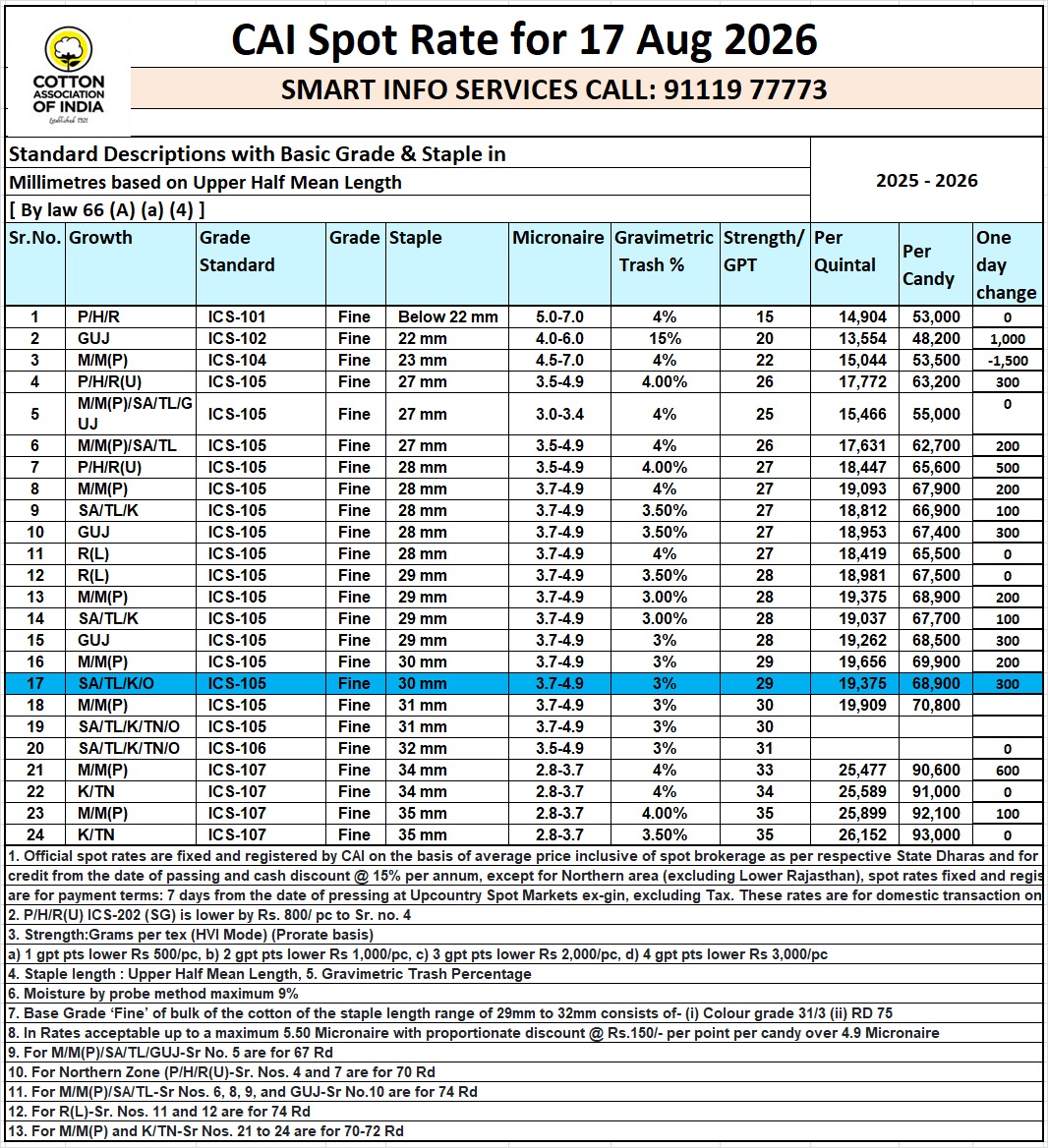
Gujarat has established a strong position in the textile industry, ranking second in exports for five consecutive yearsGujarat is making a significant comeback in India's textile exports, becoming the second-largest exporter with $5,749 million in 2023-24, closely following Tamil NaduAHMEDABAD : Gujarat is stitching a strong comeback in India's textile export map. Over the past five years, the state has emerged as the second-highest textile exporter in the country. While Tamil Nadu retained the top spot in 2023-24, Gujarat wasn't far behind with exports worth $5,749 million. Experts believe the state's new textile policy could soon tip the scales.State leading in textile exportWhile Gujarat has consistently maintained a strong presence in the cotton yarn and fabric segments, industry insiders say the state has yet to unlock its full potential in the global textile supply chain. Experts believe the newly launched textile policy could be the game-changer. By encouraging fresh investments, especially in garment manufacturing, it aims to turn the state into a global textile powerhouse. The policy focuses on integrated infrastructure, technical textiles and higher value-added production, which could strengthen Gujarat's position in coming years.A major export spike was seen in 2021-22, largely due to soaring cotton prices. But with cotton prices now stabilising at around Rs 53,500 per candy (356kg), manufacturers are looking at more predictable input costs and better long-term planning.In a reply to the Lok Sabha, Union minister of state for textiles Pabitra Margherita highlighted the Centre's push to boost the sector's competitiveness through key initiatives. These include the PM MITRA scheme for world-class textile parks and the production-linked incentive (PLI) scheme aimed at technical textiles and man-made fibre (MMF) segments.Rahul Shah, co-chairman of the GCCI textile taskforce, said Gujarat's rise began with the 2012 textile policy. "We have a strong edge in cotton yarn and fabric exports. While demand dipped in Europe due to the Russia-Ukraine conflict, Gujarat still has the capacity to grow," he said. He added that the global move to reduce reliance on China and Bangladesh could work in Gujarat's favour, especially as big brands explore new sourcing hubs post-Covid.read more :-Indian rupee opens 20 paise higher at 85.84 against US dollar

title Created At Action
India’s cotton panel recommends removing 11% import duty 17-04-2025 18:31:11 view
US cotton exports to India rise on lower prices, tariff uncertainties 17-04-2025 17:57:26 view
Rupee opened 20 paise higher at 85.48 17-04-2025 17:21:00 view
Why did Bangladesh suspend yarn imports from India through land ports 17-04-2025 00:50:02 view
Indian Rupee lower 7 Paisa, Ends at 85.68 per Dollar 16-04-2025 22:41:59 view
USDA Announces 2025 Cotton Loan Rate Differentials 16-04-2025 18:54:43 view
China appoints new top trade negotiator amid US tariff war 16-04-2025 18:31:24 view
Rupee opens 16 paise higher at 85.61 against dollar 16-04-2025 17:31:00 view
Monsoon Rain: This year it will rain heavily! IMD said that monsoon rain will be above average in 2025 15-04-2025 23:29:13 view
Rupee higher 7 Paisa Against Dollar, Closes at 85.77 15-04-2025 22:48:55 view
Gujarat weaves strong textiles story, second in exports for 5 years straight 15-04-2025 18:07:37 view
Copyright© 2023 | Smart Info Service
Application Download