Filter

Recent News

Gujarat weaves strong textiles story, second in exports for 5 years straight

Gujarat has established a strong position in the textile industry, ranking second in exports for five consecutive yearsGujarat is making a significant comeback in India's textile exports, becoming the second-largest exporter with $5,749 million in 2023-24, closely following Tamil NaduAHMEDABAD : Gujarat is stitching a strong comeback in India's textile export map. Over the past five years, the state has emerged as the second-highest textile exporter in the country. While Tamil Nadu retained the top spot in 2023-24, Gujarat wasn't far behind with exports worth $5,749 million. Experts believe the state's new textile policy could soon tip the scales.State leading in textile exportWhile Gujarat has consistently maintained a strong presence in the cotton yarn and fabric segments, industry insiders say the state has yet to unlock its full potential in the global textile supply chain. Experts believe the newly launched textile policy could be the game-changer. By encouraging fresh investments, especially in garment manufacturing, it aims to turn the state into a global textile powerhouse. The policy focuses on integrated infrastructure, technical textiles and higher value-added production, which could strengthen Gujarat's position in coming years.A major export spike was seen in 2021-22, largely due to soaring cotton prices. But with cotton prices now stabilising at around Rs 53,500 per candy (356kg), manufacturers are looking at more predictable input costs and better long-term planning.In a reply to the Lok Sabha, Union minister of state for textiles Pabitra Margherita highlighted the Centre's push to boost the sector's competitiveness through key initiatives. These include the PM MITRA scheme for world-class textile parks and the production-linked incentive (PLI) scheme aimed at technical textiles and man-made fibre (MMF) segments.Rahul Shah, co-chairman of the GCCI textile taskforce, said Gujarat's rise began with the 2012 textile policy. "We have a strong edge in cotton yarn and fabric exports. While demand dipped in Europe due to the Russia-Ukraine conflict, Gujarat still has the capacity to grow," he said. He added that the global move to reduce reliance on China and Bangladesh could work in Gujarat's favour, especially as big brands explore new sourcing hubs post-Covid.read more :-Indian rupee opens 20 paise higher at 85.84 against US dollar

Fabric of the industry frays: What Trump’s tariffs really mean for India’s textile sector

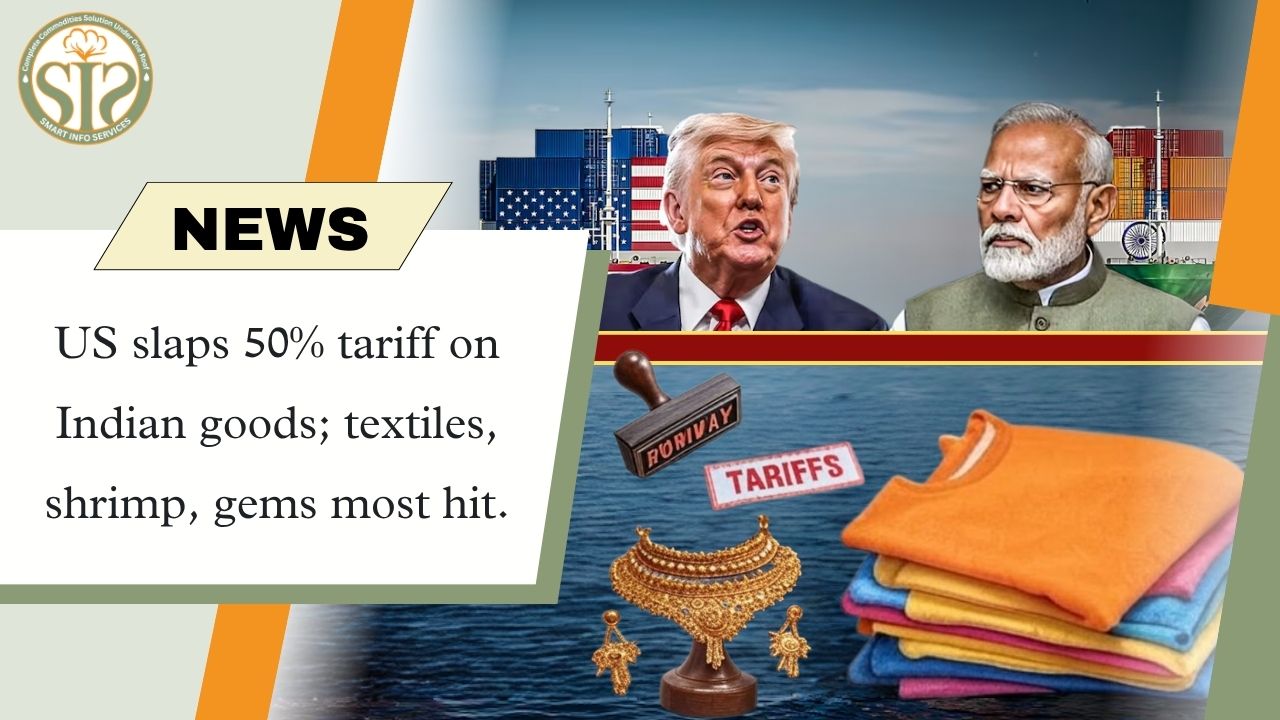
Trump's Tariffs: Impact on India's Textile IndustryThe textile and apparel industry is a significant contributor to India’s economy, contributing 2.3% to the country’s gross domestic product (GDP), 13% to industrial production and 12% to exports. The US and the European Union (EU) are the major destinations for India’s textile and apparel exports, accounting for a 47% share in India’s exports, as per a PIB release.An in-depth look at the numbers tells the facts on the ground. India exported textile items worth $34.4 billion in 2023-24, with apparel comprising 42% of the export basket, followed by raw materials/semi-finished materials at 34% and finished non-apparel goods at 30%. In fact, the US is the largest buyer of India’s textiles, accounting for nearly 28% or $10 billion.In this context, what do US President Donald Trump’s reciprocal tariffs of 26% imply for the textile sector, even though he announced a 90-day pause on Wednesday (April 9) for all countries except China?If the tariffs continue even after the break, what challenges or opportunities might arise for a sector that is the second-largest employment generator after agriculture?Sanket Desai, Indirect Tax Partner-Consumer Products and Retail, EY India, hints at a potential silver lining amidst the ongoing chaos. “The newly imposed US tariffs are expected to reshape the global textile trade landscape, potentially positioning India more favourably compared to its competitors. On the positive side, even higher tariffs on nations competing with India provide a competitive edge, potentially presenting an opportunity to increase its market share in the US. Thus, it may be a ‘blessing in disguise’ due to the relative tariff situation,” he states.Trump slapped higher tariffs on competitor countries in the segment, with Vietnam staring at a 46% tariff, Bangladesh 37%, China 34%, Cambodia 49%, and Pakistan 29%.Kumar Duraiswamy, Joint Secretary, Tiruppur Exporters’ Association (TEA), affirms that the scenario provides an edge for expanding business to the US. Making a reference to the man-made fibre (MMF) segment, he spoke of how the tariff enforced on Jordan holds us in good stead. “A lot of sportswear and handmade fibre goods were being exported from Jordan, which meant sourcing from China and Korea. But now tariffs have come upon them, too. At a time when India is eyeing MMF production in a big way, this presents a significant advantage for the textile industry,” he remarks.read more :-Tariff war: China says exports facing severe external situation but 'sky will not fall'

Tariff war: China says exports facing severe external situation but 'sky will not fall'

China Warns of Export Struggles, Says 'Sky Will Not Fall'Amid the ongoing tariff tension with the United States, a spokesperson for China's customs department said on Monday that the country is under "severe" pressure in its export sector but the situation is not catastrophic."At present, China's exports are facing a complex and severe external situation, but 'the sky will not fall'," the spokesperson said, according to news agency Reuters. He also said that China is "actively building a diversified market, deepening cooperation with all parties in the supply chain," and added, "The important thing is that China's domestic demand market is broad."The comments come a day after US President Donald Trump said no country would be exempt from tariffs. "No one is getting 'exempt'... especially not China, which treats us the worst by far!" he posted on his Truth social platform.Trump's administration has been engaged in a trade conflict with China, in which the two countries impose tariffs on each other's goods. US tariffs on Chinese imports have reached 145 percent, while China has responded with a 125 percent tariff band on US products.On Friday, the US eased some pressure by announcing temporary tariff exemptions for products such as smartphones, laptops and semiconductors, many of which come from China. These exemptions are expected to benefit US tech firms such as Nvidia, Dell and Apple, which make many of their products in China.However, President Trump and his aides made clear that these exemptions are not permanent. Trump said on Sunday that the move was being misunderstood and that his administration was working on new tariffs that could apply to recently exempted items. He said, "The tariffs will be imposed in the near future."Earlier, China's Commerce Ministry reacted to the exemption, saying the move was only "a small step" and urged the US to "resolutely cancel" its entire tariff policy.Meanwhile, Chinese President Xi Jinping warned on Monday during a visit to Vietnam at the start of his Southeast Asia tour that protectionist policies "will serve no purpose."In an article published in a Vietnamese newspaper, Xi called on the two countries to "resolutely safeguard the multilateral trading system, stable global industrial and supply chains, and open and cooperative international environment."He also reiterated China's stance that "there are no winners from a trade war and tariff war."read more :-Cotton- Production reduced and import requirement also doubled, loss in Maharashtra

Cotton- Production reduced and import requirement also doubled, loss in Maharashtra

Cotton Output Drops, Imports Double Amid Maharashtra LossBig news : This time the cotton season in India says a lot in terms of figures. On one hand, domestic production has decreased, on the other hand the need for imports has doubled and there has been a big decline in exports. All these changes can determine the direction of India's cotton market for 2024-25.Loss in Maharashtra, some relief from TelanganaThe Cotton Association of India has recently released its new estimate, according to which the total production of cotton in the country has now come down to 291.30 lakh bales. Earlier it was estimated to be 295.30 lakh bales. The biggest reason for this decline is Maharashtra, from where a loss of 5 lakh bales alone was recorded. This time in the state, neither the crop yield was good nor was the cultivation done as much as expected. Although an increase of 1 lakh bales has been registered from Telangana, but that too could not compensate for the loss.Imports reached 25 lakh bales by March itselfTo meet the domestic demand, India is now having to look towards foreign supplies. By the end of March itself, India had imported 25 lakh bales of cotton and it is estimated that this figure for the entire season can reach 33 lakh bales. Last year this number was only 15.20 lakh bales, meaning imports have almost doubled.This year India's total cotton supply, which includes both opening stocks and imports, has reached 306.83 lakh bales. But consumption is even more than that.read more :-Trump says 10% is tariff floor or pretty close, but there could be exceptions

Trump says 10% is tariff floor or pretty close, but there could be exceptions

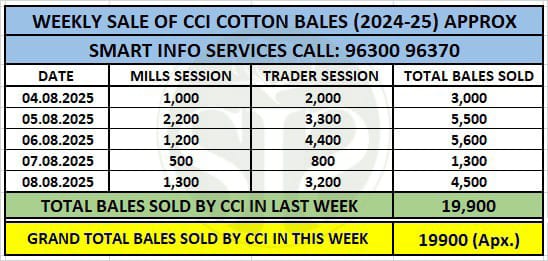
Trump Suggests 10% Tariff Floor with Possible ExceptionsU.S. President Donald Trump on Friday said that 10% is a tariff floor, or pretty close, and that there could be a couple of exceptions. He also told that he thought something positive would come out with China“There could be a couple of exceptions for obvious reasons but I would say 10% is a floor,” Trump told reporters Friday evening aboard Air Force One en route to Florida. He didn’t elaborate on the “obvious reasons” or suggest any shift in his broader tariff policy.His remarks capped a volatile week for equity and bond markets and added fresh uncertainty for nations, investors, and businesses already grappling with his evolving trade agenda. Earlier in the week, Trump announced sweeping new tariffs on several countries—only to delay them just hours later, after financial markets reacted sharply amid fears that his import taxes could hurt the global economy.While China, the world’s second-largest economy, now faces a steep 145% levy, Trump is sticking to the 10% baseline rate for most other nations, as foreign governments scramble to negotiate favorable terms with the U.S.On Friday, markets rallied. The S&P 500 climbed 1.8%, capping its best week since 2023, boosted by a report that a Federal Reserve official signaled readiness to step in and stabilize markets if necessary. Yields on U.S. 10-year Treasuries retreated from their highs, t ..Still, recent market volatility shows little sign of abating, with concerns growing that Trump’s tariff-driven push to revive U.S. manufacturing and boost federal revenue could trigger recessions and erode America’s status as a global safe haven.Trump, however, downplayed those concerns on Friday. “I think the markets were solid today. I think people are seeing we’re in great shape,” he said. He also emphasized his confidence in the U.S. dollar, declaring it would “always” remain “the currency of choice.”“If a nation said we’re not going to be on the dollar, I would tell you that within about one phone call they would be back on the dollar. You always have to keep the dollar,” he added.He also dismissed recent Treasury market turbulence—something he had cited earlier in the week when adjusting his tariff timeline. “The bond market’s going good. It had a little moment but I solved that problem very quickly,” Trump said.Even with temporary relief for some trading partners, the sharply higher tariff on China is set to push the average U.S. duty rate to historic highs, according to Bloomberg Economics. The prolonged trade conflict between the world’s two largest economies  ..In a tit-for-tat move, China on Friday raised tariffs on all U.S. goods to 125%, matching the new U.S. rate and layering it on top of an existing 20% tax. While Beijing said it wouldn’t mirror any further increases, it vowed to “fight to the end” with other unspecified countermeasures.“I think something positive is going to come,” Trump said Friday, when asked about the ongoing trade battle with China, describing President Xi Jinping as “a very good leader, a very smart leader.”read more :-Weekly Summary Report: Cotton Bales Sold by Cotton Corporation of India (CCI)

Free US imports by Asian peers will hit Indian cotton, yarn, textiles and apparel exports

Indian Yarn & Textile Exports at Risk from Asian RivalsVietnam is facing 46 per cent reciprocal tariffs, Bangladesh 37 per cent, and Cambodia 49 per cent, though they have received a breather for 90 days with a basic tariff of 10 per cent.Chennai : Bangladesh, Vietnam and Cambodia are in the process of either removing fully or charging minimal tariffs on US imports as part of their trade negotiations. This will make not just Indian textile and apparel exports to the US less competitive but shrink our cotton and yarn exports to these countries as well. Vietnam is facing 46 per cent reciprocal tariffs, Bangladesh 37 per cent, and Cambodia 49 per cent, though they have received a breather for 90 days with a basic tariff of 10 per cent.In order to offset the impact, Bangladesh has offered to increase US agricultural imports, including cotton. Similarly, Cambodia has announced a reduction in tariffs on 19 US product categories from the maximum 35 per cent to an applied 5-per cent rate. Vietnam too is ready to drop its duties on US imports. This will see the US exporting more cotton to these countries. The US is the third largest producer of cotton after China and India. According to Chandrima Chatterjee, secretary general of Confederation of Indian Textile Industry, import parity pricing of US cotton will be lower compared to India as India. In the recent past, Indian cotton has remained pricier compared to international cotton. Further, these countries will be under pressure to import more cotton from the US to ward off tariffs.India exports over $2 billion cotton and yarn to Bangladesh and a considerable portion of this is facing potential trade displacement. Similarly, the export of cotton and yarn to Vietnam and Cambodia also are sizeable. Further, in the absence of reciprocal tariffs, exports of apparels from these countries will become more competitive compared to Indian exports. Shrinkage of cotton and yarn exports along with apparels and textiles will be a double whammy for India. In 2024, India exported textile products worth $10.5 bn to the US. This mainly includes, apparels, home textiles and other textile products. India also imports cotton from the US and of the imports, Extra Long Staple cotton is not produced in India in sufficient quantities. The textile industry hopes that the Indian government too will negotiate with the US for a better deal.read more :-'There will be transition cost': Donald Trump holds ground on tariffs as US markets falter

'There will be transition cost': Donald Trump holds ground on tariffs as US markets falter

Trump Defends Tariffs Despite Market SlidePresident Donald Trump speaks at a cabinet meeting in the Cabinet Room of the White House, Thursday, April 10, 2025, in Washington. (AP)US President Donald Trump on Thursday said that his tariff policy would come with a "transition cost," as markets dropped again due to ongoing uncertainty around the trade conflict."There will be a transition cost, and transition problems, but in the end, it's going to be a beautiful thing," Trump said. The US president is aiming to change the global economy by encouraging manufacturers to operate from the United States.His comment came shortly after the White House said that tariffs on China would rise to 145 per cent on some products. This includes a previous 20 per cent tariff on those making the drug fentanyl.Despite the tensions, Trump said he still hopes to make an agreement with China. "I think we'll end up working something out that's very good for both countries. I look forward to it," he said.Markets continued to show signs of trouble on Friday, after Trump’s earlier announcement of a 10 per cent tariff on all countries except China.On Wednesday afternoon, Trump said that for 90 days, the US would apply a flat 10 per cent tariff on all countries except China, instead of setting different "reciprocal" tariffs for each country.Trump also paused a plan to impose tariffs as high as 50 per cent on countries he described as the "worst offenders." However, the trade dispute with China remains.Meanwhile, China has increased its retaliatory tariffs on American goods to 84 per cent .In a televised cabinet meeting, Trump said, "There would always be transition difficulty," but added that "it was the biggest day in history in markets."He said investors were pleased with how the US was managing its trade policy and that the country was "trying to get the world to treat us fairly."He also said, "everybody wants to come and make a deal" to lower tariffs.US commerce secretary Howard Lutnick, who was also at the meeting, said several countries were entering talks and bringing "offers they never would have" if not for Trump’s trade actions."We're getting the respect we deserve now," Lutnick said. "I think you're going to see historic deals one after the other."Moreover, Trump also said the US would "love to be able to work a deal (with China)" and added that he had "great respect for President Xi." He also said he thought they would "end up working something out that's very good for both countries."He repeated his claim that China had "taken advantage" and "ripped off" the US "more than anybody" for a long time.Meanwhile, China announced that it would reduce the number of American-made films in its cinemas. It also said that the trade dispute had lowered interest in Hollywood movies among Chinese audiences.Currently, China allows up to 34 US films each year. Local movies are becoming more popular.The European Union said it would pause its planned countermeasures against the US for 90 days. These were scheduled to start on April 15.On Wednesday, 26 out of 27 EU countries — all except Hungary — voted to apply tariffs in response to the US 20 per cent tariff.European Commission President Ursula von der Leyen said in a statement that the EU wanted "to give negotiations a chance."read more :-Rupee opens 44 paise higher at 86.25 against dollar

title Created At Action
Gujarat weaves strong textiles story, second in exports for 5 years straight 15-04-2025 18:07:37 view
Indian rupee opens 20 paise higher at 85.84 against US dollar 15-04-2025 17:15:14 view
Fabric of the industry frays: What Trump’s tariffs really mean for India’s textile sector 15-04-2025 00:56:52 view
Tariff war: China says exports facing severe external situation but 'sky will not fall' 14-04-2025 20:21:10 view
Cotton- Production reduced and import requirement also doubled, loss in Maharashtra 14-04-2025 17:35:21 view
Trump says 10% is tariff floor or pretty close, but there could be exceptions 12-04-2025 22:26:32 view
Weekly Summary Report: Cotton Bales Sold by Cotton Corporation of India (CCI) 12-04-2025 19:24:51 view
Free US imports by Asian peers will hit Indian cotton, yarn, textiles and apparel exports 12-04-2025 18:04:58 view
Indian rupee ended higher at 86.05 per dollar on Friday 11-04-2025 23:00:37 view
'There will be transition cost': Donald Trump holds ground on tariffs as US markets falter 11-04-2025 20:26:00 view
Rupee opens 44 paise higher at 86.25 against dollar 11-04-2025 17:29:53 view

Copyright© 2023 | Smart Info Service
Application Download