Filter

Recent News

India's monsoon overcomes delay, set to cover country on time

India's monsoon beats the delay and is expected to arrive on schedule.India's annual monsoon has covered more than three-fourths of the country and it is set to cover the entire country on time for the planting season despite stalling earlier this month, two senior weather officials said on Thursday.Summer rains, critical for economic growth in Asia's third-largest economy, usually begin in the south around June 1 before spreading nationwide by July 8, allowing farmers to plant crops such as rice, cotton, soybeans, and sugarcane."Monsoon is advancing quickly in northern India and will cover the entire country on time," said an official of the India Meteorological Department (IMD), who spoke on condition of anonymity as he was not authorised to speak to the media.The southwest monsoon advanced on Thursday, covering more parts of Rajasthan, most of Madhya Pradesh, additional areas of Uttar Pradesh, Bihar, and nearly all of Uttarakhand and Himachal Pradesh, the IMD said in a statement.India has received 19% less rainfall since June 1, IMD data showed, as the monsoon's progress had stalled, with almost the entire country except for a few southern states experiencing shortfalls and parts of the northwest gripped by heatwaves.The lifeblood of the nearly $3.5-trillion economy, the monsoon brings nearly 70% of the rain India needs to water farms and refill reservoirs and aquifers.Without irrigation, nearly half of the farmland in the world's second-biggest producer of rice, wheat, and sugar depends on the annual rains that usually run from June to September.Rainfall is picking up, and most parts of the country will receive good rainfall in the next fortnight, accelerating the planting of summer-sown crops, another weather official said.Read more :- Brazil to Surpass US as Top Cotton Exporter

Brazil to Surpass US as Top Cotton Exporter

Brazil Will Overtake the US as the Leading Cotton ExporterBrazil is poised to become the world’s leading cotton exporter in the 2023-24 season, overtaking the United States, which has held the top spot for decades. This shift follows an over 80% surge in Brazilian cotton shipments this season, according to the local exporters’ association, Anea.With just a month remaining in the 2023-24 cycle, Brazil's ascension to the number one exporter position is now certain, driven by record production, strong demand from Asian countries, and a significant drop in US output due to adverse weather conditions.It happened a little earlier than we imagined,” said Anea head Miguel Faus. “The main reason is the failure of the US crop, while Brazilian production increased.Faus predicts that Brazil's exports could rise further in the next season, as farmers are set to harvest another record crop, with expectations of continued growth into 2025-26. In the medium term, Brazil will consolidate itself in this leadership position,” he said.The US Department of Agriculture (USDA) recently increased its forecast for Brazil’s cotton exports by 300,000 bales to 12.4 million bales, while cutting the US forecast by 500,000 bales to 11.8 million bales.A USDA report noted that the US had led global cotton exports since the early 1990s. However, Brazil surpassed the US in production in 2023-24, ranking third globally behind China and India, a position expected to continue in 2024-25.Brazil has also been increasing its exports of other commodities, including corn and coffee. While it remains the world's largest coffee producer and exporter, Faus noted that Brazil's influence in the cotton market, though significant, is more balanced. In the case of cotton, the forces are more balanced… But of course, if Brazil’s production rises or falls, the market will be paying attention, he said.Key buyers of Brazilian cotton include China, Vietnam, Bangladesh, Turkey, and Pakistan.Read More :>  Indore Division Farmers to Sown Kharif Crops on Nearly 21 Lakh Hectares

Indore Division Farmers to Sown Kharif Crops on Nearly 21 Lakh Hectares

Farmers in the Indore Division Will Plant Kharif Crops on Almost 21 Lakh HectaresIndore: Farmers in the Indore division are expected to sow kharif crops across nearly 21 lakh hectares, with soybeans, cotton, and maize likely to dominate the planted area, according to the farm department.The area under maize cultivation is anticipated to increase compared to last year, driven by higher maize prices in the previous season, which have attracted farmers in various regions. Maize is expected to be cultivated on 3.4 lakh hectares in the Indore division this season, as per the department's projections.The farm department has set a target of 5.6 lakh hectares for cotton in the division, marking an increase of close to 3% from the previous year.With recent showers and adequate soil moisture, farmers in many parts of Indore, Dhar, Khandwa, Alirajpur, and Jhabua, among other places, have completed more than 50% of kharif crop sowing.Sowing of kharif crops is progressing well, and current weather conditions are favorable for crop growth. The area under maize is higher than last season, and cotton acreage has also increased,said an official from the farm department who wished to remain anonymous.According to a field survey compilation report from the farm department issued on June 21, farmers are likely to sow soybeans on 9.3 lakh hectares and cotton on 5.7 lakh hectares. Soybeans, cotton, maize, and pulses are the main kharif crops in the Indore division.Ramswarup Patel, a farmer from Sanwer, said, We have sown soybeans on 20 bighas, the same as last year, because we do not have many options to switch. This region is well suited for soybeans and gives a good yield. Climatic conditions look good and suitable for crop growth.Read More :> Cotton Loses Its ‘Most Profitable Crop’ Status in Andhra Pradesh’s Undivided Kurnool District

Cotton No Longer the Top-Earning Crop in Kurnool Region

Cotton Loses ‘Most Profitable Crop’ Tag in Undivided Kurnool DistrictCotton cultivation in the undivided Kurnool district of Andhra Pradesh has declined sharply in recent years, raising concerns among farmers as well as agricultural experts.Once contributing nearly 70% of the state’s total cotton output, the region was known for its naturally colored cotton with strong export potential. The traditional Mungari variety, cultivated since the early 1900s, earned the reputation of ‘white gold’. During the 1990s, farmers achieved average yields of 10–25 quintals per acre, supported by popular hybrids like Mallika, Bunny, Brahma, and NHH-44. The introduction of Bt cotton between 2002 and 2006 initially boosted expectations.However, cotton has gradually lost its position as the most profitable crop due to multiple challenges. Following the reorganization of Kurnool district, a large portion of cotton-growing areas shifted to rainfed zones, leading to a significant drop in acreage. In Kurnool, the cultivated area declined by 26%, from 2.50 lakh hectares to 1.83 lakh hectares in 2023-24. Nandyal saw an even sharper fall of around 70%, from 25,586 hectares to just 7,932 hectares.Despite being a cash crop with attractive prices, cotton has become less viable over the past decade. Erratic weather patterns—such as delayed monsoon onset, early withdrawal, and unseasonal cyclones during October-November—have negatively impacted production, largely due to climate change.Pest attacks have further worsened the situation. The incidence of pink bollworm has increased significantly, as pests have developed resistance to Bt cotton. In addition, tobacco streak virus has affected crops in both Kurnool and Nandyal districts, according to agricultural scientists.As a result, many farmers are shifting to short-duration and more reliable crops like maize and soybean. This trend is particularly visible in Nandyal, where assured irrigation from projects like the Kurnool-Cuddapah Canal and Telugu Ganga Canal supports alternative cropping. Meanwhile, farmers in rainfed Kurnool continue to struggle with pest-related losses and limited options.Experts suggest several measures to revive cotton cultivation, including adopting early-maturing Bt hybrids (around 150 days), maintaining a strict six-month crop-free period, and using pest control techniques such as mating disruption technology to manage pink bollworm during the off-season.Read More :> SISPA Urges CCI to Prioritize Cotton Sales to MSME Mills

SISPA Urges CCI to Prioritize Cotton Sales to MSME Mills

SISPA requests that CCI give MSME mills priority in cotton sales.COIMBATORE: The South India Spinners Association (SISPA) has called for immediate action from the Cotton Corporation of India (CCI) to prioritize the sale of cotton to Micro, Small, and Medium Enterprise (MSME) spinning mills starting July 1. SISPA has also requested the continuation of the current cotton sales policy from CCI for the next three months."The textile sector in India is at a critical juncture, grappling with significant financial strain. Numerous spinning mills have ceased operations due to liquidity crises, high operational costs, and market volatility. These challenges are compounded by a notable decline in yarn and textile exports, as well as increased pressure from imports," stated S. Jagadesh Chandran, Secretary of SISPA.Chandran also warned that selling cotton to traders leads to speculative practices, resulting in inflated prices and market instability.Despite these challenges, there are promising signs of revival within the spinning sector. Recent increases in garment export orders have enabled many mills to resume operations, leading to a growing demand for cotton to meet production needs. "Our request to the CCI is to refrain from diverting cotton stocks of 24 lakh bales, which is just one month of mill consumption. In the last three days, 2.5 lakh bales were sold to mills. If this trend continues, all stock will be sold in a month. We request CCI to stop selling to traders and instead retain these stocks for exclusive sale to mills," he added.Chandran noted that cotton prices suddenly increased from Rs 58,000 to Rs 63,000 per candy four months ago. "At that time, we requested the Ministry of Textiles and CCI not to sell cotton to traders. Based on our request, the Union Ministry of Textiles advised the CCI not to sell cotton to traders. As a result, CCI stopped selling cotton to traders, and the cotton price immediately dropped to Rs 57,000 per candy and remained stable for the last four months. The cotton prices in the open market were also stable because CCI's prices acted as a benchmark. If CCI resumes selling to traders, the prices will rise again," he said.Read More :> Piyush Goyal to Meet Exporters on Thursday

Cotton Association of India

India Cotton AssociationAs per CAI presentation at Ludhiana national crop committee meeting on dt 14 th june Bullish Factors for the Indian Cotton Market (June 2024 to October 2024)1. Hike in Indian Cotton MSP: The government is likely to increase the Minimum Support Price (MSP) for cotton by 5 to 10%.2. Shortage of Sowing Seed: India requires 450 lakh sowing packets, but only 300 lakh packets are available.3. Reduction in Cotton Sowing Acreage: More land is being allocated to other crops, reducing cotton acreage.4. Increase in Cotton Consumption: If large mills decide to stock up on old cotton for October/November, smaller mills may face a shortage.5. Tight Cotton Balance Sheet: A tighter balance sheet could influence market dynamics.6. Consistent Export Shipments: Exporters are continuing to ship 1 to 1.5 lakh bales per month.7. Delay in Import Shipments: Any delays could impact supply.8. Increase in Yarn Prices: Higher yarn prices will drive up cotton prices.9. Water Shortage: Early sowing percentages have drastically reduced due to water shortages.10. Delayed Sowing in North India: Sowing is down by 30-35% and delayed by a month, with new arrivals expected in the first week of October if conditions improve.11. Weather Risks: Adverse weather in India or other major cotton-growing countries could impact production.12. Delayed Crop Arrivals: Delays in sowing will push back new crop arrivals.13. Marketing Policies: The strategies of MNCs and the CCI need careful monitoring.14. Pent-Up Demand: Improved geopolitical situations may dry up supply chain pipelines.15. US Federal Bank Interest Rate Cut: A cut could lead to bullish trends in all commodities.16. Depression in Dollar Index: A weaker dollar could boost commodity prices.Bearish Factors for the Indian Cotton Market (June 2024 to October 2024)1. ICE Futures Fall: If December 24 ICE futures fall below 70 cents, Indian cotton prices will decline.2. Slow Demand for Cotton Yarn and Cloth: Reduced demand will negatively impact prices.3. Spinning Mills Losses: If spinning mills start losing Rs.20 per kg on yarn, they will reduce cotton consumption.4. Competition from Man-Made Fibers: These fibers are competing with cotton.5. Large Crops in the USA, Brazil, and Australia: These countries' large crops will prevent cotton prices from rising significantly.6. China's Economic Conditions: Economic instability due to simultaneous global conflicts could affect demand.7. Retailers’ Cautious Inventories: Uncertainty is leading retailers to avoid building large inventories.8. Hand-to-Mouth Operations: Most cotton spinning mills worldwide are operating on minimal inventories.Read More :> Cotton Factory Owners and Ginners Express Concern Over Decrease in Crop Area
Related News

Youtube Videos

कपास बाज़ार साप्ताहिक रिपोर्ट 🔥 | तेजी या मंदी? | CCI Update | Cotton Market Today
कपास बाज़ार साप्ताहिक रिपोर्ट 🔥 | तेजी या मंदी? | CCI Updat...
कैसा रहा आज का कपास बाज़ार? 😱 | Cotton Market Rate Today | 26 June 2026
कैसा रहा आज का कपास बाज़ार? 😱 | Cotton Market Rate Today |...
जानिए आज का कपास बाज़ार 🔥 | तेलंगाना कपास बुआई | Cotton Market Rate Today
जानिए आज का कपास बाज़ार 🔥 | तेलंगाना कपास बुआई | Cotton Mar...
राजस्थान कपास बुआई + रुई बाजार भाव 🔥 | Cotton Market Rate Today | 24 June 2026
राजस्थान कपास बुआई + रुई बाजार भाव 🔥 | Cotton Market Rate T...
कपास बाज़ार में आज क्या हुआ? 😱 Cotton Market Rate 23 June 2026
कपास बाज़ार में आज क्या हुआ? 😱 Cotton Market Rate 23 June 2...
ऐसा रहा आज कपास बाज़ार😱🔥Cotton market rate today #youtube
रुई बाजार में तेजी! 🚨 CCI की रिकॉर्ड बिक्री | पूरे भारत की कपास बुवाई रिपोर्ट | Cotton Market Update
रुई बाजार में तेजी! 🚨 CCI की रिकॉर्ड बिक्री | पूरे भारत की...
CCI Update: आज कितनी रुई गठानें बिकीं? 😱 | Cotton market price today  #youtube
CCI Update: आज कितनी रुई गठानें बिकीं? 😱 | Cotton market pr...
आज का कपास बाजार भाव LIVE 🤔| CCI बिक्री अपडेट, राज्यवार मंडी भाव और Cotton Rate Today #kapas #rates
आज का कपास बाजार भाव LIVE 🤔| CCI बिक्री अपडेट, राज्यवार मंड...
ऐसा रहा आज का कपास बाज़ार || cotton market price update #youtube #cottonmarket #kapas
ऐसा रहा आज का कपास बाज़ार || cotton market price update #yout...
🚨 सम्पूर्ण भारत की बुआई रिपोर्ट 2026-27😱आज का कपास बाज़ार #youtube
🚨 सम्पूर्ण भारत की बुआई रिपोर्ट 2026-27😱आज का कपास बाज़ार #...
गुजरात में कपास बुवाई ने पकड़ी रफ्तार! 😱 Cotton market rate today #youtube
गुजरात में कपास बुवाई ने पकड़ी रफ्तार! 😱 Cotton market rate...
कपास बाज़ार में गिरावट का सिलसिला जारी 😱Weekly Cotton Market #youtube
कपास बाज़ार में गिरावट का सिलसिला जारी 😱Weekly Cotton Market...
जानिए आज का कपास बाज़ार 😨 Cotton market rate today #youtube
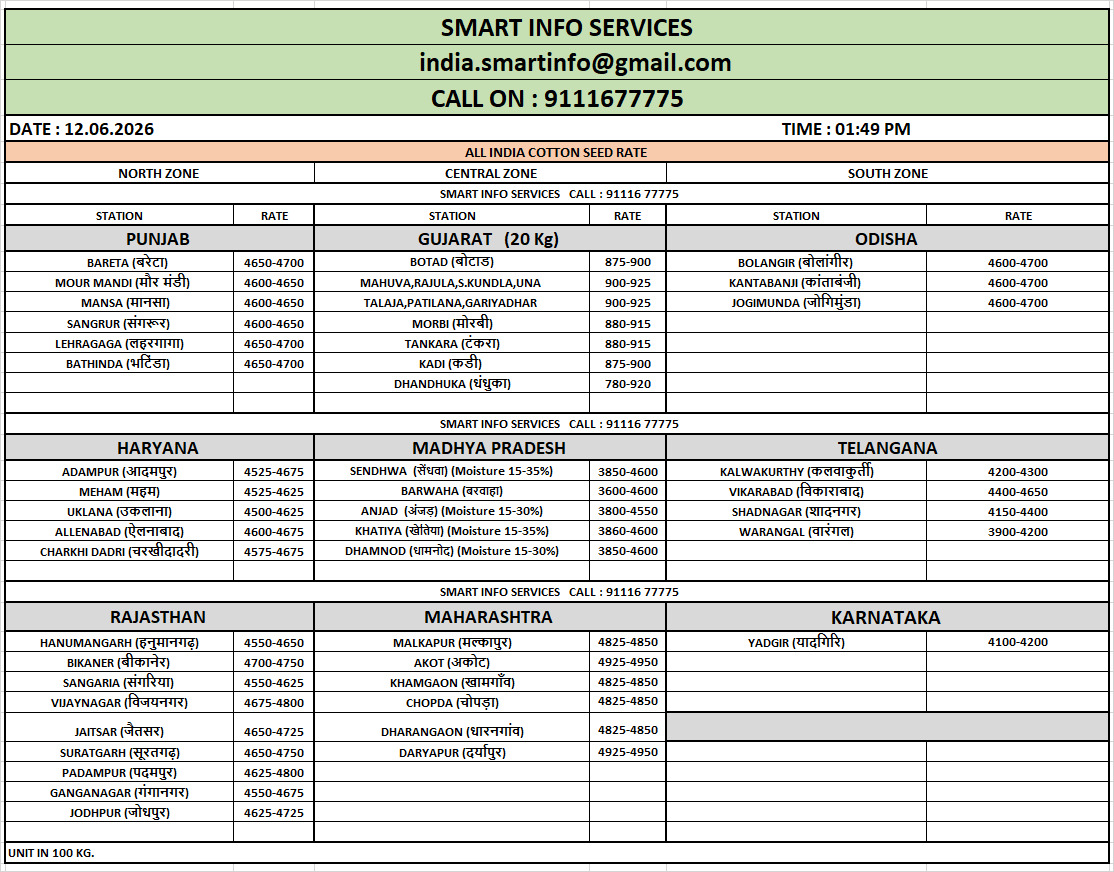
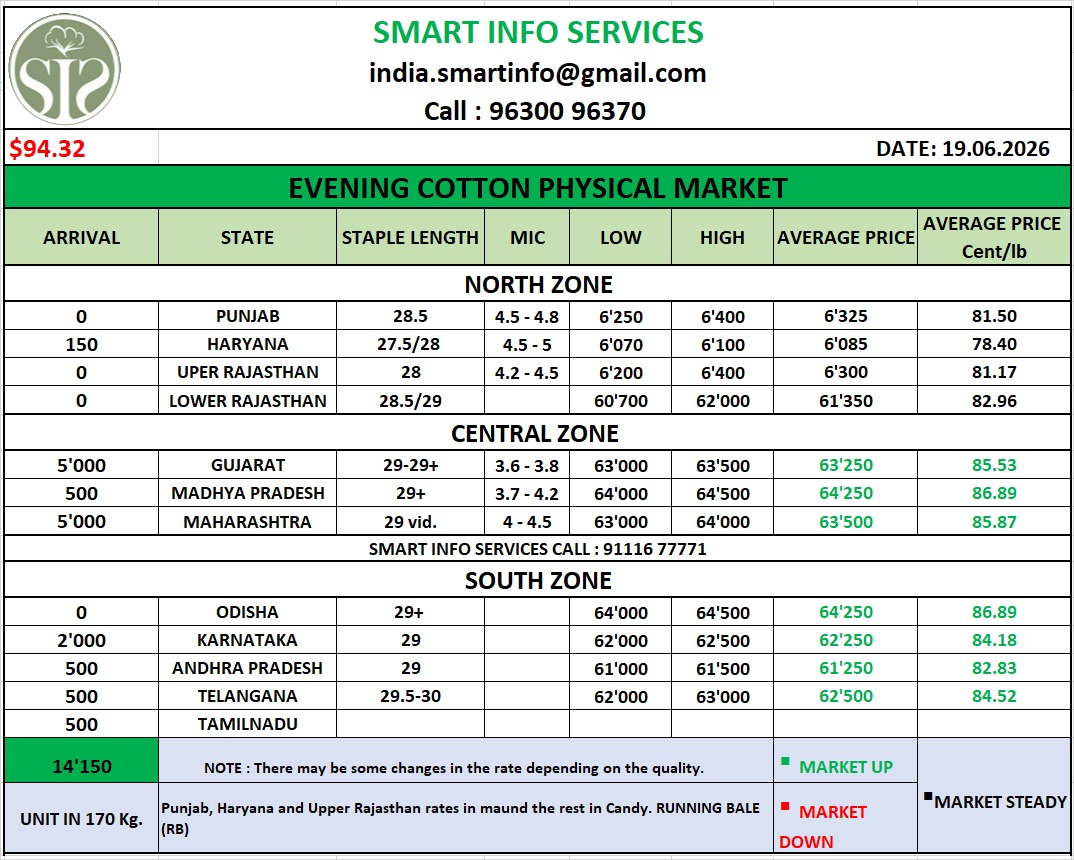
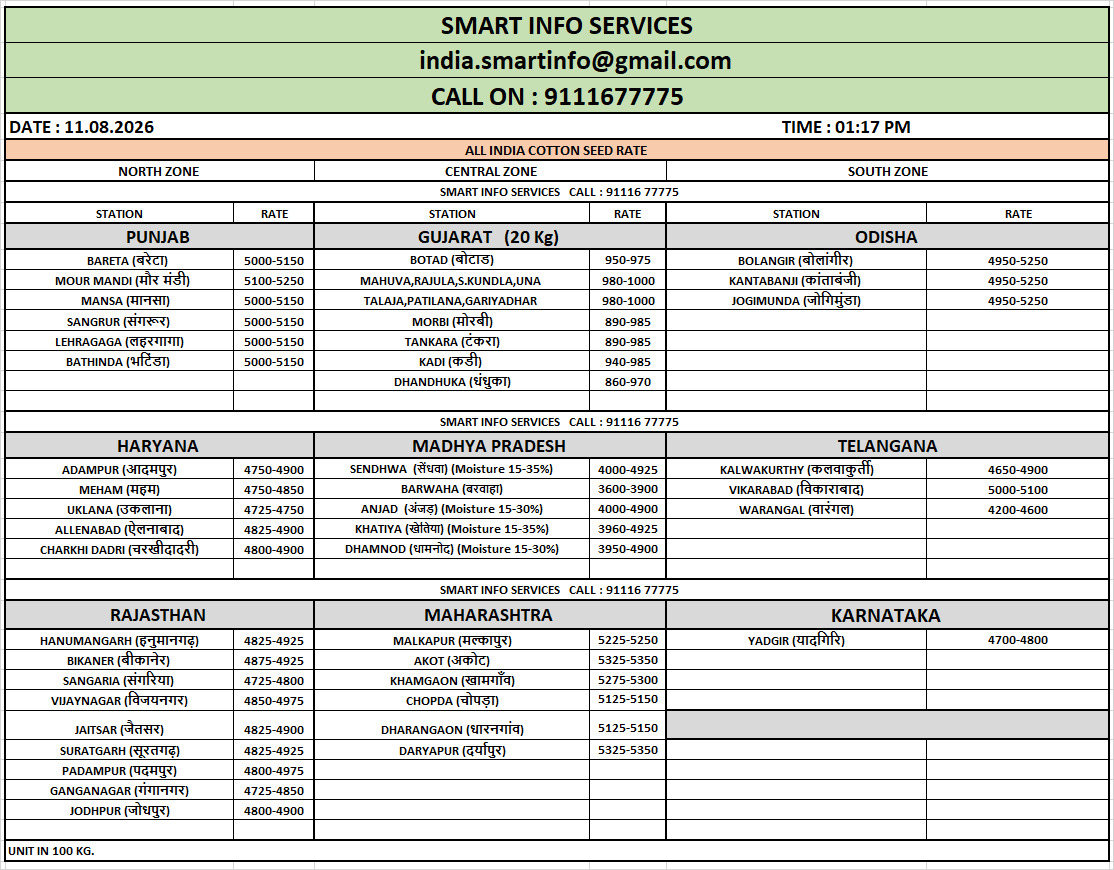
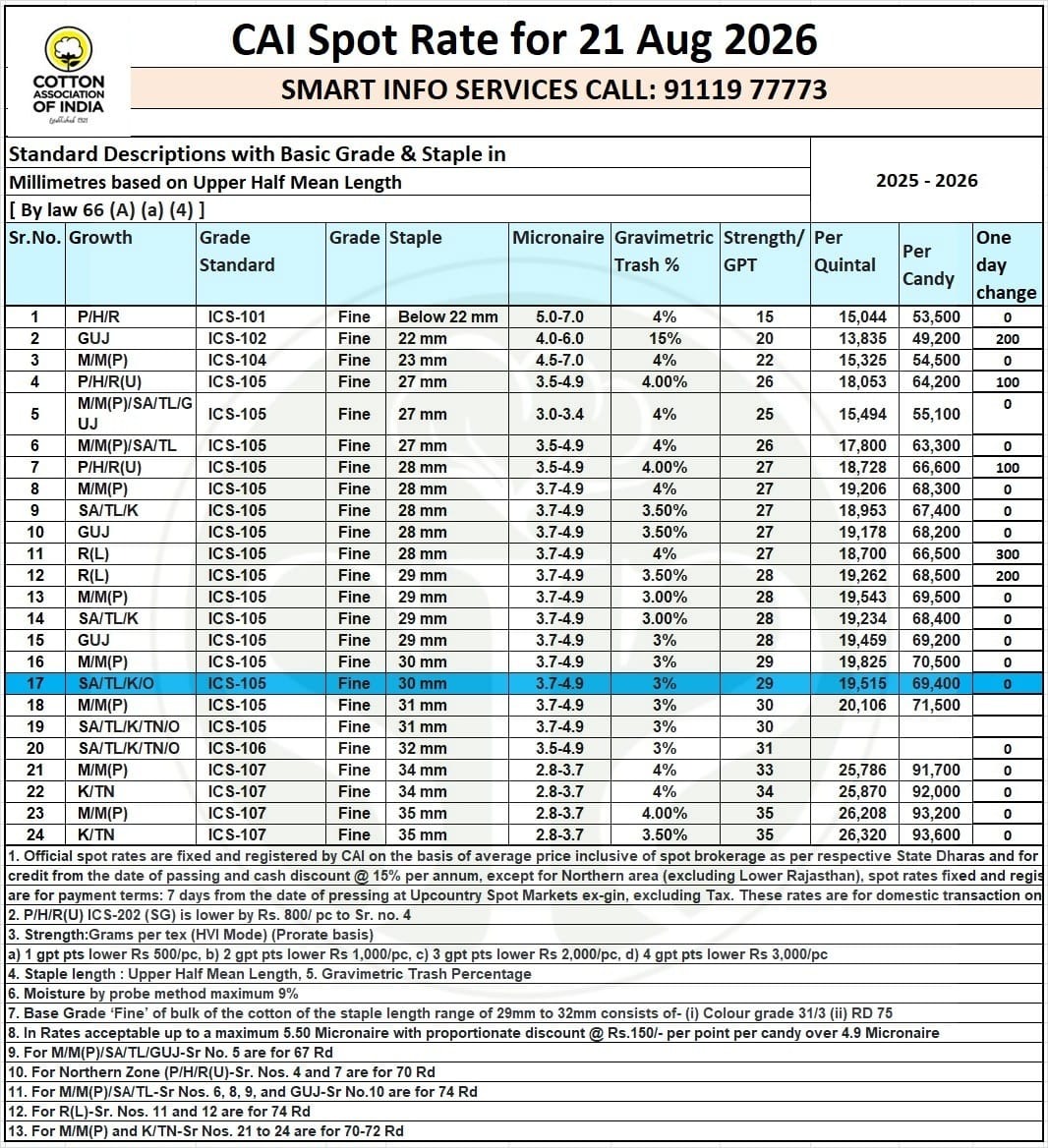
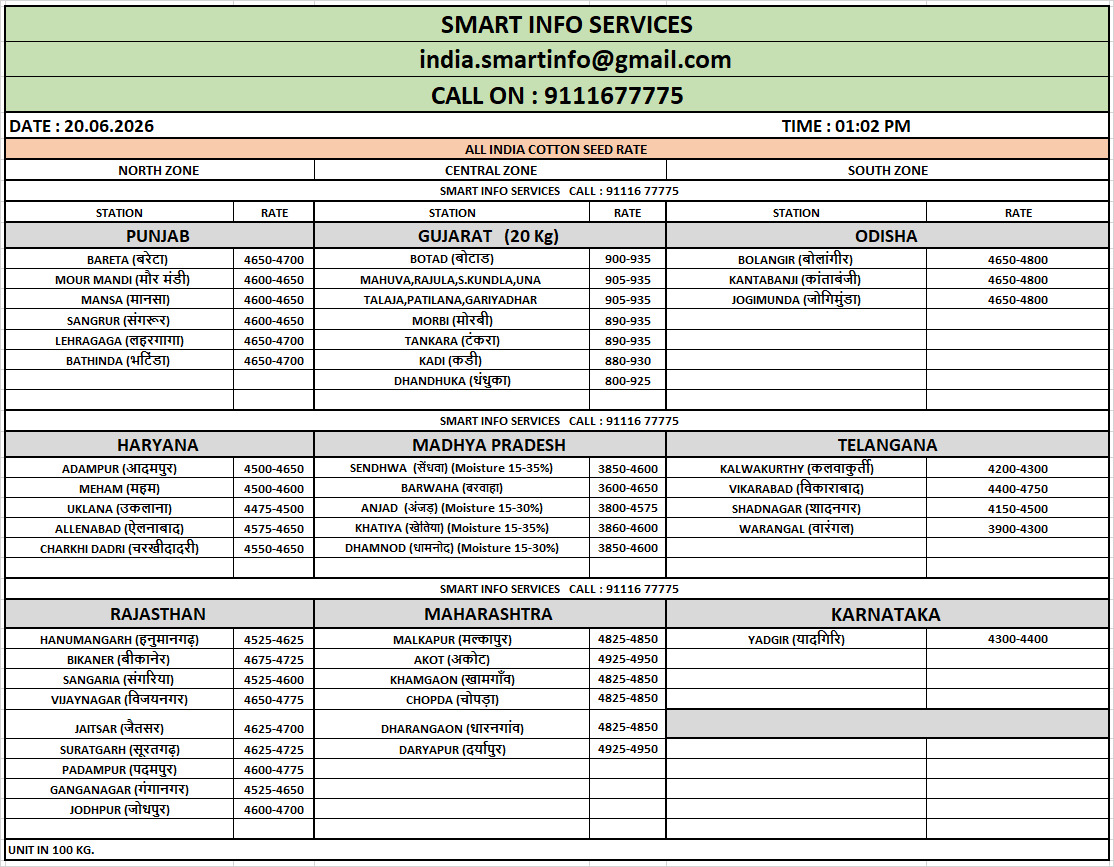
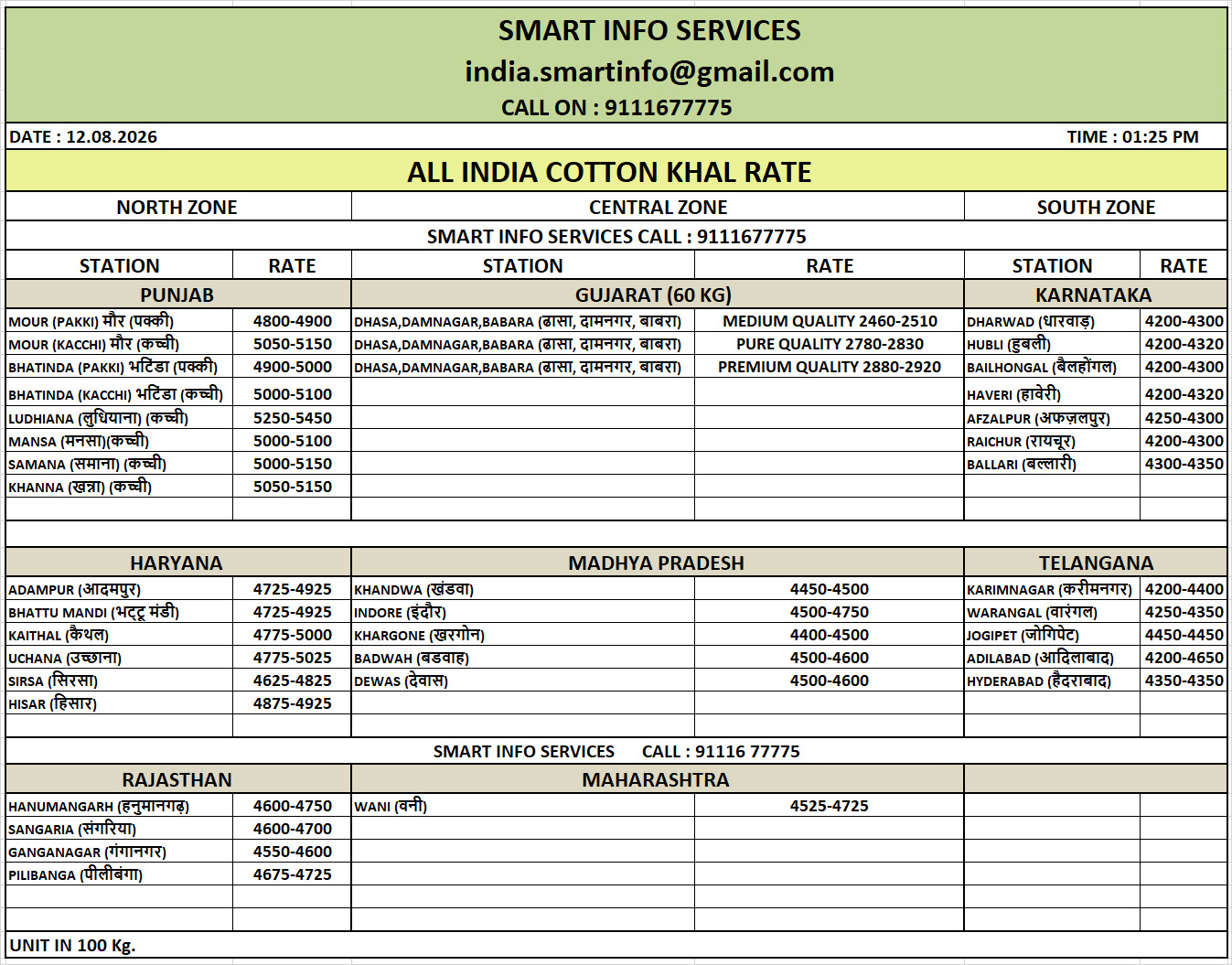
All India cotton market rate
Copyright© 2023 | Smart Info Service
Application Download