Recent News

Monsoon rains will come earlier than normal in India, there will be a boom in sowing of crops

Monsoon rains will come earlier than normal in India, there will be a boom in sowing of cropsIndia's monsoon season rains are due across the country by the weekend, according to meteorological officials, allowing farmers in northern states to start sowing summer-sown crops a week earlier than usual.The monsoon, the lifeblood of India's $3 trillion economy, provides about 70% of the rain needed to water its farms and recharge reservoirs and aquifers. This also gives relief from the scorching heat.In a normal year, the state of Kerala on India's southwest coast usually receives rain around June 1 and moves north to cover the entire country by July 8.This year, the formation of severe cyclone Biperjoy in the Arabian Sea delayed the onset of monsoon rains and halted their progress, covering only a third of the country till last week.But the rains resumed over the weekend and by Tuesday it had spread to other parts of the country except for some areas in the northern states of Rajasthan, Punjab and Haryana, a senior India Meteorological Department (IMD) official told Reuters. Said, "By this weekend, the monsoon will cover the rest of the areas as well."IMD data shows that the resumption of rains during the last few days has reduced the rain deficit in the June-September season to 23% from 33% a week ago.A second IMD official said several north-eastern, central and northern states are likely to receive heavy rains this week, bringing the deficit down to below 20%.Sowing of paddy, cotton, soybean, pulses and other summer-sown crops has been delayed, a senior government official said on condition of anonymity, but sowing would pick up from this week.The IMD has forecast an average amount of rainfall for the entire four-month season despite the formation of an El Nino weather pattern.A strong El Niño, marked by sea surface warming over the Pacific Ocean, can cause severe drought in Southeast Asia, India and Australia.The emergence of El Niño weather patterns resulted in only the fourth drought in more than a century in 2014 and 2015, driving many Indian farmers into poverty.

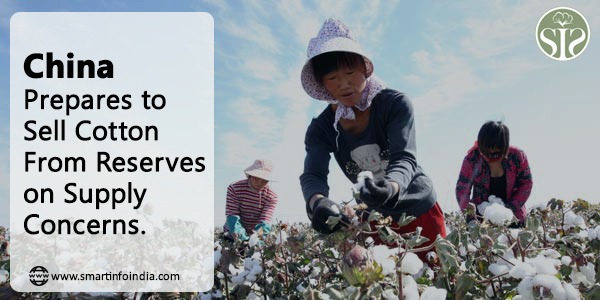
China Prepares to Sell Cotton From Reserves on Supply Concerns

China Prepares to Sell Cotton From Reserves on Supply ConcernsGovernment may announce cotton sale as soon as this weekExtreme weather may have reduced production in XinjiangChina is planning to release cotton from state stockpiles to boost supplies, people familiar with the matter said, underscoring concerns that the crop to be harvested later this year has been hit by poor weather. China may gather a smaller crop in the new season after a severe cold spell delayed sowing and hurt yields in Xinjiang, the top-producing region. The government could announce a plan to sell cotton from reserves as soon as this week, with volumes likely to be as much as a few hundred thousand tons, said the people, who asked not to be identified as the information is private.China is the world’s biggest textile producer and one of the largest cotton importers. While it could boost purchases of foreign cotton to meet any shortfall in production, that may be countered by a weak outlook for demand as exporters of textile products grapple with a slowing global economy.China imported just 490,000 tons of cotton in the first five months of the year, half the amount in the same period a year earlier. That has contributed to the weakness in benchmark US cotton prices, which are near a three-month low. China’s top economic planner, the National Development and Reform Commission, didn’t respond to a faxed request for comment.The crop in Xinjiang, which accounts for about 90% of China’s cotton, is currently at risk from high temperatures and hailstorms, just a few months after cold weather disrupted sowing. Mysteel, a commodity consultancy in China, forecast a 10% drop in cotton acreage as farmers have also switched to growing grains under a nationwide drive to bolster food security. “It’s a recognized fact in the market that Xinjiang’s cotton inventory is tight,” broker SHZQ Futures said. “Prices are likely to stay volatile in the short term.”China manages its cotton supply through the state reserves. It’s hard to ascertain how the sale will influence Chinese imports, as the move could either curb demand for overseas supplies or increase the need to replenish stockpiles. The government limits imports through a tariff-rate quota system.

Punjab: Rain problem for cotton growers, paddy farmers hope for relief

Punjab: Rain problem for cotton growers, paddy farmers hope for reliefThe area was flooded due to a breach in the Ramsara Minor (tributary) last night. About 50 acres of cotton crop was submerged between Bhagu and Wahabwala villages.Farmers Gurpreet Singh and Kuldeep Singh said that due to heavy rains in the area late last night, the canal had overflowed, leading to a breach in the canal. Canal Department employee Rakesh said that JCB machine has been arranged to bridge the crack.He said that the farmers have given their cooperation in vacating the fields.Meanwhile, rain accompanied by strong winds in Muktsar last night brought relief to the paddy growers of the district. The paddy sowing season is underway and the temperature has been hovering around 42 degree Celsius for the past few days.However, the rain caused some damage to the Punjab State Power Corporation Limited (PSPCL) and the Irrigation Department. For example, power supply was restored in Gidderbaha town today only after about 15 hours.On the other hand, two minors of the district also developed cracks due to rain. About 50 acres of land in Warring village was submerged due to a breach in the Khara Minor. Similarly, there was a crack in Sakkanwali minor also. The farmers claimed that the administration failed to clean the water channels in time.During the day, Muktsar Additional Deputy Commissioner Bikramjeet Singh Shergill held a meeting with officials of various departments to review preparedness to deal with waterlogging.He directed the officials of the drainage wing of the Irrigation Department to clean the drains by July 10. He also directed all Block Development and Panchayat Officers (BDPOs) to clean the village ponds and keep water lifting motors ready to meet any eventuality.

Pakistan: The trend of declining spot rate continues amid light business.

Pakistan: The trend of declining spot rate continues amid light business.LAHORE: The spot rate committee of the Karachi Cotton Association (KCA) on Monday reduced the spot rate by Rs 2,00 per head and closed it at Rs 17,500 per head.The local cotton market remained stable and the trading volume was satisfactory. Cotton analyst Naseem Usman said that the rate of new cotton crop in Sindh is between Rs 17,700 to Rs 17,800 per head.The rate of footi in Sindh is between Rs 7,000 to Rs 8,000 per 40 kg. The rate of cotton in Punjab is between Rs 18,000 to Rs 18,200 per head and the rate of cotton is between Rs 7,500 to Rs 8,500 per 40 kg.200 bales of Sanghar were sold at Rs.17,300 per head, 1000 bales of Khadro, 1000 bales of Shahpur Chakkar at Rs.17,400 to Rs.17,500 per head, 1200 bales of Tando Edam were sold at the rate of Rs.16,800 to Rs.17,400 per head. Kotri sold for Rs.16,800 to Rs.16,900 per head in 400 bales, Shahdadpur in 600 bales for Rs.17,300 to Rs.17,500 per head, Hyderabad in 600 bales for Rs.17,200 to Rs.17,400 per head, Khanewal in 600 bales. 18,000 to 18,500 per head, 200 bales of Haasil Pur were sold at 18,000 per head, 600 bales of Vehari and 200 bales of Chichavatni were sold at 18,500 per head and 400 bales of Winder Bales were sold at the rate of Rs.17,300. to Rs.17,400 per head.The Spot Rate Committee of the Karachi Cotton Association reduced the spot rate by Rs 2,00 per head and closed it at Rs 17,500 per head. Polyester fiber was available at Rs 355 per kg.

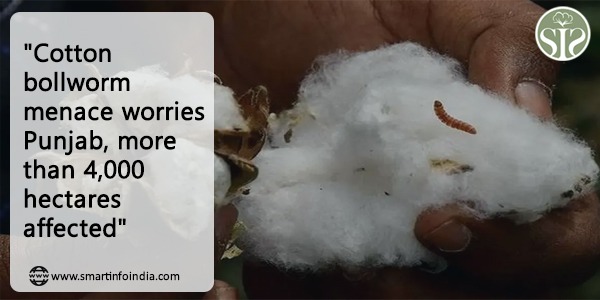
"Cotton bollworm menace worries Punjab, more than 4,000 hectares affected"

"Cotton bollworm menace worries Punjab, more than 4,000 hectares affected"A detailed field survey by the Punjab Agriculture Department has said that early sowing of cotton in 2% of the total area under cotton in various districts is putting a provisional area of 1.75 lakh hectares at risk of infection with the deadly pink bollworm this year.Experts said untimely rains with the onset of summer this year provided suitable breeding and feeding grounds for the pest.The next three weeks are critical for farmers to use the recommended steps to detect pest populations and check for any widespread infestations. PBW has surfaced in limited locations, but it can spread rapidly and potentially threaten crops in other areas if pest control management is not executed effectively, he says.This year, a section of farmers from vulnerable areas of Punjab started sowing 'white gold' as early as March 28, much before the recommended sowing time of April 15 to May 15, agriculture officials said. The pest attacks cotton plants at flowering stage in mid-July and PBW is already visible, posing a risk of infection to other fields.State agriculture director Gurvinder Singh, who made an extensive tour of cotton-growing districts this week, said the current situation was not alarming and farmers were advised to use recommended sprays to control the pest population.The director said that unlike last season, whitefly has not been detected this year and cotton growers have been advised to be vigilant.Field surveys revealed impressive plant health. “In 2022, most of the plant growth had stopped, but this time farmers are following an advisory to provide enough nutrients to the crop. This trend may help in reducing the adverse effects of pests,” he said.Punjab saw the first appearance of PBW in 2020 on about 100 acres of land at Jodhpur Romana in Bathinda. The following year, the pest severely affected other districts and in 2022, whitefly and PBW ravaged cotton production in Punjab.In the current kharif season, the traditional crop area in Punjab has come down to 1.75 lakh hectares and farmers have suffered heavy losses due to pest attack, which is responsible for the lowest acreage ever.Vijay Kumar, principal entomologist at Ludhiana-based Punjab Agricultural University (PAU), said early sowing of cash crops in such areas has been observed for the first time and is a cause of concern for pest attack. accompanied by prolonged wet and humid conditions and when the cotton plants reached the flowering stage.The expert said the bollworm is affecting only those fields from where last year's residues were not cleared as advised and making other areas vulnerable to pest infestation.“Bollworm is a deadly pest which appears in cotton plant at flowering stage, 65-70 days after sowing. It is monophagous or feeds only on cotton plants and affects the plant at flowering stage. Now farmers will have to work harder to control the pest population till mid-July when timely sown plants will enter flowering stage,” said the expert.SK Verma, head of Sirsa-based Central Institute of Cotton Research (CICR), said uniformity in sowing helps in effective pest management and farmers should strictly follow the recommended sowing time. "Bollworm infestation can be easily detected in the field by pheromone traps that catch male insects and an advisory has been issued to the farmers of Punjab in this regard," he added.

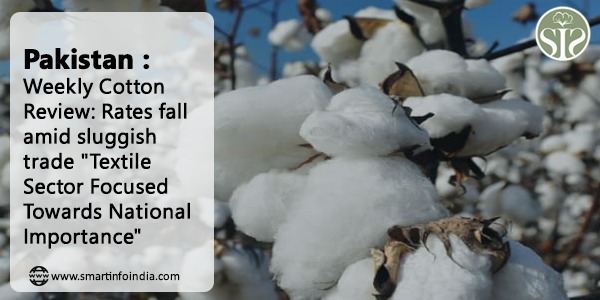
Pakistan : Weekly Cotton Review: Rates fall amid sluggish trade; "Textile Sector Focused Towards National Importance"

Pakistan : Weekly Cotton Review: Rates fall amid sluggish trade; "Textile Sector Focused Towards National Importance"KARACHI: The cotton market turned bearish last week, witnessing a fall. Significant reduction in rate from Rs.2,500 to Rs.3,000 per head. The spot rate was also reduced by Rs 2,500 per head.Former President Asif Ali Zardari met members of the All Pakistan Textile Mills Association (APTMA) to discuss issues related to the economy, revival of the cotton and textile sector.The intervention price of footy has come down from Rs 8500 per 40 kg. Growers say that as promised, the government should buy cotton through the Trading Corporation of Pakistan (TCP) to stabilize the price.Javed Bilwani, chairman of the Pakistan Apparel Forum, has said that the government should refrain from implementing RCET under Section 99D on the textile sector.In the local cotton market last week, cotton prices fell by Rs 2,500 to Rs 3,000 per head due to panic selling by ginners and low rates buying by spinning mills, creating chaos in the market.In Sindh province, cotton prices declined from Rs 17,000 to Rs 18,500 per head, while the price of foot per 40 kg fell by Rs 1,000 to Rs 7,000 to Rs 8,000. Similarly, the spot price of cotton decreased by Rs 2,200 per head to reach Rs 17,700.Cotton prices are expected to fall further after Eid al-Adha due to distress in the textile sector.The government has fixed the intervention price of cotton at Rs 8,500 per 40 kg and has promised that if the price of cotton falls below Rs 8,500, the government will provide about one million rupees through the Trading Corporation of Pakistan to stabilize the price of cotton. Gant will buy cotton. At present, the price of footi has come down to a low of Rs 7,000 to Rs 7,500 per 40 kg in many areas. Cotton farmers demand that the government should start purchasing cotton through TCP as promised.The rate of cotton in Sindh is between Rs 17,000 to Rs 18,000 per head. The rate of footi is between Rs 7,000 to Rs 7,700 per 40 kg. Cotton rates in Punjab range from Rs 18,500 to Rs 19,000 per head, while footy rates range from Rs 8,500 to Rs 8,800 per 40 kg. Cotton rates in Balochistan range between Rs 17,700 to Rs 18,000 per head. The rate of footi is between Rs 7500 to Rs 8200 per 40 kg.The spot rate committee of the Karachi Cotton Association has reduced the spot rate by Rs 2,200 per head and closed it at Rs 17,700 per head.Naseem Usman, president of Karachi Cotton Brokers Forum, has said that the overall bearish trend in the international cotton markets remains. The futures trading rate for the month of July closed at 78 cents.One lakh 87 thousand six hundred bales were sold in the year 2023-24. China remained on top by buying one lakh thirty seven thousand three hundred bales. Turkey bought 24,400 bales and stood second. Honduras was third with 10,900 bales.However, local textile mills have warned the government that a large number of export units may shut down as they have lost their competitive edge after the Regional Competitive Energy Tariff (RCET) is abolished.The APTMA has reiterated its demand for resumption of gas and electricity supply at subsidized rates and warned that failure to do so would lead to unemployment, loss of export revenue and further deterioration in the trade balance.Meanwhile, former President Asif Ali Zardari met APTMA leaders over revival of the economy, cotton and textile sector.In addition, Javed Balwani, head of the Pakistan Apparel Forum, which includes representatives of Pakistan's textile sector, has said that value-added garment exporters are concerned with the proposed implementation of an additional tax on "income, profits, gains and gains" under Art. 99D. He dismissed it as a "draconian and anti-business" move by the government.Garment exporters are already burdened with rising operational costs of manufacturing for exports. The super tax has been extended from one year to the second year. The present Government has earlier abolished the Regional and Competitive Energy Tariff (RCET), thereby depriving the exporters of a level playing field and a fair competitive environment.

Related News

Youtube Videos

साप्ताहिक कपास बाज़ार में गिरावट 😱 | नए सीजन 2026-27 की शुरुआत | Weekly Cotton Market 3 Oct 2026
साप्ताहिक कपास बाज़ार में गिरावट 😱 | नए सीजन 2026-27 की शुर...

Cotton Breaking 🔥 कॉटन, सीड, खल तीनों का भाव | जानिए आज का कपास बाज़ार | 1 October 2026
Cotton Breaking 🔥 कॉटन, सीड, खल तीनों का भाव | जानिए आज का...
रुई बाज़ार में गिरावट का रुख 😱 जानिए कपास भाव 🔥Cotton Market Rate Today 30 Sep 2026
रुई बाज़ार में गिरावट का रुख 😱 जानिए कपास भाव 🔥Cotton Mark...
Application Download
Whatsapp Contact