Recent News

China: China's exports fall the most in three years due to the struggle of the global economy

China: China's exports fall the most in three years due to the struggle of the global economyBEIJING: China's exports plunged the most in three years in June, falling a more than expected 12.4% year-on-year, as tensions from the struggling global economy show signs of escalating and Chinese policymakers face mounting pressure. facing. for promotional measures.Customs data on Thursday showed imports also fell more than expected, falling by 6.8%. A Reuters poll of economists had forecast a 9.5% drop in exports and a 4.0% decline in imports.The pace of China's post-pandemic recovery has slowed after rising sharply in the first quarter, with analysts now downgrading their projections for the economy for the rest of the year as factory production slowed due to persistently weak global demand. Is.Lav Daliang, spokesman for the General Administration of Customs, blamed "weak global economic recovery, slowing global trade and investment, and rising unilateralism, protectionism and geopolitics" for the poor export performance in remarks at a press conference in Beijing.Policymakers are now staring at the prospect of slowing growth to just 3% a year in the world's second-largest economy, according to economists' forecasts. This is less than half the normal rates of recent decades and creates a sense of an economy in recession.Chinese Premier Li Keqiang, who took office in March, has talked a good game on implementing policy measures to boost demand and strengthen markets, but few concrete steps have been announced and Investors are getting impatient."Looking ahead, headwinds facing the external sector remain strong, requiring policy support for domestic demand," said Zhou Hao, economist at Guotai Junyan International.South Korean shipments to China, a leading indicator of China's imports, fell 19.0% last month, the smallest decline since October, but the decline in semiconductors and other components used to manufacture electronic goods Demand remains weak.Raw material demand also showed signs of weakness, with copper imports falling 16.4% in June from a year earlier.Chinese factory activity has been shrinking in recent months, while consumer prices edged into deflation in June and producer prices fell at their sharpest pace in more than seven years.After badly missing the 2022 target, the government has set a modest GDP growth target of around 5% for this year.

Pakistan: Cotton market stable with satisfactory trading volume

Pakistan: Cotton market stable with satisfactory trading volumeLAHORE: The local cotton market remained stable on Wednesday with satisfactory trading volume.Cotton analyst Naseem Usman said that the rate of new cotton crop in Sindh is between Rs 16,900 to Rs 17,100 per head. The rate of footi in Sindh is between Rs 6,500 to Rs 7,300 per 40 kg.The rate of cotton in Punjab is between Rs 17,300 to Rs 17,500 per head and the rate of cotton is between Rs 7,200 to Rs 8,200 per 40 kg. The rate of cotton in Balochistan is Rs 17,100 per head while the rate of footy is between Rs 7,000 and Rs 7,300 per 40 kg.About 400 bales of Shahdad Pur were sold at Rs.16,900 to Rs.17,200 per head, 8800 bales of Tando Adam at Rs.16,900 to Rs.17,200 per head, 3800 bales of Sanghar at Rs.16,750 to Rs.17,100 per head, 1400 bales were sold. 600 bales of Mirpur Khas, 600 bales of Hyderabad were sold at Rs.16,800 per head, 200 bales of Qazi Ahmed at Rs.16,875 per head, 200 bales of Kotri at Rs.16,800 per head, 400 bales of Shahpur Chakkar were sold. Rs 16,900 to Rs 17,000 per head, 200 bales of Gup Chani sold at Rs 17,000 per head, 400 bales of Haider Shah sold at Rs 16,900 per head, 200 bales of Nawab Shah sold at Rs 16,800 per head 400 bales were sold at the rate of Rs.17,000 per head of Dalawar Pur, 400 bales of Tando Muhammad Khan at Rs.16,900 per head, 800 bales of Harunabad at Rs.17,400 to Rs.17,500 per head, 600 bales of Miyan Channu at Rs.17,500. Per head, 800 bales of Burewala were sold at Rs.17,400 per head, 800 bales of Khanewal at Rs.17,500 to 17,600 per head, 1000 bales of Chichavatni at Rs.17,400 to 17,500 per head, 1200 bales of Vehari were sold at Rs.17,500 per head. 17,400 to Rs 17,500 per head, 2600 bales of Laiya for Rs 17,300 to Rs 17,500 per head, 400 bales of Haasil Pur at Rs 17,350 per head, 200 bales of Ahmed Pur Purvi at Rs 17,300 per head. 200 bales of Maund, Fazilpur were sold at Rs.17,400 per head, 200 bales of Kaur Lal Esan at Rs.17,400 per head and 200 bales of Multan at Rs.17,350 per head.The spot rate remained unchanged at Rs 17,000 per head. Polyester fiber was available at Rs 350 per kg.

Pakistan: Considerable activity seen in the cotton market

Pakistan: Considerable activity seen in the cotton marketLAHORE: The local cotton market remained stable on Tuesday with satisfactory trading volume.Cotton analyst Naseem Usman said that the rate of new crop of cotton in Sindh is between Rs 17,000 to Rs 17,100 per head. The rate of footi in Sindh is between Rs 7,000 to Rs 7,400 per 40 kg.The rate of cotton in Punjab is between Rs 17,300 to Rs 17,500 per head and the rate of cotton is between Rs 7,300 to Rs 7,900 per 40 kg. Cotton rates in Balochistan range from Rs 17,000 to Rs 17,100 per head, while footy rates range from Rs 7,200 to Rs 7,400 per 40 kg.About 200 bales of Daur, 200 bales of Bukhari were sold at Rs.17,200 per head, 1200 bales of Nawab Shah at Rs.17,100 to Rs.17,200 per head, 4000 bales of Tando Edam at Rs.17,000 to Rs.17,200 per head. , Kotri 800 bales sold at Rs 16,900 to Rs 17,100 per head, Khadro 400 bales at Rs 17,000 to Rs 17,100 per head, Shahdadpur 2,000 bales at Rs 17,000 to Rs 17,300 per head, 1000 bales were sold. Mirpur Khas was sold for Rs.17,000 to Rs.17,100 per head, Sanghar for Rs.17,000 to Rs.17,100 per head for 1800 bales, Hyderabad for Rs.17,000 per head for 600 bales, Khando for Rs.17,100 for 600 bales. Rs 17,200 per head, 200 bales of Jhola Rs 17,000 per head, 200 bales of Hala Rs 17,200 per head, 200 bales of Shahpur Chakar Rs 17,000 per head, 800 bales of Laiya sold Rs 17,200 to 17,500 per head, 1 of Chichavatni 400 bales 17,200 to 17,500 rupees per head, 600 bales of Haasilpur, 800 bales of Harunabad, 200 bales of Rajanpur, 1200 bales of Burewala, 800 bales of Miyan were sold. 1600 bales of Channu, Vehari, 600 bales of Ahmed Pur East, 800 bales of Rahim Yar Khan, 600 bales of Pir Mahal, 400 bales of Gojra, 4,00 bales of Shujabad Rs.17,500 per head, 18,00 bales sold to Khanewal were sold at Rs.17,500 to Rs.17,700 per head.The spot rate remained unchanged at Rs 17,000 per head. Polyester fiber was available at Rs 350 per kg.

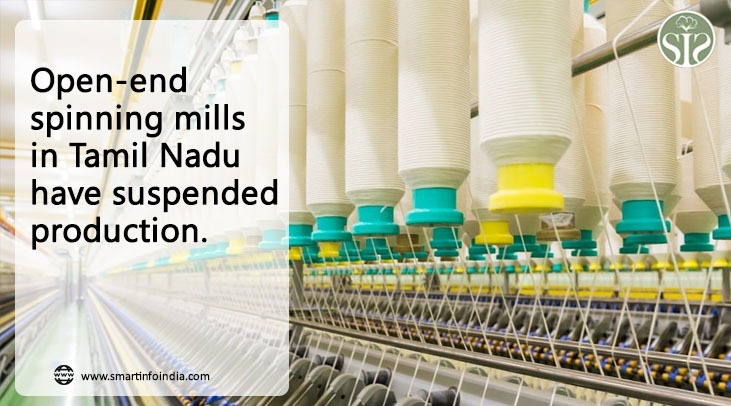
Openend spinning mills in Tamil Nadu suspend production

Openend spinning mills in Tamil Nadu suspend productionMost of the openend spinning mills, which are present in large numbers in Vellakoil, Dindigul, Mangalam, Palladam, and Sulur, are medium or small-scale and are LT CT electricity consumers.Over 400 openend spinning mills in Tamil Nadu suspended operations on Monday, July 10, as production costs had turned unviable for the mills.G. Arulmozhi, president of Openend Spinning Mills’ Association, told The Hindu the strike had resulted in the loss of ₹40 crore a day as nearly 30 lakh kg of yarn was not produced by the mills on Monday.Most of the openend spinning mills, which are present in large numbers in Vellakoil, Dindigul, Mangalam, Palladam, and Sulur, are medium or small-scale and are LT CT electricity consumers. Last year, the Tamil Nadu Generation and Distribution Corporation introduced peak hour charges, increased current consumption charges, and hiked the demand charges. The per unit cost paid by LT CT consumers is higher than HT consumers. “These units are shelling out almost ₹70,000 more a month because of higher power charges,” he said.Further, cotton waste prices are increasing for the last 10 months though raw cotton prices have reduced.With higher production costs, openend spinning mills in Tamil Nadu are unable to compete with the units in Punjab and Haryana that are now selling yarn in Tamil Nadu at ₹5 a kg less than the price quoted by the mills here.“The north Indian mills are bearing ₹10 a kg transport cost and still offering at ₹5 a kg lesser cost. We are unable to compete with these mills. Already about 20 mills have closed down,” he said.M. Jayabal, president of Recycle Textile Federation, said fabric woven using virgin cotton yarn was sold for ₹200 to ₹4,000 a metre depending on quality. However, grey cloth produced from the openend yarn, which was manufactured from waste cotton, cost just ₹28 - ₹50 a metre. In such a scenario, increasing waste cotton price to almost 72% - 75 % of virgin cotton had increased production cost. From August last year, the cost of comber noil (waste cotton) was 60 % to 87 % of cotton prices, varying every month. “Our funds are exhausted. For 10 months, we are operating without profit and spending the financial resources on hand,” he said. The mills reduced production during the last 10 months gradually, he said.

Maharashtra Cotton Rate: Cotton prices fall marginally in Parbhani

Maharashtra Cotton Rate: Cotton prices fall marginally in ParbhaniParbhani News : The arrival of cotton has decreased in Manawat, Selu, Parbhani, the main cotton mandis of Parbhani district. The procurement rates of cotton through auction are showing slight fluctuations. There has been a slight drop in price compared to last week.On Monday (10th), the minimum price of cotton in Selu Bazar Samiti ranged from Rs.6300 to maximum of Rs.7230 per quintal and the average price was Rs.7170 per quintal. While 190 to 200 carts of cotton arrived in Humanat Bazar Samiti, the minimum price per quintal was Rs 6000 to maximum Rs 7150 and the average price was Rs 7050.The Parbhani market committee used to earn about 100 quintals. Cotton received minimum price of Rs.6500 to maximum of Rs.7300 and an average of Rs.7250. At the Selu market committee on Saturday (8th), Kapala fetched a minimum price of Rs 6,000 to a maximum of Rs 7,255 per quintal and an average of Rs 7,125 per quintal.On Friday (7th), cotton received a minimum price of Rs.6100 to a maximum of Rs.7295 per quintal and an average of Rs.7240 per quintal. On Thursday (6th), the minimum price of cotton ranged from Rs.6100 to maximum Rs.7245 per quintal and the average price was Rs.7230 per quintal. On Wednesday (5th), the cotton price ranged from a minimum of Rs.6315 to a maximum of Rs.7340 per quintal and an average of Rs.7250 per quintal.There has been a slight decline in the price of cotton in Selu Bazar Samiti. Manavta Bazar Samiti received 1,650 quintals of cotton on Friday (7th) with a minimum price of Rs 6,000 to a maximum of Rs 7,200 and an average price of Rs 7,100 per quintal. On Thursday (6th), 625 quintals of cotton arrived and the prices ranged from a minimum of Rs.6000 to a maximum of Rs.7235 and an average price of Rs.7150 per quintal.On Wednesday (5th) 640 quintals of cotton arrived and the prices ranged from a minimum of Rs.6300 to a maximum of Rs.7370 and an average price of Rs.7280 per quintal. The arrival of cotton in Manav Bazar Samiti has decreased as compared to last week. The buying rate continues to fluctuate slightly. There is little fluctuation in the minimum and minimum rates.

Pakistan : Cotton Market: The week started on a positive note

Pakistan: Cotton market started the week on a positive noteLAHORE: The local cotton market remained stable on Monday with satisfactory trading volume.Cotton analyst Naseem Usman told the Business Recorder that the rate for the new crop of cotton in Sindh is between Rs 17,000 and Rs 17,300 per head. The rate of footi in Sindh is between Rs 7,000 to Rs 7,400 per 40 kg.The rate of cotton in Punjab is between Rs 17,500 to Rs 17,600 per head and the rate of foot is between Rs 7,000 to Rs 8,300 per 40 kg. Cotton rates in Balochistan range from Rs 17,000 to Rs 17,200 per head, while footy rates range from Rs 7,200 to Rs 7,500 per 40 kg.About 3600 bales of Tando Adam were sold at the rate of Rs.17,000 to Rs.17,200 per head, 1600 bales of Shahdad Pur were sold at the rate of Rs.17,000 to Rs.17,200 per head, 1400 bales of Sanghar at the rate of Rs.17,000 to Rs.17,200 per head 600 bales of Mirpur Khas were sold at Rs.7,000 per head, 400 bales of Hyderabad at Rs.17,100 per head, 800 bales of Kotri at Rs.17,000 to Rs.17,250 per head, 200 bales of Maqsuda Rind, 200 bales of Shah were sold. 400 bales of Pur Chakar, Khadro, 200 bales of Hala were sold at Rs 17,000 per head, 800 bales of Haasil Pur were sold at Rs 17,400 to 17,500 per head, 1600 bales of Chichavatni at Rs 17,600 per head 1400 bales were sold from, Vehari sold at Rs 17,400 to Rs 17,450 per head, Burewala 800 bales at Rs 17,400 per head, Taunsa Sharif 200 bales, Rajan Pur 200 bales, Dera Ghazi Khan 200 bales, Pir Mahal 400 bales were sold 200 bales of Samudri, 400 bales of Lodharan were sold at Rs.17,500 per head, 1,000 bales of Khanewal at Rs.17,500 to Rs.17,600 per head and 200 bales of Harunabad at Rs.17,500 per head.The spot rate remained unchanged at Rs 17,000 per head. Polyester fiber was available at Rs 350 per kg.

India's organic cotton cultivation figures are in dispute with global

India's organic cotton cultivation figures are in dispute with global production figuresIndia's organic cotton cultivation is once again in global controversy. This time, it's up to the Organic Cotton Market Report 2022, a non-profit organization that claims to be taking positive action on climate change.It has estimated the global organic cotton crop in 2020-21 at 342,265 tonnes produced from 6,21,691 hectares of certified organic land. Organic cotton accounts for 1.4 per cent of the total cotton production and its production has increased by 37 per cent since 2019-20.However, it has less confidence in data from five countries - India, Kyrgyzstan, Tajikistan, Turkey and Uganda - which accounted for 76 per cent of the certified organic total in 2020-21. In addition, he says he trusts Turkey's data two out of three times.due to doubtTerry Townsend, a textile industry consultant and former executive director of the International Cotton Advisory Council (ICAC), said on LinkedIn that one of the reasons to be skeptical (about the report) is that yields are calculated from the reported certified area. And the output is too high to be true.In his posting, Townsend, who is demanding the report be withdrawn, said, "Almost by definition, yields in organic agriculture are lower than those achieved by conventional farmers, and the reported organic cotton for 2020-21 The yield of the same in itself raises suspicion of fraud."One reason India's data is being viewed with skepticism is that the Agricultural and Processed Food Products Export Development Authority (APEDA) – India's nodal agency for organic farming – has sued at least four certification agencies for irregularities in the certification process. has been punished.all parameters violatedThe agencies were found to be violating all norms regarding organic cotton certification and, ironically, the growers were not aware that they were part of the organic farming group.These growers did not follow any norms for organic farming and used agro chemicals in their crop. Certifying agencies did not have internal control systems, requiring an office at the location where the producer group grew organic produce.One of the organizations penalized by APEDA did not have any records of the growers group registered for organic farming. Earlier this year, the International Organic Accreditation Service suspended the accreditation of the Control Union (CU) India to test and sample Indian organic textile products, alleging irregularities in the certification process.Mentioning India and four other countries, Townsend said that farmers, ginners and traders around the world know that it is possible to make fraudulent claims of organic cotton content without much risk.no penalty“After all, no one is ever jailed or fined for falsely claiming organic certification. Of the five countries for which the 2020-21 data has admitted to having low confidence, none has a system of Permanent Ballast Identification Number (PBI),” he said.Therefore, bales of cotton in these countries can be swapped and once the bales reach the spinning mill, there is no way to trace their origin or origin. A company making a bogus claim of organic ingredients risks losing certification and becoming an unlisted-supplier, losing the certified organic value premium, potential customs detention and reputational damage, he said, but it means a lot.Townsend wrote, "Not to say that his production estimates are almost certainly inflated, there are reasons to be highly skeptical of the figures reported by the certification agencies."Unique case of TürkiyeThe report noted that organic yields in eight countries, which account for 3,07,214 tonnes (90 per cent of the world's total) of 2020-21 production, were equal to or higher than total yields in each country, they said."At the very least, he explained how such high yields could be achieved, and nowhere did he address the issue," he said.In the case of Turkey, which is the primary issue raised by the former ICAC official, while organic cotton production has tripled, the country's agriculture ministry says it has fallen fourfold!Townsend objected to this with the disclaimer that it is "purely an aggregator of data" and does not perform an authentication function. He added that farmers, ginners and traders around the world know that it is possible to make fraudulent claims of organic cotton material without much risk.
Related News

Youtube Videos

आज कपास बाजार में कहीं तेजी, कहीं गिरावट 🔥 आवक 98,000 गांठ | 24 Nov 2026
आज कपास बाजार में कहीं तेजी, कहीं गिरावट 🔥 आवक 98,000 गांठ...
मध्य प्रदेश में कपास फसल भरपूर! 😱 पर मिलें सुस्त? | जनवरी से 11% ड्यूटी लगेगी? 🔥Podcast
मध्य प्रदेश में कपास फसल भरपूर! 😱 पर मिलें सुस्त? | जनवरी स...
CCI के पास 3-4 लाख गांठ कपास बचने का अनुमान! 😱 बाजार पर कितना होगा असर? | 21 Nov 2026
CCI के पास 3-4 लाख गांठ कपास बचने का अनुमान! 😱 बाजार पर कित...
Application Download
Whatsapp Contact