Recent News

Andhra Pradesh: Cotton price crosses Rs 11,000 per quintal

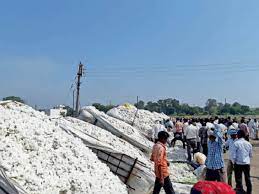
Andhra Pradesh: Cotton price crosses Rs 11,000 per quintalDaily arrivals reduced to 800 quintals, record jump in prices due to crop damage caused by rainsThe price of cotton crossed rs 11,000 mark for the first time on Thursday in the nearly eight-decade-old Adoni Krishi Mandi premises. Cotton sold at Rs 11,219 per quintal in Adoni, the state's only cotton market. Cotton had been selling below Rs 7,000 in previous years. The previous high was Rs 6,500.The price of cotton has been rising since the beginning of the current season, posting the highest December price of Rs 9,600 before crossing the Rs 10,000 level in January. B Srikanth Reddy, deputy director of the market, attributed the rise in cotton prices due to the rain on account of dwindling stocks in international markets, cultivation of cotton in low area and poor quality of produce in other markets.Kurnool's cotton seeds and lints are of superior quality, attracting traders and exporters to the market here. The official said that during the three months since last November, on an average, 4,000 quintals of cotton was traded daily in the Adani market. Recently, the average daily arrival of the produce has come down below 800 quintals due to decrease in production."Cotton comes from different parts of southern states, and at least 300 traders are working with the produce," he said. The market yard has 10 average bids per stock, which is the highest average bid in the entire country. According to official records, cotton was cultivated in 7 lakh acres across the district this year.The harvesting of the six-month crop began in December. Heavy rains destroyed the crop during the beginning of the sowing season, followed by less rainfall which also affected the farmers. Srikant Reddy said at least 40 ginning mills are operating around the market set up in 1943. Srikant Reddy said mill owners export cotton purchased after grading, separating seeds and lints.

Haryana sets target of increasing area under cotton by over three lakh acre

Haryana sets target of increasing area under cotton by over three lakh acreThe Haryana agriculture department has set a target of increasing area under cotton production up to 19.25 lakh acre in the 2022 Kharif season even though during the previous season, cotton was grown on 15.90 lakh acre.Cotton is mainly grown in Sirsa, Fatehabad, Hisar, Bhiwani, Jind, Sonepat, Palwal, Gurugram, Faridabad, Rewari, and Charkhi Dadri districts, an official spokesperson said, pointing out that during the previous season, cotton was infested with pink ball worm to some extent in few pockets of the state and losses in the yield were noticed.Keeping in view the serious threat of pink ball worm to cotton crop, additional chief secretary (agriculture and farmers’ welfare) Sumita Misra has directed the field staff to complete farmers’ awareness campaign and ensure cleaning of old cotton sticks/piles and fumigation of cotton ginning factories and oils mills in the state by March 31.The spokesperson said taking note of the said threat, the department has already covered about 85% of the villages in the cotton-growing districts and educated farmers of the areas through kisan melas and trainings by involving CCS Haryana Agricultural University, Hisar and private firms.The department has also chalked out a weekly activity calendar to increase area under cotton cultivation and to implement advisories throughout the cropping season for better production.Hardeep Singh, director general (agriculture), is leading the campaign of cleaning the old stock of cotton sticks in villages and fumigation of cotton factories.Among other initiatives being taken up, the spokesperson said special emphasis has been given to management of the pink ball worm to avoid yield losses. Also, the department has issued advisory to all cotton ginning and pressing factories to ensure fumigation of their premises. An advisory flex board has also been displayed on premises of the said firms.“The license of these firms will be renewed after compliance of fumigation advisory and producing certificate thereof,” the spokesperson said.

Cotton acreage set to grow by 10-15% on higher prices for fibre

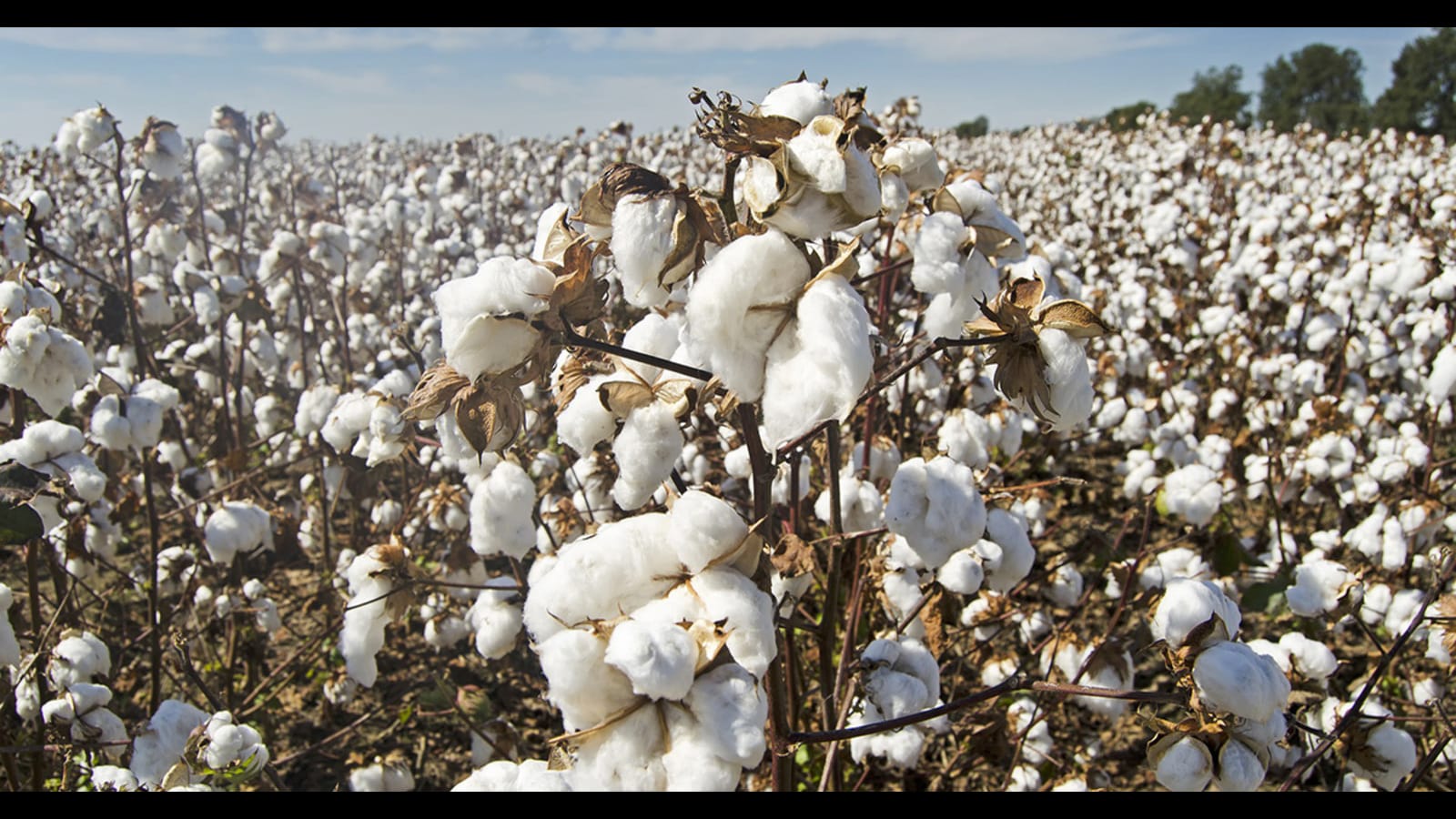
Cotton acreage set to grow by 10-15% on higher prices for fibreThreat from illegal HTBt cottonseed continue to stare at seed firmsCottonseed companies are gearing up for a high-demand market for seeds as they expect renewed interest from farmers following very good prices for the fibre crop.The seed industry forecast a growth of 10-15 per cent in the cotton acreage in the upcoming kharif season. Though higher rainfall and floods damaged the crop in many States, the season witnessed good overall productivity.Deficit in areaThe cotton area witnessed a deficit of 7.73 lakh hectares at 120 lack hectare as against the previous year’s acreage of 127.87 lack hectare.The National Seed Industry of India (NSAI) has pegged the the requirement of cottonseed at 4.50-4.75 crore packets (of 450 gm each) as against the last year’s 4.40-4.50 crore packets. “This could vary depending on the rain condition and erratic weather, which could impact the sowings. Sometimes farmers will have to go for resowing,” M Prabhakara Rao, President of NSAI told BusinessLine. He said that the area would increase due to all-time high price. The availability for some hybridseeds may be less than the demand. “But the overall supplies may be just about adequate if there is no requirement for the seed due to erratic rains,” he pointed out.“There was dip in area in 2021 by about 17 per cent when compared to the area in the previous year. It may recover by at least by 12 to 15 per cent,” M Ramasami, Chairman of Rasi Seeds (Private) Limited, said.Unauthorised seedsThe seed industry, which is facing a serious challenge from players that are selling unauthorised herbicide-tolerant cottonseeds, feels that the problem continues to pose problems.Asked whether the Bt-3 seeds will continue to pose problems, Ramasami admitted that would create some trouble. “The only possible solution is that the government should come forward to approve and see that the research-based companies are allowed to sell,” he said.A top executive of a cottonseed company said that the HTBt seed occupied about 18-20 per cent of the total cotton area last kharif. Farmers unions, however, argued that the area under illegal cotton could well be beyond 30 per cent. “Lower incidence of Pink Bollworm resulted in good quality cotton. This has led to very high commodity prices. They went up by more than 1.5 times the minimum support price,” he said.

U.S. EXPORT SALES FOR WEEK ENDING 17/03/2022

U.S. EXPORT SALES FOR WEEK ENDING 17/03/2022   Cotton:  Net sales of 307,500 RB for 2021/2022were down 17 percent from the previous week and 7 percent from the prior 4-week average.  Increases primarily for China (130,200 RB, including decreases of 8,900 RB), Turkey (71,700 RB, including decreases of 200 RB), Bangladesh (26,500 RB), Pakistan (25,700 RB, including 200 RB switched from the United Arab Emirates and decreases of 100 RB), and Vietnam (23,400 RB, including 1,400 RB switched from South Korea, 500 RB switched from Indonesia, 500 RB switched from Japan, and decreases of 200 RB), were offset by reductions for South Korea (1,400 RB), Guatemala (200 RB), and the United Arabia Emirates (200 RB).  Net sales of 67,400 RB for 2022/2023were primarily for China (21,800 RB), Thailand (13,600 RB), Pakistan (9,700 RB), Turkey (7,900 RB), and Guatemala (6,100 RB).  Exports of 442,700 RB--a marketing-year high--were up 36 percent from the previous week and 29 percent from the prior 4-week average.  The destinations were primarily to China (173,500 RB, including 46,000 RB - late), Vietnam (74,700 RB, including 12,500 RB - late), Turkey (50,400 RB, including 5,500 RB late), Pakistan (37,100 RB, including 2,300 RB - late), and Mexico (23,700 RB).  Net sales of Pima totaling 3,000 RBwere down 76 percent from the previous week and 53 percent from the prior 4-week average.  Increases were primarily for India (1,200 RB), China (700 RB), and Turkey (600 RB).  Exports of 5,800 RB were down 25 percent from the previous week and 61 percent from the prior 4-week average.  The destinations were primarily to China (2,000 RB), Peru (1,700 RB), and Vietnam (1,500 RB).   Optional Origin Sales:  For 2021/2022,options were exercised to export 4,400 RB to Pakistan from the United States.  The current outstanding balance of 57,200 RB is for Vietnam (52,800 RB) and Pakistan (4,400 RB). Exports for Own Account: For 2021/2022,the current exports for own account outstanding balance is 100 RB, all Vietnam.Late Reporting: For 2021/2022,exports totaling 80,600 RB of upland cotton were reported late to China (46,000 RB), Vietnam (12,500 RB), Bangladesh (5,900 RB), Turkey (5,500 RB), South Korea (3,600 RB), Indonesia (2,600 RB), Pakistan (2,300 RB), Thailand (700 RB), India (600 RB), Guatemala (500 RB), and Peru (400 RB).

Bangladesh: Cotton price rise impacts RMG exports

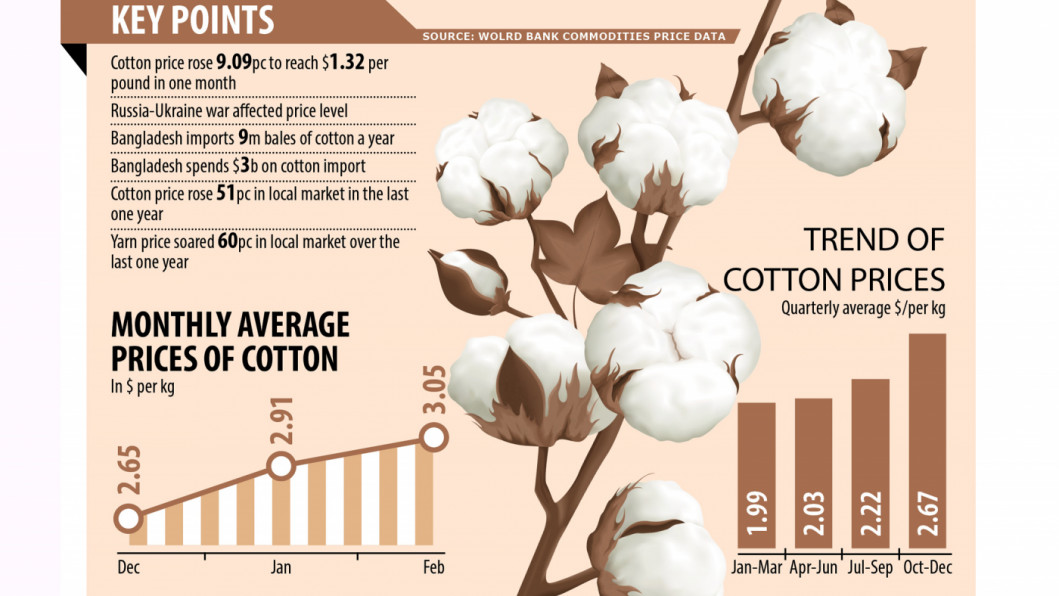
Bangladesh: Cotton price rise impacts RMG exportsCotton prices in the global market hit a high of over a decade in the wake of the Russo-Ukraine war, unusual increase in freight and drought in the US, which will increase the production cost for readymade garment (RMG) manufacturers in Bangladesh. Which is affecting their profitability.Even before the Russian-Ukraine war, the price of major textile raw materials had risen to increased demand in the international market, following the reopening of economies following the pandemic-led lockdown.Due to drought in some cotton-growing regions in the US, rising petroleum prices in global markets and high-volume purchases of cotton by China raised the price of white fiber by up to 9.09 percent last month.As a result, the cost of production for textile manufacturers and exporters will further increase as Bangladesh is completely dependent on imported cotton to feed its main export income zone.Local producers can supply less than 2 per cent of the 9 million bales of cotton consumed annually in the country, forcing the country to spend nearly $3 billion on raw material imports for the growing garment industry. Some 480 pounds, or 218 kilograms, form a bale.Importers and mill owners say that if the war continues, the price of cotton will rise further. This will eventually increase the price of the yarn in local markets, increasing the cost of production for garment manufacturing."Sometimes, spinners have increased the price by $1 per kg in recent months. "Mustafizur Rahman, distinguished fellow at the Centre for Policy Dialogue, says the high price of cotton will affect the profits of textile exporters.International retailers and brands in the apparel business at large are not bearing the extra cost of production. He said that local exporters are bearing the burden of this.Cotton prices rose 51% year-on-year in February. Rahman said the price of white fibre has increased further and this means further pressure on the profits of garment exporters.The fresh cotton price hike is expected to impact exports of garment goods from Bangladesh at a time when the industry is recovering from the dire repercussions of COVID-19.

Related News

Youtube Videos

🔥 आज के कपास और रुई के ताज़ा भाव | Cotton Rate Today | Kapas Bhav | Cotton Market 6 Oct 2026
🔥 आज के कपास और रुई के ताज़ा भाव | Cotton Rate Today | Kapa...
आज देशभर में रुई के भाव 😱 | नए कपास सीजन का ताज़ा अपडेट | Cotton Market Rate Today 5 Oct 2026
आज देशभर में रुई के भाव 😱 | नए कपास सीजन का ताज़ा अपडेट | C...
साप्ताहिक कपास बाज़ार में गिरावट 😱 | नए सीजन 2026-27 की शुरुआत | Weekly Cotton Market 3 Oct 2026
साप्ताहिक कपास बाज़ार में गिरावट 😱 | नए सीजन 2026-27 की शुर...
Application Download
Whatsapp Contact