STAY UPDATED WITH COTTON UPDATES ON WHATSAPP AT AS LOW AS 6/- PER DAY
Start Your 7 Days Free Trial TodayTextile Ministry to Get $122M Boost for Cotton Productivity MissionAccording to industry sources, the Ministry of Textiles is poised to receive an allocation of approximately ₹1,100 crore (US$122 million) from the Indian government's new Cotton Productivity Mission. This move aims to strengthen the country's textile value chain. This allocation represents more than 20% of the mission's total proposed budget of approximately ₹6,000 crore (US$668 million).The funding is coming from the five-year Cotton Productivity Mission, announced in the Union Budget 2025-26, with the objective of addressing declining cotton production and quality issues in India and revitalizing the country's textile sector. Under the scheme, a significant portion of the total expenditure is being allocated to agencies involved in agricultural research and production, but the Ministry of Textiles has negotiated for a substantial share to be directed towards post-harvest and processing activities.According to officials familiar with the discussions, the ministry will utilize these funds to modernize ginning and pressing facilities, improve lint quality control, and enhance the handling of cotton bales to ensure high-quality raw material reaches textile mills. These measures aim to reduce contamination and deficiencies that currently undermine competitiveness in both domestic and export markets.Experts note that cotton production in India has declined for several consecutive seasons, and yield per hectare remains significantly lower than the global average – factors that have put increasing pressure on raw material supply for the textile industry. Proponents of the mission argue that investment in post-harvest infrastructure is crucial to reversing this trend and reducing reliance on imported cotton.The implementation of the mission and the release of funds are still contingent on final cabinet approval, which has been delayed since the initial announcement of the scheme. Government representatives have consistently emphasized the need for sustained inter-ministerial coordination to effectively implement the program. This mission is part of a broader government strategy to improve cotton productivity, encourage the cultivation of high-value varieties, including extra-long staple cotton, and strengthen the competitiveness of India's textile exports.READ MORE :- INR Opens Stronger by 05 Paise at 89.93

Rupee opened 05 paise higher at 89.93/USDIndian rupee opened marginally higher at 89.93 per dollar on Tuesday against Monday's close of 89.98.read more :- Bangladesh textile and garment bodies seek restoration of local yarn incentives
Bangladeshi Textile Industry Demands Restoration of Yarn Incentives Amid Rising Cost PressuresBangladesh’s ready-made garment (RMG) exporters and textile millers have jointly intensified calls for the restoration of government cash incentives on the use of locally produced yarn, warning that the recent policy changes could weaken the country’s textile–apparel supply chain and hurt export competitiveness.Leading industry bodies, including the Bangladesh Garment Manufacturers and Exporters Association (BGMEA), Bangladesh Knitwear Manufacturers and Exporters Association (BKMEA), and Bangladesh Textile Mills Association (BTMA), have urged the Ministry of Finance to reinstate a 5% cash incentive on local yarn usage. The request follows a recent reduction in the incentive to 1.5% as part of Bangladesh’s transition from Least Developed Country (LDC) status.Industry leaders argue that the sharp cut has increased production costs for exporters and weakened the backward linkage textile sector. They believe restoring higher incentives would help boost local value addition, which is becoming increasingly important for maintaining competitiveness under evolving global trade conditions, including the United States’ reciprocal tariff framework.In a letter dated December 24, BTMA President Shawkat Aziz Russell highlighted multiple pressures facing the sector, including geopolitical tensions from ongoing global conflicts, depreciation of the taka, rising gas tariffs, higher labour costs, and disruptions in energy supply. The association has also requested an extension of the export cash incentive scheme under Bangladesh Bank FE Circular No. 28, proposing that it be extended from December 31, 2025, to December 31, 2028.Exporters have additionally suggested a 10% direct incentive for spinning mills to revive domestic yarn production and offset competition from cheaper imports, particularly from India. Many local mills are reportedly facing large unsold inventories, forcing them to reduce production and operate below capacity.Industry stakeholders warn that without adequate incentive support, Bangladesh’s backward linkage industry could weaken further, potentially disrupting yarn supply for the RMG sector. Together, textiles and apparel account for nearly 85% of Bangladesh’s total export earnings and remain critical to foreign exchange stability.Stakeholders also note that WTO rules allow developing economies transitional policy support during adjustment periods. They question Bangladesh’s move toward phasing out cash incentives while competing textile-exporting countries continue to support their industries through subsidies and policy incentives.With the fiscal year-end approaching, exporters and millers are closely watching government decisions, as the incentive framework is seen as crucial for sustaining export growth and maintaining the strength of Bangladesh’s industrial base.Read More :- The rupee closed 5 paise lower against the dollar at 89.98.
On Monday, the Indian rupee closed at 89.98 against the dollar, compared to its opening rate of 89.93.At the close of the market, the Sensex fell by 345.91 points or 0.41 percent to 84,695.54, and the Nifty declined by 100.2 points or 0.38 percent to 25,942.10. Approximately 1395 shares advanced, 2595 declined, and 144 remained unchanged.Read More :- Tariff impact to moderate H2 FY26 Indian cotton yarn realisation: ICRA
ICRA: Tariff Impact on Cotton Yarn to Ease in H2 FY26Following a flattish H1 FY26, the impact of US tariff on Indian cotton spinners is expected to moderate cotton yarn realisation in H2, ICRA said.Cotton spinners' revenues are projected to drop by 4-6 per cent in FY26 and margin contraction is likely to be 50-100 bps.Moderation in cotton prices is likely to offset the impact to an extent.Material expansion in capacity creations is not expected in FY26.Following a flattish first half (H1) of fiscal 2025-26 (FY26), the trickle-down effect of US tariff on Indian cotton spinners is expected to moderate cotton yarn realisation in the second half, according to ICRA.Revenues of cotton spinners are projected to decline by 4-6 per cent in FY26 and margin contraction is likely to be 50-100 basis points (bps). Moderation in cotton prices is expected to offset the impact to an extent.Any positive developments around the ongoing tariff-related negotiations with the United States could help soften the impact to an extent, the Moody’s Ratings affiliate said in a report titled ‘Indian Cotton Spinning Industry: Trends & Outlook’After witnessing a modest recovery in FY25 with increase in domestic yarn consumption by 2 per cent year on year (YoY), the Indian cotton spinning industry, is navigating a challenging phase in FY26 amidst a mix of stable domestic demand and effects of reciprocal and punitive tariffs levied by the United States on Indian apparel exports.To mitigate the impact, Indian apparel exporters are providing sizeable discounts, which are being absorbed throughout the value chain (including spinners).The import duty exemption on cotton imports in India till December 2025 and recent relaxation on quality control orders for both viscose staple fibre (VSF) and several yarns and polyester fibres is likely to moderate raw material prices for manmade fibre (MMF) yarn manufacturers, it said.“While this supports readymade garments manufacturers with access to raw material at competitive prices, it exposes domestic MMF yarn manufacturers to competition from import suppliers,” noted ICRA.Domestic cotton fibre prices fell by around 3 per cent month on month (MoM) in November 2025. Average cotton yarn prices fell by 4 per cent.This resulted in contribution levels moderating to ₹96/kg in November 2025 from ₹103 per kg in H1 FY26. ICRA anticipates contribution levels are likely to stabilise at ₹98-100 per kg for FY26 due to moderation in realisation expected in H2 FY26.ICRA's sample set of 13 companies, which accounts for 25-30 per cent of the industry's revenue, is expected to report a 4-6 per cent decline in revenues on a YoY basis in FY26.Additionally, margins are expected to contract by 50-100 basis points in FY26, primarily due to weaker performance expected in H2.Given the available capacities, material expansion in capacity creations is not expected in FY26 in the sector, ICRA added.READ MORE :-The rupee opened 8 paise lower at 89.93/USD.
The rupee opened 8 paise lower at 89.93 per dollar.The Indian rupee opened at 89.93 against the dollar on Monday, compared to its previous close of 89.85.READ MORE :- TASMA urges Finance Minister to extend duty-free cotton import facility
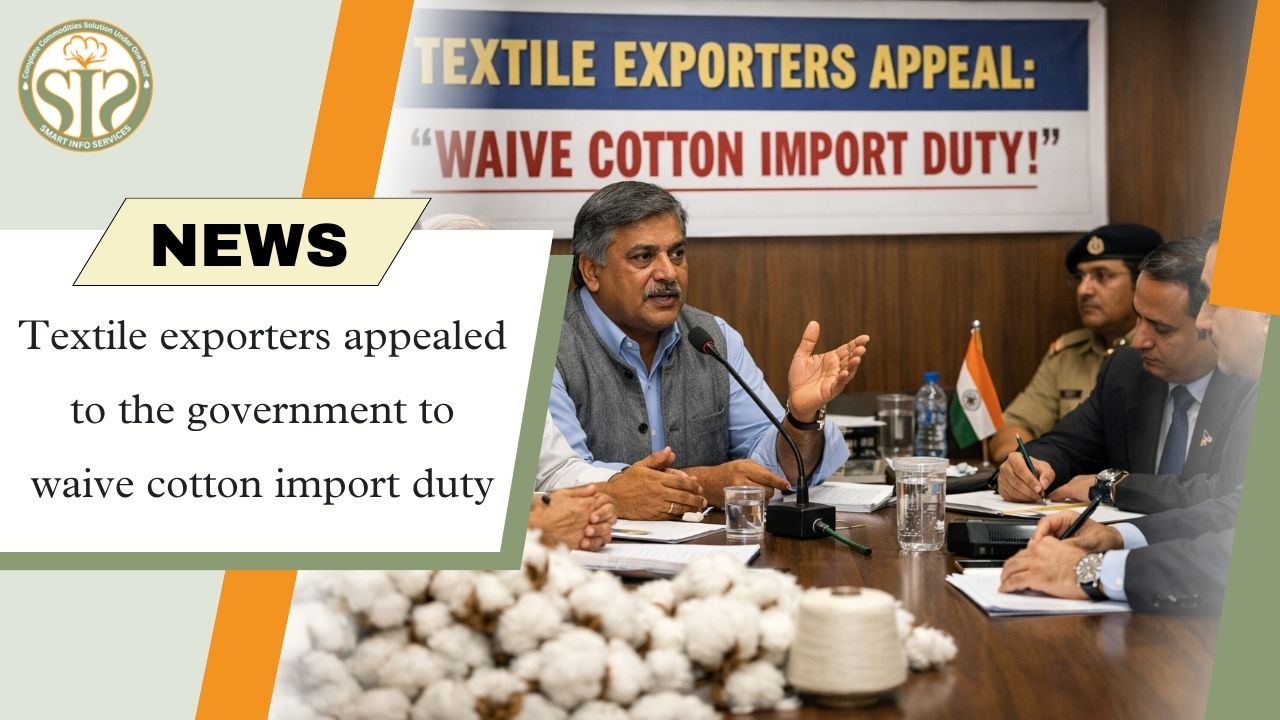
TASMA requests that the Finance Minister expand the duty-free cotton import program.It will help mills in the country to overcome shortage of the natural fibre and be competitiveThe Tamil Nadu Spinning Mills Association (TASMA) has urged Finance Minister Nirmala Sitharaman to extend duty-free imports of cotton beyond December 31, 2025, as the country could face a cotton shortage in view of lower production.TASMA President A P Appukutty, in a letter to the Finance Minister, said extending duty-free imports may ease the availability of cotton and help mills to competitively price their products in the global market. Welcoming the government’s move to extend duty-free imports from September 30, 2025, to December 31, 2025, he said it helped mills to import cotton at a price lower by 11 per cent and offer their products at a competitive price in the global market. The decision proved crucial when the industry faced a critical situation due to the imposition of 50 per cent tariffs by the US on all Imports.Lower production estimatePointing to the Committee on Cotton Production and Consumption, estimating cotton production for this season (October 2025-September 2026) lower at 292.15 lakh bales (170 kg), Appukutty said domestic availability will be the lowest compared to the past few years. Extending the duty-free imports further will benefit mills, particularly at a time when cotton arrivals are reported to be low.Read More :- China's Xinjiang achieves record cotton output in 2025
China's Xinjiang achieves record cotton output in 2025Harvesting machines shuttle among the cotton fields in the Mongolian Autonomous Prefecture of Bayingolin, northwest China's Xinjiang Uygur Autonomous Region, September 29, 2025.Northwest China's Xinjiang Uygur Autonomous Region posted a record cotton output of over 6 million tonnes in 2025, official data showed on Friday.The region produced 6.165 million tonnes of cotton this year, accounting for 92.8 percent of the national total, according to the National Bureau of Statistics.Xinjiang's cotton planting area has expanded to nearly 38.88 million mu (about 2.59 million hectares), which was up 5.9 percent year on year, and its average yield has come in at 158.6 kilograms per mu, up 2.4 percent year on year.Favorable weather conditions throughout the growing season helped boost output, with strengthened policy support, advances in agricultural technology, and improved talent development also contributing to higher productivity, experts say.The overall mechanization rate of cotton cultivation and harvesting in Xinjiang is expected to exceed 97.5 percent this year, boosting large-scale, mechanized and intelligent cotton production further.Xinjiang remains China's largest cotton-producing region. The country's cotton output rose 7.7 percent from 2024 to 6.641 million tonnes in 2025.READ MORE :- The Textiles Ministry is set to receive ₹1,100 crore from the Cotton Productivity Mission to boost quality and manufacturing
CCI sells 94% cotton stock via e-auctions; ₹6,000 crore Cotton Productivity Mission set to boost sectorNew Delhi: The Cotton Corporation of India (CCI) has sold 94.28% of its 2024–25 cotton procurement through online auctions this week, while largely maintaining prevailing price levels, indicating stable market operations despite sectoral pressures.Meanwhile, the Textiles Ministry is expected to receive over ₹1,100 crore under the government’s ₹6,000 crore Cotton Productivity Mission, a five-year initiative announced in the Union Budget aimed at reviving India’s stressed cotton ecosystem.The mission, which accounts for roughly 22% of the total outlay for the scheme, is designed to modernise textile infrastructure, improve lint quality, and strengthen the farm-to-fabric value chain. However, the final allocation is still awaiting Cabinet approval, which has reportedly been delayed for nearly a year.Declining cotton output raises concernIndia’s cotton sector continues to face structural challenges, with production falling for three consecutive years—from 32.52 million bales in 2023–24 to 29.22 million bales in 2025–26. The cultivated area has also shrunk by around 2 million hectares over the past four years.Productivity remains a major concern, with India’s yield stuck below 5 quintals per hectare, compared to a global average of 9 quintals and around 10 quintals per hectare in the United States.Fund allocation across departmentsUnder the ₹6,000 crore mission, the Department of Agriculture and Farmers Welfare will receive the largest share of over ₹4,000 crore (about 69%). The Indian Council of Agricultural Research (ICAR) will receive nearly ₹600 crore (around 9%), while the Textiles Ministry has been allocated ₹1,100 crore for textile-side interventions.The distribution has reportedly triggered internal differences, with concerns raised by ICAR scientists over limited funding despite being tasked with designing and implementing key mission objectives.Focus on quality and infrastructure upgradeThe Textiles Ministry plans to utilise its allocation to improve ginning infrastructure, bale handling systems, and lint quality assessment processes. Officials argue that while farm-level production is important, post-harvest handling plays a critical role in determining the quality of cotton supplied to mills.Poor ginning practices and contamination during handling have been identified as major factors affecting fibre quality, forcing mills to either depend on imported cotton or use lower-grade domestic supply.Long-term competitiveness goalsThe mission also aligns with India’s broader textile ambitions, including building a $250 billion industry by 2030, with $100 billion targeted from exports. Cotton remains central to India’s textile sector, supporting millions of livelihoods and export earnings.Policy makers believe that strengthening both agricultural productivity and processing infrastructure is essential to improving competitiveness and ensuring a stable supply of high-quality domestic cotton for the textile industry.Read More :- The Cotton Corporation of India (CCI) kept its prices unchanged this week and sold 94.28% of its 2024-25 cotton procurement through e-auctions.
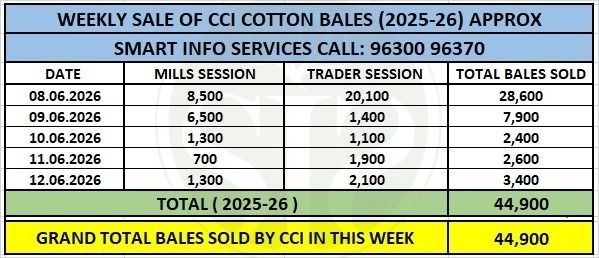
This week, the Cotton Corporation of India (CCI) sold 94.28% of its 2024–2025 cotton procurement through online auctions while maintaining its current prices.During the entire week from 22 December to 26 December 2025, CCI conducted online auctions at its mills and trader sessions, achieving total sales of approximately 1,00,400 bales. Weekly Sales PerformanceDecember 22, 2025:CCI sold 28,100 bales, of which 13,200 bales were purchased by mills and 14,900 bales by traders.December 23, 2025:Total sales stood at 21,300 bales, with mills buying 6,200 bales and traders accounting for 15,100 bales.December 24, 2025:Sales amounted to 19,300 bales, including 11,400 bales acquired by mills and 7,900 bales by traders.December 26, 2025:The highest sales of the week were recorded on this day, with 31,700 bales sold. Mills purchased 6,800 bales, while traders lifted a significant 24,900 bales.CCI sold a total of approximately 1,00,400 bales during the week, taking its cumulative sales to 94,28,100 bales for the season, which is 94.28% of its total purchases for 2024-25.Read More :- The rupee closed 01 paisa higher against the dollar at 89.85
On Friday, the Indian rupee opened at 89.86 against the dollar and closed 01 paisa higher at 89.85.The Sensex closed 367 points lower; the Nifty at 26,042; IT and auto stocks saw the biggest declines.Read More :- CCI cotton procurement 50 lakh bales at MSP till now
The rupee opened 8 paise lower at 89.86/USD.The domestic currency opened at 89.86 against the US dollar, compared to its previous closing of 89.78 against the dollar.READ MORE :- 2025 year-end achievement - India's Ministry of Textiles
Ministry of Textiles: Key Achievements 2025India’s textiles sector recorded wide-ranging policy reforms, infrastructure rollout and tax rationalisation in 2025, as outlined in the Year End Review released by the Ministry of Textiles on December 24, 2025. The measures aim to boost domestic manufacturing, improve global competitiveness and support farmers, weavers and artisans across the value chain.A major highlight was the rescinding of Quality Control Orders on viscose staple fibre from November 18, 2025, MMF polyester segments from November 12, 2025, and textile machinery, alongside deferring cotton bale QCO implementation to August 2026. Customs duty exemption on raw cotton was granted for August–December 2025 to ease input costs for spinners.The 56th GST Council meeting delivered significant tax rationalisation, cutting GST on garments and made-ups priced up to ₹2,500 per piece to 5 per cent. Rates on MMF fibres were reduced from 18 per cent to 5 per cent, and MMF yarns from 12 per cent to 5 per cent, while carpets, handicrafts, handlooms and sewing machines were also brought under the 5 per cent slab.Export facilitation improved through the extension of the export obligation period under Advance Authorisation from six to 18 months for QCO-covered items, and the extension of RoDTEP benefits to EOUs, SEZs and Advance Authorisation units. RoSCTL for garments and made-ups has been extended until March 31, 2026.The Production Linked Incentive scheme was revised to ease compliance, with expanded eligible products, relaxed company formation norms, lower investment thresholds and a reduction in incremental turnover criteria from 25 per cent to 10 per cent.On infrastructure, seven PM MITRA Parks with an outlay of ₹4,445 crore were approved and rolled out. The ministry confirmed 100 per cent land acquisition, environmental clearances for all parks and approved land allotment policies in Madhya Pradesh and Tamil Nadu. Cotton procurement systems were also expanded and digitised, while decriminalisation measures were introduced under the Jan Vishwas Bill 2025 across key textile laws.Read more :- CCI cotton procurement 50 lakh bales at MSP till now
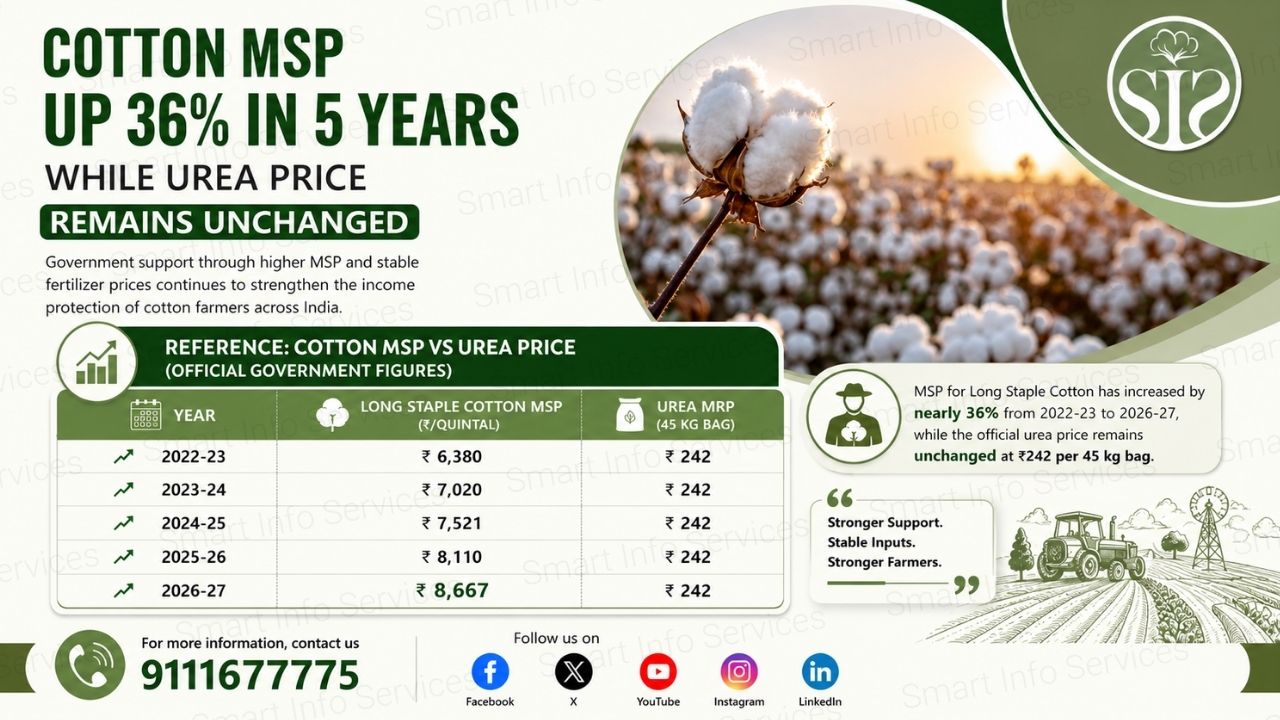
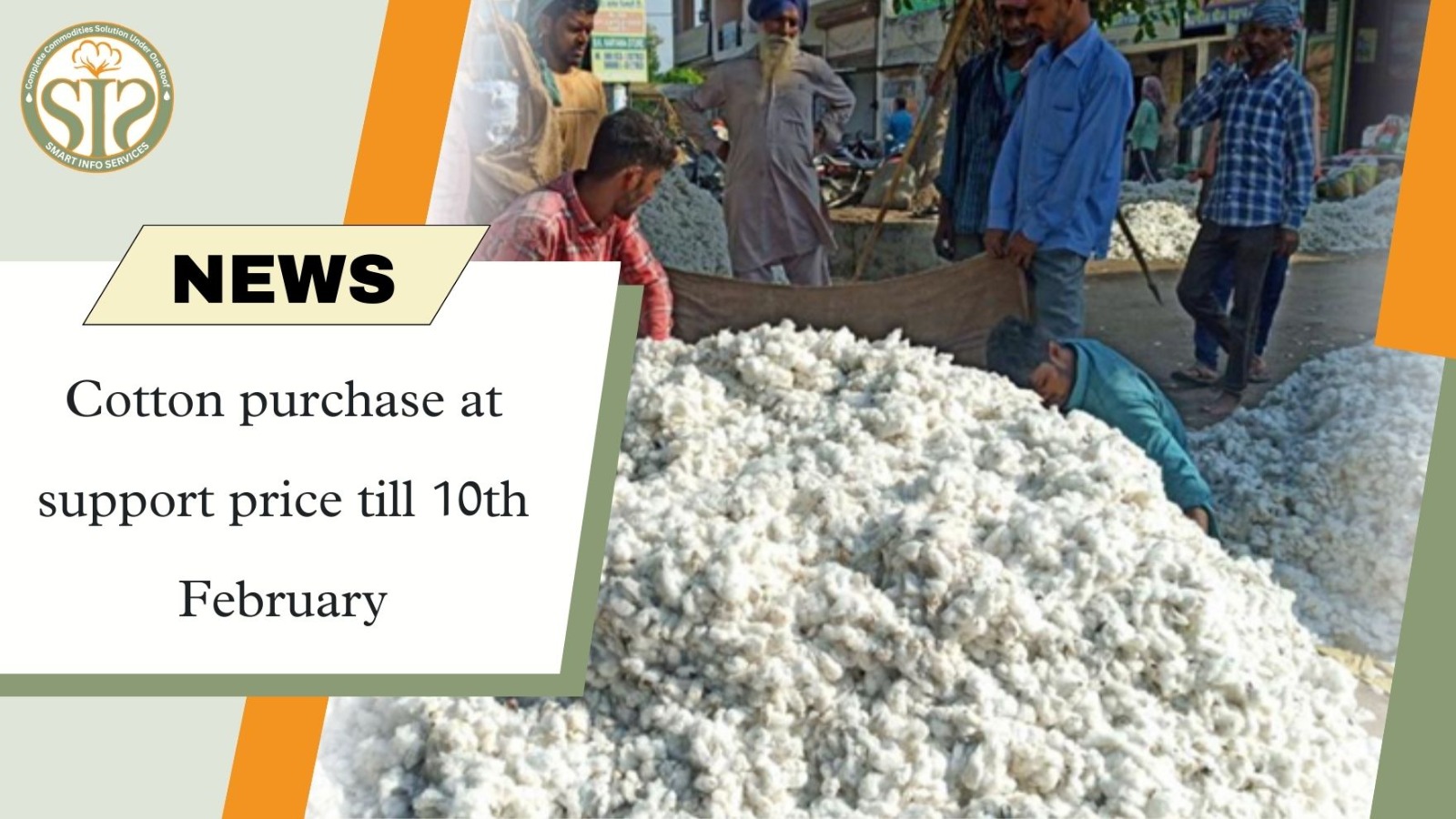
CCI Procures 50 Lakh Cotton Bales at MSPThe state-run Cotton Corporation of India (CCI) has procured about 50 lakh bales of the natural fibre crop at minimum support price (MSP ) in the current 2025-26 season till now. The MSP purchases so far this season are higher by about 60 per cent over the 31 lakh bales purchased till mid-December last year.We have procured about 50 lakh bales out of the arrivals of 118 lakh bales. The daily procurement is now more than 2 lakh bales,” said Lalit Kumar Gupta, Chairman and Managing Director, CCI.As per CCI, the progressive purchase of raw cotton till December 19 was 230.23 lakh quintals valued at ₹18,238 crore. The bulk of these purchases has been made in Telangana and Maharashtra. In Telangana, about 93.87 lakh quintals of cotton, valued at ₹7,445 crore, have been purchased, while in Maharashtra CCI has purchased about 47.69 lakh quintals valued at ₹3,779 crore.In Karnataka, 21.49 lakh quintals of cotton valued at ₹1,708 crore has been procured by CCI, while in Gujarat the purchased quantity stood at 19.23 lakh quintals valued at ₹1,546 crore. In Andhra, the procured quantity is valued at ₹972 crore, while in Rajasthan it was ₹848 crore, so far. In Haryana, the CCI has purchased cotton valued at ₹484 crore, while in Odisha it was ₹315 crore and Punjab ₹103 crore, as per the data on CCI website.CCI’s market intervention has lent stability to the cotton prices, which have firmed up from the levels at the start of the season, but are still below the MSP. The Centre has announced a MSP of ₹7,710 per quintal for the medium staple cotton and₹8,110 for the long staple cotton for the 2025-26 season.Quality raw cotton prices, which were hovering around ₹7,200-7,300 per quintal at the start of the season, are now hovering around ₹7,800 levels in the private trade at Raichur, Karnataka,” said Ramanuj Das Boob, a sourcing agent. Similarly, the pressed cotton prices have moved up by ₹2,000-2,500 per candy (356 kg) to around the ₹54,000 level. Farmers are preferring to sell to CCI as they are offering a higher prices compared to the market price, he said.Lower acreage coupled with adverse climate has shrunk the cotton crop this year. Also the excess and unseasonal rains have impacted the quality across almost all growingStates. As per the first advance estimates of the Agriculture Ministry, cotton crop for 2025-26 is projected slightly lower at 292.15 lakh bales of 170 kg each over previous year’s 297.24 lakh bales. Cotton imports are currently duty free till the end of this year.Read more :- The rupee closed 21 paise lower at 89.78 against the dollar
On Wednesday, the Indian rupee closed 21 paise lower at 89.78 against the US dollar, compared to its opening level of 89.57.At the close, the Sensex fell 116.14 points, or 0.14 percent, to 85,408.70, and the Nifty declined 35.05 points, or 0.13 percent, to 26,142.10. Approximately 1,693 shares advanced, 2,154 declined, and 118 remained unchanged.Read More :- In Wani taluka, known as the "Island of White Gold," heavy rains this year have severely impacted cotton production.
Heavy Rains Batter Cotton in WaniAs a result, cotton procurement by the end of December has decreased by 1.25 lakh quintals compared to last year. Last season, the Cotton Corporation of India (CCI) purchased 128,604 quintals of cotton by the end of December. Total procurement for the entire season reached approximately 5 lakh quintals. However, this year, CCI's procurement started late, and due to the reduced production, the expected arrivals are not being met.According to information from the Agricultural Produce Market Committee, CCI is currently purchasing cotton from 12 ginning units in Wani, as well as from ginning units in Shindola and Navargaon. Initially, the price for good quality cotton was Rs. 8,110 per quintal. However, based on grading, this price has now dropped to Rs. 6,060. The price is determined only after the cotton in each truck is inspected by a CCI grader.This year, farmers are showing a greater preference for the Shindola market compared to the Wani market. As of December 18th, a total of 168,832 quintals of cotton had been purchased, with 97,909 quintals purchased in Wani, 63,740 quintals in Shindola, and 7,182 quintals in Navargaon. The Market Committee estimates that this procurement will reach 2 lakh quintals by the end of December. However, due to the overall lower cotton production this year, only about 3 lakh quintals are expected to be purchased throughout the entire season, which is approximately 2 lakh quintals less than last year.Competition Among Ginning UnitsAlthough CCI is purchasing cotton from 12 ginning units in Wani, farmers have to choose which ginning unit to sell their cotton to. For this, they have to register on an app and specify their preferred slot and ginning unit. Therefore, ginning unit owners are running advertisements urging farmers to "choose our ginning unit." They are leaving. In some places, drivers are being offered incentives, while in other places, ginning mill owners are even talking about giving out lottery prizes. As a result, some ginning mills are empty, while in other places, large quantities of cotton are being stockpiled.Price increase by private tradersDue to lower production, cotton is expected to fetch a good price in the market this year. Because of large-scale purchases by the Cotton Corporation of India (CCI), private traders were unable to obtain cotton. Therefore, traders have also increased prices and are currently offering 7,500 to 7,600 rupees per quintal. It is expected that if the price increases by another 200 to 300 rupees, farmers will be able to sell their cotton to these traders.READ MORE :- The rupee opened 9 paise higher at 89.57/USD.
| title | Created At | Action |
|---|---|---|
| Textile Ministry Set to Receive $122 Million from Cotton Productivity Mission | 30-12-2025 18:17:00 | view |
| INR Opens Stronger by 05 Paise at 89.93 | 30-12-2025 17:35:59 | view |
| Bangladesh Textile Industry Pushes to Restore Yarn Incentives | 30-12-2025 01:26:36 | view |
| The rupee closed 5 paise lower against the dollar at 89.98. | 29-12-2025 22:56:34 | view |
| Tariff impact to moderate H2 FY26 Indian cotton yarn realisation: ICRA | 29-12-2025 18:50:09 | view |
| The rupee opened 8 paise lower at 89.93/USD. | 29-12-2025 16:43:58 | view |
| TASMA urges Finance Minister to extend duty-free cotton import facility | 27-12-2025 22:23:49 | view |
| China's Xinjiang achieves record cotton output in 2025 | 27-12-2025 19:03:53 | view |
| CCI sells 94% cotton stock via e-auctions; ₹6,000 crore mission to revive sector | 27-12-2025 01:18:27 | view |
| The Cotton Corporation of India (CCI) kept its prices unchanged this week and sold 94.28% of its 2024-25 cotton procurement through e-auctions. | 27-12-2025 00:40:51 | view |
| The rupee closed 01 paisa higher against the dollar at 89.85 | 26-12-2025 23:06:12 | view |
| The rupee opened 8 paise lower against the dollar at 89.86. | 26-12-2025 16:45:51 | view |
| 2025 year-end achievement - India's Ministry of Textiles | 25-12-2025 19:02:33 | view |
| CCI cotton procurement 50 lakh bales at MSP till now | 25-12-2025 18:30:33 | view |
| The rupee closed 21 paise lower at 89.78 against the dollar | 24-12-2025 23:05:55 | view |
| In Wani taluka, known as the "Island of White Gold," heavy rains this year have severely impacted cotton production. | 24-12-2025 18:59:25 | view |