Filter

Recent News

Maharashtra Boosts Cotton Farming: 5,000 Women Farmers to Get Advanced Training

Good News for Cotton Farmers: 5,000 Women Farmers to Receive Training Across 9 Districts in MaharashtraThe Maharashtra government has taken a significant initiative to strengthen women in agriculture by partnering with Godrej Agrovet Limited. Under this agreement, more than 5,000 women farmers will be trained in modern and improved farming practices. The initiative has been launched under the guidance of Chief Minister Devendra Fadnavis.Focus on Women FarmersChief Minister Fadnavis emphasized that farmers are the backbone of Maharashtra’s economy, and women play a crucial role in agriculture. Since women are actively involved in both farming and household responsibilities, the government aims to make them more empowered, skilled, and self-reliant.Districts Covered in First PhaseIn the first phase, the program will be implemented in nine cotton-growing districts:Nagpur, Amravati, Yavatmal, Washim, Parbhani, Jalgaon, Beed, Akola, and Nanded.Over 5,000 women farmers and around 100 self-help groups (SHGs) will benefit from this training program.Training and TechniquesThe initiative will focus on teaching:Good Agricultural Practices (GAP)Integrated Pest Management (IPM)These techniques are expected to reduce input costs, improve crop yield, and promote more sustainable farming practices, ultimately increasing farmers’ income.Coverage and Expansion PlansThe program will initially cover approximately 50,000 acres of cotton cultivation. Over the next three years, it will be expanded further, including more than 500 self-help groups and additional crops such as maize along with cotton.Roles of Government and Godrej AgrovetUnder this collaboration:The Maharashtra State Rural Livelihoods Mission (MSRLM-Umed) will mobilize women farmers through SHGs and the Krishi Sakhi network.Godrej Agrovet will provide technical training, demonstration plots, farmer field schools, and safety kits to support practical learning.Alignment with Global InitiativeThe scheme comes at a time when the United Nations has declared 2026 as the International Year of Women Farmers, highlighting the global focus on empowering women in agriculture.ConclusionThis partnership between the Maharashtra government and Godrej Agrovet marks an important step toward strengthening rural livelihoods. By equipping women farmers with modern agricultural knowledge and skills, the initiative aims to improve productivity, increase income, and support overall rural development.read more :- Rupee opens 08 paise down at 90.51



India: New hub in trade with UK, EU and US

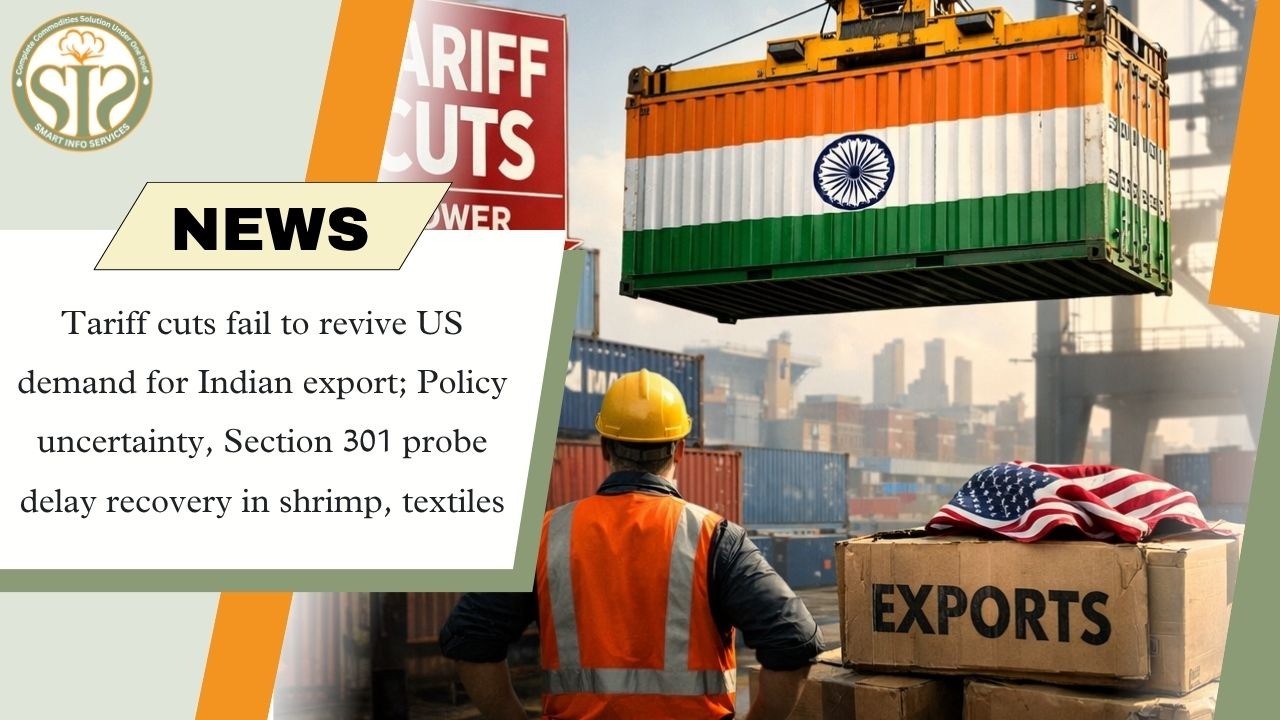
Continuous trade agreements with UK, EU and US: India becomes the new center of global tradeThe trade agreements signed by India with the United Kingdom (July 2025), the European Union (January 2026) and now the United States (February 2026) have signaled a sea change in the global trade landscape. With these agreements, India has emerged as the most attractive manufacturing and sourcing hub among emerging economies, especially in highly trade-sensitive sectors like textiles and apparel.The reduction in tariff on Indian goods to 18 percent under the latest India-US trade agreement has brought major relief to exporters. The US is the largest market for apparel exports to India and the industry believes that this tariff cut will give Indian suppliers an edge of about 2 per cent over competing countries. This is expected to reactivate stalled production capacities and generate new orders.The free trade agreement concluded with the European Union on 27 January 2026 is being considered as a structural change for the Indian textile industry. Till now, Indian apparel attracted 9 to 12 per cent duty in the EU, while many competing countries enjoyed duty-free access. With the abolition of tariffs, India's market share is expected to increase sharply in what is the second largest export market at over $4.5 billion annually.Earlier, under the India-UK FTA in July 2025, about 99 percent of Indian exports got duty-free access. India's share in Britain's $27 billion textile-apparel import market is currently 6.6 percent, which is expected to grow significantly in the coming years. Especially the export of technical textiles is expected to see a sharp rise by 2030.Apart from these three major agreements, India has also implemented FTAs with the European Free Trade Association (EFTA), Australia and New Zealand. The agreement with EFTA envisages $100 billion of investment and 1 million jobs over 15 years, while zero-tariff access with Australia and New Zealand is expected to directly benefit MSMEs and labour-intensive sectors.According to trade experts, the major reasons behind India's growing global acceptance are its large-scale manufacturing capacity, better compliance standards, emphasis on sustainability and the need for reliable alternative supply chains amid geopolitical uncertainties. The industry believes that India is no longer just a supplementary sourcing country, but is emerging as a major and long-term anchor in global supply chains.read more :- Surat textile export gets new impetus due to American tariff cut

Surat textile export gets new impetus due to American tariff cut

Gujarat: Surat Textile Traders Eye Export Boost After US Tariff Cuts.The industrial heartbeat of Gujarat, Surat, is witnessing a surge of optimism following the United States' decision to slash total tariffs on Indian imports from 50 per cent down to 18 per cent. This move is expected to breathe new life into the textile and diamond industries, which had been reeling under punitive trade measures since mid-2025.In August 2025, the US had imposed two distinct 25% tariffs on India - one citing the trade deficit and another as a penalty for Russian oil purchases. However, following high-level discussions between Prime Minister Narendra Modi and Donald Trump, a compromise was reached.According to textile expert Ranganath Sharda, the 50 per cent tariff had essentially priced Indian fabrics out of the American market, allowing competitors like China, Bangladesh, and Vietnam to dominate."The reduced tariffs are expected to bring a significant boost. We anticipate the textile trade could grow exponentially as we regain our competitive edge in the US market," Sharda said.Trade analysts suggest that India's recent Free Trade Agreements (FTAs) with European nations played a role in "nudging" the US toward this decision. By diversifying its trade partners (including ongoing talks with the UK and Canada), India demonstrated that it has viable alternatives, prompting Washington to protect its own trade interests by easing restrictions.The tangible effects of this policy shift are expected to manifest on factory floors and in export ledgers within the next two to three months, potentially marking 2026 as a year of recovery for Gujarat's industries.read more :- Relief to Tamil Nadu's textile industry due to American tariff cut

Relief to Tamil Nadu's textile industry due to American tariff cut

US tariff cut a lifeline for TN textile industry, says association.The rollback of the 50% US tariff is a lifeline for the Indian textile industry, said the Tamil Nadu based Southern India Mills’ Association, (SIMA) on Tuesday.The sudden imposition of the 50% US tariff had posed an unprecedented challenge to the textile and clothing industry largely spread across Tamil Nadu’s districts of Coimbatore and Tirupur. Indian textile accounts for nearly 29% of total US textile and apparel imports.The abrupt tariff hike had not only disrupted India’s manufacturing value chain but has also adversely impacted US consumers and importers through higher costs and supply uncertainties, said exporters. Textile and clothing (T&C) exports to the US, amounting to around USD 11 billion, account for nearly 29% of India’s total T&C exports, underscoring the market’s critical importance to the sector.Exporters predominantly dependent on the US market, particularly those in Tamil Nadu, faced a severe crisis following the tariff hike, said chairman of SIMA, Durai Palanisamy on Tuesday. “Production levels declined by 30–70% across several units, rendering around 10 lakh workers jobless and prompting the Government to announce a relief package to mitigate the unforeseen disruption,” said Palanisamy.US buyers began shifting their sourcing to competing countries such as Pakistan, Bangladesh and Vietnam, posing a serious threat to India’s export competitiveness and market share in the US textile and apparel segment, exporters said.The SIMA chairman said that the 18% tariff is the lowest rate negotiated by any T&C export competing country with the United States, reflecting the Indian government’s strong diplomatic and trade efforts. He noted that India has successfully concluded trade agreements with three major global economies and markets – the US, the UK and European Union, apart from several other countries and is steadily moving towards securing preferential or free market access across most key international markets. Palanisamy thanked Prime Minister Narendra Modi and the Union minister of commerce and industry, Piyush Goyal for successfully concluding two landmark trade deals within a week, in addition to announcing “game-changing policy measures” for the textile industry in the recent Union Budget 2026–27.As the second-largest employment provider after agriculture, supporting over 110 million livelihoods, particularly the rural communities and women, the sector has traditionally depended heavily on the US market and was anticipating the early conclusion of a Bilateral Trade Agreement between the two Nations, which had been progressing on a fast track, said SIMA’s secretary general K Selvaraju. “The industry is now poised to achieve a sustained double-digit growth rate in the coming years, aligned with the Prime Minister’s vision of building a Viksit Bharat by 2047,” Selvaraju said. “With strong policy support, enhanced market access and continued investments, the textile and clothing sector aims to expand to a domestic market size of $1.8 Trillion and achieve export earnings of $600 Billion, positioning India as a global leader in the textile value chain.”read more :- Rupee opens 15 paise down at 90.41

Boost to textile sector in Budget 2026, focus on cotton mission

Budget 2026 lifts textiles support with focus on Cotton Mission, technology upgrades.Budget 2026 has raised support for the textile sector, with higher allocation for the Ministry of Textiles and a renewed focus on the Cotton Mission and technology upgrades. The government aims to improve productivity, stabilise raw material supply and support exporters facing tariff pressure through schemes such as ATUFS, technical textile incentives and new textile parks.Textiles get higher Budget support in 2026 as Cotton Mission, technology upgrades take focus. As exporters suffer with new tariff constraints and global uncertainty, the Union Budget 2026 puts textiles back on the table. Higher spending, a renewed Cotton Mission and more support for technology upgrades suggest the government is finally trying to fix long-standing issues in the sector. After months of lobbying by industry bodies and concerns over the impact of US tariff actions under President Donald Trump, the government has chosen to lean on domestic strengths. The focus is clear: raise productivity, improve value addition and help textile manufacturers stay competitive across cotton, man-made fibre apparel and technical textiles. The nearly seven per cent rise in the Textiles Ministry’s allocation underscores that intent.As anticipated, the Budget has increased funding for the Ministry of Textiles by close to seven per cent. For the industry, this matters as much for what it signals as for the absolute number. At a time when global demand remains uneven and cost pressures persist, the higher outlay suggests policy continuity rather than short-term firefighting.Executives say the move offers some reassurance after a tough year marked by volatile cotton prices, weak export orders and thinning margins, particularly in apparel. The expectation now is that this additional spending will translate into smoother implementation of existing schemes rather than new headline announcements.Cotton Mission moves to the centre of policy.The Cotton Mission has emerged as a central pillar of the government’s textile strategy in Budget 2026. The renewed focus makes it clear the government knows raw materials remain one of the textile sector’s biggest problems. For exporters, support that helps them become more efficient may work better in the long run than short-term incentives.ATUFS funding likely to increaseA key positive for manufacturers is the expected rise in funding under ATUFS, the Amended Technology Upgradation Fund Scheme. The scheme has played a major role in helping spinning, weaving, processing and garment units modernise.Another push for technical textilesThe Budget also reinforces the long-term bet on technical textiles as a growth driver. Expanded duty exemptions on specialised machinery are expected to lower entry barriers and attract fresh investment. This push is part of India’s bigger plan to cut import dependence and build strength in exports where global demand is growing.For states and local economies, especially tier-2 and tier-3 cities where textiles are already strong, this could bring fresh investment and more jobs.Why this Budget matters for textiles?Budget 2026 positions textiles as a long-term manufacturing priority, not a sector getting temporary support. The focus is on stronger raw material access, better technology and solid infrastructure - the basics needed to compete globally.read more :- Announcement of establishment of textile mills in Odisha cotton belt

Related News

Youtube Videos

जानिए आज का कपास बाज़ार? 😱 Cotton Market Rate Today #kapasbajar
जानिए आज का कपास बाज़ार? 😱 Cotton Market Rate Today #kapasba...
ऐसा रहा आज कपास बाज़ार 😱 राजस्थान कपास बुआई | Cotton Market 22 July
ऐसा रहा आज कपास बाज़ार 😱 राजस्थान कपास बुआई | Cotton Market...
कपास बाज़ार में आज क्या हुआ? 😱 Cotton Market Rate 21 July 2026
कपास बाज़ार में आज क्या हुआ? 😱 Cotton Market Rate 21 July 2...
कैसा रहा आज का कपास बाज़ार? 😱 Cotton Market Rate Today | 20 July 2026
कैसा रहा आज का कपास बाज़ार? 😱 Cotton Market Rate Today | 20...
इस हफ्ते कपास में तेज़ी या मंदी? 😱 CCI ने बेचीं 3.18 लाख गांठें | Weekly Cotton Market
इस हफ्ते कपास में तेज़ी या मंदी? 😱 CCI ने बेचीं 3.18 लाख गा...
Cotton rate today: आज के कपास के भाव 🤔 #kapas  #youtube
Cotton rate today: आज के कपास के भाव 🤔 #kapas #youtube
रुई बाज़ार में आज तेज़ी का रुख 😱 CCI ने बेचीं 40,000+ गठानें #kapas
रुई बाज़ार में आज तेज़ी का रुख 😱 CCI ने बेचीं 40,000+ गठानें...
ऐसा रहा आज कपास बाज़ार 😱  राजस्थान कपास बुआई | Cotton Market 15 July
ऐसा रहा आज कपास बाज़ार 😱 राजस्थान कपास बुआई | Cotton Marke...
कपास की कीमतों में उछाल 😱 Cotton market rate today #kapasnabhav
कपास की कीमतों में उछाल 😱 Cotton market rate today #kapasna...
CCI Update: आज कितनी रुई गठानें बिकीं? 😱 Cotton market price today
CCI Update: आज कितनी रुई गठानें बिकीं? 😱 Cotton market pric...
साप्ताहिक कपास बाजार में तेज़ी 😱 Weekly cotton market review #kapas
साप्ताहिक कपास बाजार में तेज़ी 😱 Weekly cotton market review...
जानिए आज का कपास बाज़ार 😱 Cotton market rate today #kapas
कपास की कीमतों में उछाल 😱 Cotton market rate today #kapas
रुई बाज़ार में आज तेज़ी का रुख 😱 CCI ने बेचीं  70,000+ गठानें  #kapas
रुई बाज़ार में आज तेज़ी का रुख 😱 CCI ने बेचीं 70,000+ गठानें...
कैसा रहा आज का कपास बाज़ार? 😱 | Cotton Market Rate Today | 06 July 2026
कैसा रहा आज का कपास बाज़ार? 😱 | Cotton Market Rate Today |...
Application Download
Whatsapp Contact