STAY UPDATED WITH COTTON UPDATES ON WHATSAPP AT AS LOW AS 6/- PER DAY
Start Your 7 Days Free Trial TodayAfter PM Modi's visit, textile industry is now weaving strong ties with ChinaThe Yarn Expo in Shanghai is bringing back confidence in the Indian textile industry.The tariff war launched by US President Trump is likely to hit the Indian textile industry hard. But Prime Minister Narendra Modi has made it clear that India will not bow down to any pressure. According to experts, US tariffs could badly impact one-fourth of India's textile exports in the next six months, while traders are grappling with order cancellations in their biggest export market. Now the Indian textile industry is moving fast, as Consul General of India in Shanghai Pratik Mathur aptly put it, the thread of prosperity is weaving strong ties with China.Consul General Pratik Mathur on Tuesday visited the Yarn Expo in Shanghai, the largest of its kind in the world. The Yarn Expo in Shanghai is bringing back confidence in the Indian textile industry. This expo is the largest of its kind in the world. This time more than 30 Indian companies are participating across various sectors of the textile value chain, including yarn and fabric manufacturers from Prime Minister Modi's own Lok Sabha constituency Varanasi. India's presence at the Global Expo is highlighting our vibrant textile innovations, such as contamination-free and fully traceable Kasturi cotton.China is a global leader in textile production and trade, known for its vast scale, cost-effectiveness and integrated ecosystem, making it a major exporter of fabrics, yarns and ready-made garments across the world, and is being looked at as a new partner in this industry. India's presence in the knitting, yarn and textile sectors at the textile mega event resonates our visionary 'Make in India' philosophy, empowering global partnerships and making supply chains sustainable. India's textile exports in the region are growing impressively, boosting regional trade and economic synergies. India, inspired by the Prime Minister's call for Aatmanirbhar Bharat, is constantly striving to create opportunities for sustainable growth, with the goal of building a developed India by 2047.India's textiles and apparel (T&A) exports are projected to reach $37.7 billion in 2024-25, contributing 8.63% of total merchandise exports, with the United States and the European Union being the major destinations. The country is the sixth largest T&A exporter in the world, with a global trade share of around 4.1-4.5%. Major export categories include cotton textiles, ready-made garments and man-made textiles, while recent growth has been significantly driven by the apparel sector.



Amid Trump's tariffs, Centre to hike MSP cotton procurement to protect farmersThe Centre will hike cotton procurement at the federally determined minimum support price or MSP to protect farmers from falling local prices, following the government's decision to waive duty on fibre imports and shore up the garment sector facing Trump's 50% tariff.Farmers are already grappling with price pressures as textile manufacturers prefer to import cheaper short-staple fibres due to high domestic rates. The textile industry, one of the country's largest employers, had itself been pleading with the central government for duty relief due to falling margins and the impact of the pandemic.To support the labour-intensive garment industry on the one hand and cotton growers on the other, the Centre has directed state-run Cotton Corporation of India (CCI) to be ready for large procurement and buy as much quantity of produce as producers bring to its procurement centres, an official said. Whenever market prices fall, farmers depend on CCI for minimum prices.On August 28, India extended the 11% import duty exemption on cotton imports, including agricultural cess, till the end of December. The tax exemption was initially applicable between August 19 and September 31.By temporarily halting taxes, the government aims to stabilise inflation in products such as ready-made garments, ease raw material crisis and protect small and medium enterprises, an official said in a statement on August 19."We are ready to buy as much as farmers want and CCI is there to help cotton growers," said CCI Managing Director Lalit Kumar Gupta.For the 2025-26 season, the Centre has fixed the MSP for the popular medium-staple cotton at ₹7,710 per quintal (100 kg), up by ₹589 over the previous year. Importers say the cost of fibre imported from abroad is between ₹5000-6200 per 100 kg.Global garment buyers have cut new imports from India following Trump's hefty tariffs and analysts say companies may turn to Bangladesh or China, where tariffs are lower. CCI is expanding its buying power centres to over 500.read more:- Removing cotton import duty to bridge quality and supply gap
Proposal to remove cotton import dutyNew Delhi : India’s decision to eliminate import duty on raw cotton was driven by urgent supply, quality, and competitiveness concerns in the textile value chain.It is a strategic move initiated to address raw material shortages, reduce input costs for textile mills, curb inflationary pressures, and uphold India’s competitive edge in global textile trade.Textile and apparel exports account for a significant share of India’s foreign earnings. Duty-free access to premium cotton allows domestic producers to offer high-quality yarns and fabrics at globally competitive price points, reinforcing the “Make in India” brand and helping retain market share in key destinations such as Europe and North America.In terms of global trade, India is the sixth largest exporter of textiles, with a 3.91 per cent share in world textile exports. According to the Textile Ministry, the sector provides direct employment to over 45 million people, making it the second largest employment generator in the country, next only to agriculture.However, the country’s cotton production fell from about 35 million bales in 2020-21 to some 31 million bales in 2024-25 due to adverse weather conditions and pest attacks.The Department of Agriculture said in a recent statement that as of August 15, total cultivation area for cotton has reduced, with acreage falling by 3.24 lakh hectares in (2025-26) compared to the previous year (2024-25).The government’s duty waiver stems from concerns about cotton shortages. Industry groups had warned about higher yarn prices, leading to an increase in textile prices ahead of the festival season.Duty-free access to premium cotton allows domestic producers to offer high-quality yarns and fabrics at globally competitive price points.India’s 2024-25 cotton crop was dominated by medium-staple varieties, while many spinning mills require long and extra-long staple fibres to meet higher-end yarn specifications.Various spinning mills usually stockpile lower-grade domestic cotton to blend with imports, tying up substantial working capital. Industry estimates suggest that duty relief can cut raw-material financing needs by 15-20 per cent, immediately improving cash flows, especially for small and medium-sized spinning units grappling with post-pandemic demand volatility.Thus, allowing duty-free imports plugs this quality and quantity shortfall immediately, ensuring uninterrupted production for value-added textile units.Removal of import duty would ease the pressure on domestic textile mills by stabilising raw material costs ahead of the festive season when garments are in high demand.Concerns over farmers being affected are addressed through the minimum support price (MSP) mechanism. For the marketing season 2025-26, growers get Rs. 7,710 per quintal for medium staple variety, while for long staple, it is Rs. 8,110 per quintal.The Cotton Corporation of India continues to procure unsold crops at MSP levels, with any losses on stock clearances financed via the federal budget, ensuring farmers are insulated from market fluctuations.Meanwhile, the calibrated relief measure can defuse trade tensions with Washington, which is pushing for broader market access in bilateral trade.It may signal India’s willingness to use targeted tariff relief as a bargaining chip in broader agricultural and industrial talks.read more :- Rupee opens steady at 88.16 /USD
Rupee opens flat at 88.16 against dollar as tariff uncertainty continuesThe rupee opened flat on September 3 at 88.16 against the dollar as US tariff uncertainty continues. The currency had ended at 88.16 against the greenback the previous day.read more :- Giriraj Singh: Government is serious about the challenges of textile sector
Government Serious About Textile Sector Challenges – Interview with Giriraj SinghUnion Textile Minister Giriraj Singh, in an exclusive conversation with CNBC Awaaz, discussed in detail the condition and prospects of the Indian textile industry. He said that the government still has to meet companies with turnover below ₹100 crore in order to understand their issues and challenges.The minister acknowledged that additional tariffs have given a slight setback to the textile sector, but he expressed confidence that India has always been a country that turns crises into opportunities.Giriraj Singh explained that globally, the textile market is worth $800 billion, of which 40 countries account for nearly $590 billion. He added that India’s total textile market is $180 billion, out of which only $40 billion is exported, with 34% of it going to the U.S.He further said that despite challenges, the supply of textile products from India to the U.S. continues.The minister expressed hope that the Free Trade Agreement (FTA) could be implemented soon, which would provide more relief to exporters. He assured that the government is committed to resolving the industry’s difficulties and that corrective steps are being taken at all levels.read more :- Free import policy puts Maharashtra's cotton owners in trouble
Centre’s free imports to subdue cotton prices leave Maharashtra gin owners in dire straitsThe decision of the Central Government to extend duty-free imports of cotton till December 31 has pushed the businesses of gin press owners in Maharashtra into uncertainty.With India expected to see all-time high imports of 42 lakh bales of cotton (1 bale has 170 kg of ginned cotton), traders said the government has to step in to prevent the collapse of mandi prices of ‘kapas’ or raw unginned cotton with seeds, once the season starts.Last month, the Central Government decided to remove the 11 per cent import duty on cotton to support the domestic garment sector.Farm leader Vijay Jawandhiya had called the move suicidal, as it would leave the cotton farmers in dire straits. “The government had promised not to let farmers be affected. We want the government to remember its words,” he said.At present, while Indian candy is being traded at Rs 55,000-56,000, imported candies are available at Rs 51,000-52,000. Since the Central Government had waived off the import duty, Indian candy prices have come down by Rs 1,000/quintal.Pradeep Jain, founder director of the Khandesh Cotton Gin Press Factory Owners Traders Welfare Association, said the bigger question before the entire value chain would be the price realisation of farmers. Jain said most of the Gin Press owners and traders would be facing losses due to the availability of cheap imports. “But unless the Central Government, through the Cotton Corporation of India (CCI), steps in early, farmers would face severe loss,” he said.For this season, the Minimum Support Price (MSP) of cotton is Rs 7,710 per quintal, which has to be taken into account while finalising the price of a candy, which is approximately 356 kg of cotton. This invariably makes the candy trade at a higher price than imports, as the concept of MSP is not there in other cotton-growing countries, mainly the USA.Indian ginners, involved in the mechanical separation of cotton fibres from seeds, said the bales and candy (340 kg of pressed de-seeded cotton) are sold at higher prices in the international markets because ‘kapas’ is purchased at the government-declared Minimum Support Price (MSP).Initially, the exemption was till September, and later extended till December. This move has been welcomed by the textile industry, which felt the availability of cheap raw material would help them tide over the first few months of the cotton marketing season that begins during September-October.Atul Ganatara, president of the Cotton Association of India (CAI), the body representing the cotton value chain, said India would see an all-time high import of 42 lakh bales thanks to this move.At Khandesh, the Muhurt trade of cotton fetched a price of Rs 7,600 per quintal, which is lower than the MSP. These traders said it was a warning sign, as once the arrivals start, it would dip further. The condition of the cotton crop in most parts of the country is said to be good without any major reports of losses or pest infestation. Indian farmers had taken cotton over 108.47 lakh hectares, over the 111.39 lakh hectares of last season. Most farmers are worried about price realisation given the easy availability of cotton from overseas.
The Indian rupee on tuesday lower 01 paise to close at 88.16 per dollar, while it opened at 88.15 in the morning.Sensex drops 206.61 points to settle at 80,157.88; Nifty declines 45.45 points to 24,579.60read more :- PLI Textile Scheme: Last date of application is 30 September
PLI textile scheme application window open till September 30New Delhi: The government Monday said it has decided to extend the application window for the Production Linked Incentive (PLI) scheme for textilestill September 30, 2025 in view of the strong and enthusiastic response received from industry stakeholders.During the recent invitation of application in August, 22 new applications have been received from manmade fibre (MMF) apparel, fabrics, and technical textiles sector.“Government gives one more chance to prospective investors to benefit from the scheme,” the textiles ministry said in a statement.As per the statement, the application window is being reopened based on the appetite of the industry to invest more under the scheme, which is an outcome of the growing market and confidence generated due to manufacturing of textiles products in India under the PLI Textiles Scheme.“No application shall be accepted after the closure of the application window,” it said.So far, 74 participant companies with committed investment of Rs 28,711 crore were selected as beneficiaries under the PLI scheme.read more :- Imported cotton is being given preference over domestic cotton
Imported cotton is being preferred over domestic cotton due to better quality and competitiveness in prices.Nagpur (Maharashtra): With consignments of imported bales booked at an average of Rs 52,000-53000 per candy (per 356 kg), spinners say that despite matching with domestic rates, import of foreign bales is being preferred due to better quality.Sources said some Indian spinners (yarn mills) have imported low quality bales at Rs 48,000 per candy and are looking to buy more than 10,000 bales of the same quality at 1% lower prices. This means that the government agency, Cotton Corporation of India (CCI), will have to reduce the rates of processed cotton further.Since the government has removed import duty on cotton, CCI has cut prices by over Rs 3,000 per candy, including a discount for bulk purchases of up to Rs 400-600 per candy.Traders say if the rate per candy is between Rs 52,000-53,000, private traders will not be able to pay more than Rs 6,500-6700 per quintal for raw cotton brought by farmers. The minimum support price (MSP) is Rs 8,110 per quintal. Vijay Nival, a farmer-cum-trader from Yavatmal, said private traders will not be able to buy raw cotton at MSP and farmers will have to depend on CCI procurement.Manjit Chawla of Manjit Fiber Pvt Ltd, Wani, Yavatmal, said even at the same prices, bales coming from Brazil or Australia are being preferred due to better quality. Since the quality standards (recovery) of imported bales are slightly better than domestic bales, spinners/yarn mills will prefer imports if cotton is available at similar rates. This means Indian companies, including CCI, will have to cut prices further.Initial arrivals have started in areas like Khargone in Madhya Pradesh, but rates are low due to high moisture levels, Chawla said. Indian spinners have so far been importing cotton from countries like Australia, Brazil, Tanzania, Chad, Burkina Faso and Benin.read more :- Haryana: 90% cotton and 50% millet crop loss expected
Haryana: 90 percent of cotton and 50 percent of millet crops are expected to be destroyedMahendragarh : Farmers have expressed apprehension of damage to 90 percent of cotton and 50 percent of millet crops due to continuous rain. The compensation portal has not been opened in Mahendragarh district yet, due to which farmers are not able to apply for compensation. Farmers have demanded the administration and the government to open a compensation portal in the district.This time in Mahendragarh district, there has been 112 percent more rainfall than normal in the rainy season. From June 1 to September 1, this time the district has received a total of 718 mm of rain, whereas the normal rainfall is 338.9 mm.In terms of more than normal rainfall, Mahendragarh district is at the first position in the state. At the same time, a total of 198 mm of rain was recorded during the month of August, which is 44 percent more than normal, due to which 50 to 90 percent damage is being feared in cotton standing in about 50 thousand acres and millet crops standing in three lakh acres.Both cotton and millet crops have been completely ruined due to accumulation of two to two and a half feet of water in about 50 acres of crops in the hilly villages. The state government has not yet opened a portal for the district. In such a situation, farmers are not able to register the details of the loss. - Ramnarayan, farmer village JanjadiyawasThe cotton crop is ready for the first picking. The crop has been completely ruined due to rain. The cotton has been damaged due to getting wet, the bolls have also rotted. There has been 80 to 90 percent damage to the cotton crop. If this continues for two-three days, the crop will be completely ruined. - Dharamveer, resident of KaninaThere is a possibility of about 90 percent damage to the cotton crop. Germination has started in the harvested crop. 20 to 25 villages were visited where late sowing has been done, there is less damage right now. The order for the survey has not come yet. There is no information regarding when the government will open the compensation portal. -Dr. Ajay Yadav, Sub-Divisional Officer, Agriculture and Farmers Welfare Department, Mahendragarhread more :- Rupee opened 05 paise higher at 88.15 against dollar
Rupee opens 5 paise higher at 88.15/USD despite US tariff uncertaintyIndian rupee opened 05 paise higher at 88.15 per dollar on Tuesday versus friday's close of 88.20.read more :- Gujarat: Cotton season begins in Botad APMC:
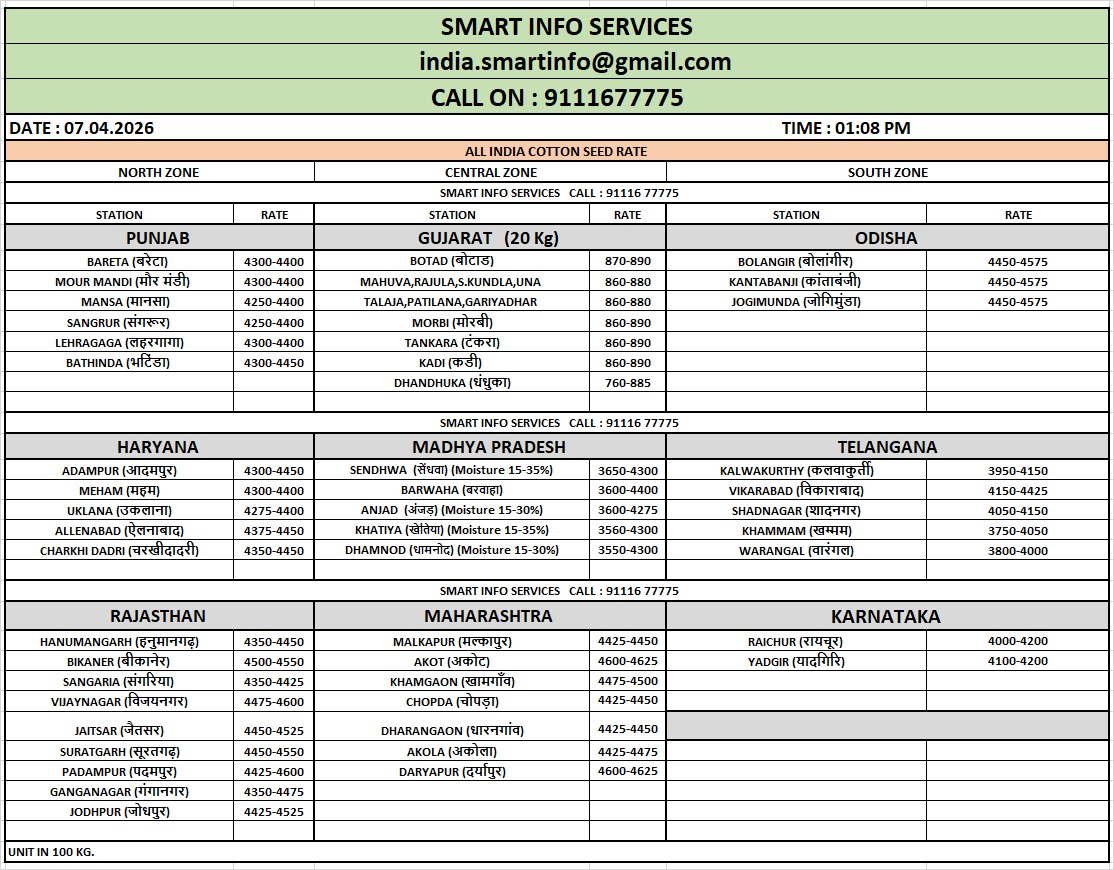
Start of New Cotton Season at Botad APMC: First Day Prices Range from ₹1500 to ₹2100 per 20 KgThe new cotton auction season began today at the Botad APMC. On the very first day, cotton prices ranged between ₹1500 and ₹2100 per 20 kilograms. More than ten traders started purchasing after performing the traditional ritual.On this auspicious occasion, the APMC chairman distributed sweets to farmers and traders, extending best wishes for a prosperous season. It is estimated that more than one lakh man (a traditional unit of weight) of cotton will arrive in the market premises this year.Last year, cotton prices were between ₹1400 and ₹1500 per 20 kilograms, while the Cotton Corporation of India (CCI) purchased at ₹1533. This year, CCI has decided to buy cotton at ₹1600 per 20 kilograms. Due to good rainfall, production has increased, which is expected to boost farmers’ income as well.Traders believe that if the government allows cotton exports, prices could rise further; otherwise, the market price is likely to remain stable at around ₹1600 per 20 kilograms. Farmers too are hopeful that in the coming days, they will receive better prices.read more :- India has shown flexibility on cotton imports. Now the U.S. must do the same
India opened cotton import, now it's America's turnIndia has allowed duty-free import of cotton until December 31, 2025. This “temporary” exemption from the earlier 11% duty comes at a time when domestic production of cotton in 2024–25 (October–September) is projected to fall to 31.14 million bales, compared to 33.65 million bales in the previous marketing year and the all-time high of 39.8 million bales in 2013–14. But it is not just lower output – a 2.6% drop in the sown area during this kharif season – that may have prompted the Narendra Modi government’s decision. The move also sends a significant signal to the U.S., where the value of cotton exports has dropped from $8.82 billion in 2022 to $4.96 billion in 2024, mainly due to reduced Chinese purchases (down from $2.79 billion to $1.47 billion). With China slashing imports further to just $150.4 million during January–June 2025, the market impact has been severe.No surprise then that the U.S. wants other countries to buy more. Vietnam, Pakistan, Turkey, and India have all stepped in. India alone imported $181.5 million worth of U.S. cotton in January–June 2025, compared to $86.9 million in the same period of 2024. With duties removed, imports are set to accelerate. The U.S. Department of Agriculture has welcomed this move. The department sees it not only as boosting U.S. cotton bookings but also as helping Indian textile exporters access cheaper and contamination-free fiber. The agency claims that nearly 95% of imported U.S. cotton is processed and then re-exported as yarn, fabric, and apparel. But above all, in this otherwise disappointing phase of Delhi–Washington ties, the development is encouraging. Keeping trade talks frozen serves neither side. By making cotton imports duty-free and improving raw material availability for its textile industry, India has shown a willingness to negotiate and flexibility. Now the U.S. must reciprocate by scrapping its unfair and irrational 25% “penalty” on India’s imports of Russian crude oil.However, there is another side to the story. After the introduction of genetically modified Bt hybrids, which raised average lint yields from 302 kg to 566 kg per hectare between 2002–03 and 2013–14, Indian cotton farmers have been left without access to any new crop technology. Since then, yields have dropped to below 450 kg, while cotton has become vulnerable to so-called secondary pests like pink bollworm and whitefly, as well as boll rot fungal pathogens. The lack of investment in breeding research and development is reflected in the record 3.9 million bales of imports projected for 2024–25. This double blow of import dependence and technology denial has also been seen in mustard and soybean. The Indian farmer can compete – and should be enabled to do so – but not with hands tied behind his back.read more :- State Wise CCI Cotton Sale 2024-25
State-wise CCI Cotton Sales Update – 2024-25 SeasonThe Cotton Corporation of India (CCI) reduced its cotton prices by a total of ₹600 per candy during the week. Following this revision, CCI recorded sales of around 29,800 bales, taking the cumulative sales for the 2024-25 season to approximately 72.49 lakh bales. This accounts for about 72.49% of the total cotton procured so far this season.A state-wise analysis shows that Maharashtra, Telangana, and Gujarat continue to lead in sales activity, collectively contributing over 83.95% of the total sales.The data highlights CCI’s active role in stabilizing the cotton market and maintaining a steady supply across major cotton-producing regions.read more:- Cotton prices fade: Prices below MSP, farmers disappointed
Cotton: The shine of white gold has faded, the price fell below MSP in Muhurat deals, the faces of the farmers are gloomy,The Muhurat sale of cotton in the new season has not been good for the farmers, as they have got prices about Rs 1500 per quintal less than the MSP. In the Muhurat deals held on Friday in the mandis of Anjad and Khargone in Madhya Pradesh, cotton was sold at the rate of Rs 6,500 to Rs 7,100 per quintal. At the same time, the government has fixed the MSP of cotton at Rs 8,110 per quintal.The Muhurat sale of cotton in the new season has not been good for the farmers, as they have got prices about Rs 1500 per quintal less than the MSP. In the Muhurat deals held on Friday in the mandis of Anjad and Khargone in Madhya Pradesh, cotton was sold at the rate of Rs 6,500 to Rs 7,100 per quintal (Cotton Prices). At the same time, the government has fixed the MSP of cotton at Rs 8,110 per quintal.Effect of removal of import dutyTraders say that this decline was certain. The main reason for this is the government's abolition of import duty on cotton till 30 September and later extending this exemption till 31 December. Muhurat sale is a symbolic beginning of the arrival of cotton from the fields, but it also indicates future trends.Possibility of government interventionCurrent trends are indicating that the rates in the open market may remain much below the MSP. If such a situation arises in the coming days, then the Cotton Corporation of India may have to intervene and buy the produce from the farmers at MSP. Let us tell you that the corporation buys raw cotton from the farmers and sells the processed bales to the traders. Recently the corporation has reduced its sales rates even further, due to which there is a bearish trend in the rates of raw cotton.Economic mathematics of farmersAccording to TOI, Kishore Tiwari, former director of a government think tank, says that to make a profit by selling cotton at MSP, farmers should get a yield of at least six quintals per acre. Due to reasons like natural disasters, the yield is constantly decreasing. The cost of cultivating one acre of cotton is about Rs 24,000 to Rs 30,000. By selling 6 quintals of produce at MSP of Rs 8,110, the farmer gets a profit of only Rs 18,000 to Rs 24,000. This meager profit keeps the farmers in financial trouble throughout the year.read more :- US court declares most tariffs illegal, Trump calls them 'devastating to the country'
‘No power to impose’: US court declares most tariffs illegal; Trump says 'total disaster for country'A US federal appeals court on Friday ruled that most tariffs imposed by president Donald Trump under emergency powers were illegal, striking at the heart of his trade policy and setting up a likely battle in the Supreme Court.The ruling by the US court of appeals for the federal circuit in Washington, DC, covered two sets of tariffs - Trump’s “reciprocal” duties imposed in April as part of his trade war and another set announced in February against China, Canada and Mexico. It does not affect other tariffs Trump imposed under separate statutes, including those on steel and aluminum imports.India’s ‘Befitting Response’ To Trump’s 50% Tariffs; Sets Russian Oil 'Import Record' | ReportIn a 7-4 judgement the court observed: “The statute bestows significant authority on the President to undertake a number of actions in response to a declared national emergency, but none of these actions explicitly include the power to impose tariffs, duties, or the like, or the power to tax,” as quoted by Reuters.The decision also said Trump had exceeded his authority under the International Emergency Economic Powers Act (IEEPA).Trump had invoked IEEPA, a 1977 law historically used for sanctions and asset freezes, to justify tariffs by declaring a national emergency over persistent US trade deficits and cross-border drug flows. The administration argued that the law’s power to “regulate” imports extended to tariffs.The appeals court rejected that view, saying: “It seems unlikely that Congress intended, in enacting IEEPA, to depart from its past practice and grant the President unlimited authority to impose tariffs. The statute neither mentions tariffs (or any of its synonyms) nor has procedural safeguards that contain clear limits on the President’s power to impose tariffs.”The appeals court put its ruling on hold until October 14, allowing the Trump administration time to seek a reversal from the Supreme Court.Minutes after the ruling, President Donald Trump sharply criticised the judgement, saying if allowed it would be a “ total disaster for the Country”. In a post on his social media platform Truth Social, he attacked the appeals courts as "Highly Partisan" and asserted that the Supreme Court would rule in his favour.“If these Tariffs ever went away, it would be a total disaster for the Country,” Trump wrote in his post. “If allowed to stand, this Decision would literally destroy the United States of America.”“The President’s tariffs remain in effect, and we look forward to ultimate victory on this matter,” White House spokesman Kush Desai said in a separate statement, as quoted by CNBC.Trump has relied heavily on tariffs in his second term, using them as a central tool of US foreign policy to pressure trading partners and push for revised trade agreements. While the duties have helped his administration secure economic concessions, they have also added to uncertainty in financial markets.The lawsuits were filed separately by five small US businesses and a coalition of 12 Democratic-led states, who argued that under the Constitution, the power to issue taxes and tariffs lies with Congress and any delegation of that authority must be both explicit and limited.Trump had defended the tariffs as a way to rebalance global trade and protect US industries. He said the April tariffs were necessary because the US had imported more than it exported for decades, undermining manufacturing and military readiness. He also said the February tariffs against China, Canada and Mexico were justified because those countries were not doing enough to curb the flow of illegal fentanyl into the US - an assertion those governments have denied.The New York-based US Court of international trade had earlier ruled against Trump’s tariff policies on May 28, saying the president had exceeded his powers when imposing both sets of challenged tariffs. That three-judge panel included one judge appointed by Trump during his first term. Another court in Washington also found that IEEPA does not authorize tariffs, with the government appealing that decision. According to Reuters, at least eight lawsuits have been filed against Trump’s tariff measures, including one brought by the state of California.While the latest decision restricts tariffs imposed under IEEPA, it leaves intact those imposed under other legal authorities. The Justice Department is expected to appeal, with the case likely headed to the US Supreme Court.read more :- Cotton sale started in Abohar
| title | Created At | Action |
|---|---|---|
| Textile relations with China strengthened after Modi visit | 03-09-2025 19:04:17 | view |
| Government will increase MSP purchase on cotton amid tariff | 03-09-2025 18:03:59 | view |
| Removing cotton import duty to bridge quality and supply gap | 03-09-2025 17:52:48 | view |
| Rupee opens steady at 88.16 /USD | 03-09-2025 17:25:51 | view |
| Giriraj Singh: Government is serious about the challenges of textile sector | 03-09-2025 00:46:52 | view |
| Free import policy puts Maharashtra's cotton owners in trouble | 02-09-2025 23:14:30 | view |
| Rupee fell 1 paisa to close at 88.16 against dollar | 02-09-2025 23:02:42 | view |
| PLI Textile Scheme: Last date of application is 30 September | 02-09-2025 19:23:53 | view |
| Imported cotton is being given preference over domestic cotton | 02-09-2025 18:42:57 | view |
| Haryana: 90% cotton and 50% millet crop loss expected | 02-09-2025 18:15:18 | view |
| Rupee opened 05 paise higher at 88.15 against dollar | 02-09-2025 17:34:34 | view |
| Gujarat: Cotton season begins in Botad APMC: | 02-09-2025 01:23:11 | view |
| India has shown flexibility on cotton imports. Now the U.S. must do the same | 01-09-2025 21:41:33 | view |
| CCI Cotton Sales Reach 72.49 Lakh Bales in 2024-25 Season | 30-08-2025 22:09:05 | view |
| Cotton prices fade: Prices below MSP, farmers disappointed | 30-08-2025 21:10:13 | view |
| US court declares most tariffs illegal, Trump calls them 'devastating to the country' | 30-08-2025 19:38:38 | view |