STAY UPDATED WITH COTTON UPDATES ON WHATSAPP AT AS LOW AS 6/- PER DAY
Start Your 7 Days Free Trial TodayNagapattinam Cotton Farmers Hit by Unseasonal RainsNagapattinam and Karaikal districts have experienced unseasonal rain since last Friday through Monday, raising concerns among cotton farmers over potential yield loss as the crop enters the flowering stage.In Nagapattinam district, cotton is grown on approximately 2,700 hectares, with the majority of cultivation taking place in Tirumarugal block and some areas of Kilvelur block. P. Balasubramanian, Alathur Panchayat president in Tirumarugal, where cotton is cultivated on about 220 hectares, said farmers are facing severe challenges.“Due to unseasonal rains in the past two months, we have had to sow seeds three times. The cotton crop is currently in the flowering stage, but the rains have caused the flowers to wither, potentially affecting yields,” he said.He added that sowing one acre of cotton involves ₹3,000 in labour charges and ₹2,400 for seeds, not including additional expenses for fertilizers or sand. “We repeated this entire process three times over the past two months, and now even this crop is at risk,” he added.“In one acre, we typically get an average yield of 10 quintals,” he said. “But now, we’re looking at a loss of at least 200 kg per acre. If such rains persist, the situation will worsen, and we will suffer badly.”In Karaikal district, cotton is cultivated on over 2,500 acres, and similar issues have been reported. D.N. Suresh of the Kadaimadai Vivasayigal Sangam said, “For the past five years, farmers in Karaikal have been growing cotton, but each year brings new challenges. Last year too, unseasonal rains during this period caused damage. We no longer have faith in crop insurance as we rarely receive fair compensation. Many of us take loans to cultivate cotton. If these rains continue, it will be very difficult for us this year.”read more :-Rupee opens 6 paise higher at 85.58 against dollar

Rupee Gains 6 Paise, Opens at 85.58/USDIndian rupee opened six paise higher on May 22 at 85.58 against the US dollar compared to the previous close of 85.64 against the greenback.read more :-Indian rupees Ends Flat at 85.64 per Dollar
Rupee Closes Flat at 85.64 Against DollarThe Indian rupee on wednesday Flat to close at 85.64 per dollar, while it opened at 85.64 in the morning.read more :- CAI urges cotton trading community to stop all trade with Turkiye, explore other options
CAI Urges Cotton Traders to Halt Business with TurkiyeMUMBAI: The Cotton Association of India on Tuesday urged the industry to stop all trade with Turkiye as it sided with Pakistan during ‘Operation Sindoor’.During India’s ongoing ‘Operation Sindoor’, Turkiye has demonstrated its anti-India stand and openly sided with Pakistan against our country, CAI president Atul S Ganatra said in a statement.He said Turkiye imports cotton and other material from India and in 2024, its total imports from India including cotton was around USD 74.27 million whereas its exports to India during the same period stood at USD 2.84 billion.“Therefore, keeping the recent geopolitical developments and Turkiye’s anti-India policies in mind, we earnestly request our cotton trading community to consider stopping all our cotton trade with Turkiye and explore alternative options to suit our nation’s interest and promote a strong and self-reliant India,” he added. (PTI)read more :-Centre backs development of cotton plucking machine in Maharashtra
Centre Boosts Cotton Harvesting Tech in StateNagpur : Union agriculture minister Shivraj Singh Chouhan appreciated Maharashtra for working on developing a cotton plucking machine. Chouhan said the govt will offer full support as he also directed his ministry's mechanisation division to work on a similar project. Chouhan said he saw a similar machine during his visit to Brazil, and it can carry out work equivalent to 12 farmhands.The topic came up as state's minister for agriculture Manikrao Kokate said the availability of farm workers is a major problem affecting the sector and mechanisation can be a solution to it. Cotton plucking is a labour-intensive job. Chouhan also stressed the need to understand soil health to ascertain the right cropping pattern.The minister asked the farmers to give natural farming a chance too. It's not necessary to entirely convert to natural farming. One can start with a small portion of the entire holding. If done properly, natural farming does not bring down the input. However, some farmers do not follow the proper method and miss out on certain inputs.He also called for diversification of crops to maintain soil health. Chouhan was speaking at a function to launch "One Nation-One Agriculture-One Team", a programme aimed at bringing coordination among all the stakeholders in the sector.read more :- Rupee down 01 Paise to 85.64 Against Dollar
Indian rupee opens 01 paise lower at 85.64 against US dollarThe local currency opened at 85.64 against the US dollar, as compared to 85.63 at the previous close against the greenback.read more :-Rupee Falls 16 Paisa, Closes at 85.63 Against US Dollar
The Indian rupee on tuesday lower 16 paise to close at 85.63 per dollar, while it opened at 85.47 in the morning.At closing, the Sensex was down 872.98 points or 1.06 percent at 81,186.44, and the Nifty was down 261.55 points or 1.05 percent at 24,683.90. About 1398 shares advanced, 2415 shares declined, and 127 shares unchanged.read more :- USDA Projects Decline in India’s Cotton Acreage for MY 2025/26 Amid Crop Shifts
USDA Forecasts Drop in India’s 2025/26 Cotton AcreageThe U.S. Department of Agriculture’s Foreign Agricultural Service (USDA FAS) forecasts India’s cotton acreage at 11.4 million hectares for the 2025/26 marketing year (MY), marking a 3% decline from the previous year. The reduction is attributed to farmers shifting toward more profitable crops, including pulses and oilseeds.Despite the smaller planted area, India’s cotton production is projected to reach 25 million 480-lb. bales, assuming a normal monsoon. The average yield is expected to rise to 477 kilograms per hectare—up 3% from the official MY 2024/25 estimate of 461 kilograms per hectare—due to increased cultivation in irrigated regions with reliable water access.However, the Indian Meteorological Department (IMD) has forecast above-normal maximum temperatures across much of the country—excluding southern regions—from March to May 2025. While cotton is relatively heat- and drought-tolerant, prolonged heatwaves and inadequate soil moisture could adversely affect yields.On the demand side, mill consumption remains strong, with projections at 25.7 million 480-lb. bales. Robust international demand for yarn and textiles is expected to sustain this level, suggesting continued reliance on imports to meet domestic consumption.On March 10, India’s Ministry of Agriculture and Farmers Welfare released its second advance estimate for MY 2024/25, lowering production to 23 million 480-lb. bales (equivalent to 29.4 million 170-kg bales or 5 million metric tons), a 2% drop from the prior forecast. Nevertheless, FAS maintains its MY 2024/25 projection at 25 million bales, based on 11.8 million hectares.FAS notes that rabi season sowing in southern India continues through December, and additional acreage data is anticipated at the close of the marketing year (October–September).Regional Planting TrendsNorth India:* Punjab’s cotton area remains stable.* Haryana sees a 5% decline as farmers pivot to paddy rice.* Rajasthan is expected to reduce cotton area by 2%, shifting to guar, maize, and mung beans; however, improved pest control may support yields.Central India:* Gujarat’s cotton area is projected to drop 3%, with growers favoring pulses, groundnut, cumin, and sesamum due to high input costs.* Maharashtra's area remains unchanged as farmers diversify away from soybean.* Madhya Pradesh expects a 5% decrease, driven by a move toward pulses and oilseeds.South India:* A 7% reduction is forecast across Telangana, Karnataka, Andhra Pradesh, and Tamil Nadu, where government incentives for ethanol production are encouraging shifts to maize and rice.read more :-India's $100-bn textile export target hinges on MSME: Primus Partners
India’s Textile Export Target Rests on MSMEsIndia’s target to hit $100 billion in textile exports in five years revolves largely around how well the country can support and scale its micro, small and medium enterprises (MSMEs), according to a new Primus Partners report, which says textile MSMEs form the backbone of the industry, but are held back now by fragmented value chains, high costs, skill shortages and limited global market access.India accounts for just 4.6 per cent of global textile exports, while China’s share is 48 per cent.Titled ‘Roadmap for $100 Billion Exports in 5 Years’, the consulting firm’s report asserts that unlocking MSME potential is key to narrowing this gap and placing India among global leaders in textile manufacturing.While geopolitical shifts offer an opportunity for Indian firms, textile MSMEs must evolve to exploit this, the report points out.Readymade garments and home textiles, which account for 75 per cent of India’s textile exports, are expected to benefit the most. The shift in sourcing patterns by global brands under the ‘China Plus One’ strategy makes India an increasingly attractive destination—if MSMEs can keep pace.MSMEs may be aggregated into formal clusters, like farmer producer organisations, enabling them to negotiate better pricing, adopt standardised practices and directly access global buyers, it recommends. These aggregations would also improve creditworthiness and streamline supply chain operations.However, a major constraint is skills. Only 15 per cent of workers in the textile manufacturing sector have received formal training, according to the National Skill Development Corporation. This contributes to a 20-30 per cent loss in productivity.Primus Partners suggests setting up dedicated training centres in tier-II and tier-III cities, especially where PM MITRA Parks are coming up, to bridge this gap.Finance remains another bottleneck. MSMEs often struggle to access affordable credit for modernising machinery or expanding operations. The report recommends expanding operational subsidies and employment-linked incentives to reduce input costs and boost competitiveness.Infrastructural inefficiencies, particularly in logistics, continue to inflate production costs. India’s logistics costs stand at 14 per cent of GDP, compared to the global benchmark of 8-10 per cent. The report urges faster development of integrated supply chain parks and better port connectivity to support textile MSMEs in becoming export-ready.Trade access is also essential. While competitors like Sri Lanka enjoy duty-free access to Europe under the Generalised Scheme of Preferences (GSP), Indian exporters face tariff disadvantages. The report calls for accelerated negotiations of free trade agreements with the European Union, the United Kingdom, and the United States to make Indian goods more price-competitive.The report also stresses on the need to integrate textile MSMEs into the growing technical textile segment, projected to reach $274 billion globally by 2027.read more :- Rupee Falls 7 Paise to 85.47 vs Dollar
EU Industrial Growth Hits 1.9% in MarchIn March 2025, compared with February 2025, seasonally adjusted industrial production increased by 1.9 per cent in the EU and 2.6 per cent in the euro area, according to first estimates from Eurostat, the statistical office of the European Union. In February 2025, industrial production grew by 1.1 per cent in both the euro area and the EU.In the euro area, industrial production showed mixed results in March 2025 compared with February 2025. Production increased by 0.6 per cent for intermediate goods, 3.2 per cent for capital goods, 3.1 per cent for durable consumer goods, and 2.3 per cent for non-durable consumer goods. However, production of energy declined by 0.5 per cent, marking the only category with a decrease during the period.In the EU, industrial production in March 2025 compared with February 2025 showed overall growth across most categories. Production rose by 0.2 per cent for intermediate goods, 3.0 per cent for capital goods, 2.8 per cent for durable consumer goods, and 1.3 per cent for non-durable consumer goods. The only decline was seen in energy production, which dropped by 1.7 per cent during the same period, according to the report.The highest monthly increases were recorded in Ireland (+14.6 per cent), Malta (+4.4 per cent) and Finland (+3.5 per cent). The largest decreases were observed in Luxembourg (-6.3 per cent), Denmark and Greece (both -4.6 per cent) and Portugal (-4.0 per cent).On an annual basis, industrial production in both the euro area and the EU showed notable growth in March 2025 compared with March 2024, particularly in consumer goods. In the euro area, production increased by 15.7 per cent for non-durable consumer goods, 2.2 per cent for energy, 1.1 per cent for durable consumer goods, and 1.0 per cent for capital goods, while intermediate goods saw a slight decline of 0.2 per cent. Similarly, in the EU, production rose by 12.2 per cent for non-durable consumer goods, 1.3 per cent for durable consumer goods, 1.0 per cent for capital goods, and 0.8 per cent for energy, with intermediate goods also decreasing by 0.2 per cent.The highest annual increases were recorded in Ireland (+50.2 per cent), Malta (+10.1 per cent) and Lithuania (+7.8 per cent). The largest decreases were observed in Bulgaria (-8.3 per cent), Romania (-7.8 per cent) and Denmark (-5.7 per cent).read more:- Rupee Falls 7 Paise to 85.47 vs Dollar
Rupee opens 7 paise lower at 85.47 against US dollarThe Indian rupee opened 7 paise lower at 85.47 against the US dollar on Tuesday, compared to its previous close of 85.40.read more :-Rupee Gains 04 Paisa, Closes at 85.40
Rupee Strengthens 04 Paisa Against Dollar, Closes at 85.40The Indian rupee on monday higher 04 paise to close at 85.40 per dollar, while it opened at 85.44 in the morning.India's benchmark Sensex closed 270 points lower at 82,059, while the Nifty ended 74 points down at 24,945. On the BSE, 2,524 stocks advanced, 1,571 declined, and 178 remained unchanged.read more :-port curbs on bangladesh imports may create Rs 1,000 crore biz for textiles
Import Curbs May Boost ₹1,000 Cr Textile Biz in BangladeshIndia's ban on imports from Bangladesh through the land ports could generate an additional business of more than ₹1,000 crore for the domestic textile industry, said industry experts. However, certain branded garments may see some supply issues in the winter season, which could raise prices of items like T-shirts and denims 2-3%.The director general of foreign trade (DGFT) in a notification on Saturday banned imports of garments and several other products from Bangladesh through land routes, but allowed them to be shipped in via Kolkata and Nhava Sheva ports.The local industry had been demanding restrictions on imports, concerned about a double-digit growth in textile imports from Bangladesh due to zero import duty.The move is also expected to curb the back-door import of Chinese fabric, which otherwise attracts 20% import duty.The trade and industry unanimously think that Bangladesh will lose more than India due to change in the import policy."India is not going to lose much... It will be difficult for Bangladesh to import by sea route through containers over the land route, which took a couple of days," said Bimal Bengani, chairman (eastern region) at Federation of Indian Export Organisations (FIEO).Boost Local Manufacturing: The ban on land route imports from Bangladesh may boost local manufacturing, industry insiders said."We were importing garments worth ₹6,000 crore annually from Bangladesh. We can now expect imports worth ₹1,000-2,000 crore to be replaced with Indian manufacturing," said Sanjay K Jain, chairman of National Textile Committee, Indian Chamber of Commerce (ICC).Indian companies have been importing woven and knitted apparel from Bangladesh due to the zero-duty advantage."With this move (ban on imports via land routes), the reduction in imports will help strengthen domestic production and support local manufacturers," said Prabhu Dhamodharan, convenor of Indian Texpreneurs Federation, which represents the entire value chain of the textile industry.According to industry estimates, India meets between 1-2% of its apparel consumption through imports, while Bangladesh accounts for about 35% of total garment imports in the country."This move would also reduce the backdoor entry of Chinese fabrics into India (without duty) that were getting converted in Bangladesh and being sent to India duty free," Jain said.Supply Disruption: All the leading Indian brands as well as the global brands present in India source between 20% and 60% garments from Bangladesh, according to industry estimates.The supply chains of these brands and many MSME units are expected to be disturbed in the short term."Buyers will be impacted as temporarily their supply chain will be disrupted and would have higher cost and lead time," Jain said.read more :- Maharastra : Cotton to dominate Kharif sowing in Wardha district
Cotton to Dominate Wardha’s Kharif SeasonNagpur : Cotton will be the leading crop in Wardha district this Kharif season, with over 2.24 lakh hectares planned for its sowing out of the total 4.30 lakh hectares earmarked for cultivation.According to district agricultural officials, cotton will account for more than half of the total sowing area. It is followed by soybean on 1.38 lakh hectares, tur (pigeon pea) on 60,670 hectares, jowar (sorghum) on 5,000 hectares, and other crops on around 1,684 hectares.To support this large-scale cultivation, the district will require approximately 11.24 lakh seed packets of cotton (5,343 quintals), making it the single largest demand among all crops. The demand for Soybean seeds stands at 62,388 quintals, tur at 2,548 quintals, and jowar at 400 quintals.Guardian minister Pankaj Bhoyar has urged officials to ensure the timely availability of seeds as per the projected demand. "Make sure the district has enough seeds stocked up — especially for cotton and soybean," he emphasised during a recent review meeting.The overwhelming preference for cotton reflects the crop's commercial value and historical importance in the region. Agriculture experts attribute this trend to favourable climatic conditions, market demand, and the availability of improved seed varieties.District superintendent agriculture officer Shankar Totawar provided these figures during a detailed presentation of the Kharif season plan, highlighting that seed stock planning and distribution is already under way.read more :- Rupee Rises 7 Paise to 85.44/USD
The local currency opened at 85.44 against the US dollar, compared to the previous close of 85.51.Indian rupee opened 7 paise up on May 19 to 85.44 against the US dollar after dollar index eased.read more :- Arvind Warns of Margin Pressure Amid US Tariff Impact
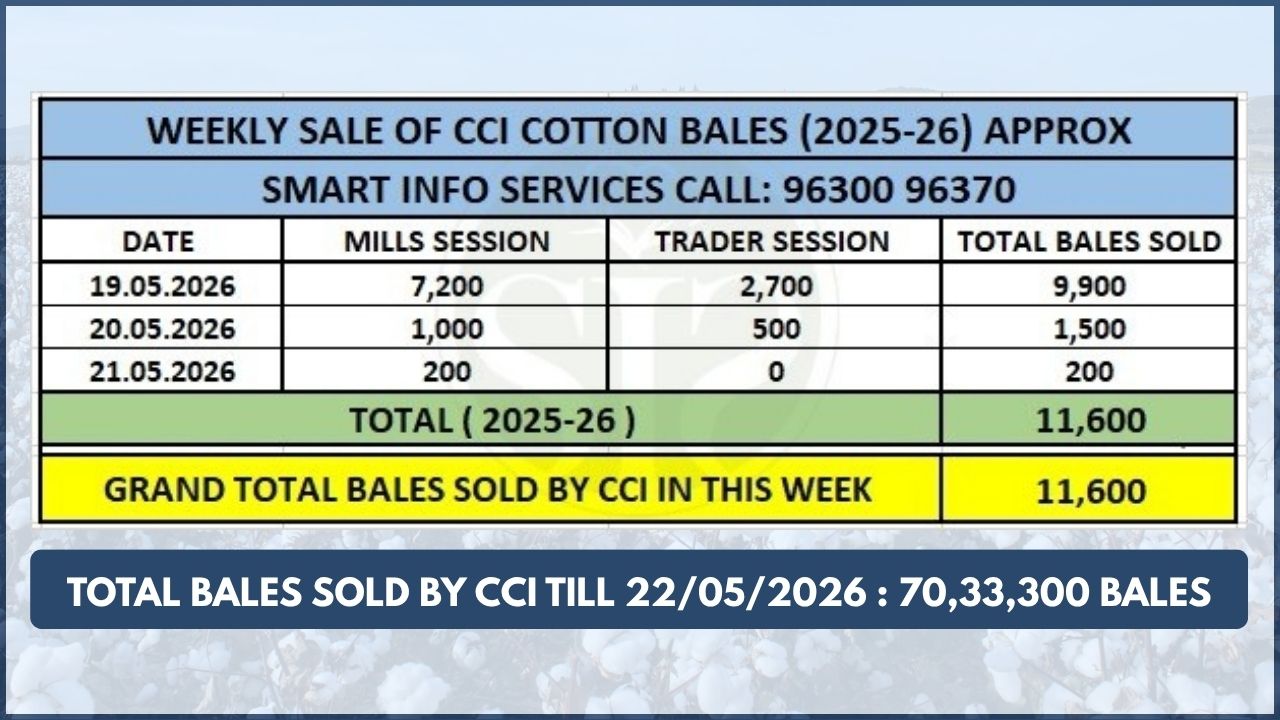
Indian apparel maker Arvind warned on Thursday that margins could be under pressure in the current financial year as it may partially absorb the impact of US tariff policy.The company will take steps to reduce costs and increase volumes to ease margin pressure and plans to issue forecasts for the financial year "at a later stage".US retailers are negotiating with suppliers on how the costs of tariff impositions will be distributed.India is still in a relatively favourable position due to higher tariffs imposed on major US apparel suppliers such as Bangladesh, Vietnam and China from July."As an immediate result of this, we are seeing an increase in demand for apparel and clothing, and positive signals from key US customers, indicating an increase in business," Arvind said.According to the company's annual report, exports will account for nearly 40% of the company's annual revenue in FY24.Arvind said a part of the volume gains could come following the UK-India free trade agreement. Currently, the UK contributes less than 2% to the company's turnover."The latest free trade agreement with the UK...opens up a new important geography for the company," it said.read more :-Weekly Summary Report : Cotton Bales Sold by Cotton Corporation of India (CCI).
| title | Created At | Action |
|---|---|---|
| Tami nadu : Nagapattinam cotton farmers worry over yield due to unseasonal rains | 22-05-2025 18:23:04 | view |
| Rupee opens 6 paise higher at 85.58 against dollar | 22-05-2025 17:39:22 | view |
| Indian rupees Ends Flat at 85.64 per Dollar | 21-05-2025 23:10:29 | view |
| CAI urges cotton trading community to stop all trade with Turkiye, explore other options | 21-05-2025 18:57:09 | view |
| Centre backs development of cotton plucking machine in Maharashtra | 21-05-2025 18:36:09 | view |
| Rupee down 01 Paise to 85.64 Against Dollar | 21-05-2025 17:42:12 | view |
| Rupee Falls 16 Paisa, Closes at 85.63 Against US Dollar | 20-05-2025 23:08:21 | view |
| USDA Projects Decline in India’s Cotton Acreage for MY 2025/26 Amid Crop Shifts | 20-05-2025 19:34:07 | view |
| India's $100-bn textile export target hinges on MSME: Primus Partners | 20-05-2025 18:52:29 | view |
| Industrial production up by 1.9% in EU in March: Eurostat | 20-05-2025 18:47:23 | view |
| Rupee Falls 7 Paise to 85.47 vs Dollar | 20-05-2025 17:17:32 | view |
| Rupee Gains 04 Paisa, Closes at 85.40 | 19-05-2025 22:58:40 | view |
| port curbs on bangladesh imports may create Rs 1,000 crore biz for textiles | 19-05-2025 18:52:48 | view |
| Maharastra : Cotton to dominate Kharif sowing in Wardha district | 19-05-2025 18:34:56 | view |
| Rupee Rises 7 Paise to 85.44/USD | 19-05-2025 17:25:36 | view |
| Arvind Warns of Margin Pressure Amid US Tariff Impact | 17-05-2025 19:06:19 | view |