STAY UPDATED WITH COTTON UPDATES ON WHATSAPP AT AS LOW AS 6/- PER DAY

Start Your 7 Days Free Trial TodayDETAILS OF COTTON PURCHASES MADE BY M/S CCI LTD DURING SEASON 2024/25 (UPTO 31ST MARCH) AT A GLANCE1. Under msp purview m/s cci ltd. purchased total one crore bales cotton equivalent to 525 lakhs quintals of kapas.2. This quantum comes around 38% of total arrival of 263 lakh upto 31st march of & 34% of expected 294.25 lakh bales during whole sesson.3. Value wise an amount of rs.37450 crores dispersed amongst 21 lakhs farmers throughout the country towards kapas purchased.4. Total 508 procurement centers were established in various states to facilitate the purchase.5. Tamilnadu state stood on top giving a highest sale of 40 lakh bales to cci.read more :-Indian Rupee lower 24 Paisa, Ends at 86.69 per Dollar
Rupee lower by 24 Paisa, Ends at 86.69 per DollarThe Indian rupee on wednesday lower 24 paise to close at 86.69 per dollar, while it opened at 86.45in the morning.At close, the Sensex was up 592.93 points or 0.78 percent at 76,617.44, and the Nifty was up 166.65 points or 0.72 percent at 23,332.35. About 2755 shares advanced, 1049 shares declined, and 130 shares unchanged.
Telangana Tops National Cotton Procurement, Reports CentreHyderabad :Telangana has emerged as the top state in cotton procurement for 2024-25, according to data released by the Centre on Tuesday. The Union ministry of textiles, through its nodal agency the Cotton Corporation of India Ltd. (CCI), said that it had procured one crore bales of cotton, which is equivalent to 525 lakh quintals, under the Minimum Support Price (MSP) operations by March 31, 2025. This procurement accounts for 38 per cent of the total cotton arrivals (263 lakh bales) and 34 per cent of the estimated total cotton production (294.25 lakh bales) in the country, marking a significant effort to stabilise cotton prices and support farmers.Telangana led the country with the procurement of 40 lakh bales, followed by Maharashtra with 30 lakh bales and Gujarat with 14 lakh bales. Other states that saw substantial procurement include Karnataka (5 lakh bales), Madhya Pradesh (4 lakh bales), Andhra Pradesh (4 lakh bales), and Odisha (2 lakh bales). Northern states such as Haryana, Rajasthan, and Punjab together contributed 1.15 lakh bales to the total.In all, the CCI has disbursed `37,450 crore to approximately 21 lakh cotton farmers across all major cotton-producing states. In a media statement, the textiles ministry said, "This large-scale procurement reaffirms the government’s commitment to protecting farmers from market volatility through the MSP mechanism." To ensure smooth and transparent operations, the CCI established 508 procurement centres across the country. Technological innovations have also enhanced the procurement process such as farmers now benefit from on-the-spot Aadhaar authentication, real-time SMS payment alerts, and 100 per cent direct benefit transfers via the National Automated Clearing House (NACH). The "Cott-Ally" mobile app, launched in nine regional languages, allows farmers to track MSP rates, locate procurement centres, and monitor payment status. Additionally, all CCI-produced cotton bales are now traceable through QR codes enabled by blockchain technology, ensuring transparency and accountability throughout the supply chain.read more :-Rupee opens 21 paise down at 86.45 against dollar
In relation to the US dollar, the rupee opens 21 paise lower at 86.45.Indian rupee opened 21 paise lower at 86.45 per dollar on wednesday versus tuesday 's close of 86.24.read more :-Rupee lower 36 Paisa Against Dollar, Closes at 86.24
Indian Rupee lower 36 Paisa, Ends at 86.24 per DollarThe Indian rupee on tuesday lower 36 paise to close at 86.24 per dollar, while it opened at 85.88 in the morning.At close, the Sensex was up 1,089.18 points or 1.49 percent at 74,227.08, and the Nifty was up 374.25 points or 1.69 percent at 22,535.85. About 2968 shares advanced, 843 shares declined, and 115 shares unchanged.read more :- Cotton Crisis: The Dark Story of White Gold
Cotton Crisis: The Dark Truth Behind White GoldIndian Agriculture Crisis: Cotton is a major cash crop in India and is popular in the country. Cotton is also called white gold. Cotton is cultivated mainly in the states of Maharashtra, Gujarat, Telangana, Andhra Pradesh, Karnataka, Tamil Nadu, Punjab and Haryana. This crop is important for farmers as well as industry. The country's largest agro-based industry, yarn and textile production, is based on cotton. The livelihood of millions of people depends on this industry. As the area under cotton crops has decreased by more than 2 million hectares in the last five years, it is a matter of concern for farmers, research institutes, government and industry. The main reason for the reduction in area is loss-making cotton cultivation.Cotton cultivation has been running at a loss for the last several years due to low productivity, rising production costs and low prices. It would not be an exaggeration to say that this crop has lagged behind in terms of mechanization. Therefore, all the work from planting cotton to harvesting has to be done by laborers. There is a huge shortage of workers in the state and cotton growers are worried because they are not getting any workers despite paying high wages for picking cotton. In such a situation, the question arises that why should cotton be cultivated?This is also the result of the government's misguided policy from input to export in the last two and a half to three decades. The policy of the central government is that if cotton, oilseeds and pulses are produced in the country, then they should be imported as per the requirement. When the prices of cotton start increasing, the industrial sector also gives priority to import. But fulfilling the requirement by import has never been a good option, especially in today's changing global situation.The newly appointed director of CICR claimed that efforts will be made to provide advanced hybrid varieties at the departmental level to increase the productivity of cotton and cooperation will be taken from organizations across the country to control the pink caterpillar. He will definitely make efforts in this direction, but he will also have to find an answer to who stopped this organization from doing so in the last two and a half decades. CICR has repeatedly announced that it will identify the reasons for low productivity and develop action plans to increase productivity. But they have not been successful so far. The central and state governments have also failed repeatedly in this. There is also turmoil in the matter of cotton picking machines in the country.If cotton productivity is to be increased in the country and this crop has to become profitable for the producers, then extensive research has to be done on its varieties. Producers should get BT cotton directly. Adoption of advanced farming techniques in cotton cultivation has to be increased. Cotton cultivation has to be brought under irrigation. Producers have to effectively control pink caterpillar. All operations from planting of cotton to harvesting should be mechanized.Intensive cultivation of indigenous varieties of long-term crops has been found to increase productivity. In such a situation, intensive cultivation of indigenous varieties will have to be increased to 20 percent. Cotton prices in the country should be determined on the basis of the percentage of cotton present in it. The entire process of 'cotton to cloth' should take place in the same area where cotton is grown. Producers should have a share in the value addition of cotton. Such measures will make cotton cultivation more cost-effective and contribute to the development of the sector.read more :- Season-wise Statement of Total Domestic Cotton Production and Procurement by CCI Under MSP Provisions Over the Last Six Years
Domestic Cotton Production and CCI MSP Procurement (Last 6 Seasons)After a significant pause, the Cotton Corporation of India (CCI) has made a significant return to procurement under the Minimum Support Price (MSP) mechanism for the 2024-25 cotton season.According to official data, domestic cotton production is expected to decline to 294.25 lakh bales (each weighing 170 kg) in the current 2024-25 season, down from 325.22 lakh bales in 2023-24. Despite the fall in production, CCI has made substantial procurement of 99.93 lakh bales till March 28, 2025 – marking a sharp increase of 33.96% in procurement percentage.This marks the return of significant procurement activity after two consecutive years of inactivity. In both the 2021-22 and 2022-23 seasons, despite domestic production being 311.17 lakh and 336.60 lakh bales, respectively, CCI did not make any procurement under MSP.The last big procurement was witnessed during the 2020-21 season, when CCI had bought 99.33 lakh bales out of 352.48 lakh bales produced, with a procurement percentage of 28.18%. In 2019-20, the corporation had bought 124.61 lakh bales, which was 19.62% of the total production of 365 lakh bales.The current procurement figure for 2024-25 is the second highest in the last six years, indicating a proactive approach by CCI in stabilising cotton prices and supporting farmers amid lower production forecasts.Experts believe that this fresh procurement effort may help maintain balance in the market and ensure fair prices for cotton growers.read more :- Rupee Opens 4 Paise Lower at 85.88 Against Dollar
Indian rupee opens 4 paise lower at 85.88 against US dollarThe Indian rupee opened 4 paise lower on April 8 at 85.88 against the US dollar, as compared to 85.84 against the greenback in the previous trading session.read more :-AUSTRALIAN COTTON SHIPPERS ASSOCIATION (ACSA) Delegation Visits CAI Headquarters
ACSA Delegation Visits CAI HQKey Insights from the Seminar :1. Annual Production: Australia produces approximately 5 million bales of cotton annually.2. Farming Community: The industry comprises around 1,500 cotton farmers.3. Landholding Size: Each farmer holds an average of 577 hectares.4. High Yield: Australian cotton achieves an average yield of 2,400 kg per hectare.5. Outturn: The kapas outturn ranges from 42% to 44%.6. Seed Size: Australian cotton seeds are smaller in size.7. Seed Distribution: Seeds are distributed by the government.8. Seed Provider: Only one company’s seeds are approved and used by farmers.9. Ginning Practice: Farmers do not sell kapas directly. Instead, they have it ginned at private ginning units by paying ginning and pressing charges, after which they sell the cotton lint and seed separately.10. Cotton Cake Usage: Primarily used in cattle farms and also exported to China.11. Primary Growing Region: Cotton in Australia is predominantly grown in Queensland.12. Fibre Quality : Staple Length: Averages 29 mm, ranging from 28.5 to 31 mm. Micronaire: Falls between 4.0 to 4.9.13. Yield Trade-off: Growing cotton with longer fibre and lower micronaire significantly reduces yield.read more :-Indian Rupee lower 10 Paisa, Ends at 85.84 per Dollar
Rupee lower 10 Paisa Against Dollar, Closes at 85.84The Indian rupee on monday lower 10 paise to close at 85.84 per dollar, while it opened at 85.74 in the morning.At close, the Sensex was down 2,226.79 points or 2.95 percent at 73,137.90, and the Nifty was down 742.85 points or 3.24 percent at 22,161.60. About 559 shares advanced, 3372 shares declined, and 137 shares unchanged. read more :-CCI Cotton Production and Purchases: Last 6 Years
According to data compiled from the cotton seasons 2019-20 to 2024-25, cotton production in the north Indian states of Punjab, Haryana and Rajasthan has seen a significant decline in the last six years.The total cotton production in India is projected to decline from 365 lakh bales in 2019-20 to an estimated 294.25 lakh bales in 2024-25. This represents a decline of about 70.75 lakh bales, underlining the growing concerns in the agriculture sector, especially in the northern region.Northern states hit hardCotton production in Punjab, Haryana and Rajasthan has seen a steep decline:Punjab's production fell from 9.50 lakh bales in 2019-20 to only 2.72 lakh bales in 2024-25.Haryana's production fell from 26.50 lakh bales to 12.44 lakh bales.In Rajasthan, traditionally the leading producer in north India, the procurement declined from 29 lakh bales to 18.45 lakh bales.Various factors such as pest infestation, climatic uncertainties and change in cropping pattern by farmers looking for more profitable or stable options are responsible for this decline.Significant drop in CCI procurementThe Cotton Corporation of India (CCI), which procures cotton under various categories (A, B and C), has also reduced its procurement drastically. In the 2019-20 and 2020-21 seasons, CCI procured significant quantities (up to 10.57 lakh bales in category B in 2020-21), but in the latest season, procurement declined to:0.02 lakh bales (A)0.62 lakh bales (B)0.50 lakh bales (C)No procurement was made by CCI in the 2021-22 and 2022-23 seasons as market prices were higher than MSP.OutlookExperts suggest that unless substantial efforts are made to support cotton growers through improved seeds, pest control and support pricing, this declining trend could threaten the livelihoods of farmers and the textile industry.The government and agricultural bodies are expected to review these trends and introduce policy measures aimed at reviving cotton cultivation in the affected northern states.read more :- Described: An emergency with cotton
Explained: A cotton emergencyThe pink bollworm has brought down India’s cotton production by a quarter in the last decade. While a few seed companies have developed new genetically modified hybrids resistant to the dreaded insect pest, regulatory barriers are coming in the way of their commercialisation.India’s cotton economy isn’t in great shape.This, despite the advantage the country has as a producer of the natural fibre and its textile exports facing only 27% duty – as against China’s 54%, Vietnam’s 46%, Bangladesh’s 37%, Indonesia’s 32% and Sri Lanka’s 44% – under US President Donald Trump’s “reciprocal tariff” policy.The cause for concern is production.India’s cotton output in the 2024-25 marketing year (October-September) is projected at just over 294 lakh bales (lb; 1 lb=170 kg), the lowest since the 290 lb of 2008-09. Production has been on a declining path since the peak of 398 lb in 2013-14 (see chart 1). A fall from almost 400 lb to under 300 lb can even be termed catastrophic.The cultivation of genetically modified (GM) cotton hybrids – incorporating alien genes isolated from a soil bacterium, Bacillus thuringiensis or Bt – had led to not only a near-trebling of production (from 136 lb to 398 lb), but also a 139-fold jump in exports (from 0.8 lb to 117 lb), between 2002-03 and 2013-14.A different bollwormThe above production slide, and India turning from a large cotton exporter to a net importer, is mainly courtesy of the pink bollworm (PBW). This is an insect pest, whose larvae bore into the bolls (fruits) of the cotton plant. The bolls contain seeds from which the white fluffy cotton fibres or lint grow. The PBW caterpillars feed on the developing seeds and the lint, causing yield loss as well as lint discolouration.The GM cotton now grown in India have two Bt genes, ‘cry1Ac’ and ‘cry2Ab’, coding for proteins toxic to the American bollworm, spotted bollworm and cotton leafworm pests. The double-gene hybrids initially provided some protection against the PBW too, but that effectiveness has dissipated over time.The reason for it is that the PBW is a monophagous pest, which feeds exclusively on cotton. This is unlike the other three pests that are polyphagous and survive on multiple host crops: The American bollworm larvae infest even maize, jowar (sorghum), tomato, bhindi (okra), chana (chickpea) and lobia (cowpea).Being monophagous enabled the PBW larvae to gradually build resistance to the toxins from the existing Bt cotton hybrids. The PBW population that became resistant from continuously feeding on these plants eventually overtook and replaced the ones that were susceptible. The pest’s short life cycle (25-35 days from egg laying to adult moth stage), allowing it to complete at least 3-4 generations in a single crop season of 180-270 days, further accelerated the resistance breakdown process.A recent article in the Nature scientific journal showed the PBW developing resistance to both cry1Ac and cry2Ab toxins by 2014, about 12 years after Indian farmers began cultivating Bt cotton.The incidence of the pest crossing the “economic threshold level” – where the value of crop damage exceeds the cost of control – was recorded from 2014 in the central (Maharashtra, Gujarat and Madhya Pradesh), 2017 in south (Telangana, Karnataka, Andhra Pradesh and Tamil Nadu) and 2021 in north (Rajasthan, Haryana and Punjab) growing zones.Not for nothing that all-India per-hectare cotton lint yields, which increased from an average of 302 kg in 2002-03 to 566 kg in 2013-14, have plunged to 436-437 kg during the last two years.Deploying new genesLeading Indian seed companies have developed GM cotton hybrids deploying new genes from Bt, which they claim confer resistance to PBW.The Hyderabad-based Bioseed Research India, a division of DCM Shriram Ltd, is conducting confined field trials of hybrids based on its proprietary ‘BioCotX24A1’ transgenic technology/event expressing the ‘cry8Ea1’ gene found in Bt.The Ministry of Environment’s Genetic Engineering Approval Committee (GEAC) had, in late-July 2024, permitted Bioseed to undertake Biosafety Research Level-1 (BRL-1) trials of its event at six locations in MP, Karnataka and AP. The trials, in isolated plots of not more than one-acre size each, are meant to evaluate the expression of the new alien genes and the agronomic performance of the hybrids/lines into which they are introduced. BRL trials also entail generation of data on food and feed toxicity and environmental safety (residue analysis, pollen flow studies, etc).read more :-Rupee opens 51 paise lower at 85.74 against US dollar
Against the US dollar, the Indian rupee begins 51 paise lower at 85.74.Indian rupee opened 51 paise lower at 85.74 per dollar on Monday versus Friday's close of 85.23.read more :- Declining Cotton Production and Procurement by CCI in Punjab, Haryana, and 10 Other States
Cotton production and procurement by CCI is continuously declining in 12 states including Punjab, Haryana and 12 other statesChandigarh: Cotton production and procurement by the Cotton Corporation of India (CCI) is continuously declining in 12 states, including major North Indian states Punjab, Haryana and Rajasthan.From 365 lakh bales (1 bale = 170 kg) in the 2019-20 season, production is expected to decline to 325 lakh bales in 2023-24 and provisionally to 294 lakh bales in the 2024-25 season by March 24, 2025. CCI's cotton procurement also witnessed a sharp decline, dropping from 124.61 lakh bales in 2019-20 to only 32.84 lakh bales in 2023-24, while the provisional figures for 2024-25 are expected to reach only 99.93 lakh bales by March 26, 2025.According to Union Minister of State for Textiles Pabitra Margherita, the reason for CCI's inability to make some procurement is due to cotton prices often being higher than the minimum support price (MSP), as explained in the Rajya Sabha in a written reply to a question by Punjab MP Sandeep Kumar Pathak.According to the minister, the country has produced 365 lakh bales in 2019-20, 352.48 lakh bales in 2020-21, 311.17 lakh bales in 2021-22, 336.60 lakh bales in 2022-23, 325.22 lakh bales in 2023-24 and 294.25 lakh bales in 2024-25 season up to 24th March 2025. Punjab, Haryana and Rajasthan have produced 9.50 lakh bales, 26.50 lakh bales and 29 lakh bales respectively in 2019-20; while it was 10.23 lakh bales, 18.23 lakh bales and 32.07 lakh bales in 2020-21; 6.46 lakh bales, 13.16 lakh bales and 24.81 lakh bales in 2021-22; 4.44 lakh bales, 10.01 lakh bales and 27.74 lakh bales in 2022-23; 6.29 lakh bales, 15.09 lakh bales and 26.22 lakh bales in 2023-24; and 2.72 lakh bales, 12.44 lakh bales and 18.45 lakh bales in 2024-25 season till 24th March. With regard to procurement by CCI, 124.61 lakh bales were procured in 2019-20, 99.33 lakh bales in 2020-21 while no procurement was made in the years 2021-22 and 2022-23. 32.84 lakh bales were procured in 2023-24 while 99.93 lakh bales have been procured in 2024-25 season till 26th March. Specifically, 3.56 lakh bales, 6.22 lakh bales and 3.76 lakh bales were procured by CCI from Punjab, Haryana and Rajasthan, respectively, in 2019-20; 5.36 lakh bales, 10.57 lakh bales and 9.11 lakh bales in 2020-21; no procurement in 2021-22 and 2022-23; 0.38 lakh bales, 0.43 lakh bales and 0.52 lakh bales in 2023-24; and 0.02 lakh bales, 0.62 lakh bales and 0.50 lakh bales in 2024-25 season till March 26.read more :-Farmers Run Out of Cotton, Prices Spike
Cotton Price: Prices rise after farmers run out of cottonWardha News: The prices of cotton have risen across the country due to the decrease in moisture content in the cotton currently coming to the market as compared to the beginning of the season as well as the increase in the price of silk. At present, cotton is trading at Rs 7,000 to Rs 8,000 per quintal.The central government had declared a price of Rs 7121 per quintal for medium-staple cotton and Rs 7521 per quintal for long-staple cotton. However, cotton was not purchased from farmers at this rate throughout the season. On the one hand, the productivity of cotton has declined and it has stabilized at four to five quintals per acre. Cotton producers were in a situation where productivity costs were rising and prices were falling.This does not even include the productivity cost of cotton. This has also affected the cotton cultivation area. Now that the cotton season is in its final stages and farmers have very little stock left, the price of cotton has gone up by Rs 1,000 per quintal. At the beginning of the season, the moisture content in cotton ranges between 10 to 14 per cent. Now it has come down to 6 to 7 per cent. Experts in the field said that the price of sugar has also increased.The market price of sugarcane was Rs 3200 to Rs 3300 per quintal. Now it has increased and it is trading at Rs 3,700 per quintal. As a result of all this, the prices of cotton have gone up. Vinegar is used for oil and it also provides a base during the process. These value-added products are used in food and animal feed. As a result of this boom in the market, the prices of cotton have gone up.Hinganghat (Wardha) Market Committee is famous for cotton. At present, a huge amount of cotton is arriving in this mandi. Ginning traders have to buy cotton by participating in the auction process of the market. Market Committee Secretary Tukaram Chambhare said that farmers come here to sell cotton because the entire transaction is transparent.Currently, 10 to 15 percent of cotton stock is left. The percentage of good quality cotton does not exceed 10. That is why prices have increased. Rates have increased from Rs 7,000 to Rs 8,000.The arrival of good quality cotton in the market has reduced. The price has been revised accordingly. Cotton producers can get good profits only when the area of cotton sowing and productivity decrease in the coming time. Because according to economic theory, demand and supply affect prices.read more :-Weekly Sales Report - Cotton Corporation of India (CCI)
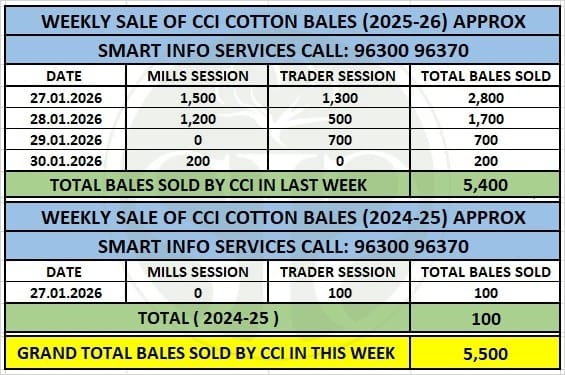
Cotton Corporation of India (CCI) Weekly Sales ReportCURRENT WEEK : 31 March 2025 – 04 APRIL 2025✅ Total Sales: 7,71,000 bales ( 2023-24 & 2024-25 Season )📌 Segment-wise Sales:🔸 Trader Session: 4,14,700 bales (2024-25)🔸 Trader Session: 3400 bales (2023-24)🔸 Mills Session: 3,41,700 bales (2024-25)🔸 Mills Session: 11,200 bales (2023-24)read more :-Rupee lower 19 Paisa Against Dollar, Closes at 85.23
| title | Created At | Action |
|---|---|---|
| CCI Ltd Cotton Purchases - 2024/25 (Up to March 31) | 10-04-2025 00:01:17 | view |
| Indian Rupee lower 24 Paisa, Ends at 86.69 per Dollar | 09-04-2025 22:47:45 | view |
| Telangana tops in cotton procurement, says Centre | 09-04-2025 18:20:01 | view |
| Rupee opens 21 paise down at 86.45 against dollar | 09-04-2025 17:41:23 | view |
| Rupee lower 36 Paisa Against Dollar, Closes at 86.24 | 08-04-2025 22:49:51 | view |
| Cotton Crisis: The Dark Story of White Gold | 08-04-2025 18:48:29 | view |
| Season-wise Statement of Total Domestic Cotton Production and Procurement by CCI Under MSP Provisions Over the Last Six Years | 08-04-2025 18:21:53 | view |
| Rupee Opens 4 Paise Lower at 85.88 Against Dollar | 08-04-2025 17:11:31 | view |
| AUSTRALIAN COTTON SHIPPERS ASSOCIATION (ACSA) Delegation Visits CAI Headquarters | 08-04-2025 00:46:40 | view |
| Indian Rupee lower 10 Paisa, Ends at 85.84 per Dollar | 07-04-2025 22:51:47 | view |
| CCI Cotton Production and Purchases: Last 6 Years | 07-04-2025 21:19:02 | view |
| Described: An emergency with cotton | 07-04-2025 18:21:23 | view |
| Rupee opens 51 paise lower at 85.74 against US dollar | 07-04-2025 17:33:20 | view |
| Declining Cotton Production and Procurement by CCI in Punjab, Haryana, and 10 Other States | 05-04-2025 19:03:08 | view |
| Farmers Run Out of Cotton, Prices Spike | 05-04-2025 17:52:49 | view |
| Weekly Sales Report - Cotton Corporation of India (CCI) | 05-04-2025 01:22:24 | view |