Filter

Recent News

India's cotton imports hit record levels amid duty exemptions

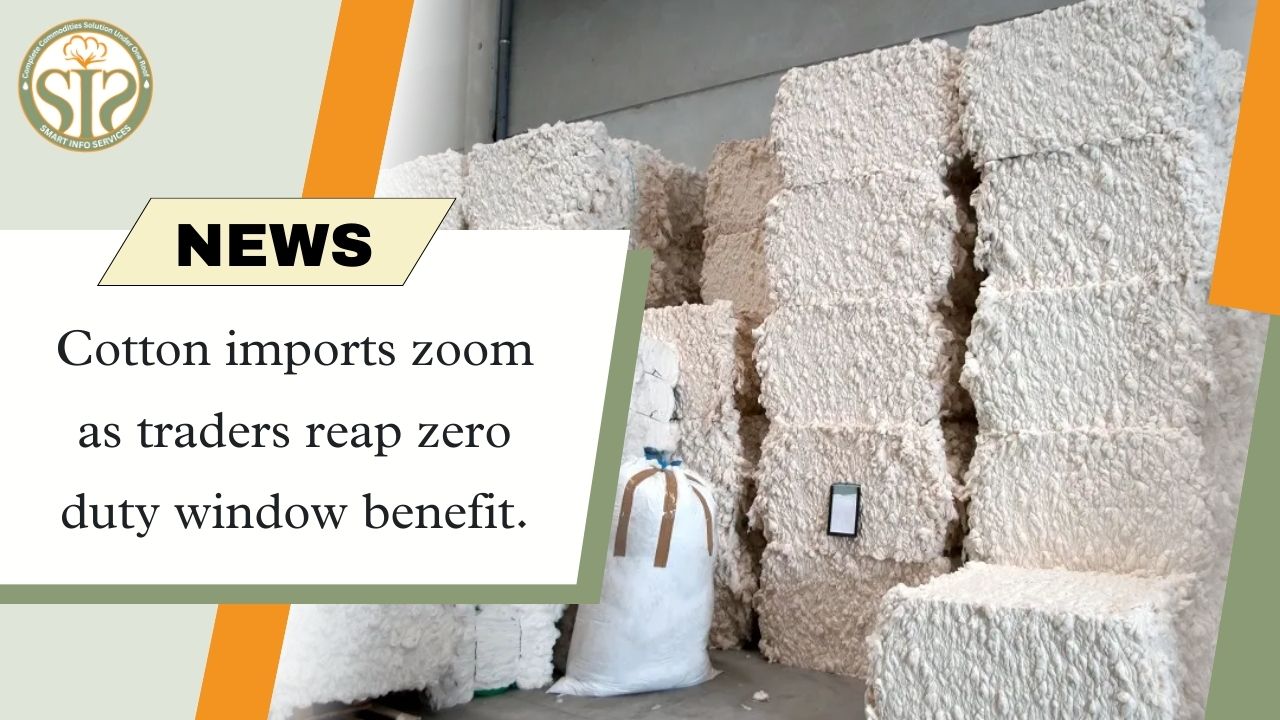
India’s Cotton Imports Set to Hit Record High Amid Duty Exemption, Weak OutputIndia’s cotton imports are projected to surge nearly 10% in the 2025/26 season to a record high, fueled by the government’s decision to allow duty-free imports and a sharp decline in domestic production to a 17-year low, industry officials told Reuters.Higher purchases by the world’s second-largest cotton producer are expected to lend support to global cotton prices, which are currently hovering near six-month lows.According to Atul Ganatra, president of the Cotton Association of India (CAI), India’s cotton imports could rise to 4.5 million bales in the 2025/26 marketing year that began on October 1, with around 3 million bales expected to arrive in the December quarter alone.Domestic cotton production is forecast to fall 2.4% from last year to 30.5 million bales, the lowest output since 2008/09, CAI estimates show. Some traders predict an even sharper drop, possibly to 28 million bales.The textile industry—one of India’s largest employers, providing jobs to over 45 million people—is also facing weakening demand. The CAI expects cotton consumption to fall 4.5% to 30 million bales in 2025/26 amid sluggish export orders.“Demand from the U.S. has dropped after the imposition of steep tariffs, forcing many textile units in southern India to scale back operations,” Ganatra said.The United States, which accounts for nearly 29% of India’s $38 billion in annual textile exports, doubled tariffs on Indian imports to as high as 50%, effective August.read more :- Punjab's cotton procurement is minimal, Kisan App in trouble

Punjab's cotton procurement is minimal, Kisan App in trouble

Kapas Kisan app runs into trouble in Punjab despite relaxed norms; Cotton Corporation of India’s purchases remain minimal.The Cotton Corporation of India’s (CCI) Aadhaar-based pre-registration system for cotton farmers, introduced this season through the new ‘Kapas Kisan’ mobile app, has hit major hurdles in Punjab, with farmers avoiding registration despite relaxed conditions and the state expecting more than 3 lakh quintals to arrive in mandis.CCI had initially mandated uploading of fresh ‘girdwari’ (records of cotton cultivation) verified by the revenue department for farmers to become eligible for procurement based on the Minimum Support Price (MSP). However, following media reports and requests from the Punjab Government, the Central Government relaxed the norm in the third week of October. Farmers are now allowed to upload land records based on seed-subsidy data, as the state provided a 33 per cent subsidy on Bt cotton seeds this year and holds complete acreage records.“The relaxation has been done, but the purchase is happening based on the registration being done by the farmer through the app. We are open to purchasing the stock which has 12 per cent moisture,” said an officer with the CCI, Bathinda office.CCI procurement remains negligibleHowever, CCI procurement remains negligible. To date, around 4,000 quintals have been purchased, as against the agriculture department’s expected arrival of an estimated 2 lakh bales (more than 3 lakh quintals) this season. Private players are dominating purchases, largely below MSP.Punjab’s major cotton-growing districts include Muktsar, Bathinda, Mansa, and Fazilka. The state’s cotton acreage, though slightly higher this year at 1.19 lakh hectares (target: 1.29 lakh ha) when compared to 2024, remains much below earlier levels. Acreage has fallen sharply from 3.35 lakh hectares in 2019 to 1.79 lakh hectares in 2023. CCI officials also doubt the estimate of 2 lakh bales due to crop loss from waterlogging and floods. In 2024, the area under cotton cultivation was 99,000 hectares.“Farmers were busy in the paddy procurement season, and now it is at its fag end. Hence, we are expecting more registrations through the Kapas Kisan app, and accordingly, purchases will increase. We have no hassles in buying; the farmer has to do the registration through the app,” officials said.But on the ground, farmers are reluctant. “The farmers are finding self-registration through the Kapas Kisan app a hassle and hence are preferring to sell it to private players. Many farmers don’t even have their old bills of seeds purchased on subsidy; many are not tech-savvy and prefer the old-school way,” said Sukhmandar Singh, president, BKU Rajewal (Fazilka).Abohar-based farmer Sukhjinder Singh Rajan said, “It is nice that norms to register through Kapas Kisan app have been relaxed… but the department of agriculture needs to find out why farmers are still not selling through CCI.”The ‘Kapas Kisan’ app‘Kapas Kisan’ app, available on both Android and iOS platforms, requires farmers to upload valid land records and details of cotton sowing areas, certified by revenue or agriculture authorities. The idea behind the introduction of this app was to bring transparency in maintaining land records, cotton arrival, and the purchases accordingly.What the stats sayMarket arrivals underline the trend. As of November 10, 54,900 quintals of cotton had arrived in Fazilka, but CCI purchased only 2,000 quintals; the rest went to private buyers. In Mansa, 21,230 quintals arrived, with CCI buying just 139 quintals. In Bathinda, 34,606 quintals of cotton had arrived in the mandis till November 10, with 117 quintals purchased by CCI. Sources revealed that overall arrivals are likely to be much lower than earlier projections, as a portion of the crop was damaged during the floods while the agriculture department’s estimates were prepared before the flooding occurred.read more :- Karnataka: Labour shortage affects cotton harvesting in Yadgir

Karnataka: Labour shortage affects cotton harvesting in Yadgir

Karnataka : Labour shortage hampers cotton harvesting in Yadgir district.Labour scarcity has become a hurdle in the cotton harvesting process in Yadgir district. Due to the non-availability of labour, particularly women, a majority of farmers have left cotton unpicked.Farmers in the district have chosen cotton as a major crop for the kharif season. However, there is labour scarcity as farmers start picking cotton manually at the same time.According to data available with the Agriculture Department, cotton cultivation has been taken up in a higher quantum of area than the target.It was sown in 2,04,474 hectares against the targeted area of 1,85,999 hectares. Out of the sown area, approximately one lakh hectare has been damaged due to the recent rain and floods.And, labour scarcity has become a hurdle in the harvesting process.“Each woman labour charges ₹200 for four to four-and-a-half hours of work to pick cotton. Instead, I hired workers on contract basis paying them ₹15 for picking one kilogram of cotton,” Vijay Kumar Gulgi, a farmer of Satyampet village, told The Hindu.Cotton-picking process through labour consumes more time and this is also one reason for labour scarcityMachines for cotton picking are available. But farmers do not use machines due to many reasons, including the cost they have to pay.“A majority of individual farmers are small and the area they sow cotton in is very small. It will be very expensive for them to invest money for hiring machines,” Gulagi said.Meanwhile, the district administration has set up 29 cotton procurement centres and of them, nine are now functioning. The remaining will function on demand.Despite procurement centres, farmers opt to go to private buyers citing delays in the registration and payment process there.Deputy Director of APMC Shivakumar Desai denied allegations of delay. He said that after the online process was introduced at the beginning of November, 20,000 farmers have already registered and payment will be made to them in three days after procuring cotton from them.He also said that ₹8,110 per quintal of first quality cotton and ₹7,750 per quintal of second quality will be given.Farmers are also saying that private buyers go directly to their fields and purchase cotton making payment on the spot. The buyers transport cotton on their own.“The rates fixed by private buyers is ₹7,110 per quintal of first quality cotton and ₹6,200 per quintal of second quality,” sources said.read more :- Cotton production in Madhya Pradesh stable in 2025-26: Traders

Cotton production in Madhya Pradesh stable in 2025-26: Traders

Cotton production in MP steady for 2025-26 season: Traders association.Indore: Cotton production in Madhya Pradesh in 2025-26 is estimated at 19 lakh bales, unchanged from the previous season but, India's cotton production in 2025-26 is projected to decline 2.4 per cent from the previous year., as per the Cotton Association of India (CAI) first estimate of the cotton pressing numbers for the new season beginning Oct 1, 2025. One bale is equal to 170 kg.Despite the steady production in Madhya Pradesh, the CAI forecasts a decline in India's cotton consumption, projecting it will fall to 300 lakh bales in 2025-26, 14 lakh bales less than the previous season. Factors contributing to this decrease include lowered demand, tariff issues, and a trend among spinning mills to shift towards man-made fibres, compounded by a shortage of labour.Industry experts attribute the stable production in Madhya Pradesh to increased acreage and favourable weather conditions during the crucial cultivation and growth periods.CAI president Atul Ganatra said that committee members will closely monitor the cotton pressing figures in the coming months and make necessary adjustments to their reports as needed.A farmer and owner of ginning units in Khargone Kailash Agrawal said, "Cotton production in Madhya Pradesh has remained stable as last year due to a rise in cultivation area and favourable weather conditions."Madhya Pradesh is a leading cotton-producing state and a hub of vital textile establishments. Key cotton-growing districts in Indore division include Khargone, Khandwa, Barwani, Manawar, Dhar, Ratlam, and Dewas.read more :- Rupee open Falls 07 Paise to 88.63/USD

India hikes anti-dumping duty on flax fabrics from China, Hong Kong

India Extends Anti-Dumping Duty on Flax or Linen Fabric Imported from China and Hong KongIndia has extended the anti-dumping duty on flax or linen fabric imported from China and Hong Kong for another five years. This decision follows a sunset review that confirmed continued dumping and injury to domestic producers.The DGTR found that despite the earlier duties, import volumes have increased and domestic prices have declined.Imports from China will be charged $2.36 per meter, while imports from Hong Kong will be charged $1.14 per meter.India has extended the anti-dumping duty (ADD) on flax or linen fabric imported from China and Hong Kong for another five years. The Indian government first imposed these duties on November 10, 2020, for a period of five years. The sunset review concluded that material injury persists due to increased imports. Flax fabric, often considered 'super cotton,' is widely used in premium clothing.Following the outcome of the Sunset Review investigation, the government has issued a formal notification continuing the ADD on imports of flax fabric from China and Hong Kong. The extension was issued last Friday by the Ministry of Finance, Department of Revenue, through Notification No. 31/2025-Customs (ADD).The subject goods are defined as woven fabrics with more than 50 percent flax content—commonly referred to as flax or linen fabric—classified under HSN code 5309 of the Customs Tariff Act, 1975.The Directorate General of Trade Remedies (DGTR) initiated the review on March 29, 2025. In its final findings on August 8, 2025, the authority confirmed continued dumping of these goods from China and Hong Kong, resulting in material injury to the domestic industry. The report cited an increase in import volumes despite existing duties, a decline in domestic price levels due to import reductions, and a decrease in domestic prices, which prevented local manufacturers from bearing the increased cost of raw materials.Based on these findings, the central government has increased anti-dumping duties on flax fabric imports from identified sources. Flax fabric imported or exported from China will be subject to a duty of $2.36 per meter, while imports originating from Hong Kong will be subject to a duty of $1.14 per meter, regardless of the producer or exporter. This duty is payable in Indian currency, calculated at the exchange rates notified by the Ministry of Finance under Section 14 of the Customs Act, 1962, on the date of filing the bill of entry. The latest notification confirms that this duty will remain in effect for the next five years from the date of publication.The continuation of the duty is aimed at ensuring fair trade and protecting domestic producers of flax-based fabrics and linen textiles, who are facing persistent price and volume pressure from low-priced imports.read more :- SKM intensifies agitation against central policies, demands increase in MSP

SKM intensifies agitation against central policies, demands increase in MSP

SKM will intensify its agitation against the central government's policies, demanding a new MSP for paddy, sugarcane, and cotton.The Samyukta Kisan Morcha (SKM) has announced an intensification of local protests across the country against the central government's agricultural policies and the neglect of farmers. The organization has demanded government procurement of paddy, sugarcane, and cotton crops at the rate of ₹3,012, ₹500, and ₹10,121 per quintal, respectively. SKM stated that, in addition to the farmers' pressing local demands, policy demands such as MSP@C2+50%, loan waivers, the repeal of the Electricity Bill 2025, and the implementation of the Land Acquisition Act 2013 (LARR) will also be included in the movement. The organization has threatened to submit a memorandum to the District Magistrate and launch a "protracted struggle" if its demands are not met.Government's Failure on MSPThe Morcha accused the central government of forcing farmers to sell their produce at throwaway prices despite the announced MSP of ₹2,369 per quintal for paddy for 2024-25. According to the organization, farmers in Uttar Pradesh are forced to sell paddy at ₹1,500-₹1,600 per quintal, which is about ₹800 less than the official rate. Meanwhile, in Bihar and Jharkhand, prices have fallen to ₹1,200-₹1,400. The SKM stated that according to the Swaminathan formula, the MSP for paddy should be ₹3,012 per quintal, resulting in a loss of about ₹1,600 per quintal at current rates.Major Demands for Sugarcane and Cotton FarmersThe organization also expressed concern over the plight of sugarcane farmers in Uttar Pradesh. According to the statement, the price of sugarcane has increased by only ₹55 in the last nine years, while the cost has increased manifold. The price of sugarcane in the current season is ₹370 per quintal, while farmers have demanded an increase of ₹500 per quintal and immediate payment of ₹3,500 crore owed to sugar mills. SKM said that cotton farmers are forced to sell their produce at ₹5,500-₹6,000 per quintal, while the declared MSP is ₹7,710. Mung bean farmers are forced to sell for less than ₹4,000 per quintal, instead of the declared rate of ₹8,768 per quintal. The organization demanded an MSP of ₹5,000 per quintal for basmati rice and the establishment of a government procurement mechanism.Fertilizer, electricity, and MNREGA also targetedThe Morcha alleged that fertilizer black marketing and arbitrary pricing are rampant across the country. Farmers are paying up to ₹700 for a bag of urea worth ₹270. The organization demanded a crackdown on black marketing and strict action against counterfeit fertilizers. On the issue of electricity, the SKM stated that farmers are being forcibly installed with prepaid smart meters and that the Electricity Bill 2025 is against farmers' interests. The organization demanded the withdrawal of this bill and the provision of 300 units of free electricity. Regarding MNREGA, the SKM stated that despite the law's guarantee of 100 days of work, workers receive only 47 days of work on average, and the average daily wage of ₹284 is less than the state minimum wage. The organization demanded the inclusion of agriculture and dairy in MNREGA, a daily wage of ₹700, and a guarantee of 200 days of employment.Action against Microfinance InstitutionsThe Samyukta Kisan Morcha stated that under the NDA regime, microfinance institutions are charging exorbitant interest rates from poor families and, in many cases, engaging in illegal activities in the name of debt recovery. The SKM demanded that the government enact laws regulating microfinance institutions and providing interest-free loans to the poor. In its statement, the SKM appealed to all state coordination committees to organize farmers and agricultural laborers at the local level. The organization said that if the government does not take concrete action on the demands of the farmers, then a massive and long-term movement will be started across the country.read more :- Demand to increase cotton-soybean purchase limit

Related News

Youtube Videos

आज देशभर में रुई के भाव 😱 Cotton Market Rate Today #kapasbajar
आज देशभर में रुई के भाव 😱 Cotton Market Rate Today #kapasba...
जानिए आज का कपास बाज़ार? 😱 Cotton Market Rate Today #kapasbajar
जानिए आज का कपास बाज़ार? 😱 Cotton Market Rate Today #kapasba...
ऐसा रहा आज कपास बाज़ार 😱 राजस्थान कपास बुआई | Cotton Market 22 July
ऐसा रहा आज कपास बाज़ार 😱 राजस्थान कपास बुआई | Cotton Market...
कपास बाज़ार में आज क्या हुआ? 😱 Cotton Market Rate 21 July 2026
कपास बाज़ार में आज क्या हुआ? 😱 Cotton Market Rate 21 July 2...
कैसा रहा आज का कपास बाज़ार? 😱 Cotton Market Rate Today | 20 July 2026
कैसा रहा आज का कपास बाज़ार? 😱 Cotton Market Rate Today | 20...
इस हफ्ते कपास में तेज़ी या मंदी? 😱 CCI ने बेचीं 3.18 लाख गांठें | Weekly Cotton Market
इस हफ्ते कपास में तेज़ी या मंदी? 😱 CCI ने बेचीं 3.18 लाख गा...
Cotton rate today: आज के कपास के भाव 🤔 #kapas  #youtube
Cotton rate today: आज के कपास के भाव 🤔 #kapas #youtube
रुई बाज़ार में आज तेज़ी का रुख 😱 CCI ने बेचीं 40,000+ गठानें #kapas
रुई बाज़ार में आज तेज़ी का रुख 😱 CCI ने बेचीं 40,000+ गठानें...
ऐसा रहा आज कपास बाज़ार 😱  राजस्थान कपास बुआई | Cotton Market 15 July
ऐसा रहा आज कपास बाज़ार 😱 राजस्थान कपास बुआई | Cotton Marke...
कपास की कीमतों में उछाल 😱 Cotton market rate today #kapasnabhav
कपास की कीमतों में उछाल 😱 Cotton market rate today #kapasna...
CCI Update: आज कितनी रुई गठानें बिकीं? 😱 Cotton market price today
CCI Update: आज कितनी रुई गठानें बिकीं? 😱 Cotton market pric...
साप्ताहिक कपास बाजार में तेज़ी 😱 Weekly cotton market review #kapas
साप्ताहिक कपास बाजार में तेज़ी 😱 Weekly cotton market review...
जानिए आज का कपास बाज़ार 😱 Cotton market rate today #kapas
कपास की कीमतों में उछाल 😱 Cotton market rate today #kapas
रुई बाज़ार में आज तेज़ी का रुख 😱 CCI ने बेचीं  70,000+ गठानें  #kapas
रुई बाज़ार में आज तेज़ी का रुख 😱 CCI ने बेचीं 70,000+ गठानें...
Application Download
Whatsapp Contact