Filter

Recent News

"Prices lower than MSP, cotton farmers ready to crowd the market"

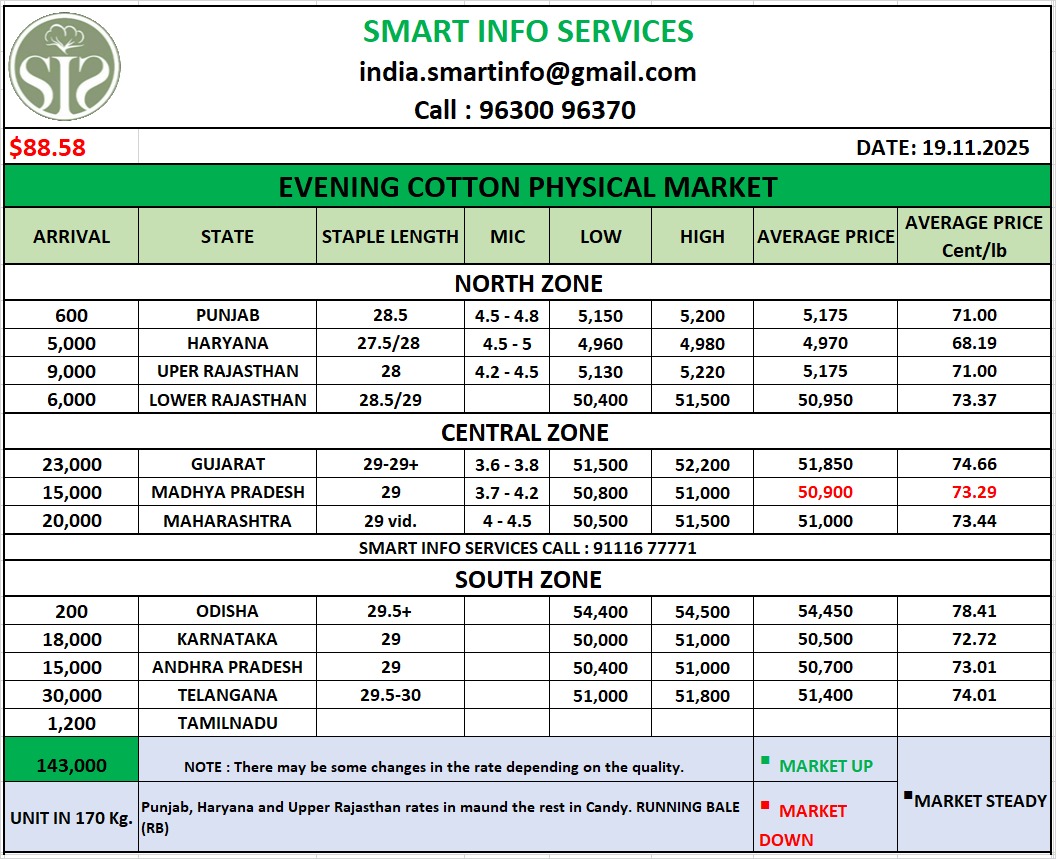
Cotton farmers brace for a rush at procurement centers as market prices remain below the MSP.As Telangana's cotton marketing season approaches, farmers are bracing for a surge at procurement centers as market prices are falling well below the MSP. With over 600,000 farmers affected, the state has expanded procurement facilities and introduced digital tools like the Cotton Farmer App to manage these crowds. However, concerns remain about payment delays, quality-related rejections, and private traders taking advantage of long queues.Hyderabad: With the 2025-26 cotton marketing season set to begin in mid-October, Telangana farmers are bracing for a rush at government procurement centers as market prices remain well below the Minimum Support Price (MSP). This price gap has raised concerns about bottlenecks and delayed payments for nearly 600,000 farmers in districts like Warangal, Adilabad, and Nalgonda.Currently, market prices in markets like Jammikunta and Bhainsa are ranging between ₹6,333 and ₹6,805 per quintal, and reaching up to ₹10,000 per quintal. The MSP for medium-staple cotton is ₹1,435 to ₹7,710, lower than the 8.27 percent increase from last year. The situation is even worse for long-staple varieties; the MSP is fixed at ₹8,110, but market prices are significantly lower.In a recent meeting, state officials and representatives of the Cotton Corporation of India (CCI) cited the ₹1,099 MSP-market gap as a major concern and urged aggressive procurement to protect farmers from distress sales. Telangana expects 5.3-5.5 million bales from 1.851 million hectares of cotton cultivated this season, with the potential to reach 7 million bales under favorable conditions.To manage the expected surge, the number of procurement centers has been increased from 110 to 122, with a new facility added at Konaraopet in Rajanna Sircilla. Last season, Telangana had the highest procurement nationally, procuring 4 million bales of cotton at 508 centers, but this year's anticipated high arrivals could put significant pressure on the system.CCI President Lalit Kumar Gupta said the agency aims to procure 5-7 million bales of cotton nationally, but warned that, like last year, peak arrivals could exceed capacity. There are fears that private traders could take advantage of long queues at centers to purchase cotton at cheaper prices.In response, the state has launched the Cotton Farmers App for slot booking, Aadhaar-linked payments, and monitoring committees at local centers to ensure fair quality checks and accurate weighing. A toll-free helpline (1800-599-5779), WhatsApp support (88972-81111), and a new command control room at the Directorate will provide real-time grievance redressal.Globally, cotton production declined by 1.3 percent to 117.2 million bales, and international prices remained below production costs due to higher supplies from Brazilian exports, further depressing Telangana's market rates.Officials have warned that 80-90 percent of Telangana's production could end up at CCI centers, risking payment delays and quality-related rejections. A trader from Nalgonda warned, "Lower prices will mean procurement disruptions. Small farmers could lose thousands per acre if CCI doesn't take immediate action."

Cotton prices remained stable despite market equilibrium.

Cotton prices remain unusually stable amid market equilibriumWhile other commodity prices have seen significant fluctuations throughout the year, cotton has maintained remarkable stability.Since January, cotton prices have consistently traded within a narrow range of 65 to 69 US cents per pound, a stark contrast to the volatility seen in other commodity markets.(SIS)This week, cotton's historical volatility reached multi-year lows, underscoring the current calm.According to Commerzbank AG, the difference between the monthly high and low in September was just 2 US cents.This trend of limited price movement was also seen in July and August.During the first half of the year, the typical monthly trading range was 4-5 US cents, with April being the only exception at 9 US cents.(SIS)The German bank noted in an update on Friday that the brief spike in volatility in April stemmed from a temporary drop in prices to just over 60 US cents following US President Donald Trump's announcement of reciprocal tariffs.“The decline in price volatility began last year, when prices peaked at nearly 100 US cents per pound in the first quarter of 2024,” said Commerzbank commodity analyst Karsten Fritsch in the update.Market balance is a key factorThe current stability in cotton prices can largely be attributed to the near-equilibrium state of the market since last year.For the current 2025-26 crop year, the US Department of Agriculture (USDA) projects a modest supply deficit of 250,000 tons.This is based on an estimated supply of 25.62 million tons and demand of 25.87 million tons.(SIS)The previous crop year saw an even smaller gap between supply and demand, with a modest supply surplus.*This year, the US cotton crop is projected to be 8% smaller... A decline is expected, resulting from significantly reduced acreage and lower yields.(SIS)However, the low abandonment rate (the difference between planted and harvested acreage) has helped to limit the overall reduction in crop volume, Fritsch said.Due to the smaller crop and a modest increase in exports, US cotton stocks at the end of the crop year are expected to be slightly lower than at the beginning.China's Dominance and the Impact of Trade DisputesChina has a significant influence on the global cotton market, ranking first in both supply and demand, ahead of India.Since China consumes more cotton than it produces, it relies on imports.These imports saw a notable decline in the previous crop year, and according to USDA forecasts, no significant increase is expected this year.(SIS)Brazil, which surpassed the US as the largest cotton exporter two years ago, can easily meet China's import needs on its own."This is why the trade dispute will play a smaller role for cotton than for many other agricultural commodities," Fritsch said.It is clear that this stability in cotton prices will not last forever.While the current stability in cotton prices is not expected to last indefinitely, what will ultimately disrupt this equilibrium remains unclear.(SIS)However, it is not entirely clear what could push prices out of their comfortable range.Cotton prices have been unusually stable since January, trading between 65 and 69 US cents per pound.This stability is due to a near-balance in the market, with a slight shortage in supply projected for 2025-26.China's dominant role and Brazil's export capacity suggest that trade disputes will have a limited impact on prices.(SIS)read more:-   CCI sells 88% of cotton through e-auction, weekly sales at 2.95 lakh bales

CNBC Markets Interview with CAI President – ​​September 19, 2025

CAI President Interview on CNBC Bazar (Gujarati), Dated 19.09.2025Q1. What is the reason ICE futures are range-bound between 64 to 69 cents?Ans.: Since last year, ICE futures have been range-bound between 64 to 70 cents. The main reasons are :1. Brazil’s bumper crop of about 240 lakh bales (Indian 170 kg standard). Brazil is offering cotton at 4 to 6 cents lower than the U.S.2. China is producing its largest cotton crop in the last 12 years and has stopped importing U.S. cotton.These two factors are exerting pressure on ICE futures and preventing any upward movement. Until ICE futures cross 75 cents, we will not see a significant rise in Indian or global cotton markets.Q2. What is the outlook for Indian cotton and the condition of the new crop?Ans.: Currently, Indian cotton prices are steady, ranging from ₹53,000 to ₹55,000 per candy, depending on quality. These rates are expected to remain stable for some time, and an upward trend is unlikely in the near term.On 30th September 2025, India will have record closing stocks of 60–65 lakh bales — the highest since the COVID year. The new season (starting 1st October) will therefore open with 60–65 lakh bales of old stock, equivalent to around 75 days of mill consumption.For the new crop, state associations estimate a 5–10% higher output compared to last season, mainly due to the widespread adoption of new “4G” technology seeds across major cotton-growing states. According to Gujarat experts, these seeds yield over 700 kg per hectare with 36–40% lint output.* Expected new crop (2025/26): 325–340 lakh bales (vs. 312 lakh last season)* Opening stock: 60–65 lakh bales* Imports expected: 40–50 lakh bales Thus, the total availability will be about 430 lakh bales. This surplus will put downward pressure on the market.Q3. Out of the 60–65 lakh bales carry-forward stock on 30th September, how much will be with CCI, traders, MNCs, and mills?Ans.: Currently, CCI holds 12–15 lakh bales of unsold stock, plus 20–25 lakh bales sold but not yet lifted. Out of this, about 15 lakh bales were sold in the last 15 days alone and remain unlifted. Therefore, by 30th September, CCI’s godowns will hold around 30–35 lakh bales, while mills will have another 30–35 lakh bales — making the total 60–65 lakh bales.This year, mills purchased heavily from CCI and also imported record quantities. By 30th September, mills are expected to have an average of 40–45 days’ stock in their godowns.Since the government has allowed duty-free imports until 31st December, mills have covered imports in large volumes, especially lower-quality cotton at ₹48,000–₹51,000 (Indian port delivery). Around 20 lakh bales are expected to arrive at Indian ports between October and December.Q4. Should the government reconsider the duty-free import decision, as it could harm farmers?Ans.: Farmers are protected by higher MSP rates of ₹8,110 per quintal. Duty-free import was a long-pending demand of the textile industry, and its approval addresses that need.Q5. Why are Indian mills importing such large quantities despite sufficient domestic stock?Ans.: There are two main reasons: 1. Imported cotton, especially Brazilian, is cheaper than Indian cotton.2. CCI procures over 100 lakh bales between October and April but withholds selling immediately, storing it for 8–9 months. Mills requiring continuous supply therefore turn to imports.For the next season, contracts for about 20 lakh bales (October–December shipment) are already in place. Overall, imports could reach 40–50 lakh bales. With this plus higher domestic production and record opening stock, India may see more than 100 lakh bales of carryover stock on 30th September 2026 — the highest ever.Q6. The government recently reduced GST on man-made fibres from 18% to 5%. How much shift do you expect from cotton to man-made fibre?Ans.: This 13% tax advantage will boost demand for man-made fibres. As per Grasim (Birla), sales of viscose and other fibres are expected to rise by 5–7% in the coming year. Consequently, Indian cotton consumption could decline by 15–20 lakh bales.For 2025–26, overall cotton consumption may fall from 315 lakh bales to about 290 lakh bales, mainly due to the GST reduction on man-made fibres and the 50% U.S. tariff.read more :- INR Gains 12 Paise, Closes at 88.10 per Dollar

Girdawari mandatory: Zero registration on MSP portal in 17 days

The mandatory Girdawari (land survey) requirement for registration to sell cotton at MSP has been achieved to date, but the result is not a single registration on the portal in 17 days.Piles of cotton piled up on the bales at Hanumangarh Junction Mandi. | Hanumangarh: For the first time, the CCI has implemented online registration for cotton purchases at the Minimum Support Price (MSP). The 'Kapas Kisan' app has been launched for this purpose on September 1st.After the Girdawari (land survey) is 100% complete, the report will be certified and uploaded. Only then will farmers be able to obtain the Girdawari report from the Patwari or online. The complete Girdawari is unlikely to be completed before October 15th. Consequently, government cotton procurement will also be delayed. The Agricultural Marketing Department has written to the CCI requesting the removal of the Girdawari requirement at the time of registration. Despite this, the CCI has not issued any orders in this regard. The FCI also purchases wheat at the support price based on online registration, but a survey is not required during registration.When farmers bring their produce to the market, the survey is conducted and the purchase is made.However, the CCI has made it mandatory to upload the survey report at the time of registration. Consequently, registration will be delayed, and procurement will not begin on time. This will result in significant losses for farmers. This year, cotton has been sown on approximately 180,000 hectares in the district. The sown area is approximately 61,000 hectares more than last year. The crop is in good condition so far. Consequently, production is expected to be good. Cotton will arrive in the markets in October.If procurement at the support price does not begin on time, farmers will face difficulties. This time, the Cotton Corporation of India (CCI) will procure at nine centers in the district. The CCI has written to the secretaries of the Agricultural Produce Market Committees of Hanumangarh Town, Junction, Goluwala, Pilibanga, Rawatsar, Bhadra, Nohar, Tibbi, and Sangaria, urging them to educate farmers about registering. However, due to the mandatory uploading of a Girdawari report, farmers are unable to register. CCI officials claim that online registration has been initiated for the convenience of farmers. After registration, farmers will be able to bring their produce to the market according to their slots. The Girdawari requirement is to harass farmers. The government does not want to purchase agricultural commodities at the support price. The government makes new rules every day, but does not consider the interests of farmers. Therefore, various obstacles are imposed. First, online registration was made mandatory for purchasing cotton. Now, Girdawari is being imposed. Farmers will not tolerate this.Surendra Sharma, farmer leader, Hanumangarh Deputy Director, said, "A letter has been written to the General Manager to remove the requirement of Girdawari (land survey) during registration. Girdawari is mandatory during registration on the Cotton App. Due to this, not a single registration has been made. A letter has been written to the General Manager of CCI to remove the requirement of Girdawari during registration." DL Kalwa, Deputy Director, Agricultural Marketing Department, Hanumangarh. The Central Government has increased the MSP of cotton by Rs. 589 per quintal, benefiting farmers. This time, the Central Government has increased the MSP of cotton by Rs. 589 per quintal. This time, the support price for medium-staple cotton has been set at Rs. 7710 per quintal, and the MSP for long-staple cotton has been set at Rs. 8110 per quintal. In recent years, Hanumangarh district has produced common staple cotton, between medium and long. When arrivals begin in the markets, the CCI determines the price by checking the length. Purchases are then made at that rate. Last year, the price of medium staple cotton was fixed at Rs 7121 per quintal and that of long staple at Rs 7521 per quintal. Due to low production last year, procurement could not be done at the support price.Traders only purchased the produce through open auction. The average market price during the season was Rs 6500 to 7000 per quintal. Guidelines from higher level, Girdawari is necessary for registration. Cotton producing farmers can register online on the Kapas Kisan App to sell their produce. Girdawari is necessary at the time of registration. Registration and procurement guidelines for cotton procurement are decided at higher level. Kewalkrishna Sharma, Quality Inspector, CCI

"GST 2.0: New impetus for textiles and logistics"

GST 2.0 Boosts Textile and Logistics SectorsNew Delhi : According to an official statement issued on Thursday, the rationalization of the Goods and Services Tax (GST) under GST 2.0 is a significant reform aimed at addressing structural anomalies, reducing costs, and boosting demand in the textile and logistics industries. Both of these are crucial for domestic growth, employment, and export competitiveness.By uniforming tax rates across the value chain, the GST reform ensures affordability for consumers, sustains employment in labor-intensive sectors, and enhances India's ability to compete globally. The statement states that in the textile sector, this rationalization strengthens the entire value chain—from fiber to apparel—by reducing distortions, improving apparel affordability, reviving retail demand, and boosting export competitiveness.The reduction in GST will make apparel more affordable for middle- and lower-income families, boosting domestic demand and having a significant impact in smaller towns and rural areas.The GST on readymade garments up to ₹2,500 is now 5%, making apparel more affordable and boosting domestic demand.Reducing the GST on man-made fibers and yarns from 12% and 18% to 5% removes the inverted duty structure and strengthens small and medium enterprises, while reducing the GST on carpets and other textile floor coverings from 12% to 5% will enhance global competitiveness, the statement said.Similarly, reducing the GST on commercial goods vehicles from 28% to 18% will reduce logistics costs and boost exports.GST reforms also extend to the transportation sector, which plays a key role in reducing logistics costs and promoting industrial growth. Trucks and delivery vans, which carry approximately 65-70% of India's freight traffic, benefit significantly from the tax rationalization. Cheaper freight transportation – Lower costs per tonne-km benefit the transportation of textiles, FMCG, and e-commerce deliveries.The cascading effect of lower logistics costs helps mitigate overall price pressures and reduce inflation. Furthermore, lower logistics costs make the Indian textile industry more competitive abroad.Rationalizing GST in the textile and logistics sectors is a decisive step towards strengthening India's manufacturing base, improving affordability, and boosting exports. By reducing structural imbalances and easing cost pressures, these reforms benefit consumers, small businesses, and exporters alike. The statement further stated that these reforms reinforce the vision of a globally competitive India, driven by resilient supply chains and a thriving textile sector.read more :- Tamil nadu : Mini textile park inaugurated in Karur
Tamil nadu : Mini textile park inaugurated in Karur

Tamil Nadu: Karur gets new textile parkMinister for Textiles and Handlooms R. Gandhi on Thursday inaugurated a mini textile park at Kodangipatti on Thursday.It has been set up under the Tamil Nadu Mini Textile Park Scheme. Under the scheme, the State government will bear 50% of the expenditure on establishing common facilities, infrastructure, and factory buildings. The maximum grant will be ₹2.5 crore for each park. A sum of ₹11.87 crore had been spent on establishing the park. Of the expenditure, the State government had extended ₹2.5 crore as grant. Oasis Texpark Private Ltd. has spent the remaining amount.Minister for Textiles and Handlooms R. Gandhi on Thursday inaugurated a mini textile park at Kodangipatti on Thursday.It has been set up under the Tamil Nadu Mini Textile Park Scheme. Under the scheme, the State government will bear 50% of the expenditure on establishing common facilities, infrastructure, and factory buildings. The maximum grant will be ₹2.5 crore for each park. A sum of ₹11.87 crore had been spent on establishing the park. Of the expenditure, the State government had extended ₹2.5 crore as grant. Oasis Texpark Private Ltd. has spent the remaining amount.A press release said that three companies would function in the textile park. About 400 persons would get employment.Mr. Gandhi said that approval had been given to nine mini textile parks in Karur district. Of them, two parks had started functioning. Other parks were under construction.Earlier, Mr. Gandhi and Mr. Senthilbalaji inaugurated a quilt machine erected at an estimate of ₹35 lakh at Thiyagi Kumaran Handloom Weavers Cooperative Society here.read more :- Rupee open Falls 09 Paise to 88.22/USD

Related News

Youtube Videos

साप्ताहिक कपास बाजार में तेज़ी 😱 CCI ने बेचे 2 लाख+ बेल्स | Weekly Cotton Market 25 July 2026
साप्ताहिक कपास बाजार में तेज़ी 😱 CCI ने बेचे 2 लाख+ बेल्स |...
आज देशभर में रुई के भाव 😱 Cotton Market Rate Today #kapasbajar
आज देशभर में रुई के भाव 😱 Cotton Market Rate Today #kapasba...
जानिए आज का कपास बाज़ार? 😱 Cotton Market Rate Today #kapasbajar
जानिए आज का कपास बाज़ार? 😱 Cotton Market Rate Today #kapasba...
ऐसा रहा आज कपास बाज़ार 😱 राजस्थान कपास बुआई | Cotton Market 22 July
ऐसा रहा आज कपास बाज़ार 😱 राजस्थान कपास बुआई | Cotton Market...
कपास बाज़ार में आज क्या हुआ? 😱 Cotton Market Rate 21 July 2026
कपास बाज़ार में आज क्या हुआ? 😱 Cotton Market Rate 21 July 2...
कैसा रहा आज का कपास बाज़ार? 😱 Cotton Market Rate Today | 20 July 2026
कैसा रहा आज का कपास बाज़ार? 😱 Cotton Market Rate Today | 20...
इस हफ्ते कपास में तेज़ी या मंदी? 😱 CCI ने बेचीं 3.18 लाख गांठें | Weekly Cotton Market
इस हफ्ते कपास में तेज़ी या मंदी? 😱 CCI ने बेचीं 3.18 लाख गा...
Cotton rate today: आज के कपास के भाव 🤔 #kapas  #youtube
Cotton rate today: आज के कपास के भाव 🤔 #kapas #youtube
रुई बाज़ार में आज तेज़ी का रुख 😱 CCI ने बेचीं 40,000+ गठानें #kapas
रुई बाज़ार में आज तेज़ी का रुख 😱 CCI ने बेचीं 40,000+ गठानें...
ऐसा रहा आज कपास बाज़ार 😱  राजस्थान कपास बुआई | Cotton Market 15 July
ऐसा रहा आज कपास बाज़ार 😱 राजस्थान कपास बुआई | Cotton Marke...
कपास की कीमतों में उछाल 😱 Cotton market rate today #kapasnabhav
कपास की कीमतों में उछाल 😱 Cotton market rate today #kapasna...
CCI Update: आज कितनी रुई गठानें बिकीं? 😱 Cotton market price today
CCI Update: आज कितनी रुई गठानें बिकीं? 😱 Cotton market pric...
साप्ताहिक कपास बाजार में तेज़ी 😱 Weekly cotton market review #kapas
साप्ताहिक कपास बाजार में तेज़ी 😱 Weekly cotton market review...
जानिए आज का कपास बाज़ार 😱 Cotton market rate today #kapas
कपास की कीमतों में उछाल 😱 Cotton market rate today #kapas
Application Download
Whatsapp Contact