STAY UPDATED WITH COTTON UPDATES ON WHATSAPP AT AS LOW AS 6/- PER DAY
Start Your 7 Days Free Trial TodayRupee drops 3 pip to 83.88 against the US dollar.Rupee depreciates 3 paise to 83.88 against the US dollar in early trade on Monday, influenced by fluctuating crude oil prices and volatility in international dollar trade. Positive domestic equity market and foreign fund inflow capped the fall.Read More :> Floods in Bangladesh Disrupt Cotton Imports, Shipments May Shift to India
Imports of cotton are disrupted by flooding in Bangladesh; shipments may go to IndiaFlooding in Bangladesh has severely disrupted cotton supplies to the country’s garment factories, one of the world’s largest clothing production hubs. This disruption, coupled with recent political turmoil, has slashed garment production by 50%, according to industry officials. The floods have hindered transportation from Chittagong port, further aggravating delays in completing orders.With Bangladesh being a leading global cotton importer, the impact is significant. Industry leaders warn that if the supply chain issues aren't quickly resolved, the situation could worsen, potentially causing Bangladeshi manufacturers to lose 10%-15% of business to competitors.Amid these challenges, some cotton shipments may be redirected to India, Pakistan, and Vietnam. Analysts have noted increased interest from these countries for prompt cotton deliveries. Additionally, new garment orders originally destined for Bangladesh might shift to southern India.The Bangladesh garment industry, already grappling with power shortages, faces ongoing uncertainty as floods persist. This has led buyers to adopt a cautious approach, possibly delaying new orders and further straining the industry.Read More :- Cotton prices rise in Maharashtra ahead of new season
The rupee strengthened by 1 paisa to close at 83.86 against the US dollar.At the close of trading, the BSE Sensex rose 231.16 points or 0.28 per cent to close at 82,365.77. During the day's trading, the Sensex touched a new all-time high of 82,637.03 points. On the other hand, the NSE's 50-share index, Nifty, rose by just 83.95 points or 0.33 per cent to close at 25,235.90. During the day's trading, the Nifty touched a new highest level of 25,268.35.Read more:- Severe Weather Threatens Gujarat's Cotton and Peanut Crops Ahead of Harvest
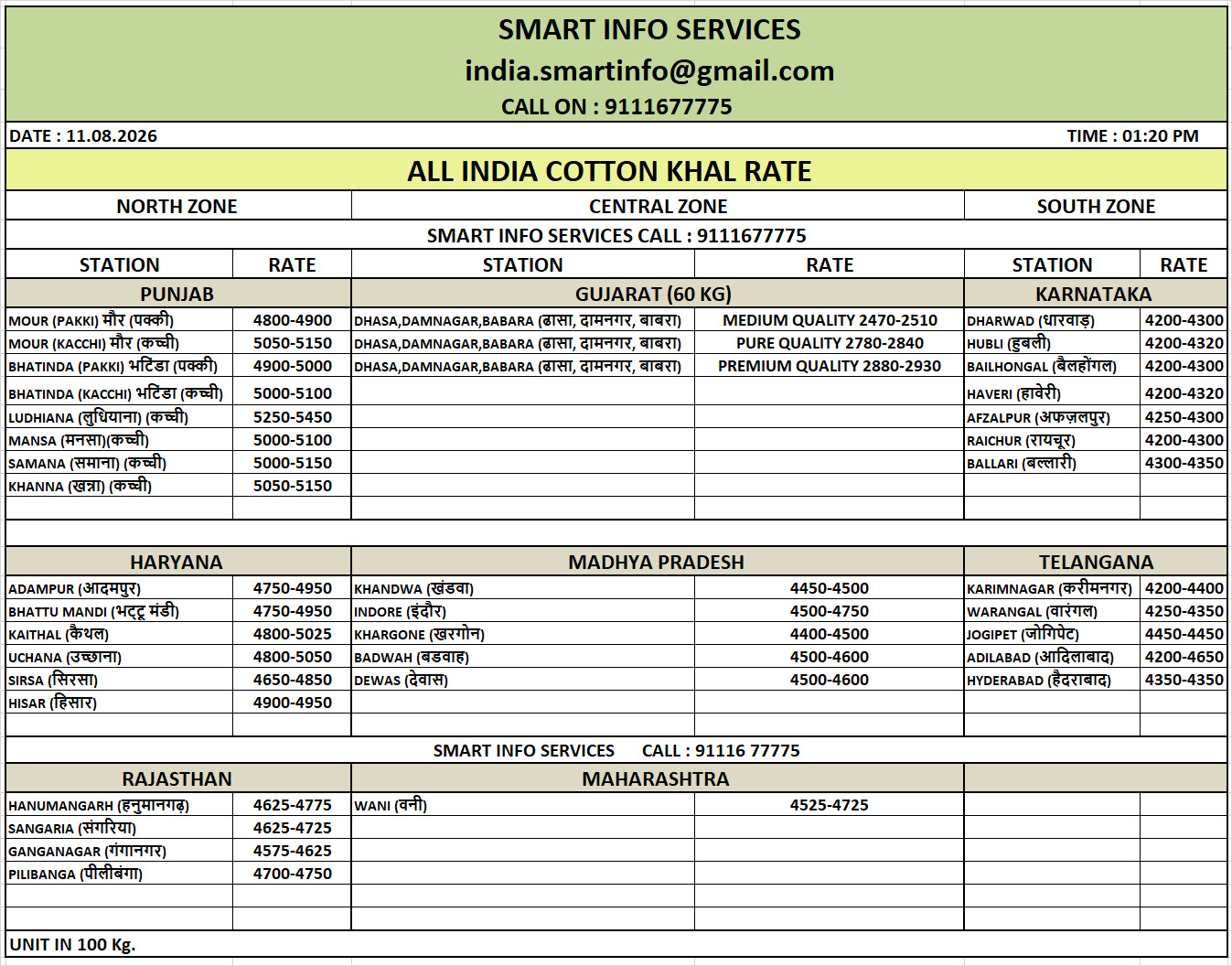
Prior to the new season, cotton prices in Maharashtra increaseAhead of the start of the new cotton season, cotton prices have risen by about 3 per cent in the last 15 days. Currently, the available stock of cotton in the country has decreased, and cotton cultivation has also decreased by about 10 per cent. Along with this, crops have been damaged by rain in Gujarat and Maharashtra, due to which the market is seeing improvement.The new cotton season in India starts in October, while the arrival of cotton in the northern states starts from September itself, as cotton cultivation starts earlier there. Usually before the new season, cotton prices remain high during the off-season, but prices start softening before the new goods come to the market, as the supply increases.This year, however, the market witnessed a decline during the off-season due to several reasons. Cotton prices in the international market reached the lowest level in the last four years, which also put pressure on the domestic market. But, cotton prices in India remained stable compared to the international market, which ranged between Rs 6,800 and Rs 7,300. The main reason for this was the low supply in the country, which kept the prices stable.There was constant pressure in the cotton market for the last three months, raising concerns about the new season. Usually, prices rise in the off-season, but this year prices fell, creating uncertainty in the market. However, cotton prices have improved in the last two weeks due to three major reasons, giving a positive start to the season.Low cotton stockThe country currently has low cotton stock. Production was low last season, while consumption by domestic industries increased and exports are also estimated to be around 28 lakh bales. It is estimated that only 20 lakh bales of cotton will remain in the new season this year. If the arrival of new cotton is delayed due to rain, the shortage of cotton may increase furtherReduction in cultivationCotton cultivation has decreased by about 10 percent compared to last year. There has been a significant reduction in cultivation in northern states like Punjab, Haryana and Rajasthan. Apart from this, cotton acreage has also decreased in Gujarat and Maharashtra. Last season, cotton was cultivated in 122 lakh hectares in the country, which has come down to 111 lakh hectares this year. The decline in cultivation will reduce production, which has supported the prices.Heavy rainsIn recent days, many important cotton producing areas of Gujarat and Maharashtra have received heavy rains, causing damage to the crop. The same situation is in some parts of Madhya Pradesh. The market has already been affected due to low sowing and crop damage. Apart from this, good rains are also expected in September, which may affect the cotton crop. Due to all these reasons, prices are seeing improvement in the market.Read More : - Abohar Flooded After Continuous Rain, Cotton Farmers Fear Crop Damage
Abohar Flooded Following Nonstop Rain, Worries Cotton Growers About Crop DamageAbohar town and its neighboring villages have been battered by continuous rain for the past 24 hours, leading to severe waterlogging in several areas, including the Sub-divisional Administrative Complex. The situation has left farmers deeply concerned about the cotton crop, as many fields are now submerged.The rain continued intermittently throughout the day, exacerbating water accumulation in the city. The flooding in administrative offices disrupted operations, causing difficulties for both staff and visitors.Residents have expressed frustration that the state government relocated the divisional office of the Punjab Water Supply and Sewerage Board, leaving only junior engineers in Abohar. They also criticized the lack of budget and heavy equipment necessary to clean the main sewage lines before the monsoon season.Read More :> Severe Weather Threatens Gujarat's Cotton and Peanut Crops Ahead of Harvest
Gujarat's Cotton and Peanut Crops Face Danger From Severe Weather Before HarvestGujarat, India's leading cotton and peanut-producing state, is facing a severe threat from ongoing heavy rains and impending strong winds, just as the harvest season approaches. These adverse weather conditions could lead to flooding, endangering key crops in the region.The India Meteorological Department (IMD) has predicted significant rainfall for the Saurashtra and Kachchh regions of Gujarat, continuing for three days through Saturday. The situation is further aggravated by a deep depression near the coast, which is expected to intensify into a cyclone by Friday. Wind speeds could escalate to as high as 85 kilometers (53 miles) per hour, according to a Thursday bulletin.If the cotton crops suffer severe damage, India may be forced to increase its cotton imports, which could provide a boost to global cotton prices that have dropped nearly 15% this year. Meanwhile, a potential decline in peanut production could tighten supplies in the domestic market, impacting a nation that already imports approximately 60% of its vegetable oil needs.Earlier this week, parts of Gujarat experienced flash floods due to heavy rainfall, with one town recording up to 300 millimeters of rain in just 24 hours by Thursday morning, the IMD reported.The National Disaster Response Force (NDRF) has been dispatched to the affected regions, successfully rescuing over 500 individuals from waterlogged areas across several districts of Gujarat, the agency shared on social media.The IMD has issued warnings to oil exploration companies and port operators along the Gujarat and Maharashtra coasts, advising them to monitor the developing weather closely and take appropriate measures until Friday. Fishermen have also been cautioned to avoid the Arabian Sea due to the dangerous conditions.Read More :> Indian Textile Industry Urges Extension of MIP on All Knitted Fabrics to Curb Imports
Rupee Gains 7 Paise Against US Dollar to 83.82Mumbai, Aug 30 (PTI) Rupee appreciated 7 paise to 83.82 against the US dollar in morning trade on Friday, supported by significant foreign fund inflows and a positive trend in domestic equities.Read More :> India's Monsoon Prolonged, Threatening Ripe Crops
Long-lasting Monsoon in India Endangers Ripe CropsIndia's monsoon season is expected to extend into late September this year due to the formation of a low-pressure system mid-month, according to two weather department.The extended monsoon and above-normal rainfall could jeopardize summer-sown crops such as rice, cotton, soybean, corn, and pulses, which are usually harvested around mid-September. This could lead to increased food inflation. However, the extended rains might also improve soil moisture, potentially benefiting the planting of winter crops like wheat, rapeseed, and chickpea.A senior official from the India Meteorological Department, who requested anonymity, mentioned that there is a heightened chance of a low-pressure system emerging in the third week of September, which might delay the monsoon's retreat.India, a major producer of wheat, sugar, and rice, has already implemented various export restrictions on these commodities. Any additional losses from excessive rainfall could lead the Indian government to extend these restrictions.Typically, the monsoon season starts in June and begins to retreat from northwestern India by September 17, ending across the country by mid-October. The monsoon is crucial for India's $3.5-trillion economy, as it provides nearly 70% of the rainfall needed for agriculture and replenishes water sources. About half of India's farmland relies on this seasonal rain, which normally lasts from June to September.September and October's rainfall could be influenced by developing La Nina conditions, which might cause a delayed monsoon withdrawal, according to another IMD official. Historical patterns suggest that La Nina during the latter part of the monsoon season can result in a prolonged monsoon period.read more :- Indian Textile Industry Urges Extension of MIP on All Knitted Fabrics to Curb Imports
The Indian rupee strengthened on Thursday, Rupee closed at 83.8700 against the U.S. dollar at, up 0.1% from 83.9525 in the previous sessionSensex hit a fresh record high of 82,285.83, while the Nifty 50 scaled a fresh peak of 25,192.90 during the session. The Sensex finally closed 349 points, or 0.43 per cent, higher at 82,134.61. The Nifty 50 settled at 25,151.95, up 100 points, or 0.40 per cent.Read more:- Cotton Prices Rise Amid Tight Supplies, Lower Sowing, and Delayed Crop Arrivals
To reduce imports, the Indian textile industry requests that the Minimum Input Price (MIP) be extended for all knitted fabricsIndia's textile industry is advocating for an extension of the minimum import price (MIP) across all HS lines under Chapter 60, which includes various knitted and crocheted fabrics. The current MIP, applied to five specific HS lines, is set to expire on September 15, 2024, prompting industry stakeholders to call for its broader application to protect domestic producers from a surge in imports.In a letter addressed to the Ministry of Textiles, industry organizations and numerous business leaders expressed concern that imports of knitted fabrics have not decreased significantly, even with the existing MIP on certain fabric types. The Ministry had previously sought input on which specific HS lines at the 6/8-digit level should have an extended or new MIP.R K Vij, Emeritus President of the Textile Association of India (TAI) and Secretary General of the Polyester Textile and Apparel Industry Association (PTAIA), emphasized the detrimental impact of fabric dumping on the domestic market. “The selective MIP on five HS lines has not been effective, as imports surged in other lines. The industry unanimously supports imposing MIP on the entire Chapter 60, which covers all knitted fabrics.”The Confederation of Indian Textile Industry (CITI) echoed these concerns in a letter to the Ministry, noting that since the MIP of $3.5 per kg was introduced, imports of other fabric varieties under different HSN codes have increased at lower prices. The fabric import data from April-June 2024 compared to the same period in 2023 highlights this issue.Industry feedback suggests that previously, due to a uniform duty structure across all knitted fabric categories, significant quantities of fabric were misclassified under Chapter 6006, which should have been categorized under other chapters. Currently, unit import prices for fabrics, particularly under HSN 6001 and 6005, are unsustainable for domestic producers and are harming the local industry. To safeguard the domestic market, the industry is urging the government to extend the MIP beyond September 15, 2024, and to apply the $3.5 per kg MIP to all knitted fabric categories under HSN 6001, 6002, 6003, 6004, and 6005.Support for this measure has also come from various industry bodies, including the North India Textile Mills Association (NITMA), Southern India Mills Association (SIMA), Federation of Surat Textile Traders Association, and Punjab Dyers Association. Many business leaders are calling for stricter controls on fabric imports, arguing that the influx of cheaper fabrics has marginalized the domestic market, especially at a time when global demand for textiles from developed markets is sluggish.Read more :- Cotton Prices Rise Amid Tight Supplies, Lower Sowing, and Delayed Crop Arrivals
Reduced Sowing, Tight Supply, and Delayed Crop Arrivals Lead to Rising Cotton PricesCotton prices have surged recently due to tight supplies, reduced kharif sowing, and reports of continuous rainfall affecting crop prospects in key producing states like Gujarat and Maharashtra. Spot prices have increased by ₹1,500-2,000 per candy (356 kg) over the past two weeks, representing a 2.5-3 percent rise. Trade experts expect prices to remain steady, with arrivals likely delayed by 15-30 days due to excessive rains.Atul Ganatra, President of the Cotton Association of India (CAI), attributes the price increase to several factors, including a shortage of cotton, a tight closing balance sheet, and reduced sowing. Closing stocks for the 2023-24 season, ending in September, are projected to be below 20 lakh bales (170 kg each).Additionally, the recent uptrend in cotton futures on the Intercontinental Exchange (ICE), where prices have risen from 66.35 cents to 70.35 cents, has also contributed to the local price hike.Ganatra also noted that reduced sowing could impact cotton production for the upcoming 2024-25 season, starting in October. According to the Agriculture Ministry’s latest data, cotton acreage for the current kharif season is down 9 percent, totaling 111 lakh hectares compared to last year’s 122.15 lakh hectares.The decline in acreage is most significant in northern states like Punjab, Haryana, and Rajasthan, as well as in major cotton-producing states such as Gujarat and Maharashtra. In Gujarat, acreage has decreased by 12 percent to 23.58 lakh hectares, while Maharashtra’s cotton area is down to 40.78 lakh hectares from 41.86 lakh hectares last year.The continuous rains have raised concerns about potential crop damage, particularly in Gujarat and Maharashtra. Ganatra notes that heavy rains in these regions have resulted in waterlogged fields, with some areas receiving 20-30 inches of rainfall over the past few days.However, Rajkot-based trader Anand Poppat suggested that while excess rain could harm crops in specific areas of Gujarat, Maharashtra, and Madhya Pradesh, overall, the rains might be beneficial. Poppat believes the upward trend in prices will continue due to tight stock levels and delayed arrivals caused by late sowing across the country.Pradeep Jain, President of Khandesh Gin Press Association in Jalgaon, noted that despite concerns, the crop is in good condition with minimal pest issues, potentially better than the last 2-3 years. Jain added that increased demand for cotton is supporting prices, particularly as there are currently no new arrivals of raw cotton.Ramanuj Das Boob, Vice President of the All India Cotton Brokers Association in Raichur, observed that the crop in Karnataka, Telangana, and Andhra Pradesh looks promising due to timely and adequate rainfall. Boob echoed the sentiment that delayed crop arrivals have driven recent price increases of ₹1,500-2,000 per candy, with the market likely to remain steady until the end of September. He also noted that reduced stock levels with the Cotton Corporation of India, multinationals, and traders will continue to support prices.Cotton Prices Rise Amid Tight Supplies, Lower Sowing, and Delayed Crop ArrivalsCotton prices have surged recently due to tight supplies, reduced kharif sowing, and reports of continuous rainfall affecting crop prospects in key producing states like Gujarat and Maharashtra. Spot prices have increased by ₹1,500-2,000 per candy (356 kg) over the past two weeks, representing a 2.5-3 percent rise. Trade experts expect prices to remain steady, with arrivals likely delayed by 15-30 days due to excessive rains.Atul Ganatra, President of the Cotton Association of India (CAI), attributes the price increase to several factors, including a shortage of cotton, a tight closing balance sheet, and reduced sowing. Closing stocks for the 2023-24 season, ending in September, are projected to be below 20 lakh bales (170 kg each).Additionally, the recent uptrend in cotton futures on the Intercontinental Exchange (ICE), where prices have risen from 66.35 cents to 70.35 cents, has also contributed to the local price hike.Ganatra also noted that reduced sowing could impact cotton production for the upcoming 2024-25 season, starting in October. According to the Agriculture Ministry’s latest data, cotton acreage for the current kharif season is down 9 percent, totaling 111 lakh hectares compared to last year’s 122.15 lakh hectares.The decline in acreage is most significant in northern states like Punjab, Haryana, and Rajasthan, as well as in major cotton-producing states such as Gujarat and Maharashtra. In Gujarat, acreage has decreased by 12 percent to 23.58 lakh hectares, while Maharashtra’s cotton area is down to 40.78 lakh hectares from 41.86 lakh hectares last year.The continuous rains have raised concerns about potential crop damage, particularly in Gujarat and Maharashtra. Ganatra notes that heavy rains in these regions have resulted in waterlogged fields, with some areas receiving 20-30 inches of rainfall over the past few days.However, Rajkot-based trader Anand Poppat suggested that while excess rain could harm crops in specific areas of Gujarat, Maharashtra, and Madhya Pradesh, overall, the rains might be beneficial. Poppat believes the upward trend in prices will continue due to tight stock levels and delayed arrivals caused by late sowing across the country.Pradeep Jain, President of Khandesh Gin Press Association in Jalgaon, noted that despite concerns, the crop is in good condition with minimal pest issues, potentially better than the last 2-3 years. Jain added that increased demand for cotton is supporting prices, particularly as there are currently no new arrivals of raw cotton.Ramanuj Das Boob, Vice President of the All India Cotton Brokers Association in Raichur, observed that the crop in Karnataka, Telangana, and Andhra Pradesh looks promising due to timely and adequate rainfall. Boob echoed the sentiment that delayed crop arrivals have driven recent price increases of ₹1,500-2,000 per candy, with the market likely to remain steady until the end of September. He also noted that reduced stock levels with the Cotton Corporation of India, multinationals, and traders will continue to support prices.Read more :>Possibility of pressure on cotton prices, despite decline in area and productivity
Rupee Gains 9 Penisses Against US Dollar to 83.88Rupee appreciated 9 paise to 83.88 against the US dollar in morning trade on Thursday, supported by the weakness of the American currency in the overseas market and a positive trend in domestic equities.Read More :> India's Textile Exports Set to Reach $65 Billion by 2025-26: Invest India
The rupee closed 2 paise lower at 83.95 against the US dollar this evening.At the close of trading, the BSE Sensex rose 73.80 points or 0.09 per cent to close at 81,785.56. The NSE's 50-share index, Nifty, rose 34.60 points or 0.14 per cent to close at 25,052.35. During the day's trading, the Nifty touched a new high of 25,129.60.Read more:- Attack of leaf wrapping disease on cotton crop
Rupee Depreciates by 2 Paise to 83.95 vs US DollarThe Indian Rupee depreciated by 2 paise to 83.95 against the US dollar in early trade on Wednesday, weighed down by a muted trend in domestic equities. Experts believe the RBI is intervening to prevent further depreciation.Read More :>IMD Warns of Intense Rainfall in Madhya Pradesh, Rajasthan, Gujarat, and Maharashtra
The rupee closed 3 paise lower at 83.93 against the US dollar this evening.At the close of trading, the BSE Sensex rose marginally by 13.65 points or 0.017 per cent to close at 81,711.76. The NSE's 50-share index, the Nifty, rose just 7.15 points or 0.029 per cent to close at 25,017.75.Read more:- IMD Warns of Intense Rainfall in Madhya Pradesh, Rajasthan, Gujarat, and Maharashtra
In early trade, the rupee drops 7 paise to 83.94 against the US dollar.Rupee depreciated 8 paise to 83.95 against the US dollar in morning trade on Tuesday (August 27, 2024), weighed down by elevated crude oil prices and a muted trend in domestic equities.Stock market starts sluggishly, Sensex near 81700, BPCL top loserThe stock market is witnessing flat trading today on 27 August. The major indices of the market are trading sluggishly. The effect of mixed global signals is visible on the markets. Sensex is trading at the level of 81650 and Nifty at 25000. Read More :> Attack of leaf wrapping disease on cotton crop
| title | Created At | Action |
|---|---|---|
| Rupee Falls 3 Paise to 83.88 vs US Dollar | 02-09-2024 17:26:06 | view |
| Floods in Bangladesh Disrupt Cotton Imports, Shipments May Shift to India | 31-08-2024 01:47:59 | view |
| The rupee gained 1 paisa, ending at 83.86 per US dollar. | 30-08-2024 23:46:49 | view |
| Cotton prices rise in Maharashtra ahead of new season | 30-08-2024 23:35:50 | view |
| Abohar Flooded After Continuous Rain, Cotton Farmers Fear Crop Damage | 30-08-2024 18:19:35 | view |
| Severe Weather Threatens Gujarat's Cotton and Peanut Crops Ahead of Harvest | 30-08-2024 17:58:14 | view |
| Rupee Rises 7 Paise to 83.82 vs US Dollar | 30-08-2024 17:17:28 | view |
| India's Monsoon Prolonged, Threatening Ripe Crops | 30-08-2024 00:17:29 | view |
| The Indian rupee strengthened and closed at 83.87 against the US dollar. | 29-08-2024 23:37:32 | view |
| Indian Textile Industry Urges Extension of MIP on All Knitted Fabrics to Curb Imports | 29-08-2024 23:12:25 | view |
| Cotton Prices Rise Amid Tight Supplies, Lower Sowing, and Delayed Crop Arrivals | 29-08-2024 18:08:07 | view |
| Rupee Rises 9 Paise to 83.88 Against US Dollar | 29-08-2024 17:27:41 | view |
| The rupee ended the day 2 paise lower at 83.95 against the US dollar. | 28-08-2024 23:43:32 | view |
| Rupee Falls 2 Paise to 83.95 Against US Dollar | 28-08-2024 17:22:34 | view |
| The rupee ended the day 3 paise weaker, closing at 83.93 against the US dollar. | 27-08-2024 23:46:37 | view |
| Rupee falls 7 paise to 83.94 against US dollar in early trade | 27-08-2024 17:42:08 | view |