STAY UPDATED WITH COTTON UPDATES ON WHATSAPP AT AS LOW AS 6/- PER DAY
Start Your 7 Days Free Trial TodayThe textile industry in Tirupur is severely impacted by a shortage of containers and rising shipping costsThe textile export industry in Tirupur has been significantly impacted by a severe container shortage and a sharp increase in shipping costs over the past three months.Shipping plays a vital role in garment exports, especially from Tirupur to key markets such as Europe, the UK, the USA, and Arab countries. Goods are primarily shipped through the ports of Tuticorin, Chennai, and Kochi, with Tuticorin handling about 80% of Tirupur's exports.M P Muthurathinam, president of the Tirupur Exporters and Manufacturers Association, emphasized the importance of timely delivery in the export business. "Garments from Tirupur are transported by container trucks to Tuticorin, then shipped to Colombo, where they are transferred to larger vessels. However, the container shortage has severely disrupted this process, affecting the garment export business for the last three months. Three months ago, the cost of a 40-foot container was $1,700; it has now surged to $7,000 due to the shortage."India relies heavily on China for containers, where production delays have further exacerbated the issue. Previously, containers returning from China with imported goods were refilled with exports. However, they are now frequently sent back empty, as shipping companies prioritize routes to Europe and the USA, where they earn higher profits.An exporter noted that air freight costs are four times higher than sea freight, making shipping the preferred mode of transport. He stressed the need for India to start producing containers domestically. "The Union government should consider establishing public sector shipping firms to tackle the issue. Unfortunately, the Centre has not yet taken any significant steps in this direction. Export disruptions are treated as temporary, but they have long-term consequences on employment, trade, and foreign exchange earnings."K M Subramanian, president of the Tirupur Exporters Association, pointed out that the rising shipping costs have forced businesses to increase the prices of their products, making it difficult to compete with countries like Bangladesh and Vietnam. "In Tirupur, 90% of textile players are micro, small, and medium enterprises (MSMEs), with only 10% being large companies. The burden of increased shipping costs is especially hard on these smaller enterprises."




India Will Produce Carbon Fiber by 2025–2026: Giriraj Singh, the Textile MinisterUnion Textiles Minister Giriraj Singh announced on Friday that India is expected to start producing carbon fibre by 2025-26. Carbon fibre, a key material used in aerospace, civil engineering, and defence, is currently imported from countries like the US, France, Japan, and Germany. Singh expressed confidence that this niche product would soon be domestically produced.Addressing the media, Singh highlighted the growing importance of technical textiles across various sectors, stating, "The future belongs to technical textiles, and I am confident that India will produce carbon fibre by 2025-26."He also mentioned the European Union’s upcoming Carbon Border Adjustment Mechanism, a tax on embedded carbon imports, which is set to take effect in 2026, underscoring the urgency of local production.The minister praised the Narendra Modi-led government for initiatives that have reduced imports in sectors like hygiene. He credited the Production-Linked Incentive (PLI) scheme with boosting domestic production, noting, "We used to import diapers, but thanks to PM Modi’s PLI scheme, the industry has been revitalized."At a technical textiles event organized by Ficci, Singh reiterated the government’s commitment to developing the industry. Initiatives like the National Technical Textiles Mission (NTTM) and the PLI scheme for man-made fibre (MMF) fabrics and technical textiles were cited as key efforts.Singh highlighted 156 research projects under NTTM, including carbon fibre development and support for startups. He also pointed to innovations such as the North India Textile Research Association's (NITRA) work on Milkweed fibres, which are useful for cold-weather applications.Discussing export targets, Singh expressed confidence that India would surpass the $10 billion goal for technical textiles exports by 2030. He emphasized the potential of the Meditech sector, particularly hygiene products, and also identified Agrotech as a promising area for employment and daily use products.Singh concluded by expressing optimism about India’s ability to develop high-performance fibres with applications in aerospace, automotive, construction, and other fields.Read More :>PLI Benefits Likely to Expand to More Textile Items
PLI Advantages Are Probably Going to Spread to More Textile ProductsThe government is planning to extend the Production Linked Incentive (PLI) scheme to additional items in the textiles, pharmaceuticals, and solar photovoltaics (PV) sectors, while also considering increasing its duration from five to six years. This move is aimed at boosting domestic manufacturing, driving investments, and increasing production and exports. Launched in 2021 with a budget of ₹1.97 lakh crore, the PLI scheme offers subsidies to manufacturers based on their production output and capital spending in key sectors like semiconductors, among others. Although the scheme has seen considerable success in mobile manufacturing and holds potential for electronics, telecom, and food processing industries, its progress has been slower in areas like textiles and solar PV. In response, the government is now considering expanding PLI benefits to cotton garments, in addition to its current focus on man-made fiber (MMF) apparel, MMF fabrics, and technical textiles. Cotton garments represent a significant portion of India’s textile exports, which largely come from small mechanized looms.The expansion is intended to support large-scale industrial parks linked to global value chains, with a specific focus on man-made fibers and technical textiles, which have struggled due to lower investment levels. According to officials, cabinet notes on the proposed expansion have been submitted to the Prime Minister’s Office and are awaiting final approval.Since its launch, the PLI scheme has attracted ₹1.5 lakh crore in investments, generated production worth ₹10 lakh crore, and facilitated the disbursement of ₹10,000 crore in incentives. Despite these successes, the textile and apparel sector has seen a decline in exports, dropping to $35.94 billion in 2023-24 from a record high of $44.51 billion in 2021-22, according to the commerce ministry.In the pharmaceutical and solar PV sectors, additional items are also being considered for inclusion in the PLI scheme to improve its overall impact and utilization.PLI Benefits Likely to Expand to More Textile ItemsThe government is planning to extend the Production Linked Incentive (PLI) scheme to additional items in the textiles, pharmaceuticals, and solar photovoltaics (PV) sectors, while also considering increasing its duration from five to six years. This move is aimed at boosting domestic manufacturing, driving investments, and increasing production and exports. Launched in 2021 with a budget of ₹1.97 lakh crore, the PLI scheme offers subsidies to manufacturers based on their production output and capital spending in key sectors like semiconductors, among others. Although the scheme has seen considerable success in mobile manufacturing and holds potential for electronics, telecom, and food processing industries, its progress has been slower in areas like textiles and solar PV. In response, the government is now considering expanding PLI benefits to cotton garments, in addition to its current focus on man-made fiber (MMF) apparel, MMF fabrics, and technical textiles. Cotton garments represent a significant portion of India’s textile exports, which largely come from small mechanized looms.The expansion is intended to support large-scale industrial parks linked to global value chains, with a specific focus on man-made fibers and technical textiles, which have struggled due to lower investment levels. According to officials, cabinet notes on the proposed expansion have been submitted to the Prime Minister’s Office and are awaiting final approval.Since its launch, the PLI scheme has attracted ₹1.5 lakh crore in investments, generated production worth ₹10 lakh crore, and facilitated the disbursement of ₹10,000 crore in incentives. Despite these successes, the textile and apparel sector has seen a decline in exports, dropping to $35.94 billion in 2023-24 from a record high of $44.51 billion in 2021-22, according to the commerce ministry.In the pharmaceutical and solar PV sectors, additional items are also being considered for inclusion in the PLI scheme to improve its overall impact and utilization.Read More :> Farmers of North Gujarat worried about monsoon devastation
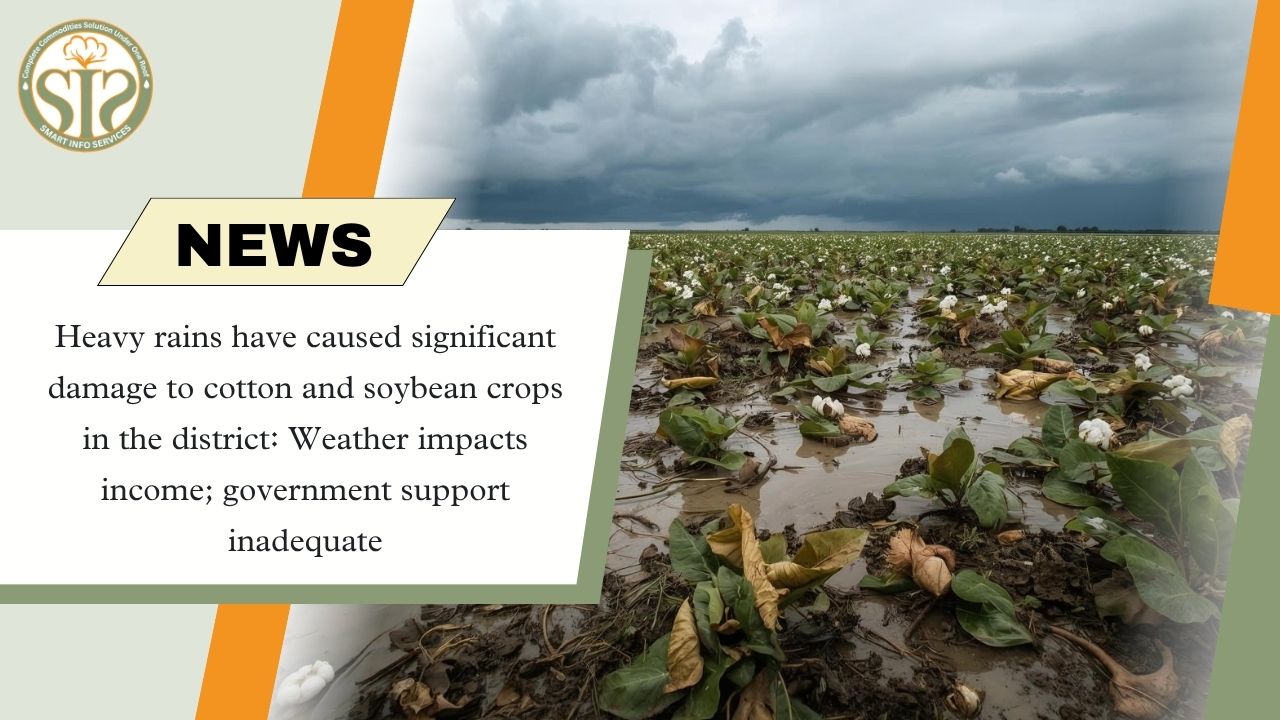
Farmers in North Gujarat fear the destruction caused by the monsoonMehsana: This year monsoon is proving to be a curse for the farmers of North Gujarat. Continuous rains have ruined major crops like cotton and castor. Crops are rotting due to waterlogging in the fields, which has wasted the hard work of the farmers and increased their concern.Due to heavy rains last week, most of the fields were submerged in water, and the water had not yet receded when the rain started again. Due to this, the cotton crop standing in the fields is on the verge of drying up. Farmers are losing sleep in the struggle to save their crops.The situation is especially serious in Kansa village of Visnagar taluka of Mehsana district, where the problem of waterlogging has increased due to sticky soil. About 15 to 17 thousand population of this village is dependent on agriculture, where cotton, castor and oilseeds are the main crops. This year continuous rains have caused heavy damage to these crops, and the concern of the farmers is increasing.Mukeshbhai Patel, a farmer of Kansa village, says that he has five bighas of land on which he had cultivated cotton, castor and oilseeds. But due to heavy rains, the castor and sesame crops have been completely ruined, while the production of cotton has also decreased drastically. Where usually 35 to 40 maunds of cotton were produced in one bigha, this time due to waterlogging, the production will hardly be even 20 maunds.This condition of the farmers has happened due to the uncertainty of monsoon and excessive rain, due to which their season has been completely affected.Read More :- Farmers of North Gujarat worried about monsoon devastation
This evening, the rupee strengthened by 3 paise to close at 83.95 against the dollar.At the end of trading, the Sensex closed at 81,183.93, down 1017.23 points or 1.24%. The Nifty closed at 24,852.15, down 292.98 points or 1.17%.Readmore:- Indian Textile Industry Poised to Reach $300 Billion by 2030, Aims for $100 Billion in Exports: Government
In early trade, the rupee gained 2 paise to 83.95 against the US dollar.Mumbai, Sep 6 (PTI) Rupee rose by 2 paise to 83.95 against the US dollar in early trade on Friday amid a weaker dollar against major currencies overseas.Read More :> Indian Textile Industry Poised to Reach $300 Billion by 2030, Aims for $100 Billion in Exports: Government
The rupee closed 1 paisa lower at 83.98 against the US dollar this evening.At the close of trading, the BSE Sensex fell 151.48 points or 0.18 per cent to close at 82,201.16. The NSE's 50-share index, Nifty, fell 53.60 points or 0.21 per cent to close at 25,145.10.Read more:- Rains and Floods Ravage Over 20 Lakh Acres of Crops in Telangana
The Indian government projects that the textile industry will generate $300 billion by 2030 and export $100 billion.The Indian textile industry has the potential to grow into a $300 billion powerhouse by 2030, with $100 billion expected to come from exports, the government announced on Wednesday. Currently valued at $175 billion, including $38-40 billion in exports, the industry is playing a crucial role in driving India's GDP, according to Pabitra Margherita, Minister of State for Textiles and External Affairs.At Assocham’s ‘Global Textile Sustainability Summit,’ the minister highlighted the importance of sustainability in shaping the future of India's textile sector. He emphasized the need for India to take the lead in sustainable textiles while promoting global responsibility. Margherita advocated for innovation and collaboration, stating that economic growth must align with social responsibility and inclusivity.“India’s textile sector offers unique opportunities to set new standards in sustainability. Our progress must be guided by these principles, ensuring the industry thrives while also positively impacting the planet,” Margherita said during the event.Rohit Kansal, Additional Secretary at the Ministry of Textiles, identified four major trends driving the sector: steady growth with a compound annual growth rate (CAGR) of 8% in the domestic market, increased digitization, automation, and the integration of artificial intelligence (AI).Kansal also highlighted government policy initiatives, such as the production-linked incentive (PLI) scheme, PM Mega Integrated Textile Region and Apparel (PM MITRA) parks, and the National Technical Textile Mission (NTTM), all of which are creating world-class infrastructure, encouraging investment, and generating employment in the textile industry.“Our goal is not just to position India as a hub for sustainable textiles but to inspire a global shift toward a more responsible textile industry. Achieving sustainability will require commitment, collaboration, and innovation,” Kansal said.MS Dadu, Chairman of Assocham’s Textiles and Technical Textiles Council, noted the importance of adopting advanced technologies like waterless dyeing, digital processing, and energy-efficient garment manufacturing. “By embracing these innovations, we are setting a global standard for a more environmentally conscious industry,” Dadu added.Read More :> Tamil Nadu Textile Mills Struggling Amid Multiple Challenges
Rupee Gains 4 Paise Against US Dollar to 83.97The Indian rupee appreciated by 4 paise to 83.97 against the US dollar in early trade on Thursday, supported by a weakening American currency and positive domestic equities.Read More :> Rains and Floods Ravage Over 20 Lakh Acres of Crops in Telangana
This evening, the rupee closed at 83.97 against the dollar without any change.At the close of trading, the BSE Sensex fell 202.80 points or 0.25 per cent to close at 82,352.64. The NSE's 50-share index, Nifty, fell 81.15 points or 0.32 per cent to close at 25,198.70.Readmore:- Abohar Flooded After Continuous Rain, Cotton Farmers Fear Crop Damage
In Telangana, Rain and Floods Destroy Over 20 Lakh Acres of Crops Telangana has been severely affected by recent heavy rains and floods, leading to widespread crop damage across the state. Initial estimates suggested crop losses in about 4.15 lakh acres, but sources now indicate that over 20 lakh acres may have been destroyed. Final figures will be confirmed after a thorough assessment, but officials are already concerned about a significant decline in crop production this season.The worst-affected districts include Mahabubabad, Mulugu, Khammam, Nalgonda, Nagarkurnool, Mahabubnagar, Hanamkonda, Bhadradri Kothagudem, and Jangaon. Early assessments show that paddy, cotton, and maize have suffered the most, with cotton at particular risk since it was in the flowering stage. Standing water in fields could cause the plants to turn red and dry out, leading to further losses.Agricultural scientists warn that the situation could deteriorate if the rains continue, especially for cotton, which is cultivated on nearly 42.6 lakh acres in the state. Cotton cultivation has already decreased by nearly eight lakh acres during the current Vanakalam (Kharif) season, down from the normal sown area of 50.4 lakh acres.The ongoing heavy rains have severely disrupted agricultural activities, with sowing operations covering only 1.1 crore acres, compared to the season's normal sown area of 1.29 crore acres. Paddy is being cultivated in about 48 lakh acres and cotton in 42.6 lakh acres, both of which are now likely to see reduced production due to the adverse weather conditions.The relentless downpour has caused widespread concern among farmers, with 85,323 farmers already reporting significant losses across the state. Khammam district alone has seen 46,374 farmers affected, followed by Mahabubabad with 18,089 and Suryapet with 9,227.In addition to waterlogging, the majority of crops, including paddy, cotton, maize, soybean, sorghum, and millets, are facing an increased threat of pests, which could further impact production. The Agriculture Department is currently assessing the damage, with a full report expected soon to provide a comprehensive understanding of the losses. Read More :- Tamil Nadu Textile Mills Struggling Amid Multiple Challenges
Rupee Gains 2 Paise Against US Dollar to 83.96 Mumbai, Sep 4 (PTI) The rupee rose 2 paise to 83.96 against the US dollar in early trade on Wednesday aided by a weakening dollar against major currencies overseas and a drop in crude oil prices.Read More :> Tamil Nadu Textile Mills Struggling Amid Multiple Challenges
The rupee closed 5 paise lower at 83.97 against the US dollar this evening.At the close of trading, the BSE Sensex closed at 82,555.44, down 4.41 points or 0.0053 per cent. The NSE's 50-share index, Nifty, closed at 25,279.85, up 1.15 points or 0.0046 per cent.Read more:- Tamil Nadu Textile Mills Struggling Amid Multiple Challenges
Textile Mills in Tamil Nadu Are Struggling Despite Several ObstaclesTextile factories in Tamil Nadu are grappling with severe challenges, including declining demand, high electricity costs, and elevated raw material prices, which have persisted for nearly two years. To prevent losing market share to competitors from other states, the industry is urging both Central and State Governments to intervene and address these issues.Tamil Nadu, home to 24 million spindles across 2,100 textile mills, has seen a significant decline in production. Over the past two years, more than 500 mills have shut down, and 1,000 others are operating at reduced capacity.Ravi Sam, a former president of the Southern India Mills’ Association (SIMA), highlighted that yarn from states like Madhya Pradesh, Gujarat, Maharashtra, and Odisha is priced Rs. 20 to Rs. 25 per kilogram lower than Tamil Nadu's yarn, making it difficult for the state's mills to compete.A. Sakthivel, honorary chairman of the Tiruppur Exporters’ Association, noted that Tiruppur's knitwear units have started sourcing yarn from mills in other states due to more competitive pricing.S.K. Sundararaman, SIMA's current chairman, explained that Tamil Nadu mills produce various types and quality levels of yarn. However, the hosiery yarn market, crucial to Tiruppur's knitwear industry, is being lost to mills in other states. He suggested that Tamil Nadu’s mills need to shift to producing higher count yarn, invest in integrated plants, add value, or secure nominations from garment buyers.Additionally, states like Gujarat, Madhya Pradesh, and Odisha offer attractive packages, significantly impacting Tamil Nadu’s mills. As Tamil Nadu cannot produce enough cotton, mills are forced to import from other states, adding Rs. 8 to Rs. 10 per kilogram to the cost. This, coupled with subsidies in other states for power, capital investment, and talent development, has further eroded the competitiveness of Tamil Nadu’s mills.Industry experts recommend that Tamil Nadu focus on increasing the production of extra long staple cotton and consider providing some form of electricity subsidy to its mills. They also suggest that the Central Government should lower import duties on cotton and relax Quality Control Orders to help MSME textile mills remain competitive.Read More :> Abohar Flooded After Continuous Rain, Cotton Farmers Fear Crop Damage
Rupee drops to 83.95 in relation to the USDMumbai, Sep 3 (PTI) The rupee declined 4 paise to 83.95 against the US dollar in early trade on Tuesday due to a stronger greenback in global markets and weak domestic manufacturing data.Read More :>Cotton prices rise in Maharashtra ahead of new season
This evening, the rupee closed 6 paise lower at Rs 83.92 against the dollar.At the close of trading, the BSE Sensex closed at 82,559.84, up 194.07 points or 0.24 per cent. During the day's trading, the Sensex touched a new all-time high of 82,725.28 points. On the other hand, the NSE's 50-share index, Nifty, closed at 25,278.70, up just 42.80 points or 0.17 per cent. During the day's trading, the Nifty touched a new highest level of 25,333.65.Read more:- Cotton prices rise in Maharashtra ahead of new season
| title | Created At | Action |
|---|---|---|
| Container Shortage and Rising Shipping Costs Severely Impact Tirupur's Textile Industry | 07-09-2024 18:35:55 | view |
| India to Produce Carbon Fibre by 2025-26: Textile Minister Giriraj Singh | 07-09-2024 18:25:21 | view |
| PLI Benefits Likely to Expand to More Textile Items | 07-09-2024 17:57:16 | view |
| Farmers of North Gujarat worried about monsoon devastation | 07-09-2024 00:32:36 | view |
| This evening, the rupee gained 3 paise against the dollar, ending the day at Rs 83.95. | 06-09-2024 23:34:50 | view |
| Rupee rose by 2 paise to 83.95 against the US dollar in early trade | 06-09-2024 17:36:45 | view |
| This evening, the rupee finished at Rs 83.98 per dollar, marking a decline of 1 paisa. | 05-09-2024 23:33:54 | view |
| Indian Textile Industry Poised to Reach $300 Billion by 2030, Aims for $100 Billion in Exports: Government | 05-09-2024 21:00:36 | view |
| Rupee Rises 4 Paise to 83.97 vs US Dollar | 05-09-2024 17:21:58 | view |
| This evening, the rupee remained steady, closing at 83.97 against the dollar. | 04-09-2024 23:52:44 | view |
| Rains and Floods Ravage Over 20 Lakh Acres of Crops in Telangana | 04-09-2024 23:05:31 | view |
| Rupee Rises 2 Paise to 83.96 vs US Dollar | 04-09-2024 17:18:20 | view |
| This evening, the rupee finished 5 paise lower at 83.97 against the US dollar. | 03-09-2024 23:32:18 | view |
| Tamil Nadu Textile Mills Struggling Amid Multiple Challenges | 03-09-2024 19:35:00 | view |
| Rupee Falls to 83.95 Against US Dollar | 03-09-2024 17:22:24 | view |
| This evening, the rupee fell by 6 paise, ending at Rs 83.92 against the dollar. | 02-09-2024 23:54:36 | view |