Recent News

Challenges, Solutions and Prospects of Cotton Farming in India

Cotton Cultivation in India: Challenges and Way ForwardCotton farming in India faces challenges like poor germination, pests, and climate change. Adopting certified seeds, bio-based protection, and advanced water management can boost resilience, improve yields, and restore economic viability, sustaining millions of farmers' livelihoods amid environmental uncertainties.India's Major Cotton Growing StatesCotton is largely cultivated in Gujarat, Maharashtra, Madhya Pradesh, Karnataka, Punjab, Haryana, Rajasthan, Tamil Nadu, and Andhra Pradesh. Among these, the top cotton-producing state is Gujarat followed by Maharashtra and then Telangana. In North India, cotton is planted in about April-May, while in the southern states, sowing is done late due to climate variations. Cotton is a Kharif crop and highly rainfall and irrigation-sensitive.Why Farmers Should Still Choose CottonCotton remains a profitable crop if grown with better practices in spite of its problems. It has a strong domestic and international market demand. Besides the cotton fiber, its seeds are utilized to produce oil and cottonseed cake, which contributes to farmers' income. With integrated crop management, using certified seeds, enhancing soil health, minimizing chemical inputs, and practicing smart irrigation—farmers can get improved yields and can boost their income.Scientific Approach to Cotton FarmingTo ensure profitability and sustainability, cotton farming needs to switch to organic methods from traditional ones. The process should begin with soil analysis, selecting region-suitable high-quality seeds, and paying attention to sowing at the right time. Organic treatment of seeds will help to improve germination. For pest management, neem-based products, pheromone traps, and bio-based protectants used early on will minimize crop loss. Scientific water management is necessary, particularly in the summer when high temperature and low water availability challenge the survival of crops.Key Challenges in Cotton Farming and Their Solutions.Poor Seed GerminationCotton farmers in many regions are facing a major problem of seed germination. The root cause is compact and heavy soils that restrict air and water movement which are both critical for seed germination. Additionally, poor sowing methods and low-quality seeds, lower seed germination levels. As a result, farmers end up planting more seeds per acre, thereby increasing the cost without improving any yield.Solution:The application of soil conditioners using Zytonic technology which is a unique biodegradable polymer. It can significantly enhance soil structure, making the soil loose, porous, and full of beneficial microbes. Such soils not only hold water but also provide effective aeration, increasing germination rates by as much as 95%. Due to increased root strength, the crops are well prepared to thrive even under unfavourable climatic conditions.Pest and Disease InfestationCotton plants are usually damaged by pests like whiteflies, pink bollworms, red spider mites, mealy bugs, and leaf curl virus among other diseases. Among these, the most destructive is the pink bollworm that infests cotton balls from the interior. All these problems are aggravated by monoculture, excessive pesticide application, and cultivating the same variety every year.Solution:Neem-based products are great for early pest control. For example, Zytonic Neem, which is developed using microencapsulation technology. It is adhesive in nature and creates an egg-laying-deterrent protective coating for the leaves. Pheromone traps are also available for monitoring and controlling pests without the use of chemicals. Where pesticides are necessary, their effectiveness can be improved upon through Zytonic Active, a formulation enhancer that provides pest protection for longer periods with reduced chemical use.Irrigation Problems and Hot WeatherIn the north of India, cotton is usually sown in peak summer, when the temperature rises to 40–45°C and the monsoon season has not yet arrived. Maintenance of soil moisture is a big problem, which leads to water and electricity bills becoming very high. In regions where groundwater is limited, it becomes more and more difficult to grow cotton. Apart from this, irregular rainfall due to climate change also affects the yield.read more :-Rupee Opens 13 Paise Lower at 85.84 Against Dollar

Tariff reduction under India-UK FTA will strengthen textile sector: Experts

India-UK FTA to Boost Textiles: ExpertsThe Indian textile industry has welcomed the India-UK Free Trade Agreement (FTA) and termed it a significant step towards increasing India's presence in the UK market. Industry leaders believe that the agreement will open doors to new opportunities for exporters, boost trade, employment and global competitiveness. Santosh Kataria, President, Clothing Manufacturers Association of India (CMAI), highlighted the potential of the UK as a growing and promising market for Indian textile and apparel products. He pointed out that the recent tariff development in the US has underlined the need to diversify export destinations, making this FTA particularly timely. "After the US's latest tariff announcement, there was a dire need to diversify textile exports and with this FTA agreement, India's knitted and woven apparel can now gain a substantial foothold in the UK market," Kataria told news agency ANI. He further added, "The emphasis on sustainability, quality and digital marketing will not only give our exports but also Indian brands an opportunity to stand out with lower prices to UK consumers." This is a great opportunity for textile stakeholders in both countries to do business.A. Sakthivel, Vice Chairman, Apparel Export Promotion Council (AEPC), also lauded the deal. He expressed gratitude to Prime Minister Narendra Modi and Union Commerce Minister Piyush Goyal for playing a key role in securing this historic trade agreement. Sakthivel said, "This is a major achievement which will provide a strong boost to India's textile exports and boost employment and growth in the sector." He added, "The India-UK FTA is expected to pave the way for long-term growth, attract investments and create a more favourable business environment for textile stakeholders in both countries." Industry leaders believe that the India-UK FTA is the beginning of a new era for Indian textiles, with long-term benefits expected in market access, innovation and global branding.read more :-Indian Rupee lower 21 Paisa, Ends at 84.83 per Dollar

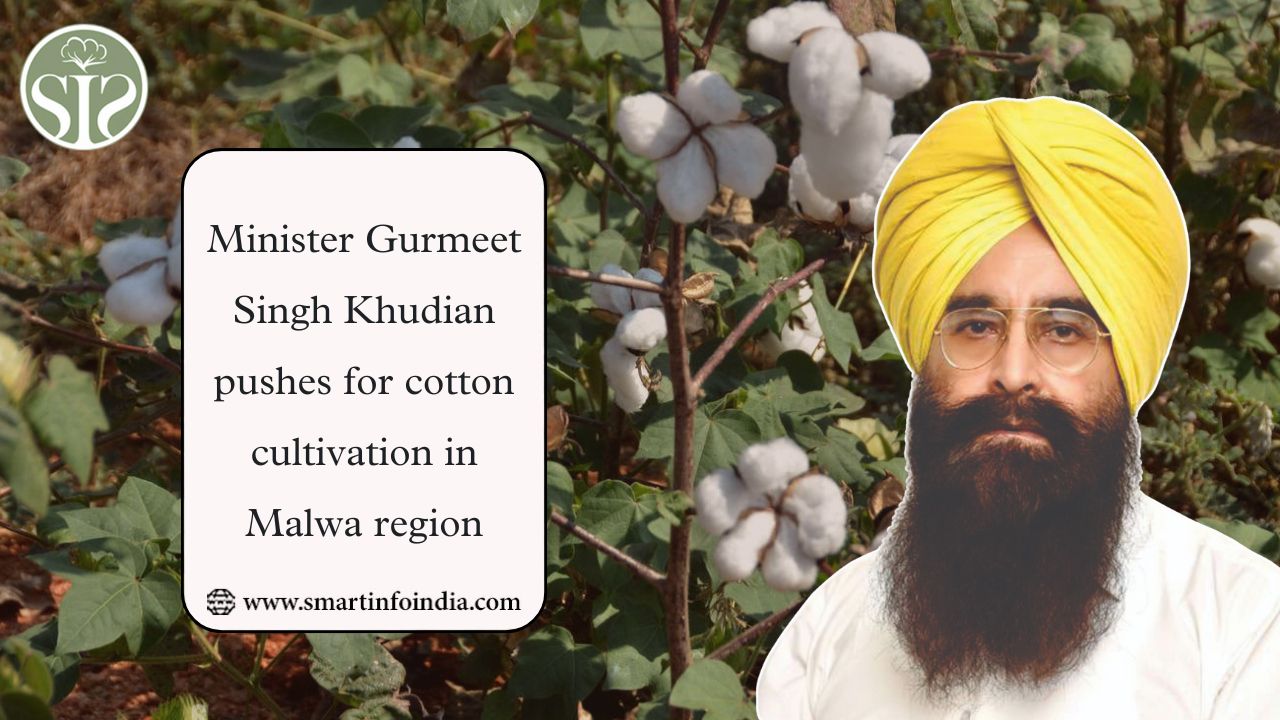
Punjab Targets Cotton Revival in Malwa with Modern Farming Push

Punjab Minister Pushes Cotton Cultivation in Malwa, Focus on Modern PracticesChandigarh: Punjab Agriculture and Farmers Welfare Minister Gurmeet Singh Khudian has directed chief agriculture officers across eight districts of the Malwa region to actively train and guide farmers on modern cotton cultivation techniques.The instructions were issued after reviewing block-wise progress of cotton sowing in Fazilka, Muktsar, Bathinda, Mansa, Barnala, Sangrur, Moga, and Faridkot. The minister also stressed strict implementation of pest control measures and stronger field-level monitoring.Khudian said the state has set a target of bringing 1.25 lakh hectares under cotton cultivation this season. To support farmers, the Punjab government has announced a 33% subsidy on BT cotton hybrid seeds recommended by Punjab Agricultural University (PAU), Ludhiana. The move aims to lower input costs and discourage the use of non-recommended seeds.He added that the focus is on promoting high-yielding and pest-resistant BT cotton hybrids. PAU has recommended 87 such varieties suited to Punjab’s agro-climatic conditions.Addressing pest challenges, the minister reviewed steps to control pink bollworm, including proper disposal of cotton stalks and crop residues that act as breeding grounds. A weed eradication drive has also been launched in cotton-growing areas to manage whitefly infestation.Additionally, officials have been asked to monitor pink bollworm presence in ginning factories and ensure fumigation of cotton stocks to control larvae at the ginning stage.read more :-Rupee declines 19 paise to 84.62 against US dollar in early trade

Heavy rains, dangerous thunderstorms and lightning likely in Gujarat

Severe Rains and Thunderstorms Likely in GujaratThe state of Gujarat has witnessed widespread pre-monsoon weather activity. Moderate rains occurred across the region in north and central Gujarat and Saurashtra. Ahmedabad, Gandhinagar, Baroda, Deesa, Surendranagar, Bhavnagar, Rajkot and Naliya in Kutch are the major places to witness the weather activity. This was the second consecutive day of weather activity and is likely to continue for the next 3-4 days.The state of Gujarat normally experiences thunderstorms, dust storms, lightning, heavy rains and strong winds before the monsoon. Extreme heat remains the main threat before the monsoon. The current spell of thunderstorm conditions is unusual and unseasonal. Even if there is any pre-monsoon weather, it is usually for a short duration. The current spell started a day ago and is likely to continue till 10 May 2025. The weather is expected to clear up widely after 11 May 2025.Earlier, the state was grappling with severe heat conditions. Rajkot recorded temperatures above 46°C and Ahmedabad above 45°C, which was the main highlight on the weather front. In the last 24 hours, the temperature has dropped to 40°C in Rajkot and 38°C in Ahmedabad. The temperature is likely to drop further and remain within comfortable limits. Hazardous weather conditions are likely to prevail at some places for one or two days.Today, heavy weather with thunderstorms, lightning and heavy rain is expected in Anand, Vadodara, Nadiad, Bharuch, Surat, Ahmedabad, Gandhinagar and Surendranagar. The next two days, 07 and 08 May, will see more activity over Saurashtra. On the next day, moderate to heavy rainfall will occur over North Gujarat including Deesa, Patan and coastal Saurashtra to Veraval, Diu, Somnath, Porbandar, Okha, Dwarka and Jamnagar. Caution is required against strong winds, lightning, thunderstorms and heavy to very heavy rainfall. Though this is not at all normal for Gujarat, the possibility of hailstorm at some places cannot be ruled out.Weather conditions will start improving from the weekend. The intensity of the weather will reduce on May 10, but its spread will continue as before. Its extent and scale will reduce further on the next day, May 11. Weather activity can be expected to decrease substantially from May 12. Weather conditions will remain favourable except for heat for the rest of the month.read more :-Rupee Falls 15 Paise, Closes at 84.43/USD
Related News

Youtube Videos

कैसा रहा आज का कपास बाज़ार? 😱 Cotton Market Rate Today 28 Sep 2026
कैसा रहा आज का कपास बाज़ार? 😱 Cotton Market Rate Today 28 S...
साप्ताहिक कपास रिपोर्ट 😱 तेज़ी या मंदी? Weekly Cotton Market 26 Sep 2026
साप्ताहिक कपास रिपोर्ट 😱 तेज़ी या मंदी? Weekly Cotton Marke...
ऐसा रहा आज कपास बाज़ार 😱 महाराष्ट्र कपास बुवाई जानकारी | Cotton Market Rate Today 24 Sep 2026
ऐसा रहा आज कपास बाज़ार 😱 महाराष्ट्र कपास बुवाई जानकारी | Co...
Application Download
Whatsapp Contact