Recent News

Farmers Run Out of Cotton, Prices Spike

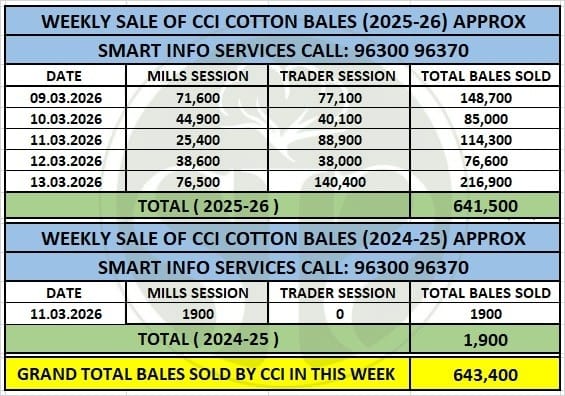
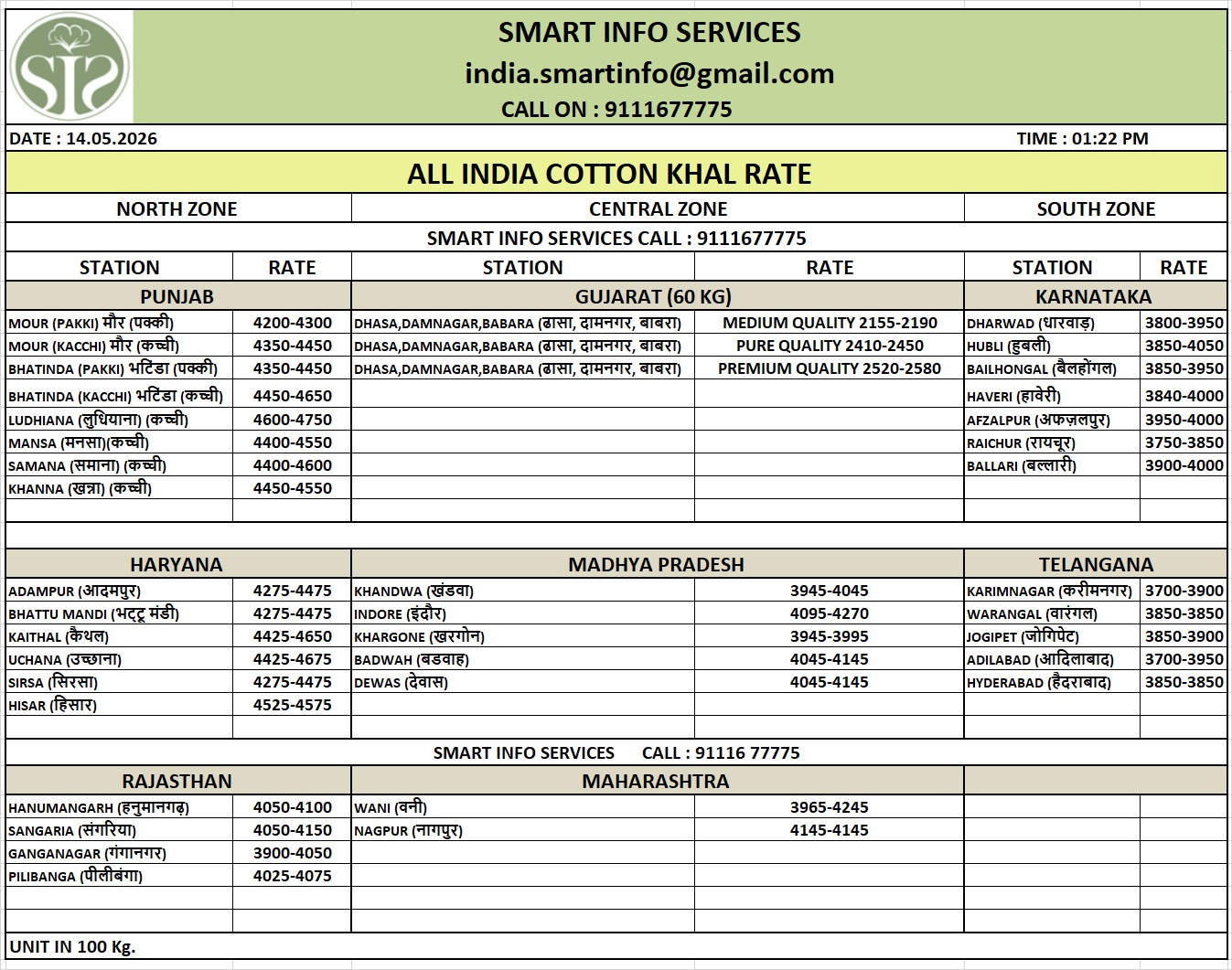
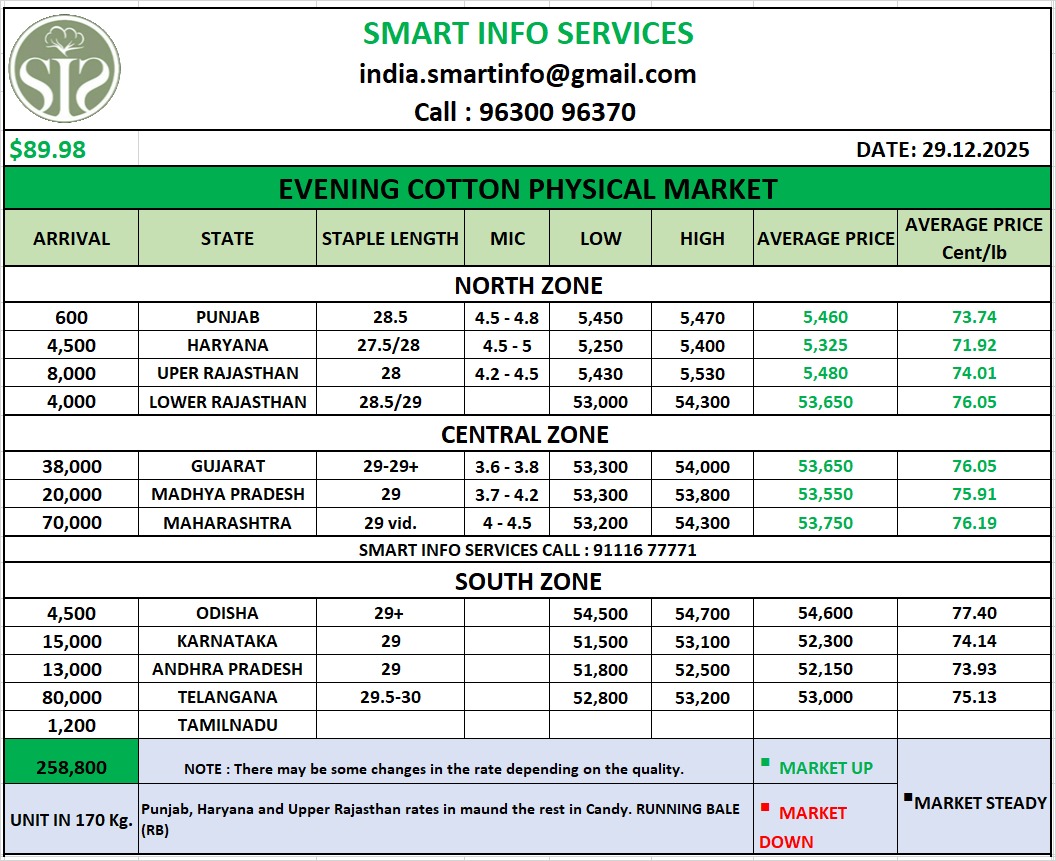
Cotton Price: Prices rise after farmers run out of cottonWardha News: The prices of cotton have risen across the country due to the decrease in moisture content in the cotton currently coming to the market as compared to the beginning of the season as well as the increase in the price of silk. At present, cotton is trading at Rs 7,000 to Rs 8,000 per quintal.The central government had declared a price of Rs 7121 per quintal for medium-staple cotton and Rs 7521 per quintal for long-staple cotton. However, cotton was not purchased from farmers at this rate throughout the season. On the one hand, the productivity of cotton has declined and it has stabilized at four to five quintals per acre. Cotton producers were in a situation where productivity costs were rising and prices were falling.This does not even include the productivity cost of cotton. This has also affected the cotton cultivation area. Now that the cotton season is in its final stages and farmers have very little stock left, the price of cotton has gone up by Rs 1,000 per quintal. At the beginning of the season, the moisture content in cotton ranges between 10 to 14 per cent. Now it has come down to 6 to 7 per cent. Experts in the field said that the price of sugar has also increased.The market price of sugarcane was Rs 3200 to Rs 3300 per quintal. Now it has increased and it is trading at Rs 3,700 per quintal. As a result of all this, the prices of cotton have gone up. Vinegar is used for oil and it also provides a base during the process. These value-added products are used in food and animal feed. As a result of this boom in the market, the prices of cotton have gone up.Hinganghat (Wardha) Market Committee is famous for cotton. At present, a huge amount of cotton is arriving in this mandi. Ginning traders have to buy cotton by participating in the auction process of the market. Market Committee Secretary Tukaram Chambhare said that farmers come here to sell cotton because the entire transaction is transparent.Currently, 10 to 15 percent of cotton stock is left. The percentage of good quality cotton does not exceed 10. That is why prices have increased. Rates have increased from Rs 7,000 to Rs 8,000.The arrival of good quality cotton in the market has reduced. The price has been revised accordingly. Cotton producers can get good profits only when the area of cotton sowing and productivity decrease in the coming time. Because according to economic theory, demand and supply affect prices.read more :-Weekly Sales Report - Cotton Corporation of India (CCI)

Indian Textile Stocks Resilient Amid Market Slump

Indian textile stocks defy market slumpMUMBAI: For the Indian textile industry, the Oval Office has spun a surprising tale, in which Vietnam, Bangladesh, China or Sri Lanka have been harmed by imposing far more punitive tariffs than hubs in Tirupur, Surat or Noida.So, shares of textile manufacturers jumped as much as 18% on Thursday, as the 26% tariff imposed on home furnishings and readymade garments from India is lower than the 54% tariff imposed on China, 46% on Vietnam, 37% on Bangladesh and 30% on Pakistan.In fact, Indian manufacturers will benefit from the 'Liberation Day' announcements by the White House.Gautam Shahi, director, Crisil Ratings, said, "Tariffs on Indian textiles are lower than other major exporting countries, which could enhance India's competitiveness and help it increase its share in US textile exports." However, analysts cautioned that while the tariff differential would benefit India, higher duties could also lead to higher end product prices, dampening demand in the medium term. "How these tariffs impact consumers and the potential reversal of tariffs on India or competitors will be key factors to watch out for," Shahi said.The US is India's largest textile export market, accounting for 28% of India's total textile exports, valued at $35 billion in FY24. Despite this, Indian textiles currently hold only a 9% share in the US market, trailing behind Vietnam (15%) and China (24%)."We expect this tariff structure to make Indian textiles more attractive to US buyers, potentially increasing India's market share in the US," said Antu Thomas, senior research analyst at Geojit Investments. "However, in the near term...Despite short-term concerns, analysts maintain a positive long-term outlook on the sector, especially for companies with strong capital expenditure plans and high export focus such as Welspun Living, Indo Count Industries, Trident, Gokaldas Exports."These companies are well positioned to take advantage of the changing trade landscape and rising global demand," Thomas said.read more :-US Reciprocal Tariffs: Boon or Bane for Textiles and Apparel?

US Reciprocal Tariffs: Boon or Bane for Textiles and Apparel?

Opinion: Impact of US reciprocal tariffs on textiles and apparel sector – boon or bane?The United States has imposed significant duties on textile imports from various countries with the aim of protecting domestic industries and addressing trade imbalances. Under the Trump administration, reciprocal duties of about 27% were imposed on Indian textile imports. The move is part of a broader strategy, where duties on competitors such as Vietnam (46%), Bangladesh (37%), Cambodia (49%), Pakistan (29%), and China (34%) appear to be even higher. These duties have reshaped the global textile trade landscape, potentially putting India in a more favourable position than its competitors.Impact on Indian exports: The imposition of US tariffs presents both opportunities and challenges for the Indian textile industry. The positive side is that higher duties on competing countries provide India with a competitive edge, potentially increasing its market share in the US. In 2023-24, approximately 75% of the US textiles imports are expected to grow by 2024-25. Of the $36 billion in textile exports, the US accounted for about 28%, equivalent to about $10 billion. This favourable situation could increase export volumes and revenues for Indian manufacturers.Impact on US consumption: However, tariffs also have an impact on US consumers. Higher import costs could lead to higher retail prices for textiles and apparel, potentially reducing overall consumption. This price sensitivity could result in a contraction in the US market, impacting demand for Indian exports. Conversely, some US consumers may turn to more affordable options, benefiting Indian exporters if they can maintain competitive pricing.Growing US exports: The US textile and apparel industry has seen significant growth in exports due to rising global consumer demand for downstream textile products such as technical textiles and home textiles. In 2021, US exports of textile and apparel products grew by $3.4 billion (18.3%) to $22.3 billion. This growth was particularly notable in exports of fibers and yarns, which saw a 23.8% increase. This trend indicates strong demand for US textile products, which could impact global trade dynamics and affect Indian exports.Forecasts suggest that the Indian textile sector will continue to expand, leveraging its competitive advantage in the US market. The industry’s ability to innovate and adapt to changing consumer preferences will be key in maintaining its growth trajectory. However, a short-term slowdown in the US market is anticipated due to tariff-induced price increases. Current Issues in the Industry Despite the opportunities presented by US tariffs, the Indian textile industry is already facing a number of challenges.These include :Environmental concerns : The industry contributes significantly to pollution, with high volumes of waste and chemical hazards.Raw material shortages : Dependence on imported raw materials and rising costs pose significant risks.Infrastructure constraints: Inadequate infrastructure and logistics challenges hinder efficient production and exports.Labour shortage : The industry is grappling with labour shortages, which have been exacerbated by the pandemic.Resolving these issues is critical for the long-term sustainability and competitiveness of the Indian textile sector.In conclusion, the imposition of US tariffs on textile imports has had mixed consequences for the Indian textile industry. While it provides a competitive advantage over other exporting countries, it also presents challenges related to market contraction and increased costs. The future growth of the industry will depend on its ability to innovate, adopt sustainable practices, and overcome existing challenges. By strategically navigating these complexities, the Indian textile sector can thrive in the global market.read more :-Rupee opens 40 paise higher at 85.04 against US dollar

Trump Announces 26% Reciprocal Tariff Discount on India

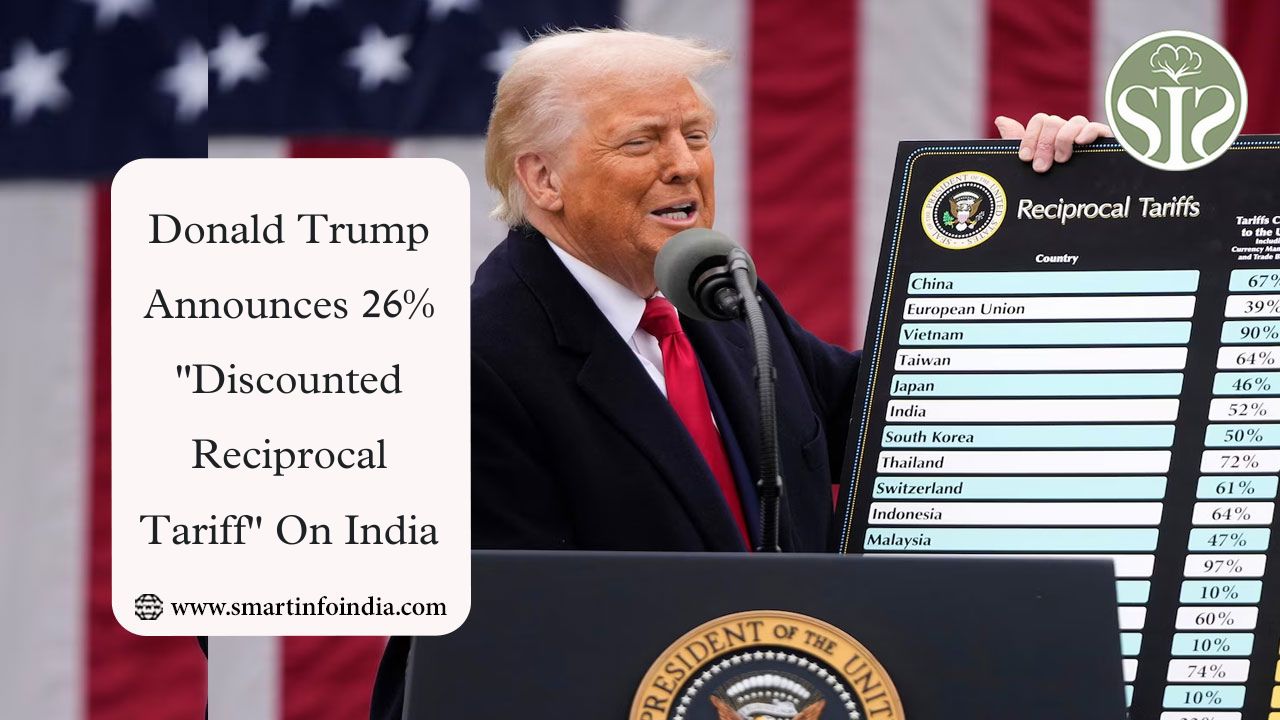
Donald Trump Announces 26% "Discounted Reciprocal Tariff" On IndiaTrump Tariff Announcement: The US President also announced a 20 per cent levy on imports from the European Union and 10 per cent from the UK - two of the main trade partners and allies of the United States.Washington:US President Donald Trump has announced significant reciprocal tariffs on India and China, but said he is being kind on them by charging roughly "half of what they charge us". Calling these as "discounted reciprocal tariffs", President Trump said the US will charge an import duty of 26 per cent on India and 34 per cent on China.Speaking about India, President Trump described tariffs by New Delhi as "very very tough". He went on to say that "Their Prime Minister (Narendra Modi) just left (US recently)...he is a great friend of mine, but I said to him that 'you're a friend of mine, but you've not been treating us right'. India charges us 52 per cent, so we will charge them half of that - 26 per cent."The President also announced a 20 per cent levy on imports from the European Union and 10 per cent from the UK - two of the main trade partners and allies of the United States. On Japan too, he levied a 24 per cent tariff.These tariffs, the White House said, come over and above a 10 per cent base import duty on all products imported into the United States. President Trump, however, did not explain how these tariffs would be levied in an industry-wise break-up.The announcement was made to loud cheers at the White House Rose Garden, as Donald Trump said, "For far too long, other countries have looted and plundered us, while taking advantage of our policies. But no longer. April 2nd will forever be known as Liberation Day - when America reclaimed its industries. We will now impose reciprocal tariffs on countries that tariff us - Reciprocal means we do to them, what they do to us, as simple as that.""By doing this we will reclaim our jobs, we will reclaim our industry, we will reclaim our small and medium scale businesses...and we will make America wealthy again. Jobs will come roaring into America now," he added.The White House told reporters shortly after the "Liberation Day" tariff announcement that due to a "national emergency" which has stemmed from security concerns due to persistent trade deficits, the US is imposing a "baseline" 10 per cent tariff that would start at 12:01am local time (9:30 am IST) on April 5, while the higher country-specific tariffs would begin from 12:01 am local time (9:30 am IST) on April 9.read more :-Indian textile exporters get a boost from Trump's tariffs

Indian textile exporters get a boost from Trump's tariffs

Trump's tariffs will give Indian textile exporters an edge over competitorsPresident Donald Trump's decision to impose tariffs on all imports into the United States (US) will benefit India's textile industry, as its competitors such as Vietnam, Bangladesh and China will face higher tariffs, experts say.If the trade talks result in zero duty on cotton imports, it could be even more beneficial. A key factor for Indian textile exports will be buyer sentiments in the US. "In the past, India, Bangladesh and Vietnam faced similar tariff structures for cotton apparel exports. However, with the recent changes, India now holds a tariff advantage over these competing countries in comparative terms, which could increase its competitiveness in the US market for apparel exports," said Prabhu Dhamodharan, convener of the Coimbatore-based Indian Texpreneurs Federation.As per Trump's announcement, Vietnam's textile exports will be subject to a 46 per cent tariff, Bangladesh 37 per cent and China 54 per cent.According to US data on textile shipments and bill of lading data for 2024, China's share in its textile imports was about 30 percent, or $36 billion. Vietnam was second with textile imports of $15.5 billion (13 percent share), and India was at $9.7 billion (8 percent share). Bangladesh used to have a large share in US textile imports, but its share fell by 6 percent to $7.49 billion in 2024 due to political turmoil. Total textile imports to the US in 2024 were $107.72 billion. Imports of clothing, which is the bulk of textile imports to the US, increased by 2 percent from $77 billion in 2023 to $79 billion in 2024."If India reduces the import duty on cotton from 11 per cent to 0 per cent, it will benefit both countries. Now the ball is in India's court," said K Venkatachalam, chief advisor, Tamil Nadu Spinning Mills Association.India's Apparel Export Promotion Council (AEPC) has already approached the textiles ministry seeking a 'zero for zero' duty policy on textiles and apparel. It believes that the government should reduce the duty on textile products to zero per cent, which will prompt the US to apply the same duty rate on Indian exports."India is well positioned to increase its market share in the US because of this tariff hike. The ongoing trade talks can further strengthen India's position - especially if India offers zero-duty import of cotton in exchange for sector-specific benefits in apparel exports. This move could prove to be a game changer for the industry," Dhamodharan said.Another advantage for India is that the textile sector contributes only 2 per cent to its GDP, compared to 11 per cent and 15 per cent for competitors Bangladesh and Vietnam."It looks negative for the whole world, and short-term buying will slow down as they will eat up their pipeline inventory in the hope of relief as countries renegotiate tariffs with the US. However, if all this continues, the US will have to buy apparel, and compared to all major global textile suppliers (except the EU), we will be cheaper, and hence India will be the preferred destination for textile and apparel sourcing," said Sanjay Kumar Jain, managing director of textile producer TT Ltd. According to an industry expert, companies such as Trident, Welspun India, Arvind, KPR Mill, Vardhman, Page Industries, Raymond and Alok Industries will benefit as their revenue share from the US market is between 20 per cent and 60 per cent.read more :-Live Updates: Donald Trump's Latest Tariff Announcement

Live Updates: Donald Trump's Latest Tariff Announcement

Donald Trump Tariff Announcement Live Updates  Mixed bag: Govt analysing impact of 26% Trump tariff on India. Indian-American lawmakers criticise Trump's reciprocal tariffs, call them 'reckless'Indian-American members of the US Congress and the diaspora community criticised the reciprocal tariffs imposed by President Donald Trump, calling them "reckless and self-destructive", urging leaders in both countries to engage in dialogue to address these challenges.On Wednesday, Trump imposed a 26 per cent "discounted reciprocal tariff" on India. While making the announcement, he said "India charges us 52 per cent so we will charge them half of that - 26 per cent."President Trump, in a historic measure to counter higher duties on American products imposed globally, announced reciprocal tariffs on about 60 countries.The lawmakers also said that Trump's tariffs will likely make Indian goods less competitive.Congressman Raja Krishnamoorthi said Trump's blanket tariffs are a tax on working families so that he can cut taxes for the wealthiest Americans."These latest so-called 'Liberation Day' tariffs are reckless and self-destructive, inflicting financial pain on Illinois at a time when people are already struggling to keep their small businesses afloat and put food on the table."Krishnamoorthi, a Democratic lawmaker from Illinois, said the tariffs isolate the United States on the global stage, alienate America's allies, and empower its adversaries – all while forcing America's seniors and working families to bear the brunt of higher prices.Urging Americans to call on Trump to end his "disastrous" tariff policies before he sends the country into a recession, Krishnamoorthi said the tariffs do nothing to strengthen the American economy or national security.Congressman Ro Khanna said in a video posted on his social media handle that the tariffs announcement "isn't an April Fool's joke."Trump is literally trying to destroy our economy with his Liberation Day tariffs slapped overnight, no strategy, no consultation, no congressional input."What does this mean? Prices are going to go up. Prices for cars are going up. Prices for groceries are going up. Prices for home repairs and home building are going up, and there's total uncertainty," Khanna said.He added that businesses don't know whether to invest, the stock market is down and "people are saying we could have a recession. We could have stagflation, meaning slow growth and higher inflation, all because of Trump's incoherent, incompetent economic policy."Indian-American Congressman Dr Ami Bera said in a post on X "Let me be clear: these tariffs will not make America wealthy again. These costs will be passed onto YOU- the American consumer. This is not a tax cut. This is a tax hike."Former advisor to President Joe Biden and Co-Chair for Economic Subcommittee for Asian American and Native Hawaiian/Pacific Islander (AANHPI) Commission Ajay Bhutoria told PTI that Trump's 'Liberation Day' initiative imposes a 26% reciprocal tariff on India's exports to the United States, alongside new tariffs on imports from China, Mexico, Canada, and Japan, significantly impacting both nations and beyond."This sweeping policy will likely make Indian goods-such as textiles, and pharmaceuticals-less competitive, while tariffs on other major trading partners will drive up the cost of automobiles, groceries, medical supplies, and countless other products, hitting American consumers hard with an estimated additional $2,500 to $15,000 in annual expenses."Bhutoria said India's key industries face declining export volumes and financial strain, threatening millions of livelihoods and potentially weakening the strong US-India economic partnership, while American households grapple with rising prices for everyday essentials."This decision injects market uncertainty and risks disrupting global supply chains, possibly pushing Japan, South Korea, India and others to diversify markets or pursue countermeasures."He urged leaders in both countries to engage in dialogue to address these challenges, "minimising the burden on American consumers and Indian producers alike, and preserving the collaboration that has long driven innovation and prosperity between our nations."Asia Society Policy Institute Vice President Wendy Cutler said the reciprocal tariff rates will come as a "shock to our trading partners" and will cause harm to the US economy with higher prices, slower economic growth, and slowed down business investment."Our close partners appear to be treated similarly to our rivals, with China's reciprocal tariff rate just a tad higher than Taiwan. This is difficult to understand given Taiwan's open economy and extensive manufacturing FDI projects in the United States," she said.Cutler added that America's Asian FTA partners were not spared with Korea's rate at 25 percent at the high end of the group. Asian countries in particular have been hard hit causing them shar.read more :-Rupee opened 24 paise lower at 85.75

Related News

Youtube Videos

कैसा रहा आज का कपास बाज़ार? 😱 Cotton Market Rate Today 28 Sep 2026
कैसा रहा आज का कपास बाज़ार? 😱 Cotton Market Rate Today 28 S...
साप्ताहिक कपास रिपोर्ट 😱 तेज़ी या मंदी? Weekly Cotton Market 26 Sep 2026
साप्ताहिक कपास रिपोर्ट 😱 तेज़ी या मंदी? Weekly Cotton Marke...
ऐसा रहा आज कपास बाज़ार 😱 महाराष्ट्र कपास बुवाई जानकारी | Cotton Market Rate Today 24 Sep 2026
ऐसा रहा आज कपास बाज़ार 😱 महाराष्ट्र कपास बुवाई जानकारी | Co...
Application Download
Whatsapp Contact