Recent News

Pakistan: Strong trend in cotton market update

Pakistan: Strong trend in cotton market.The Spot Rate Committee of the Karachi Cotton Association (KCA) on Friday increased the spot rate by Rs 200 per maund and closed it at Rs 17,700 per maund.The local cotton market remained firm and the trading volume remained low.Cotton Analyst Naseem Usman told Business Recorder that the rate of new crop of cotton in Sindh is in between Rs 17,700 to Rs 17,800 per maund. The rate of Phutti in Sindh is in between Rs 7,700 to Rs 8,600 per 40 kg.The rate of cotton in Punjab is in between Rs 18,200 to Rs 18,500 per maund and the rate of Phutti is in between Rs 7,800 to Rs 8,600 per 40 kg. The rate of cotton in Balochistan is Rs 17,600 to Rs 18,000 per maund while the rate of Phutti is in between Rs 7,700 to Rs 8,000 per 40 kg.Around 400 bales of Maqsooda Rind, 200 bales of Nuabad, 200 bales of Jhol is Rs 17,600 per maund, 400 bales of Dolat Pur were sold at Rs 18,000 per maund, 4800 bales of Tando Adam were sold at Rs 17,450 to Rs 17,800 per maund, 200 bales of Kotri were sold at Rs 17,600 per maund, 1600 bales of Mir Pur Khas were sold at Rs 17,600 to Rs 17,700 per maund, 3200 bales of Sanghar were sold at Rs 17,500 to Rs 17,600 per maund, 2200 bales of Shahdad Pur were sold in between Rs 17,500 to Rs 17,700 per maund, 1200 bales of Khanewal were sold at Rs 18,300 to Rs 18,500 per maund, 600 bales of Lodhran were sold at Rs 18,200 to Rs 18,400 per maund, 400 bales of Chichawatni were sold at Rs 18,200 per maund, 400 bales of Vehari were sold at Rs 18,200 per maund, 200 bales of Gojra, 200 bales of Hasil Pur, 200 bales of Rahim Yar Khan were sold at Rs 18,000 per maund and 1,000 bales of Ali Pur were sold at Rs 17,900 per maund.The Spot Rate Committee of the Karachi Cotton Association increased the spot rate by Rs 200 per maund and closed it at Rs 17,700 per maund. Polyester Fiber was available at Rs 345 per kg.

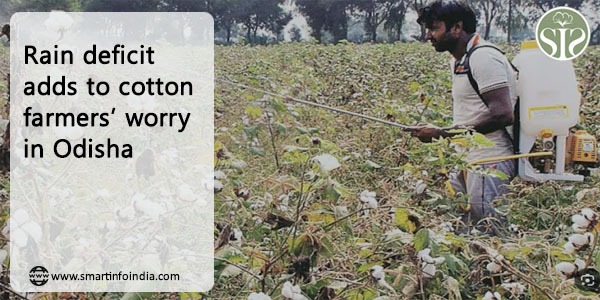
Rain deficit adds to cotton farmers’ worry in Odisha

Rain deficit adds to cotton farmers’ worry in OdishaThe officer in charge of Cotton Scheme, Suvendu Kar said farmers in the black cotton soil areas have incurred extra expenses in gap fillingDelay and erratic monsoon rain contributing to the long dry phase besides the large coverage of paddy has affected cotton cultivation in the district. Kalahandi is the largest producer of cotton in the state. But deficit rainfall of 66.54% in June and 82.60% till July has left the farmers worried. It was only after July 8, the district witnessed rain.Last year, cotton was grown on 70,780 hectares with a production of 8,50,000 quintals of seed cotton. For the current kharif season,  a  target to cover cotton in 73,550 ha was fixed.However, the major black cotton growing areas in Bhawanipatna, Kesinga and Golamunda blocks cover 25,400 ha, 17,000 ha and 16,000 ha respectively totalling 58,400 ha. The rest of the areas that grow cotton include Narla, M.Rampur and Lanjigarh blocks having red,  red and black and sandy loom soils.Usually, in the major cotton growing pockets in Bhawanipatna, Kesinga and M.Rampur blocks, the water retaining capacity of black cotton soil always benefited the crop. But due to the long dry phase in most of the areas, the farmers are distressed as they had to incur extra expenditure for gap filling. In Narla, M. Rampur and Lanjigarh, so far only 50 per cent area have been covered and now farmers are taking up sowing in many areas.The officer in charge of the Cotton Scheme, Suvendu Kar said farmers in the black cotton soil areas have incurred extra expenses in gap filling. But  this season, the plant condition so far seems okay.“Cotton plants in these areas are now in the vegetative stage with five to seven leaves. In other areas, farmers will pick up and the target is likely to be achieved,” Kar said.Inter-cropping in cotton fields has been given a thrust, the officer said, adding, in eight lines of cotton, there will be two rows of arhar which have been targeted to cover 30,000 ha.“Arhar plantation has been cultivated in about 20,000 ha so far. This would protect the cotton from pests and give substantial additional income to farmers,” he said.Coverage areaCurrent kharif season target for cotton 73,550 haBhawanipatna block  25,400 haKesinga block 17,000 haGolamunda block 16,000 haNarla, M.Rampur and Lanjigarh to cover rest of the targetLast year, cotton coverage 70,780 hectare

Spot rate higher amid brisk activity

Spot rate higher amid brisk activityThe Spot Rate Committee of the Karachi Cotton Association (KCA) on Thursday increased the spot rate by Rs 200 per maund and closed it at Rs 17,500 per maund.The local cotton market remained bullish and the trading volume remained satisfactory. Cotton Analyst Naseem Usman told Business Recorder that the rate of new crop of cotton in Sindh is in between Rs 17,500 to Rs 17,800 per maund.The rate of Phutti in Sindh is in between Rs 7,500 to Rs 8,200 per 40 kg. The rate of cotton in Punjab is in between Rs 17,800 to Rs 18,000 per maund and the rate of Phutti is in between Rs 7,600 to Rs 8,600 per 40 kg. The rate of cotton in Balochistan is Rs 17,600 to Rs 17,700 per maund while the rate of Phutti is in between Rs 7,600 to Rs 7,900 per 40 kg.Around, 200 bales of Rani Pur were sold at Rs 17,700 per maund, 800 bales of Jhole, 800 bales of Moro were sold in between Rs 17,400 to Rs 17,700 per maund, 800 bales of Nawab Shah were sold at Rs 17,400 to Rs 17,600 per maund, 800 bales of Maqsooda Rind were sold at Rs 17,600 to Rs 17,700 per maund, 800 bales of Khair Pur were sold at Rs 17,500 to Rs 17,700 per maund, 800 bales of Sanghar were sold in between Rs 17,300 to Rs 17,500 per maund, 800 bales of Shahdad Pur were sold at Rs 17,400 to Rs 17,550 per maund, 1600 bales of Tando Adam were sold at Rs 17,400 to Rs 17,600 per maund, 600 bales of Mir Pur Khas were sold at Rs 17,475 per maund, 600 bales of Lodhran, 800 bales of Khanewal were sold in between Rs 17,900 to Rs 18,000 per maund, 400 bales of Hasil Pur, 800 bales of Vehari were sold at Rs 17,800 to Rs 18,000 per maund, 400 bales of Chichawatni were sold at Rs 17,900 per maund, 400 bales of Chowk Matila were sold at Rs 18,000 per maund, 600 bales of Ahmed Pur East, 400 bales of Burewala were sold at Rs 17,900 per maund, 400 bales of Peer Mahal were sold at Rs 17,800 to Rs 17,900 per maund, 200 bales of Khair Pur Tamiwali were sold at Rs 17,900 per maund, 1400 bales of Layyah were sold at Rs 17,800 to Rs 17,900 per maund, 1000 bales of Rajan Pur, 800 bales of Fazil Pur were sold at Rs 17,800 per maund, 800 bales of Tounsa Shareef were sold at Rs 17,900 per maund, 200 bales of Faqeer Wali were sold at Rs 17,900 per maund, 200 bales of Jhang were sold at Rs 17,800 per maund and 200 bales of Mian Channu were sold at Rs 17,950 per maund.The Spot Rate Committee of the Karachi Cotton Association increased the spot rate by Rs 200 per maund and closed it at Rs 17,500 per maund. Polyester Fiber was available at Rs 345 per kg.

Tamil Nadu Chief Minister writes to PM Modi regarding the spurt in cotton prices; Urges to withdraw import duty for relief to MSMEs

Tamil Nadu Chief Minister writes to PM Modi regarding the spurt in cotton prices; Urges to withdraw import duty for relief to MSMEsEase of doing business for MSMEs: Tamil Nadu Chief Minister MK Stalin on Wednesday wrote to Prime Minister Narendra Modi, drawing his attention to the 'sharp' rise in cotton prices and also to roll back import duty to provide relief to them. the requested. According to a PTI report, MSME. Stalin said high cotton prices, increase in operational costs including bank interest rates and poor demand have affected the sector."The spinning sector with 1,500 mills and around 15,000 employees was one of the important engines of Tamil Nadu's industrial economy," Stalin said.According to the Chief Minister of Tamil Nadu, the spinning sector played a significant role in Tamil Nadu's industrial economy, with 1,500 mills and a workforce of approximately 1.5 million employees.He said the sector is in "such grave trouble that the spinning mill association has announced to stop production from July 15, 2023." The minister said repayment of loans provided under the Emergency Credit Line Guarantee Scheme (ECLGS) to MSMEs has begun, "which has become an additional burden on the spinning mills and increased the cost of production."Another factor that set India apart from international competitors was the 11 per cent import duty on cotton, reported PTI.Stalin also recalled the earlier request for increasing the cash credit limit of spinning mills from the existing 3 months to 8 months for buying cotton as well as reducing the margin money demanded by banks from 25 per cent to 10 per cent. percentage of the purchase price.“I request the Central Government to provide financial assistance under ECLGS to MSMEs in textile sector by extending the moratorium by one more year. Existing loans can be restructured under ECLGS, converting them into six-year term loans, and new loans can be provided under ECLGS, reducing the regular banking interest rate,” he PM Modi. said, as reported by PTI.Stalin appealed to the government to consider temporarily banning the export of waste cotton to meet the supply crunch faced by open-end spinners who fall under the category of micro enterprises.

Pakistan: Mills raise their hands on quality cotton

Pakistan: Mills raise their hands on quality cottonLAHORE: The local cotton market remained firm on Wednesday with satisfactory trading volume. Cotton analyst Naseem Usman said that the rate of new cotton crop in Sindh is between Rs 17,400 to Rs 17,600 per head. The rate of footi in Sindh is between Rs 7,500 to Rs 7,900 per 40 kg.The rate of cotton in Punjab is between Rs 17,800 to Rs 18,000 per head and the rate of cotton is between Rs 7,500 to Rs 8,600 per 40 kg. Cotton rates in Balochistan range from Rs 17,300 to Rs 17,500 per head while footy rates range from Rs 7,500 to Rs 7,700 per 40 kg.For the first time in the country's history, the collective cotton production figures have been released in the month of July instead of September, which is expected to record cotton production in the country this year.A total of 858,000 bales have arrived at ginning factories across the country as of July 15, according to data released by the Pakistan Cotton Ginners Association (PCGA). Of them, 659,134 bales reached Sindh and 198,873 bales reached ginning factories in Punjab.The PCGA report shows that textile mills have purchased 691,731 bales till July 15, 1,000 bales have been exported and 165,276 salable bales are available with factories. Contrary to the previous practice of releasing the first cotton data in September, this year the data has been shared on July 18.Khair Pur sold 600 bales at Rs 17,400 per head, Daur 600 bales at Rs 17,200 to Rs 17,300 per head, Shahdad Pur 1400 bales at Rs 17,200 to Rs 17,400 per head, Nawab Shah 800 bales, Shah Pur Chakar 800 bales at Rs 17 per head Yes. Rs 200 to Rs 17,300 per head, Tando Adam 2200 bales Rs 17,000 to Rs 17,275 per head, Lidharan 800 bales Rs 17,775 to 17,800 per head, Harunabad 1200 bales Rs 17,750 to Rs 17,800 per head, 10 Alipur 0 Bales, 3200 bales of Burewala, 200 bales of Rahim Yar Khan, 200 bales of Bahawalpur, 200 bales of Peer Mahal, 600 bales of Haasilpur, 200 bales of Ahmed Pur Purvi, 200 bales of Faridpur, 200 bales of Jhang Rs.17,700 per head, 600 bales of Toba Tek Singh were sold. Sold at Rs 17,550 per head, Miyan Channu 800 bales at Rs 17,700 to Rs 17,800 per head, Fakir Wali 400 bales at Rs 17,775 per head, Laya 1200 bales at Rs 17,700 to Rs 17,7750 per head were soldThe spot rate remained unchanged at Rs 17,300 per head. Polyester fiber was available at Rs 345 per kg.

Related News

Youtube Videos

Cotton Breaking 🔥 कॉटन, सीड, खल तीनों का भाव | जानिए आज का कपास बाज़ार | 1 October 2026
Cotton Breaking 🔥 कॉटन, सीड, खल तीनों का भाव | जानिए आज का...
रुई बाज़ार में गिरावट का रुख 😱 जानिए कपास भाव 🔥Cotton Market Rate Today 30 Sep 2026
रुई बाज़ार में गिरावट का रुख 😱 जानिए कपास भाव 🔥Cotton Mark...
🔥 1200+ दिग्गज एक मंच पर! नागपुर में सजा Cotton Industry का महाकुंभ | India Cotton Summit 2026
🔥 1200+ दिग्गज एक मंच पर! नागपुर में सजा Cotton Industry का...
Application Download
Whatsapp Contact