Filter

Recent News

India’s exports rise 5.26% to $714 billion in FY26 (Apr–Jan), showing strong resilience

Resilient export growth continues, India crosses $714 billion in FY26 (Apr–Jan)India’s total exports of goods and services reached USD 714.73 billion during April–January of FY 2025–26, registering a 5.26% increase compared to USD 679.02 billion in the same period last year. The growth highlights the resilience of India’s trade sector despite global economic uncertainty, supply chain disruptions, and volatile commodity prices.Over the past few years, India’s exports have shown a steady upward trend. From USD 497.90 billion in 2020–21, exports rose to USD 828.25 billion in 2024–25, reflecting a compound annual growth rate (CAGR) of 6.9%. This sustained expansion underscores India’s strengthening position in global trade.The government continues to support export growth through policy measures, financial incentives, and digital infrastructure. A key focus remains on empowering MSMEs by improving access to markets, finance, and logistics support.The Foreign Trade Policy (FTP) 2023 emphasizes trade facilitation, export promotion, and digital integration. Schemes such as RoDTEP help offset embedded taxes, ensuring Indian products remain competitive in global markets.Additionally, the Export Promotion Mission (EPM), with an outlay of Rs 25,060 crore for FY 2025–26 to FY 2030–31, aims to strengthen trade finance, logistics, and quality standards. A special ‘RELIEF’ scheme under EPM, implemented via ECGC, addresses risks arising from geopolitical disruptions.India is also enhancing trade infrastructure and leveraging digital platforms such as Trade e-Connect and the Certificate of Origin system to streamline processes. The country currently has 19 Free Trade Agreements (FTAs) in place and is negotiating new ones with partners including the European Union (EU) and the United Kingdom (UK).read more :- Rupee fell 02 paise to close at 93.97 per dollar

CCI closed, cotton purchase shifted to private market

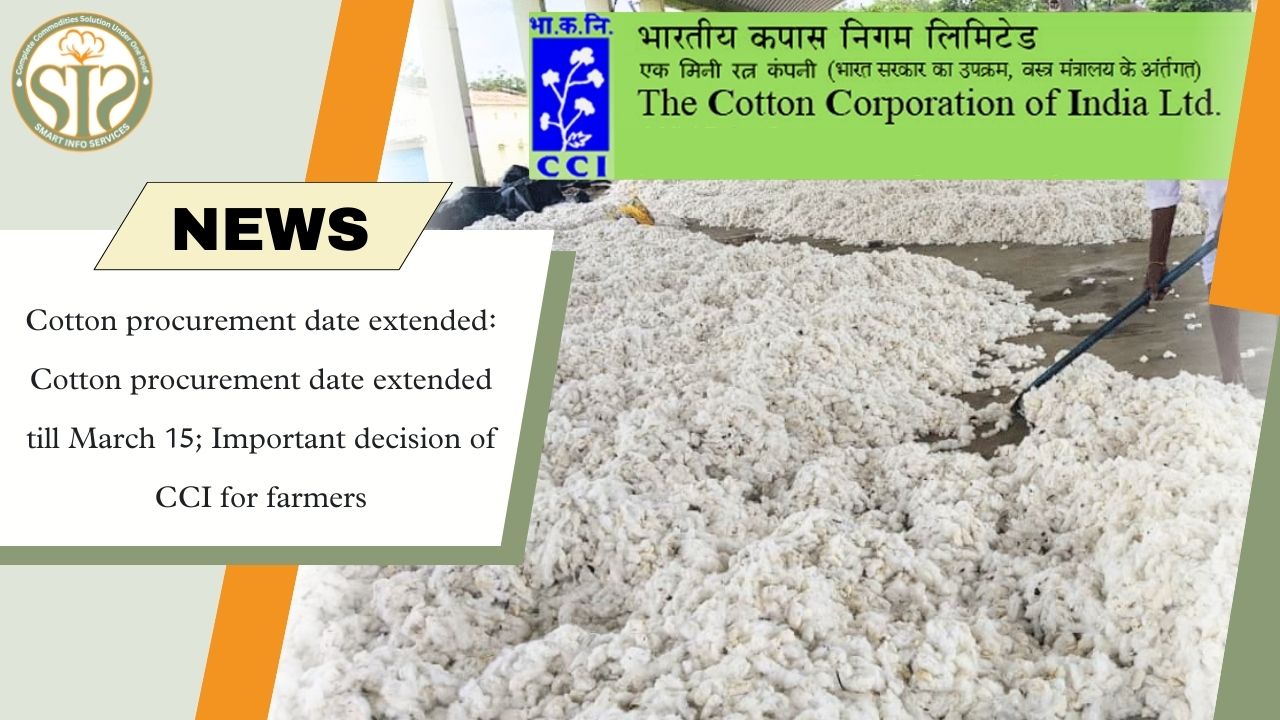
Cotton purchase from CCI stopped: Farmers turned to private traders, purchased more than 1500 quintals of cotton in a weekSince CCI has closed cotton procurement centers in the district from March 13, farmers now have no option but to buy cotton from private traders. Farmers of the district including Khamgaon are selling the cotton kept in their homes to private traders.After CCI procurement stops, private traders will buy cotton by paying Rs 100 to 200 more than CCI. On this hope, about ten percent of the farmers of the taluka kept the cotton at home. Now when the hope of price rise is gone and CCI procurement has stopped and seeing that even its deadline will not be met and it is dangerous to store cotton at home during summer days, farmers of various villages are taking vehicles to the factories of private traders and counting it in their pards and giving money hand over hand. The situation is similar in the district as well as in Khamgaon. At present, it is known that only three private traders, Amit Goenka, Vasant Pandey and Trilokchandra Agarwal, are purchasing cotton in Khamgaon and currently BT cotton is coming for sale in the market.Three private traders of Khamgaon city have purchased more than one and a half thousand quintals of cotton in the last eight days. It has been told that 231 quintals of paddy was purchased on March 14, 156 quintals on 16th, 204 quintals on 17th, 271 quintals on 18th, 285 quintals on 19th, 205 quintals on 20th, 131 quintals on 21st and 172 quintals on 23rd.The cotton sold by farmers on March 23 was purchased at a higher price on Monday by private traders at a price of Rs 7400 to Rs 7700 per quintal. This price is Rs 300 more than the cotton purchased before March 23. In such a situation, the farmers who sold cotton on March 23 got a higher price.read more :- Rupee Opens 8 Paise Lower at 93.95

Govt to Fix Bt Cotton Seed Price for 2026–27 Soon

Government to soon notify Bt cottonseed price cap for 2026–27 kharif seasonThe Union Agriculture Ministry is expected to shortly announce the maximum retail price (MRP) for Bt cotton seeds for the upcoming 2026–27 kharif season, covering Bollgard I and Bollgard II varieties, as sowing preparations begin across cotton-growing regions.According to industry sources, the government is unlikely to raise seed prices this year, although a final decision will be taken at the highest level after ongoing stakeholder consultations.In the previous revision, the MRP of Bollgard II seeds was increased to ₹900 per 450-gram packet for 2025–26, up from ₹864 in the preceding year. The price of Bollgard I seeds has remained unchanged at ₹635 per packet since 2016, when cotton seed price controls were first introduced.Industry representatives noted that in some earlier years, such as 2019–20, the Bollgard II price remained unchanged at ₹710 per packet. They suggest that even if no revision is made this year, it may not significantly impact the industry given the relatively modest increase in the previous cycle.Under the Cotton Seeds Price (Control) Order, 2015, the government is legally required to notify seed prices annually, regardless of whether there is a change. Officials said this mechanism ensures transparency and prevents farmers from being overcharged, as the notified MRP acts as an upper limit rather than a fixed selling price.However, the policy has faced criticism from some farmer groups, including those aligned with the Bharatiya Kisan Sangh, which has opposed government-set pricing for Bt cotton seeds. The group argues that price controls have distorted the seed market and claim that non-GM cotton seeds are being sold at lower prices as a result. They also question the effectiveness of Bt cotton against pests such as the pink bollworm.Government officials, meanwhile, maintain that price regulation was introduced after earlier instances of overpricing in the seed market, and is intended to protect farmers. They emphasize that the MRP is only a ceiling price, not a floor price.Cotton remains one of the most widely cultivated cash crops in India, with official data indicating that around 95% of cotton acreage is under Bt cotton. At the same time, concerns have been raised about evolving pest resistance, particularly the pink bollworm, which has reduced the effectiveness of Bt traits in several regions.Officials also noted that while Bt cotton initially helped reduce pesticide use, farmers are now reporting increased pressure from sucking pests, leading to higher pesticide expenditures in recent years.read more :- DGTR Proposal: Anti-Dumping Duty on Chinese Yarn

DGTR Proposal: Anti-Dumping Duty on Chinese Yarn

Govt trade body DGTR recommends anti-dumping duties on Chinese yarn amid ethyl chloroformate probeNEW DELHI: The Directorate General of Trade Remedies (DGTR), a body under the Union commerce ministry, has recommended the imposition of anti-dumping duties on Chinese viscose rayon filament yarn (above 75 deniers)—a widely used man-made textile fibre, according to a government notification issued on Monday.The proposed duties include $386 per metric tonne for Xinxiang Chemical Fibre Co Ltd, $667 for Jilin Chemical Fiber Co., and $518 for Yibin Hiest Fibre Limited Corporation and related exporters. Other producers would face a duty of $1,071 per metric tonne, the notification stated.The move comes days after the DGTR initiated an anti-dumping investigation into imports of ethyl chloroformate from China. The probe followed a complaint by domestic manufacturer Paushak, which alleged that the chemical was being sold in India at “unfairly low prices,” impacting local industry.The DGTR’s findings indicated that dumped imports from China had risen significantly, undercutting domestic prices and causing material injury to Indian producers.The duties, if approved by the Ministry of Finance, will be imposed on yarn imports for a period of five years.Paushak's complaintIn its complaint, Paushak—a Gujarat-based company that describes itself as India’s largest specialty phosgene-based chemical manufacturer—alleged that imports from China had caused “material injury” to domestic producers.The firm also claimed to be the country’s sole producer of ethyl chloroformate, accounting for India’s entire output of the chemical.The DGTR said it would examine whether the product was being dumped in the Indian market and whether anti-dumping duties were necessary to offset the alleged injury to the domestic industry.Ethyl chloroformateEthyl chloroformate is an organic chemical intermediate widely used in the manufacture of pharmaceuticals and agrochemicals. Given its importance to these sectors, any anti-dumping duty could have wider downstream implications.If the DGTR’s recommendations are approved, they could raise input costs for drugmakers and agrochemical firms, even as they provide protection to domestic producers.The body’s preliminary assessment indicated that the dumping margin was above the de minimis threshold, suggesting significant price undercutting by Chinese exporters—one of the key factors examined in anti-dumping cases.The investigation covered the period from October 2024 to September 2025.(With Reuters inputs)read more :- Fear of Tariffs or War: Which Impacts the Textile Market More?

Textile Industry Feels More Pressure from Tariffs Than West Asia Conflict, Says Expert

Tariffs Impact Textile Sector More Than US–Iran Conflict: Industry ExpertThe ongoing US–Israel–Iran conflict has added fresh uncertainty to global markets, raising concerns about its potential impact on the textile and apparel industry. However, industry leaders believe that earlier tariff measures imposed by the administration of Donald Trump have had a far greater impact on the sector than the current geopolitical tensions.Speaking to NDTV Profit, Pallab Banerjee, Managing Director of Pearl Global, said that the tariff-related disruptions created a much stronger setback for the textile industry compared to the ongoing West Asia conflict.According to him, price fluctuations and commodity shocks from the current conflict remain relatively limited so far. In contrast, tariffs introduced earlier have already created significant structural pressure on exporters and manufacturers.He added that, despite global uncertainty, consumer sentiment has remained largely stable for now, with no major disruption observed in demand conditions.Key Concern: Rising Freight and Oil PricesBanerjee highlighted that the major risk from the ongoing conflict is uncertainty over crude oil prices. If tensions escalate further, oil prices could rise sharply, potentially crossing higher thresholds and affecting global trade costs.He also pointed out that container freight rates have surged by nearly 50% since before the conflict. However, he noted that exporters are not directly absorbing these costs, as freight charges are typically borne through import arrangements.Industry OutlookThe textile sector is currently weighing two major external pressures:Long-term tariff impacts from earlier trade policiesShort-term uncertainty from the US–Israel–Iran conflictDespite these challenges, the industry has not yet seen a major disruption in demand, though rising logistics costs remain a key concern.read more :- Rupee Opens 34 Paise Higher at 93.63

Related News

Youtube Videos

ऐसा रहा आज कपास बाज़ार 😱 राजस्थान कपास बुआई | Cotton Market 22 July
ऐसा रहा आज कपास बाज़ार 😱 राजस्थान कपास बुआई | Cotton Market...
कपास बाज़ार में आज क्या हुआ? 😱 Cotton Market Rate 21 July 2026
कपास बाज़ार में आज क्या हुआ? 😱 Cotton Market Rate 21 July 2...
कैसा रहा आज का कपास बाज़ार? 😱 Cotton Market Rate Today | 20 July 2026
कैसा रहा आज का कपास बाज़ार? 😱 Cotton Market Rate Today | 20...
इस हफ्ते कपास में तेज़ी या मंदी? 😱 CCI ने बेचीं 3.18 लाख गांठें | Weekly Cotton Market
इस हफ्ते कपास में तेज़ी या मंदी? 😱 CCI ने बेचीं 3.18 लाख गा...
Cotton rate today: आज के कपास के भाव 🤔 #kapas  #youtube
Cotton rate today: आज के कपास के भाव 🤔 #kapas #youtube
रुई बाज़ार में आज तेज़ी का रुख 😱 CCI ने बेचीं 40,000+ गठानें #kapas
रुई बाज़ार में आज तेज़ी का रुख 😱 CCI ने बेचीं 40,000+ गठानें...
ऐसा रहा आज कपास बाज़ार 😱  राजस्थान कपास बुआई | Cotton Market 15 July
ऐसा रहा आज कपास बाज़ार 😱 राजस्थान कपास बुआई | Cotton Marke...
कपास की कीमतों में उछाल 😱 Cotton market rate today #kapasnabhav
कपास की कीमतों में उछाल 😱 Cotton market rate today #kapasna...
CCI Update: आज कितनी रुई गठानें बिकीं? 😱 Cotton market price today
CCI Update: आज कितनी रुई गठानें बिकीं? 😱 Cotton market pric...
साप्ताहिक कपास बाजार में तेज़ी 😱 Weekly cotton market review #kapas
साप्ताहिक कपास बाजार में तेज़ी 😱 Weekly cotton market review...
जानिए आज का कपास बाज़ार 😱 Cotton market rate today #kapas
कपास की कीमतों में उछाल 😱 Cotton market rate today #kapas
रुई बाज़ार में आज तेज़ी का रुख 😱 CCI ने बेचीं  70,000+ गठानें  #kapas
रुई बाज़ार में आज तेज़ी का रुख 😱 CCI ने बेचीं 70,000+ गठानें...
कैसा रहा आज का कपास बाज़ार? 😱 | Cotton Market Rate Today | 06 July 2026
कैसा रहा आज का कपास बाज़ार? 😱 | Cotton Market Rate Today |...
CCI ने अब तक कितनी कपास गांठें बेचीं? 😱 | Statewise Bales Sold Report  #youtube

CCI ने अब तक कितनी कपास गांठें बेचीं? 😱 | Statewise Bales S...
Application Download
Whatsapp Contact