STAY UPDATED WITH COTTON UPDATES ON WHATSAPP AT AS LOW AS 6/- PER DAY
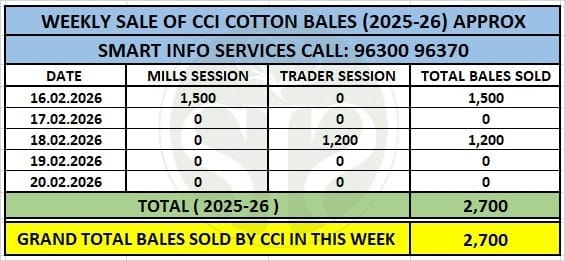
Start Your 7 Days Free Trial TodayThe Cotton Corporation of India (CCI) reduced its prices by a total of ₹500 per candy this week and sold 90.44% of its 2024-25 cotton procurement through e-auctions.During the entire week from 10 November to 14 November 2025, CCI conducted online auctions at its mill and trader sessions, achieving total sales of approximately 2,900 bales. Significantly, CCI reduced its prices by a total of ₹500 per candy this week.Weekly Sales PerformanceNovember 10, 2025: The highest sales of the week were recorded at 1,300 bales, with mills purchasing 600 bales and traders holding a reserve of 700 bales.November 11, 2025: CCI sold 1,000 bales, with mills purchasing 900 bales and traders holding a reserve of 100 bales.November 12, 2025: Total sales were recorded at 300 bales, with mills purchasing 200 bales and traders purchasing 100 bales.November 13, 2025: A total of 200 bales were sold by CCI in the mill session alone.November 14, 2025: The week ended with sales of 100 bales in the mill session.CCI sold a total of approximately 2,900 bales during the week, taking its cumulative sales for the season to 90,44,500 bales, which is 90.44% of its total purchases for 2024-25.read more :- Rupee closed 1 paisa higher at 88.74
On Friday, the Indian rupee rose 1 paisa to close at 88.74 per dollar, compared to its opening price of 88.75 in the morning.At the end of trading, the Sensex closed at 84,562.78, up 84.11 points, or 0.10 percent. The Nifty closed at 25,910.05, up 30.90 points, or 0.12 percent.read more:- The government canceled 14 quality orders.
Government revokes 14 quality control orders, textile units to benefitThe government has withdrawn quality control orders (QCOs) for fourteen petrochemical products, which are used as inputs in various sectors, from textiles to high-performance plastics. The revocation of QCOs will provide relief to user industries, providing them with access to wider sources of these products. QCOs, which apply equally to domestic manufacturing and imports, would have limited the number of suppliers of these products. Under QCOs, suppliers of products covered by the order must certify their manufacturing facilities and production before selling in India. This involves both cost and time. Many foreign suppliers are excluded from this process, limiting the number of suppliers for Indian industry. The number of QCOs has increased from fewer than 70 in 2016 to approximately 790 by 2025, with most introduced in the last five years. The products covered under the recently issued Quality Control Orders (QCO) withdrawal order include 100% polyester spun grey and white yarn, polyester industrial yarn, polyester staple fiber, polyvinyl chloride homopolymer, terephthalic acid, polyurethane, and polycarbonate."The revocation of Quality Control Orders (QCOs) on polyester fiber and yarn is a major relief, as it has been a long-awaited demand from all user industries. Polyester fiber and polyester yarn constitute the majority of man-made fiber (MMF) products, and therefore, this step taken by the authorities will contribute to the growth of the MMF segment in India," said Ashwin Chandran, President of the Confederation of Indian Textile Industry. The removal of QCOs will also improve the cost competitiveness of Indian textile and apparel products by making it easier to source raw materials at internationally competitive prices. He further added that, along with the export package announced on November 12th, the revocation of these QCOs will be a major confidence booster for the textile and apparel sector.India's QCOs were designed to enhance product quality and protect consumers, but their implementation has sparked debate as businesses grapple with compliance costs, import delays, and supply shortages.Following industry complaints about the heavy compliance burden, a high-level panel chaired by NITI Aayog member Rajiv Gauba was formed to review the system. According to reports, the panel has suggested canceling or suspending more than 200 QCOs. It has also recommended radical changes to the QCO system.The committee found that the rapid expansion of QCOs in India—though intended to improve quality—has led to supply shortages, high input costs, and long delays in certification, especially for MSMEs. Many QCOs cover raw materials that pose no direct safety or environmental risks, making such regulation unnecessary. The committee noted that most countries use voluntary or buyer-based standards, while excessive regulation in India has distorted manufacturing and trade efficiency.read more :- CCI's cotton procurement slows
Maharashtra: CCI Cotton Procurement Slows Amid Verification and Administrative HurdlesAkola: The Cotton Corporation of India (CCI) has started cotton procurement at the Minimum Support Price (MSP), but progress remains slow due to technical and administrative issues. In nine districts of Vidarbha, over 3.5 lakh farmers have registered so far. However, only 21,314 farmers have been verified and approved, while nearly 2.9 lakh applications are still pending. Around 13,921 applications have been rejected due to technical errors.District-wise Procurement CentresA total of 89 procurement centres have been set up across the region, including nine in Akola, 14 in Amravati, nine in Buldhana, ten in Chandrapur, one in Gadchiroli, 11 in Nagpur, 13 in Wardha, four in Washim, and 18 in Yavatmal.For the current season, CCI has introduced a mobile app for farmer registration, requiring details such as crop information, Aadhaar card, and photographs. Verification of these details has been assigned to state agencies at the market committee level. However, delays in this process are preventing many farmers from selling their produce at procurement centres.Most of the centres are operational or nearing readiness. So far, around 16,500 quintals of cotton have been procured. While intermittent rains delayed harvesting, arrivals are now gradually increasing. Officials expect procurement to gain momentum once verification speeds up.Verification Delays and RejectionsThe slow pace of verification at the market committee level has become a major bottleneck. In several cases, applications have been rejected due to errors made by farmers while entering details in the app.Issues at Akot Market CommitteeProcurement at the Akot Market Committee in Akola district faced delays as no-objection certificates (NOCs) were not issued to 22 ginning operators due to pending market fee payments. This halted the opening of procurement centres.After the issue came to light, District Sub-Registrar Geetesh Chandra Sable directed CCI and the Market Committee to convene a meeting at the District Collector’s office. Local MP Anup Dhotre also intervened, urging immediate action. Following this, the administration resolved the issue, and NOCs were issued to 10 buyers in Akot, allowing procurement activities to resume.Read More :- Cotton app and government delays add to farmers' woes in Telangana
Kisan Kapas app confusion, govt delays worsen crisis for flood-hit Telangana farmersWeeks after floods battered Telangana’s farmlands, farmers say the devastation has barely begun to register with those in power. On Wednesday, November 12, Telangana-based farmers’ rights collective Rythu Swarajya Vedika (RSV) convened a roundtable meeting in Hyderabad to take stock of what they describe as a worsening crisis — crop losses from Cyclone Montha, stalled procurement, and governments that have failed to respond with urgency.Around 45 farmers, activists, and agricultural experts gathered at Sudarayya Vignana Kendram, representing districts across the state. The discussion, presided over by RSV Convenor Kiran Vissa, centred on compounding blows including the destruction caused by relentless rains, the hurdles created by the BJP-led Union government’s mandatory Kapas Kisan app for cotton procurement, and the apathy of the Congress-led government in Telangana.“I have five acres of land: three for cultivating cotton and two for paddy. In the recent cyclone, the cotton crop was completely inundated and destroyed. But there has been no compensation from the state government yet,” said K Deepak, a farmer from Adilabad.Similar issues were raised by other farmers. Sundar, another farmer from Adilabad, described how continual spells of rain in August, September, and October had ravaged fields. Cotton, highly vulnerable to excess moisture, has taken a particularly severe hit this Rabi season (October to December).Farmers said the situation has been made worse by the requirement to register on the Kapas Kisan app for cotton procurement. The app, launched by the Cotton Corporation of India (CCI) — a public sector undertaking under the Union government — is an Aadhaar-based pre-registration system that farmers are required to use before selling their yield.But the app itself has become a barrier, farmers said. Poor digital literacy, patchy internet access, and the lack of assistance from village and district officials have left many unsure of how to use it at all.“Since its introduction in September 2025 by the CCI, the Union government has promoted it as a way to rule out the middle men and enable procurement directly from the farmers. But several farmers still do not understand how the slot booking works,” Thanneru Harsha, an activist and member of RSV, told TNM.The confusion is widespread, said Anjaneyulu, a farmer and activist from Nalgonda district. “Eight gram panchayats that I know of in Nalgonda have been adversely affected. Farmers’ homes and crops have been destroyed by Cyclone Montha. Many do not even know if their Kisan Kapas registration has gone through,” he said.Karunanidhi Goud, a farmer from Vikarabad district, said that this time around, farmers were only able to sell 3-4 quintals of cotton unlike their usual 10 quintals. “Even some of that yield was rejected because procurers complained about how the cotton was blackened due to rains and debris,” he added.The meeting also discussed the precarious situation of tenant farmers, who face the brunt of crop loss without formal recognition or access to compensation and procurement systems.read more :- Farmers in Adilabad are forced to sell cotton to private traders.
Farmers forced to sell cotton to private traders in AdilabadCotton farmers in Adilabad and nearby districts are forced to sell produce to private traders below MSP as the Cotton Corporation of India refuses procurement citing high moisture levels. Farmers allege heavy losses and seek government intervention and compensation (SIS)Adilabad: Farmers are being forced to resort to distress sale of cotton produce to private traders as the Cotton Corporation of India (CCI) is refusing to procure it citing higher moisture content, causing huge losses to the growers.The CCI has imposed certain restrictions on cotton procurement from farmers. For instance, it is not purchasing cotton containing moisture higher than 12 percent. (SIS)These restrictions have become a boon to traders and a bane to farmers. The traders have set up temporary centres along national highways and at important junctions to purchase the cotton.The farmers alleged that traders were offering at least Rs 1,000 less than the MSP of Rs 8,110 per quintal fixed by the government, with the CCI rejecting the cotton citing moisture content. They said they were incurring huge losses by selling the cotton to traders and requested officials to take steps to prevent fleecing by private buyers.The growers further said that they had already witnessed a dip in yield due to unfavourable climatic conditions and unseasonal rains. They said they were left with no option but to sell the cotton to traders and were vexed by the restrictions imposed by the CCI. They also sought compensation for suffering huge losses in cultivating the crop for the third consecutive year.Officials said the commercial crop, cotton, was raised in over 10 lakh acres across Adilabad, Kumram Bheem Asifabad, Nirmal and Mancherial districts this agriculture season. It was cultivated in 4.25 lakh acres in Adilabad district, while Kumram Bheem Asifabad district accounted for 3.35 lakh acres. Mancherial and Nirmal districts saw 1.61 lakh acres and 1.40 lakh acres of cultivation respectively.Officials estimated that the erstwhile Adilabad district would register a yield of 84 lakh quintals. Adilabad district alone is expected to record 34 lakh quintals of cotton, followed by Kumram Bheem Asifabad with 26 lakh quintals. The district administration has established helpline number 1800 599 5779 and WhatsApp number 88972 81111 to help farmers in booking slots on the Kapas Kisan application to sell their cotton produce.read more :- Rupee fell 09 paise to open at 88.75/USD
On November 14, the rupee opened 09 paise lower at 88.75 against the US dollar.The Indian rupee opened at 88.75 per dollar on Friday, while it had closed at 88.66 on Thursday.READ MORE :- The rupee fell 2 paise to close at 88.66 per dollar.
On Thursday, the rupee fell 2 paise to close at 88.66 per dollar, after opening at 88.64 in the morning.At close, the Sensex was up 12.16 points or 0.01 percent at 84,478.67, and the Nifty was up 3.35 points or 0.01 percent at 25,879.15. About 1661 shares advanced, 2193 shares declined, and 107 shares unchanged.READ MORE :- Big Relief for Exporters as Cabinet Clears ₹20,000 Crore Credit Guarantee Scheme
Big Relief for Exporters as Cabinet Approves ₹20,000 Crore Credit Guarantee SchemeIn a major relief for Indian exporters hit by U.S. President Donald Trump’s tariff measures, the Union Cabinet, chaired by Prime Minister Narendra Modi, on Wednesday approved a significant support initiative — the Credit Guarantee Scheme for Exporters (CGSE).The ₹20,000 crore scheme aims to ease credit access for exporters impacted by the punitive duties imposed by the U.S., providing them with much-needed liquidity and stability.Announcing the decision, Information and Broadcasting Minister Ashwini Vaishnaw said the scheme will be implemented through the National Credit Guarantee Trustee Company Limited (NCGTC) under the supervision of the Department of Financial Services (DFS).“The CGSE will offer 100% loan guarantee coverage to Member Lending Institutions (MLIs), enabling them to extend additional credit facilities up to ₹20,000 crore to eligible exporters, including MSMEs,” Vaishnaw stated.A Management Committee, headed by the Secretary of the Department of Financial Services, will oversee the implementation and monitor the progress of the scheme to ensure timely support to the exporting community.READ MORE :- While the announcement of the start of procurement at MSP has come, there's bad news for India's cotton farmers.
Start of MSP Cotton Procurement Marks Good News, But Farmers Face SetbacksIndia's cotton imports are expected to increase by 9.8 percent in the new season, reaching an all-time high. This is certainly a shock for Indian farmers. This is because one of the reasons behind this is the duty-free imports approved by the Indian government a few months ago. This information comes at a time when the cotton procurement season has begun in the country, while farmers have been devastated by excessive monsoon rains and subsequent unseasonal rains. In such a situation, the increase in imports will undoubtedly harm them.Imports Continuously RisingAccording to news agency Reuters, there are two reasons behind the increase in cotton imports in India: first, the approval of duty-free imports from India, and second, domestic production reaching a 17-year low. India is the world's second-largest cotton producer. In such a situation, while India's increased imports are expected to support cotton prices in the global market, there is a strong possibility that it will also harm the country's farmers. Currently, cotton prices in the international market are near a six-month low.News agency Reuters quoted Atul Ganatra, President of the Cotton Association of India (CAI), as saying that India's cotton imports could reach 4.5 million bales in the 2025/26 marketing year, which began on October 1. This number could reach 3 million bales in December alone. Last year, India's cotton imports from the US, Brazil, Australia, and African countries reached a record 4.1 million bales.Duty-free imports and weak productionCotton Association of India President Atul Ganatra said, "At present, cotton prices abroad are much cheaper than in the domestic market, so textile mills are rapidly importing before the end of December." The Indian government has extended the 11% import duty exemption on cotton imports until December 31. A New Delhi-based trader associated with a global trade house reported that textile mills are turning to better-quality imported cotton due to growing concerns about domestic supply due to crop damage.Heavy and untimely rains in October in the western states of Maharashtra and Gujarat, as well as the southern states of Andhra Pradesh and Telangana, damaged cotton crops ready for harvest. These states account for more than 70% of India's total cotton production.Largest Employment SectorAccording to estimates by the Cotton Association of India (CAI), India's cotton production could decline by 2.4% compared to the previous year to 30.5 million bales in 2025-26. This would be the lowest production since 2008-09. Some traders estimate that production could fall further to 28 million bales. The textile industry is one of India's largest employers, directly employing over 45 million people. According to the CAI, cotton consumption is expected to decline by 4.5 percent in 2025-26, falling to 30 million bales due to weak export demand.Atul Ganatra said, "The US has imposed heavy tariffs, which has led to a decline in demand from there, forcing many textile units in South India to cut production." The US buys approximately 29 percent of India's annual textile exports of $38 billion. Since August, it has doubled the tariff on imports from India to 50 percent.READ MORE :- Haryana: Cotton purchased at MSP, but prices reduced citing low quality.
"Haryana Buys Cotton at MSP, But Prices Cut Due to Low Quality"Fatehabad: The Cotton Corporation of India is purchasing cotton at the Minimum Support Price (MSP) in the district's grain markets. However, farmers are upset by the corporation's arbitrary actions, citing low quality of the cotton crop. Farmers allege that they are forced to sell their produce to private traders at lower prices, incurring losses of up to ₹1,500 per quintal.The state government has begun purchasing cotton, one of 24 crops in the district, at an MSP of ₹6,200. Farmers are arriving at the markets with their produce. On Wednesday, 40 farmers arrived at the city's new grain market with their cotton crop, hoping to sell it at the MSP. The Cotton Corporation employees refused to purchase the cotton, citing the farmers' low quality. Of the 40 farmers in the grain market, only 9 farmers' cotton was purchased at the MSP.Farmers are forced to sell their crops to private traders.Cotton procurement by the Cotton Corporation of India has been delayed. Consequently, most farmers have already sold their crops. This has deprived them of MSP procurement. Private traders are currently purchasing cotton from farmers at a price of Rs. 6,200 per quintal, whereas the central government has fixed the price for medium-staple cotton at Rs. 7,020 per quintal and for long-staple cotton at Rs. 8,110 per quintal. Farmers say there is a loss of approximately Rs. 800 to Rs. 1,500 per quintal between the MSP and private procurement price. So far, 17,253 quintals have been purchased at the grain market, of which 581 quintals were purchased at MSP.I brought 5 acres of cotton to the new grain market, but the government buyer refused to buy my crop, citing its low quality. Consequently, I am forced to sell my crop at a mere Rs. 6,200 per quintal.I have reached the grain market with a good quality cotton crop, but after reaching here, the purchase was refused on the grounds of low quality. I am forced to sell the crop at a cheap price.The Cotton Corporation of India is continuing to purchase good quality cotton. Many farmers who arrived with their cotton crop were not registered on the Meri Fasal Mera Byora (My Crop, My Details) form. The Sirsa branch of the Cotton Corporation of India inspected the procurement process in the grain market of the district. The procurement is being done as per the rules.READ MORE:- Madhya pradesh :17,000 bales of cotton procured so far in state.
Madhya Pradesh: Cotton procurement begins, over 17,000 bales purchased at MSPIndore: The Cotton Corporation of India (CCI) has commenced cotton procurement in Madhya Pradesh, purchasing around 17,000 bales at the Minimum Support Price (MSP) since the start of the season. One bale weighs 170 kg. In the previous season, CCI had procured nearly 19.35 lakh quintals of cotton from farmers in the state.The current procurement season began on October 24, with CCI setting up centres across key locations such as Khargone, Dhamnod, Bikangaon, Barwaha, and Khandwa. At present, 20 procurement centres are operational, making it easier for farmers to sell their produce.According to CCI officials, “Around 17,068 bales have been procured so far, and arrivals are expected to increase in the coming days. Due to higher moisture levels in current arrivals, cotton with up to 8% moisture is being accepted.”Major cotton-growing regions in the state include Khargone, Khandwa, Barwani, Manawar, Dhar, Ratlam, and Dewas. Farmers are advised to register through village agriculture assistants using the CM App at Rythu Seva Kendras (RSKs) to participate in the procurement process.As per the latest estimate by the Cotton Association of India, India’s cotton imports may rise to 45 lakh bales in the 2025–26 marketing year (starting October 1). Meanwhile, cotton production in Madhya Pradesh is expected to remain stable at around 19 lakh bales, unchanged from last season.READ MORE :- Rupee open Falls 01 Paise to 88.65/USD
The rupee opened 01 paise higher at 88.65 against the US dollar on November 13.The Indian rupee opened at 88.65 per dollar on Thursday, while it closed at 88.64 on Wednesday.READ MORE :- Rupee closed down by 01 paisa at 88.64 per dollar
The Indian rupee closed 0.1 paisa lower at 88.64 per dollar on Wednesday, compared to its opening price of 88.63 in the morning.At market close, the Sensex rose 595.19 points or 0.71 percent to 84,466.51 and the Nifty rose 180.85 points or 0.70 percent to 25,875.80. Around 2381 shares advanced, 1655 shares declined and 144 shares remained unchanged.read more:- India's cotton imports hit record levels amid duty exemptions
India’s Cotton Imports Set to Hit Record High Amid Duty Exemption, Weak OutputIndia’s cotton imports are projected to surge nearly 10% in the 2025/26 season to a record high, fueled by the government’s decision to allow duty-free imports and a sharp decline in domestic production to a 17-year low, industry officials told Reuters.Higher purchases by the world’s second-largest cotton producer are expected to lend support to global cotton prices, which are currently hovering near six-month lows.According to Atul Ganatra, president of the Cotton Association of India (CAI), India’s cotton imports could rise to 4.5 million bales in the 2025/26 marketing year that began on October 1, with around 3 million bales expected to arrive in the December quarter alone.Domestic cotton production is forecast to fall 2.4% from last year to 30.5 million bales, the lowest output since 2008/09, CAI estimates show. Some traders predict an even sharper drop, possibly to 28 million bales.The textile industry—one of India’s largest employers, providing jobs to over 45 million people—is also facing weakening demand. The CAI expects cotton consumption to fall 4.5% to 30 million bales in 2025/26 amid sluggish export orders.“Demand from the U.S. has dropped after the imposition of steep tariffs, forcing many textile units in southern India to scale back operations,” Ganatra said.The United States, which accounts for nearly 29% of India’s $38 billion in annual textile exports, doubled tariffs on Indian imports to as high as 50%, effective August.read more :- Punjab's cotton procurement is minimal, Kisan App in trouble
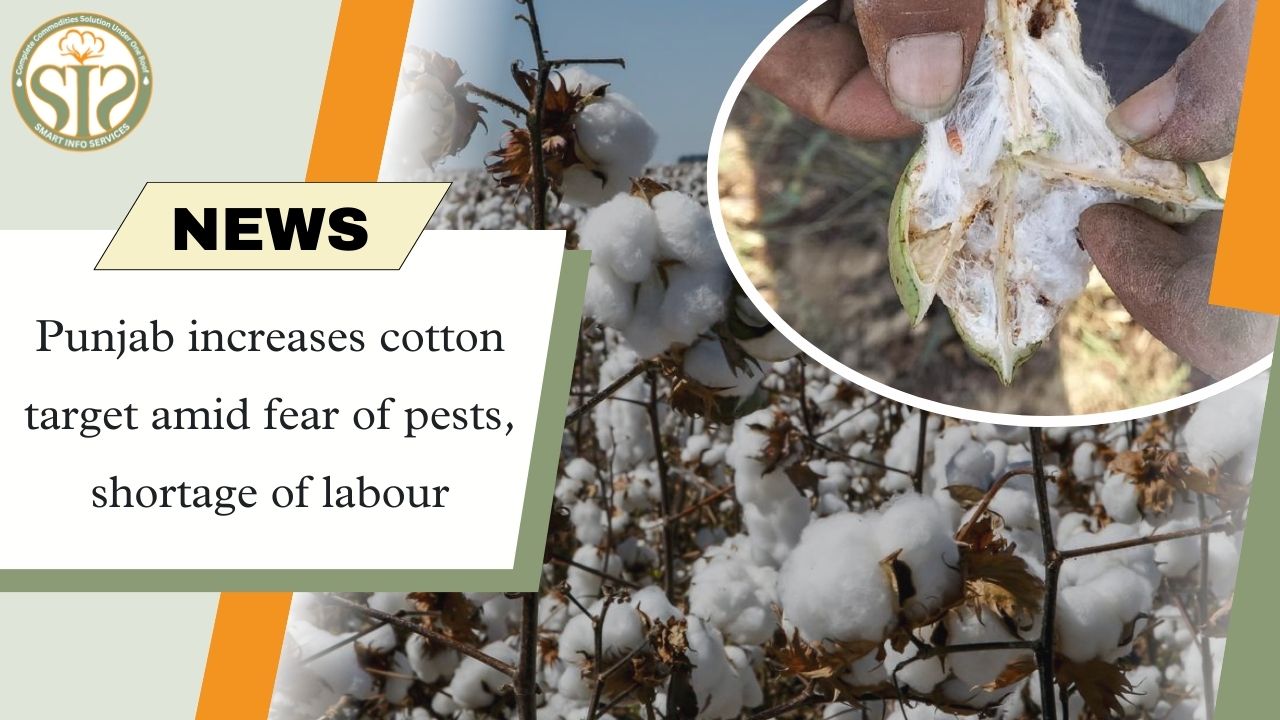
Kapas Kisan app runs into trouble in Punjab despite relaxed norms; Cotton Corporation of India’s purchases remain minimal.The Cotton Corporation of India’s (CCI) Aadhaar-based pre-registration system for cotton farmers, introduced this season through the new ‘Kapas Kisan’ mobile app, has hit major hurdles in Punjab, with farmers avoiding registration despite relaxed conditions and the state expecting more than 3 lakh quintals to arrive in mandis.CCI had initially mandated uploading of fresh ‘girdwari’ (records of cotton cultivation) verified by the revenue department for farmers to become eligible for procurement based on the Minimum Support Price (MSP). However, following media reports and requests from the Punjab Government, the Central Government relaxed the norm in the third week of October. Farmers are now allowed to upload land records based on seed-subsidy data, as the state provided a 33 per cent subsidy on Bt cotton seeds this year and holds complete acreage records.“The relaxation has been done, but the purchase is happening based on the registration being done by the farmer through the app. We are open to purchasing the stock which has 12 per cent moisture,” said an officer with the CCI, Bathinda office.CCI procurement remains negligibleHowever, CCI procurement remains negligible. To date, around 4,000 quintals have been purchased, as against the agriculture department’s expected arrival of an estimated 2 lakh bales (more than 3 lakh quintals) this season. Private players are dominating purchases, largely below MSP.Punjab’s major cotton-growing districts include Muktsar, Bathinda, Mansa, and Fazilka. The state’s cotton acreage, though slightly higher this year at 1.19 lakh hectares (target: 1.29 lakh ha) when compared to 2024, remains much below earlier levels. Acreage has fallen sharply from 3.35 lakh hectares in 2019 to 1.79 lakh hectares in 2023. CCI officials also doubt the estimate of 2 lakh bales due to crop loss from waterlogging and floods. In 2024, the area under cotton cultivation was 99,000 hectares.“Farmers were busy in the paddy procurement season, and now it is at its fag end. Hence, we are expecting more registrations through the Kapas Kisan app, and accordingly, purchases will increase. We have no hassles in buying; the farmer has to do the registration through the app,” officials said.But on the ground, farmers are reluctant. “The farmers are finding self-registration through the Kapas Kisan app a hassle and hence are preferring to sell it to private players. Many farmers don’t even have their old bills of seeds purchased on subsidy; many are not tech-savvy and prefer the old-school way,” said Sukhmandar Singh, president, BKU Rajewal (Fazilka).Abohar-based farmer Sukhjinder Singh Rajan said, “It is nice that norms to register through Kapas Kisan app have been relaxed… but the department of agriculture needs to find out why farmers are still not selling through CCI.”The ‘Kapas Kisan’ app‘Kapas Kisan’ app, available on both Android and iOS platforms, requires farmers to upload valid land records and details of cotton sowing areas, certified by revenue or agriculture authorities. The idea behind the introduction of this app was to bring transparency in maintaining land records, cotton arrival, and the purchases accordingly.What the stats sayMarket arrivals underline the trend. As of November 10, 54,900 quintals of cotton had arrived in Fazilka, but CCI purchased only 2,000 quintals; the rest went to private buyers. In Mansa, 21,230 quintals arrived, with CCI buying just 139 quintals. In Bathinda, 34,606 quintals of cotton had arrived in the mandis till November 10, with 117 quintals purchased by CCI. Sources revealed that overall arrivals are likely to be much lower than earlier projections, as a portion of the crop was damaged during the floods while the agriculture department’s estimates were prepared before the flooding occurred.read more :- Karnataka: Labour shortage affects cotton harvesting in Yadgir
| title | Created At | Action |
|---|---|---|
| CCI Cuts Cotton Prices by ₹500, Sells Over 90% via E-Auctions | 15-11-2025 01:15:54 | view |
| Rupee closed 1 paisa higher at 88.74 | 14-11-2025 22:54:56 | view |
| The government canceled 14 quality orders. | 14-11-2025 21:51:06 | view |
| Maharashtra CCI Procurement Hit by Delays in Farmer Verification | 14-11-2025 20:32:48 | view |
| Cotton app and government delays add to farmers' woes in Telangana | 14-11-2025 18:37:35 | view |
| Farmers in Adilabad are forced to sell cotton to private traders. | 14-11-2025 18:22:04 | view |
| Rupee fell 09 paise to open at 88.75/USD | 14-11-2025 17:40:03 | view |
| The rupee fell 2 paise to close at 88.66 per dollar. | 13-11-2025 22:54:19 | view |
| Big Relief for Exporters as Cabinet Clears ₹20,000 Crore Credit Guarantee Scheme | 13-11-2025 19:13:44 | view |
| While the announcement of the start of procurement at MSP has come, there's bad news for India's cotton farmers. | 13-11-2025 18:54:30 | view |
| Haryana: Cotton purchased at MSP, but prices reduced citing low quality. | 13-11-2025 18:39:15 | view |
| CCI procures over 17,000 cotton bales at MSP in Madhya Pradesh as season gains pace | 13-11-2025 18:16:47 | view |
| Rupee opened 01 paise higher at 88.65/USD | 13-11-2025 17:44:45 | view |
| Rupee closed down by 01 paisa at 88.64 per dollar | 12-11-2025 22:45:45 | view |
| India's cotton imports hit record levels amid duty exemptions | 12-11-2025 19:29:42 | view |
| Punjab's cotton procurement is minimal, Kisan App in trouble | 12-11-2025 19:14:50 | view |