STAY UPDATED WITH COTTON UPDATES ON WHATSAPP AT AS LOW AS 6/- PER DAY
Start Your 7 Days Free Trial TodayGujarat's textile industry threatened by 50% US tariffs demands 10% export incentive.Gujarat’s textile sector is staring at a severe crisis after the US announced a 50 per cent tariff on all imports from India — a move industry leaders say could force many exporters to shut shop. Industry stakeholders have urged the Centre to step in to take effective measures, including a 10 per cent export incentive to help offset the tariff’s impact.The new duty was imposed by US President Donald Trump in two stages — a 25 per cent tariff on all Indian imports and an additional 25 per cent penalty over India’s continued purchase of Russian oil. The Indian government condemned the decision and has refused to bow to American pressure to stop buying Russian crude.The blow is particularly harsh for Gujarat, home to major textile hubs Ahmedabad and Surat. India’s total textile exports to the US are valued at USD 10–12 billion annually, with Gujarat accounting for more than 15 per cent of that trade.Sandip Shah, co-chairman of the textile committee of the Gujarat Chamber of Commerce and Industry, said exporters had initially hoped the earlier 25 per cent tariff would be rolled back after talks. "But with 50 per cent now in place, trade with America has become impossible," he said. "For textiles, the US market is now almost shut".According to Shah, such a sudden halt in trade will create serious liquidity problems. "If this is not resolved quickly, it could take the industry more than six months to recover," he warned.Many believe that Surat, known for its synthetic fabric exports, will be hit hard.Ashish Gujarati, former president of the Southern Gujarat Chambers of Commerce and Industries, said the city alone accounts for Rs 3,000–Rs 4,000 crore in direct exports to the US. "The indirect impact will be even bigger — losses could touch Rs 10,000–Rs 12,000 crore because several allied industries depend on textiles," he said.For some, the only option might be to shut down or relocate production. "If 50 per cent tariff is implemented, no one will be able to export to the US," said PR Kankaria, owner of Kankaria Textiles in Ahmedabad. "Units will close, artisans will lose jobs, and many will have to migrate".Industry bodies are urging the central government to step in. One proposal is for a 10 per cent export incentive to help offset the tariff’s impact and redirect exports to other countries. "If we get incentives, our exports to other markets can triple," said Kankaria. "If not, everything will stop".The US remains a key buyer of Indian textiles, and losing that market could have ripple effects across supply chains — from yarn makers to embroidery units.While the sector has diversified exports to regions like Europe, West Asia, and Latin America, replacing the US market in the short term will be difficult.read more :- INR Up 02 Paise, Opens at 87.47
Indian rupee opened 2 paise up on August 14 on easing dollar index and traders await the outcome of a key meeting between US President Donald Trump and Russian President Vladimir Putin.The domestic currency opened at 87.47 against the US dollar, as compared to 87.49 against the greenback at previous close.read more :- "Textiles ministry to meet exporters on duty concerns"
Textile Ministry to have meeting with exporters amidst tariff concernsAmid mounting concern among businesses over the 25% reciprocal tariff imposed by the United States, the Ministry of Textiles has convened a meeting today with major textile and apparel exporters from across the country. The session, chaired by Union Textiles Minister Giriraj Singh, focuses on the challenges exporters are facing in order flows, particularly after the recent US decision to levy secondary tariffs on Indian goods, widening the tariff gap with other competing Asian countries.The US is India’s largest export market for the labour-intensive textile and apparel industry. Exporters have been under pressure since 7th August, when import tariffs were raised to 25% by the Trump administration. The rate is set to double to 50% from 27th August. Exporters say orders have slowed, with buyers either asking them to share the tariff burden or holding back purchases until clarity emerges on trade talks between India and the US.Officials said a key issue to be raised during the meeting is the disruption of cash flows caused by reduced orders. Exporters have sought Government support in the form of soft loans, interest subvention schemes, and focused market development initiatives to ensure liquidity.While exporters hope the tariff hike will be temporary, many are concerned about losing market share to countries such as Vietnam and Bangladesh, which face lower US duties. With India’s 25% reciprocal tariff exceeding that of most Asian competitors except China, policy circles are also worried about potential job losses in the sector if the situation persists.According to officials, the Government is in continuous dialogue with exporters to assess the evolving situation and explore possible interventions. The Ministry of Finance estimates that over half of India’s merchandise exports to the US will be affected by the higher tariffs. The US accounted for 33% of India’s ready-made garment exports in 2024, while also being a key destination for home textiles and carpets—sectors where 60% and 50% of exports, respectively, go to the US.read more :- Rupee higher 16 Paisa Against Dollar, Closes at 87.49
The Indian rupee ended 16 paisa higher on wednesday at 87.49 to the dollar, while it opened at 87.65 in the morning.At close, the Sensex was up 304.32 points or 0.38 percent at 80,539.91, and the Nifty was up 131.95 points or 0.54 percent at 24,619.35. About 2099 shares advanced, 1806 shares declined, and 142 shares unchanged.read more :- INR Opens Stronger by 05 Paise at 87.65
Indian rupee opens 5 paise up at 87.65/USD as US Inflation shows limited tariff impactThe domestic currency opened at 87.65 against the US dollar, as compared to 87.70 against the greenback at previous close.read more :- Trump's statement: Tariff on India, shock to Russia; duty on China stopped
"Trump says India duties a 'huge blow' to Russia, keeps China tariffs paused"About 55% of India's total merchandise exports to the US will be subject to 25% reciprocal tariff, minister of state (MoS) for finance ministry Pankaj Chaudhary has said. In a written reply to a question in the Lok Sabha, Chaudhary said the government attaches utmost importance to protecting and promoting welfare of farmers, entrepreneurs, exporters, MSMEs, and will take all necessary steps to secure our national interest. Earlier, Union minister Rajnath Singh took a veiled jibe at United States President Donald Trump on Sunday over the country's steep 50% tariffs on Indian goods. “There are some people who are jealous of India’s rapid development. They think, ‘we are the boss of all.’ They cannot accept how quickly India is moving ahead,” the defence minister said at an event in Madhya Pradesh. He added that efforts were being made to make Indian-made products more expensive in global markets so they lose their competitiveness.The United States has imposed punishing 50 per cent tariffs on Indian goods, half of which are ‘punishment’ for purchasing oil from Russia. The move comes as the US seeks to pressure Russia into stopping the war in Ukraine.After the announcement of tariffs last week, US President Trump on Thursday ruled out the possibility of trade talks with India until the issue of tariffs is resolved. When asked by a reporter whether he expects increased trade negotiations with India after announcing 50% tariffs, Trump replied, “No, not until we get it resolved.”Meanwhile, India is considering to announce tariffs countering the United States' punishing 50 per cent tariffs on steel, aluminium and their derivatives from India that it imposed in June with , according to people aware of the matter.US tariffs on India | Key pointsThe United States imposed 25 per cent tariffs on India before its August 1 deadline kicked in, followed by additional 25 per cent tariffs that it announced on August 6 as punishment for buying Russian oil, taking the total tariffs on India to 50 per cent.While the initial 25 per cent tariffs came into effect on August 7, the remaining 25 per cent will come into effect by August 27.India has called US' move to slap such steep tariffs for doing trade with Russia as “unfair, unjustified, unreasonable”.The US' move to slap India with penalty for buying oil from Russia is also a way for it to push Russia to end the war in Ukraine.United States President Donald Trump will meet his Russian counterpart Vladimir Putin on August 15 in Alaska. The announcement of the meeting came after after Trump on Friday claimed that “we're getting very close” to a peace deal.“The highly anticipated meeting between myself, as President of the United States of America, and President Vladimir Putin, of Russia, will take place next Friday, August 15, 2025, in the Great State of Alaska,” Trump said in a post on Truth Social.Amid US tariff row, Prime Minister Narendra Modi held a phone conversation with Russian President Vladimir Putin on Friday and discussed a range of issues."read more:- Maharashtra's cotton production in trouble: two major reasons
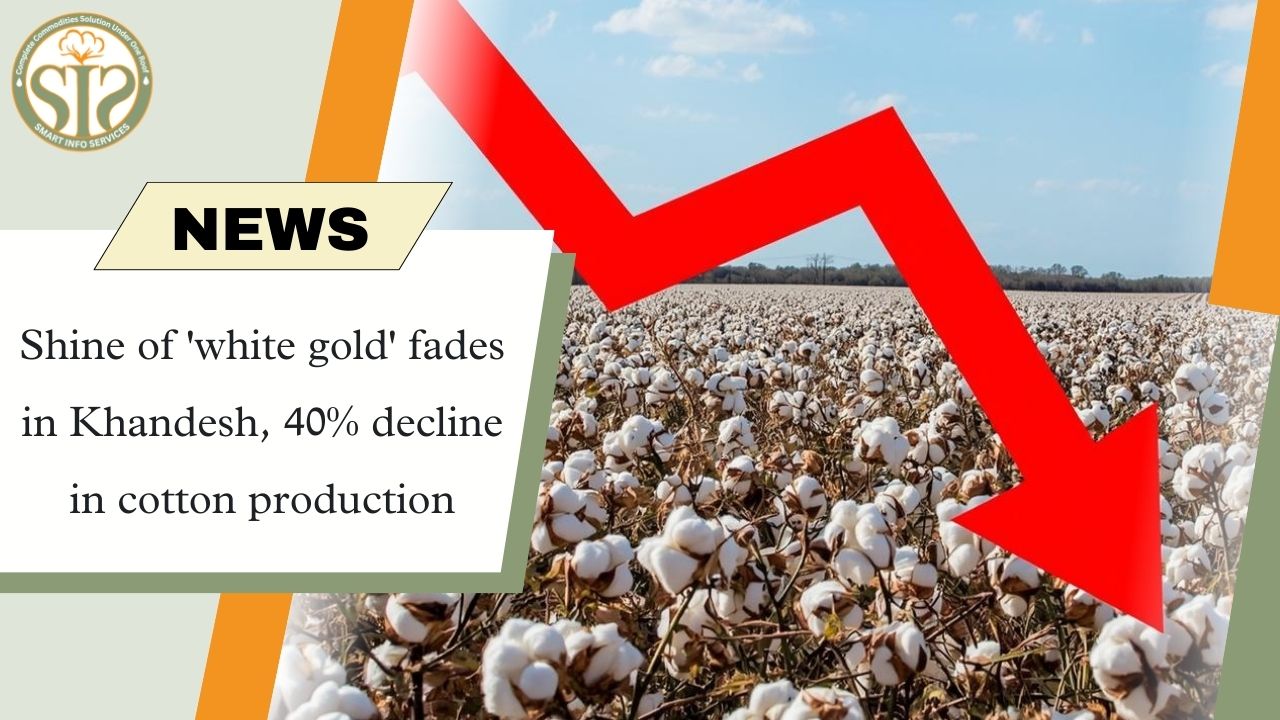
This time in Maharashtra, cotton farming has two big villains, huge decrease in productionLast year also, cotton production had declined and its prices had also fallen sharply. Farmers have not been able to get good prices for cotton for the last two years. Last year, cotton crop could be sold only for 6 to 7 thousand rupees per hectare. Whereas usually it is sold for 10 thousand rupees. Due to this, farmers have turned away from it this time.This time, good rains were recorded in Maharashtra in the month of May itself and in such a situation, it was expected that the cotton acreage would be more this time than every time. But this did not happen and this time a significant decline has been recorded in the cotton acreage in the state. After May, the lack of rain for about 25 days in the months of June and July has affected it. According to a report, the area under cotton cultivation in Ahilyanagar, Maharashtra has come down from 4 lakh 29 thousand hectares last year to 2 lakh 53 thousand hectares this time. It is clear that there has been a decline of about 50 percent.In Kolhapur, farming has completely disappearedCotton farming is done in 21 districts of Maharashtra. Apart from Latur, only in Washim, Yavatmal, Nagpur, Nagpur, Chandrapur, Gadchiroli, the cotton cultivation figure has increased a bit compared to last year. Whereas in all other districts it is less than the average. In Kolhapur, farmers have not sown cotton this time. Apart from this, cotton farming has not been done in Konkan as well. At the same time, farming has been very less this time in Sangli, Satara, Dharashiv, Bhandara and Gondia districts.These 2 reasons had an impactLast year also, there was a decline in the production of cotton and its prices also fell sharply. Farmers have not been able to get good prices for cotton for the last two years. Last year, cotton crop could be sold only for 6 to 7 thousand rupees per hectare. Whereas usually it is sold for 10 thousand rupees. Due to this, farmers have turned away from it this time. They say that they grow cotton with great hard work and if they do not get good prices for it then what is the use. This year, rain has also had an impact. At the time when seeds were to be sown, it did not rain and this also affected the farming.This time cotton is behindThe average area of Kharif in the state is 144 lakh 36 thousand 54 hectares. So far, sowing has been completed in 137 lakh 59 thousand 761 hectares. Cotton is an important crop for the state. Its average area is 42 lakh 47 thousand 212 hectares. So far this year, cotton sowing has been done on 38 lakh 17 thousand 221 hectares. During the same period last year, its sowing was completed in more than 40 lakh 70 thousand hectares of area.read more:- Rupee Ends Flat at 87.70/USD
The Indian rupee closed stable at 87.70 per dollar on tuesday, while it had opened at 87.70 in the morning.At close, the Sensex was down 368.49 points or 0.46 percent at 80,235.59, and the Nifty was down 97.65 points or 0.40 percent at 24,487.40. About 1994 shares advanced, 1889 shares declined, and 157 shares unchanged.read more :- Sowing of paddy is fast, cotton-oilseed is slow
Kharif paddy sowing rises; cotton, oilseed sowing downKharif paddy sowing rises 12% to 365 lakh hectares. Cotton, oilseed acreage down. Monsoon forecast better than normal. Read more!According to government data, paddy sowing has risen 12 per cent to 364.80 lakh hectares so far this Kharif season.Paddy, the main crop of the Kharif (summer) season, was sown in 325.36 lakh hectares in the same period last year.The agriculture department has released the progress of acreage under Kharif crops till August 8, 2025.The total sown area of all Kharif crops rose to 995.63 lakh hectares till August 8 from 957.15 lakh hectares a year ago, an official statement issued on Monday said.The area under pulses rose marginally to 106.68 lakh hectares from 106.52 lakh hectares, while the area under coarse cereals rose to 178.73 lakh hectares from 170.96 lakh hectares.In the non-foodgrain category, area under oilseeds declined to 175.61 lakh hectares from 182.43 lakh hectares.Area under cotton declined to 106.96 lakh hectares from 110.49 lakh hectares.However, sugarcane sowing has increased marginally to 57.31 lakh hectares so far as against 55.68 lakh hectares during the same period last year.The India Meteorological Department has forecast the overall monsoon to be better than normal this year.read more:- Cotton crop submerged, Haryana farmers worried
Waterlogging hits crop hard in Haryana’s cotton beltThe Hisar-Sirsa-Fatehabad-Bhiwani region is known as the ‘cotton belt’ of the state. However, repeated crop failures in recent years due to pest attacks — including those by whitefly and pink bollworm — have dealt a major blow to farmers, leading to a gradual decline in the cotton-growing area. As a result, the area under paddy cultivation hasThis season saw negligible pest attacks on cotton. Yet, the misfortune of farmers continues.Waterlogging in several parts of these districts has caused the wilting of cotton plants due to prolonged inundation — resulting in crop failure. According to Agriculture Department data, in Hisar alone, about 40,000 acres of cotton has been damaged due to flooding after the rains, up to August 2.Additional rainfall and overflowing drains have worsened the situation, causing more crop losses. The department’s report states that the Agroha, Adampur, Hisar-1, and Bass blocks have suffered the most damage.In Bhiwani district, 38,000-acre cotton is under threat due to rainwater inundation. Out of the district’s total cotton area of 1,13,265 acres, 5,400 acres has already suffered 75-100 per cent damage, while the rest of the inundated area is also said to have suffered major losses. Agriculture experts say cotton cannot survive more than two days of waterlogging, making it unlikely for the flooded crop to recover.Deputy Director (Agriculture), Hisar, Dr Rajbir Singh said the Irrigation Department was working overtime to drain out standing water from the fields.Cotton farmers facing crop failure could opt for late paddy sowing in their fields, he added.Sirsa district has incurred comparatively lesser damage to the crop, as most damage has been done in Nathusari Chopta region — where 2,600 acres of crop has been damaged.The district has total cotton area of 1,47,000 hectares. In Fatehabad district, which has over 80,000 acres of area under cotton, about 2,500 acres has suffered losses due to inundation.Vinod Kumar, a farmer from Shakkar Mandori village in Sirsa district, said he had planted cotton on eight of the ten acres of farmland he owns.Unfortunately, due to heavy rain and waterlogging, his entire cotton crop has been destroyed.He said he had spent around Rs 10,000-15,000 per acre on the crop (not counting the labour done by his family).Now, he has attempted to grow paddy on 4 acres; however, water has been standing in his fields for many days, turning them into swamps.As a result, his tractor and rotavator got stuck in the mud while trying to sow paddy.The tractor was pulled out — albeit with great difficulty — but the rotavator is still stuck in the field.“I don’t know what will happen next. I’ve used up all my savings,” he said, urging the government to provide compensation for his losses.read more:- Andhra textile industry expected to face US tariff impact.
US duty impacts Andhra textilesBeginning 27th August, Indian exporters must choose whether to continue exporting to the US in spite of the high tariff or to halt exports and search for other markets abroad. The US administration, led by President Donald Trump, has imposed a 50% tariff on textiles being imported from India. However, it will take time to build other export markets.AP Textiles Mills Association vice president Sadineni Koteswara Rao stated that, after agriculture, the textile industry is the largest source of employment. He noted that the sector is expected to face a significant impact due to the US tariffs and emphasised the need for the Andhra Pradesh Government to step in with support measures. These, he suggested, should include providing captive power and clearing arrears to help keep the industry viable in the state.Andhra Pradesh’s textile sector is reeling under uncertainty, with 30–35 of the state’s 100-plus spinning mills already shutting down. The primary cause is the steep rise in power tariffs which now account for nearly 53% of production costs, pushing many units to the brink of closure.Industry stakeholders are urging the State Government to restore the power tariff policy that was in force between 2015 and 2020. They are also seeking permission to establish captive power plants, particularly in upland districts such as Kurnool and Anantapur in the Rayalaseema region, enabling them to generate their own electricity and channel surplus power to the state grid.In addition, stakeholders are pressing for the release of pending incentives — including power subsidies, bank loan interest subsidies, and capital subsidies — amounting to Rs. 11,000 crore (US $ 1.25 billion). They believe this support is critical to restoring viability to the sector.These concerns were presented to Chief Minister N. Chandrababu Naidu around four months ago, prompting him to instruct the Chief Secretary to form a committee to study the matter. However, the committee has yet to hold discussions with industry representatives.read more:- Rupee falls 05 paise at open to 87.70 against US dollar
Indian rupee opens 5 paise lower at 87.70 against US dollar on China tariff truce extensionThe local currency opened at 87.70 against the US dollar, as compared to 87.65 against the greenback at previous close.read more :- Rupee fell 13 paise to close at 87.65
The Indian rupee on monday lower 13 paise to close at 87.65 per dollar, while it opened at 87.52 in the morning.At close, the Sensex was up 746.29 points or 0.93 percent at 80,604.08, and the Nifty was up 221.75 points or 0.91 percent at 24,585.05. About 2136 shares advanced, 1867 shares declined, and 161 shares unchanged.read more :- Rupee opens 14 paise down at 87.52
Rupee opens 14 paise down at 87.52The Indian rupee is trading 14 paise down at 87.52 per dollar, while the previous close price was 87.66 per dolread read more:- "Start Timely Procurement of Cotton in the Interest of Farmers; High Court Warns Corporation"
Start cotton procurement on time: High Court warnsTo prevent the economic losses farmers face due to delays in cotton procurement, the Nagpur Bench of the Bombay High Court has ordered the Cotton Corporation of India to provide a guarantee letter within two weeks.The court issued clear instructions to open procurement centers on time—regardless of whether farmers bring cotton for sale or not—and emphasized that procurement should begin before Diwali, with pending payments made within seven days.To safeguard the interests of cotton-growing farmers, the Nagpur Bench of the Bombay High Court has issued a stern warning to the Cotton Corporation of India to ensure timely opening of procurement centers.The court noted that delays in procurement benefit private traders while causing losses to farmers.Ordering that cotton procurement centers be opened on time, the court stated that protecting the interests of cotton farmers is the "primary duty" of the Cotton Corporation of India.The court directed that centers must open on schedule, regardless of whether farmers bring cotton to sell.The bench, comprising Justice Anil Kilor and Justice Trishali Joshi, was hearing a Public Interest Litigation (PIL) filed by Shriram Satpute, District Coordinator (Rural) of the Grahak Panchayat.The petition demanded that cotton procurement start before Diwali and that the outstanding amounts be deposited in farmers’ bank accounts within seven days.read more :- CCI Hikes Cotton Prices; Sells 70% of 2024–25 Procurement via E-Bidding.
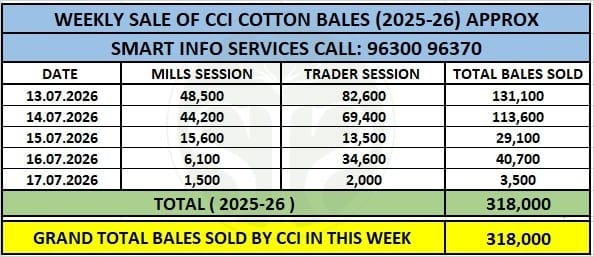
CCI Boosts Cotton Prices, Sells 71% of 2024–25 Procurement via E-BiddingThe Cotton Corporation of India (CCI) conducted online bidding for cotton bales throughout the week, witnessing active participation in both Mills and Traders sessions. Prices remained steady over the five-day trading period.As of now, CCI has sold approximately 71,47,600 bales for the 2024–25 season, accounting for 71.47% of its total procurement for the season.Weekly Sales Summary (Date-wise)04 August 2025: 3,000 balesMills session: 1,000 balesTraders session: 2,000 bales05 August 2025: 5,500 balesMills session: 2,200 balesTraders session: 3,300 bales06 August 2025: 5,600 bales (highest daily sales)Mills session: 1,200 balesTraders session: 4,400 bales07 August 2025: 1,300 balesMills session: 500 balesTraders session: 800 bales08 August 2025: 4,500 balesMills session: 1,300 balesTraders session: 3,200 balesWeekly Total: 19,900 balesThe week’s results highlight strong market engagement and the increasing efficiency of CCI’s digital transaction platform.If you want, I can also make an even snappier version suitable for a press release or news brief, emphasizing the 71% milestone and steady prices. Do you want me to do that?read more :- Rupee fell 10 paise to close at 87.66 against dollar
| title | Created At | Action |
|---|---|---|
| Gujarat textile industry demands 10% export incentive | 14-08-2025 20:06:59 | view |
| INR Up 02 Paise, Opens at 87.47 | 14-08-2025 17:29:50 | view |
| "Textiles ministry to meet exporters on duty concerns" | 14-08-2025 01:03:03 | view |
| Rupee higher 16 Paisa Against Dollar, Closes at 87.49 | 13-08-2025 22:50:06 | view |
| INR Opens Stronger by 05 Paise at 87.65 | 13-08-2025 17:24:13 | view |
| Trump's statement: Tariff on India, shock to Russia; duty on China stopped | 13-08-2025 00:26:21 | view |
| Maharashtra's cotton production in trouble: two major reasons | 12-08-2025 23:26:29 | view |
| Rupee Ends Flat at 87.70/USD | 12-08-2025 22:49:33 | view |
| Sowing of paddy is fast, cotton-oilseed is slow | 12-08-2025 19:20:26 | view |
| Cotton crop submerged, Haryana farmers worried | 12-08-2025 18:56:04 | view |
| Andhra textile industry expected to face US tariff impact. | 12-08-2025 18:32:25 | view |
| Rupee falls 05 paise at open to 87.70 against US dollar | 12-08-2025 17:21:45 | view |
| Rupee fell 13 paise to close at 87.65 | 11-08-2025 22:49:20 | view |
| Rupee opens 14 paise down at 87.52 | 11-08-2025 18:19:37 | view |
| "Start Timely Procurement of Cotton in the Interest of Farmers; High Court Warns Corporation" | 09-08-2025 01:03:06 | view |
| CCI Sells 71% of 2024–25 Cotton via E-Bidding | 09-08-2025 00:46:24 | view |