STAY UPDATED WITH COTTON UPDATES ON WHATSAPP AT AS LOW AS 6/- PER DAY
Start Your 7 Days Free Trial TodayThe Indian rupee on friday lower 10 paise to close at 87.66 per dollar, while it opened at 87.56 in the morning.At close, the Sensex was down 765.47 points or 0.95 percent at 79,857.79, and the Nifty was down 232.85 points or 0.95 percent at 24,363.30. About 1494 shares advanced, 2380 shares declined, and 137 shares unchanged.read more :- Duty-free access to US cotton, agri items’ quota likely on talks table
Talks possible on duty-free access to American cotton and agricultural quotaWhile some sectors have proposed incentives to accommodate US products, industry sources said the recent escalation in tension between New Delhi and Washington — due to additional tariffs over the Russian oil trade — is turning popular sentiment against a trade deal.Duty-free market access to US cotton, accepting agricultural items under limited quotas — these are among the possible concessions that the industry has suggested ahead of the crucial round of negotiations later this month when the US team is expected to arrive in India, The has learnt.Earlier this month, Commerce Minister Piyush Goyal had sought suggestions from industry executives on ways to sweeten the trade deal with the US.While some sectors have proposed incentives to accommodate US products, industry sources said the recent escalation in tension between New Delhi and Washington — due to additional tariffs over the Russian oil trade — is turning popular sentiment against a trade deal.Importing duty-free US cotton is one of the areas being suggested to the government, which would also benefit domestic manufacturing amid declining cotton production in the country. Notably, Bangladesh, which has signed a deal with the US, had also offered a similar concession. The US market accounts for nearly 30 per cent of India’s total apparel exports.A government official said that quotas for American agricultural items have also been considered, but these do not include genetically modified (GM) products. There is significant resistance to GM crops in India, and only one GM crop — Bt cotton — is approved for cultivation. However, no GM food crop is commercially grown in India.Meanwhile, following the steep tariff announced by the US, the industry has sought immediate relief — like expansion of the Remission of Duties and Taxes on Exported Products (RoDTEP) scheme to more sectors, and the Interest Subvention Scheme (ISS) for Micro, Small and Medium Enterprises (MSMEs).An exporter who did not want to be named said that established brands are not cancelling orders, but have begun putting them on hold, pending the outcome of negotiations slated for later this month.“Everybody [US importers] is saying, give us at least three weeks to revert — so, till the US negotiators reach India by August 25, and then maybe some relief could come. Indian exporters can absorb five to seven per cent tariff. Pharma has margins, so the challenge is less there. But in most other areas, margins are low. Other items — say proprietary items like what Apple produces — can withstand the pressure, but footwear and textiles have little margin and the competition is intense,” the exporter said.Another exporter said that higher tariffs could increase exports during the 21-day window. However, if the 50 per cent duty comes into effect, Indian goods will be worse off as compared to China, Bangladesh, Vietnam and most of the other competitors.An executive operating in the gems and jewellery sector said the industry has sought support from the government on the lines of the intervention during Covid, as concerns over imports of rough diamonds still remain and Indian goods may not remain competitive in the US market after 25 per cent tariffs.Meanwhile, India has already stepped up its oil imports from the US, with imports jumping over 270 per cent year-on-year in the first four months of 2025. According to data released by the Directorate General of Commercial Intelligence and Statistics (DGCIS), India imported 6.31 million tonnes of US crude in January–April, a sharp increase from 1.69 million tonnes in the same period last year.read more:- Textile industry worried about US tariffs
Rupee opens 14 paise up at 87.56 as dollar index easesThe currency opened at 87.56 against the dollar after ending the previous day at 87.70.read more :- Textile industry worried about US tariffs
Indian textile industry raises alarm over additional US tariff of 25%The Confederation of Indian Textile Industry (CITI) has expressed serious concern over the potentially damaging effects of the recently announced effective 50% tariff rate imposed by the US on Indian textile and apparel products, which came into effect on 6th August.CITI Chairman Rakesh Mehra stated that the 6th August US tariff announcement has dealt a major blow to Indian exporters, exacerbating an already difficult situation and severely weakening their competitiveness in the US market compared to other nations.He further urged the Government to take swift action to support the textile and apparel industry, especially given its stated commitment to enhancing the sector’s global competitiveness and enabling Indian companies to become leading players internationally.Mehra also expressed CITI’s hope that a bilateral trade agreement (BTA) between India and the US will come to fruition soon. He noted that a well-structured agreement that safeguards India’s sovereign interests while maintaining fairness could prove beneficial for both countries.In a similar vein, Sudhir Sekhri, Chairman of the Apparel Export Promotion Council (AEPC), expressed serious concern over the recently imposed 50% tariff on Indian apparel exports, calling it a major blow to the labour-intensive sector. According to him, the industry is in no position to absorb such a steep tariff hike. He noted that the government is likely aware of the severe implications of this increase, which could spell disaster for micro and medium-sized apparel exporters—particularly those heavily reliant on the US market—unless the Government of India intervenes with direct fiscal assistance.The Clothing Manufacturers Association of India (CMAI) has voiced serious concern over the United States’ decision to raise tariffs on Indian apparel exports from 25% to 50%, describing the move as a significant blow to the sector.Santosh Katariya, President of the association, noted that a 50% tariff would make Indian products 30–35% more expensive than those from competing nations like Bangladesh and Vietnam, severely undermining India’s competitiveness in global markets. According to him, international buyers are unlikely to absorb such a large cost disparity, which could result in a steep decline in export orders.Vice President Ankur Gadia called on the Indian government to adopt a strong and proactive approach in response, urging it to pursue more balanced and equitable trade arrangements with the United States.Chief Mentor Rahul Mehta remarked that while there remains hope that the tariff hike may be part of a broader negotiation strategy, there is an urgent need for both policymakers and industry stakeholders to collaborate on immediate solutions to cushion the impact of what he described as a harsh and damaging policy.Sanjay Jain, MD of TT Ltd., echoed this point of view, saying that the industry is shocked with the imposition of the additional tariff of 25% by the US on such a short notice. All goods entering the US after 21 days would have to pay this tariff. And for the previous tariff, anything which was loaded before 7th August was exempted. With the earlier tariff there was some room for negotiation with buyers but with the addition it becomes 50% and added on top of that is the regular tariff of 15-16% which takes it to 65%. In such a case, neither the Indian supplier can compensate the buyer nor can the buyer bear it. As a result, it is highly likely that new orders will not come in and pending orders will have to be shipped at significant losses.The solution to this could be to give immediate export incentives in cash to negate the effects of such tariffs. The money saved by cheaper oil should be given to the industry instead of the consumer. Another could be to put a retaliatory tariff on Pharma exports to the US.read more:- Appeal to the government to abolish cotton duty
Demand to remove import duty on cotton from the government, know what is the purposeThe Cotton Production and Consumption Committee (COCPC) has recommended removing this duty or postponing it for at least six months. Some commentators have also said that the removal of duty can be used as a bargaining chip in the ongoing trade talks with the US. However, domestic cotton producers argue that the removal of duty may affect local prices.India's textile sector is appealing to the government to remove 11 percent import duty on cotton. This appeal has been made due to severe shortage of raw material. The sector demands that if it has to remain internationally competitive, then it needs to be improved. According to some reports, due to this duty, domestic cotton prices have been consistently higher than global figures. Recently, cotton production in India has reached a 15-year low in 2024-25.CITI can make an offerThe Confederation of Indian Textile Industry (CITI) says that the difference in prices makes it difficult for manufacturers to compete in export markets and threatens job security. India's textile industry has suggested that the government can offer to remove the 11 percent duty on raw cotton imports. It can be used as a tool to negotiate favorable terms for the country's textile and apparel sectors during bilateral trade talks with the US.According to the Economic Times report, officials had earlier said that India was trying to build trade relations with the US. It was believed that due to the trade agreement, the US could consider reducing or completely eliminating import duty on walnuts, almonds, apples and cranberries.Removal of duty will have an impactHowever, the government advisory body, the Cotton Production and Consumption Committee (COCPC), has recommended removing this duty or suspending it for at least six months. Some commentators have also said that the removal of the duty could be used as a bargaining chip in the ongoing trade talks with the US. However, domestic cotton producers argue that the removal of the duty could impact local prices.Ambitious export targetExperts say the duty benefits traders and multinational companies rather than farmers. According to the Economic Times, India's textiles ministry is generally supportive of it and emphasizes that affordable raw cotton is essential to achieve India's textile export targets. The sector aims to reach $100 billion in exports by 2030.read more:- Bangladesh to double US cotton imports for duty-free access
Bangladesh to double cotton imports from USBangladesh’s textile manufacturers are aiming to double cotton imports from the United States within the next one year, as part of a strategy to secure duty-free access for apparel in the US market and strengthen bilateral trade ties.The move follows a decision by the Trump administration on 31 July to impose a 20% reciprocal tariff on Bangladeshi goods, effective from 7 August this year. Under the new rules, however, products containing at least 20% US raw materials will qualify for duty-free entry into the United States.Industry leaders believe that using more American cotton – prized for its superior quality despite higher prices – will not negatively affect the competitiveness of Bangladesh’s ready-made garment (RMG) exports.According to a White House notice, the revised tariff applies to goods “entered for consumption, or withdrawn from warehouse for consumption, on or after 12:01am eastern daylight time seven days after the date of the executive order, excluding the day the order is signed.”Over the past five years (2020-024), Bangladesh imported 39.61 million bales of cotton worth $20.30 billion from 36 countries, including the US, Australia, India, Brazil, China, and several African nations. Of this, the United States supplied 2.84 million bales valued at $1.87 billion.Between January and May 2025, US apparel imports rose by 7.06% year-on-year to $31.70 billion globally. Imports from Bangladesh grew even faster, climbing 21.60% to $3.53 billion.Calls for policy support and infrastructureBTMA President Showkat Aziz Russell told Daily Sun that US cotton currently accounts for about 8% of Bangladesh’s imports, but this is expected to rise to 20% within one fiscal year.He called for government policy support, including the establishment of a dedicated bonded warehouse – at least 500,000 square feet – to store US cotton and reduce the 90-day lead time for shipments from the US.“The price of US cotton is higher than that from other countries, but its quality is also better. This means there is no adverse impact on export pricing,” said Russell, who is also chairman and managing director of Amber Group.He urged the government to lower the Export Development Fund (EDF) loan interest rate to 2% for US cotton imports, offer a cash incentive of 3-4 cents per pound, and waive the 1% Advance Income Tax on export earnings.Quality advantage despite higher costsUS cotton costs 9-12 cents more per pound than Indian cotton, 6-8 cents more than African cotton, 12 cents more than Brazilian cotton, and 5-7 cents more than Australian cotton. However, wastage is lower – just 5-10% compared to 15% for Indian cotton and 12% for African cotton – making it more economical in the long run.About 75% of Bangladesh’s apparel exports are cotton-based.Shovon Islam, managing director of Sparrow Group and a former BGMEA director, said his company exports $1.5 million worth of shirts, trousers, women’s tops, and jackets annually to the US.“As US cotton is of better quality, our products will be better too. Although prices will rise, buyers are willing to pay more for quality,” he said, adding that his firm plans to use US cotton exclusively for garments destined for the American market to maximise duty benefits.
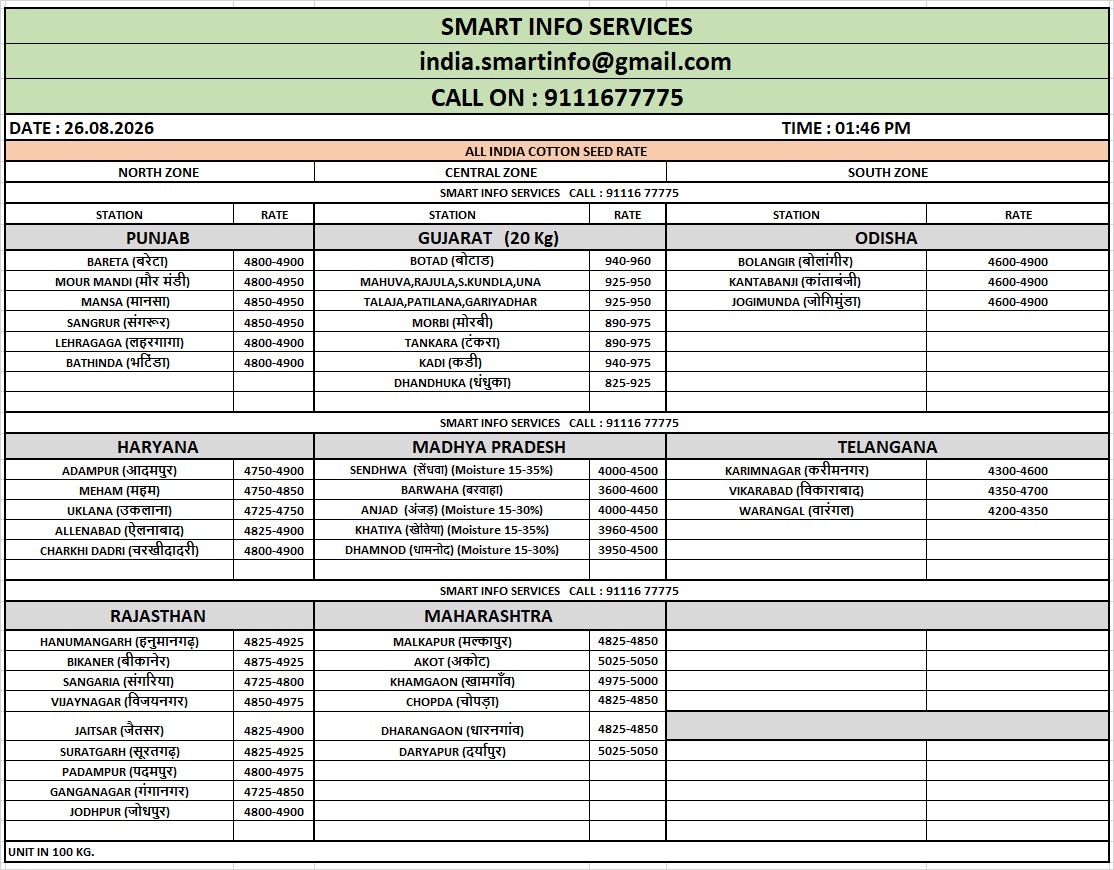

The Indian rupee on thursday higher 02 paise to close at 87.70 per dollar, while it opened at 87.72 in the morning.At close, the Sensex was up 79.27 points or 0.10 percent at 80,623.26, and the Nifty was up 21.95 points or 0.09 percent at 24,596.15. About 1716 shares advanced, 1996 shares declined, and 129 shares unchanged.read more :- Agriculture Minister Khudian: Asked for bi-weekly report on cotton
Punjab Agriculture Minister Khudian seeks bi-weekly report on cotton cropPunjab Agriculture and Farmers Welfare Minister Gurmeet Singh Khudian on Wednesday ordered the Chief Agriculture Officers (CAOs) of cotton belts to submit bi-weekly reports on the progress and status of the 'white gold' crop. The minister also directed the field officers to complete the verification of fields for direct seeding (DSR) of rice by August 10 so that the incentive amount of ₹1,500 per acre can be transferred directly to the bank accounts of eligible farmers.These directions were issued during a high-level video conference meeting with Chief Agriculture Officers and senior officials of the department on Wednesday. The minister also directed the CAOs to visit cotton fields regularly to monitor and manage pest attacks including pink bollworm, white fly, jassid, thrips and other pests. He also asked them to inspect paddy fields for rice dwarf virus and guide farmers about effective management and control measures to minimize its impact.Expressing concern over rainwater-logged fields in Fazilka and Kapurthala districts, Khudian directed agriculture officers to regularly inspect the affected fields and cooperate with other departments and district administration to ensure prompt drainage of water to minimize crop damage.read more :- US attack on Indian exports: 50% tariff imposed
US slaps 50% tariff on Indian goods; textiles, shrimp, gems most hit.US President Donald Trump on Wednesday slapped an additional 25 per cent tariff, raising the total duties to 50 per cent on goods coming from India, as a penalty for New Delhi's continued purchase of Russian oil.Domestic export sectors such as leather, chemicals, footwear, gems and jewellery, textiles and shrimp will be severely impacted by the imposition of the 50 per cent tariff by the US, say industry experts.US President Donald Trump on Wednesday slapped an additional 25 per cent tariff, raising the total duties to 50 per cent on goods coming from India, as a penalty for New Delhi's continued purchase of Russian oil.The United States has imposed additional tariffs or penalties for Russian imports only on India, while other buyers such as China and Turkey, have so far escaped such measures."The tariffs are expected to make Indian goods far costlier in the US, with potential to cut US-bound exports by 40–50 per cent," think tank GTRI said.After the new tariff, it said, organic chemicals' exports to the US will attract an additional 54 per cent duty. The other sectors which will attract high duties include carpets (52.9 per cent), apparel - knitted (63.9 per cent), apparel - woven (60.3 per cent), textiles, made-ups (59 per cent), diamonds, gold and products (52.1 per cent), machinery and mechanical appliances (51.3 per cent), furniture, bedding, mattresses (52.3 per cent).The 25 per cent duty, announced on July 31, will come into force from August 7 (9.30 am IST).The additional 25 per cent will be implemented by the US from August 27. These will be over and above the existing standard import duty in the US.In 2024-25, the bilateral trade between India and the US stood at USD 131.8 billion (USD 86.5 billion exports and USD 45.3 billion imports).The sectors, which would bear the brunt of 50 per cent duty include textiles/ clothing (10.3 billion), gems and jewellery (12 billion), shrimp (USD 2.24 billion), leather and footwear (USD 1.18 billion), chemicals (2.34 billion), and electrical and mechanical machinery (about USD 9 billion).Kolkata-based seafood exporter and MD of Megaa Moda, Yogesh Gupta said that now India's shrimp will become expensive in the US market."We are already facing huge competition from Ecuador as it has only 15 per cent tariff. Indian shrimp already attracts a 2.49 per cent anti-dumping duty and a 5.77 per cent countervailing duty. After this 25 per cent, the duty will be 33.26 per cent from August 7," Gupta said.The Confederation of Indian Textile Industry (CITI) said that it is "deeply concerned" about the potential adverse impact of the effective 50 per cent US tariff rate for India."The US tariff announcement of August 6 is a huge setback for India's textile and apparel exporters as it has further complicated the challenging situation we were already grappling with and will significantly weaken our ability to compete effectively vis--vis many other countries for a larger share of the US market," it said.It urged the government to urgently take steps to help the sector during these hugely testing times.Colin Shah, MD, Kama Jewelry, said this move is a severe setback for Indian exports, with nearly 55 per cent of India's shipments to the US market directly affected.The 50 per cent reciprocal tariff effectively imposes a cost burden, placing our exporters at a 30–35 per cent competitive disadvantage compared to peers from countries with lesser reciprocal tariff, he said."Many export orders have already been put on hold as buyers reassess sourcing decisions in light of higher landed costs. For a large number of MSME-led sectors, absorbing this sudden cost escalation is simply not viable. Margins are already thin, and this additional blow could force exporters to lose long-standing clients," Shah said.Kanpur-based Growmore International Ltd MD Yadvendra Singh Sachan said the exporters should look for new markets to maintain export growth.Exporters are hoping that early finalisation of the India-US bilateral trade agreement will help in dealing with the tariff challenges.The negotiations between India and the US are still going on for an interim trade deal, though there will be no compromise on the red lines with regard to duty concessions on agriculture items, dairy, and genetically modified (GM) products, sources said. read more:- Rupee opened 01 paisa higher at 87.72 per dollar
The Indian rupee opened 01 paisa higher at 87.72 due to a rise in the dollar index.After closing at 87.73 in the previous session, the rupee opened at 87.72 against the dollar.read more :-Heavy damage due to waterlogging in Fazilka
Punjab: 20,000 acres of paddy, cotton crops submerged in FazilkaIncessant rains over the past few days have inundated nearly 20,000 acres of standing crops in Fazilka. Farmers have accused the administration of not taking timely action.The worst-affected is the Fazilka sub-division, where official figures confirm damage to paddy and cotton crops on over 11,700 acres of land in at least 20 villages. Farmers blame clogged drains and lack of pre-monsoon cleaning for the flooding."No arrangements have been made. We are on our own," complained Gurmeet Singh, a resident of Sarjana village. "My entire crop has been destroyed and there is no fodder for the cattle," he said.Taking stock of the situation on Tuesday, Deputy Commissioner Amarpreet Kaur Sandhu said pumps have been installed to drain out the water.Sub-divisional officer (drainage) Jagdeep Singh said the floods occurred when rainwater from higher areas entered the lower areas of Fazilka.Farmers of Tahliwala Bodla, Singhpura and Chahal villages, where crops on around 1,500 acres have been affected, blocked the Fazilka-Malaut road and demanded immediate drainage.Sanpaanch Sunil Kumar of Tahliwala Bodla said standing crops on around 1,500 acres have been destroyed.Former cabinet minister Surjit Singh Jiyani, who visited the flood-affected areas, said the administration should have made a concrete plan for drainage of rainwater.read more:- Trump's tariff move is heavy on India and China
India or China, who will move ahead, the debate is useless... Amidst Trump's tariff threats, Global Times tried to woo and also took a jibeBeijing: US President Donald Trump has been aggressive towards India for the past few days. America has threatened to impose tariffs on Indian goods and harm the Indian economy. On one hand, countries like Iran and Russia have openly supported India on this issue, while on the other hand China is behaving in a cunning manner. China's Global Times is calling India's economy weak on one hand and talking about increasing cooperation. Pointing to Trump's tariff, China has emphasized on better relations with India. All this has been said by Beijing just before PM Narendra Modi's visit. Modi is going to China on 31 August.Global Times, which is considered to be the mouthpiece of the Chinese government, has reacted on Wednesday to the debate on India's economy. Global Times says in May 2025, India's net foreign direct investment (FDI) inflows fell 99 percent month-on-month and 98 percent year-on-year. This has sparked new international debate over India's economic prospects and its business environment.India's environment needs to be improvedChen Lijun, a research fellow at the Yunnan Academy of Social Sciences, believes that from the perspective of the general economic development pattern, national economic regeneration and modernization require hard struggle. The reasons behind the lack of foreign investment in India include the country's business environment, policy direction and stage of development.As an emerging major power, India is facing challenges such as outdated technology, limited capital and weak infrastructure in its industrial and economic development. It is difficult to solve this in the short term. These issues, along with investment policies and practices, have caused foreign companies investing in India to face repeated failures.Cooperation between China and IndiaThe Global Times says that Western media have talked about economic competition between China and India in recent years. Such rhetoric has no concrete significance. India and China have a long history of cooperation. There is no confrontation between the two, rather the economies of the two countries complement each other.China attaches great importance to cooperation with India and is one of India's most important trading partners. In today's complex and constantly changing global scenario, there should be no debate on who will replace whom. Instead, it is wise to use each other's strengths, promote practical cooperation and common development.A crucial turning point in relationsThe Global Times says that China-India relations are at a crucial turning point as the two countries are recovering from the lowest point. Facts have proved that the stable development of China-India relations is in line with the common interests of both sides. The two countries should enhance political mutual trust.The two countries should expand the channels of cooperation and jointly write a new chapter of friendly cooperation so as to make greater contributions to peace, stability and development in the two countries as well as the region and the world.read more:- Rupee falls 02 paise to close at 87.73 against dollar
Rupee closed 02 paise lower at 87.73 per dollarAt the close, the Sensex was down 166.26 points or 0.21 per cent at 80,543.99 and the Nifty was down 75.35 points or 0.31 per cent at 24,574.20. About 1292 stocks advanced, 2594 declined and 144 stocks remained unchanged.READ MORE :- "India: Major cotton supplier to Bangladesh"
India Remains Key Cotton Supplier to Bangladesh Despite Changing Global Trade DynamicsBangladesh continues to rely significantly on India for cotton and yarn imports, supported by geographical proximity, lower transportation costs, and easy availability of raw materials, according to industry sources.Data from the Bangladesh Garment Manufacturers and Exporters Association (BGMEA), based on central bank figures, shows that India accounted for 19.40% of Bangladesh’s raw cotton imports in FY2023–24, worth about US$684 million. During the same period, Bangladesh’s total imports of cotton (carded and combed) stood at US$3.52 billion.Brazil emerged as the second-largest supplier with a 16.11% share (US$568 million), followed by Benin (12.03%), the United States (10.12%), Burkina Faso (8%), Australia (7.8%), Mali (7.01%), and Cameroon (6.94%). Smaller volumes were sourced from China and Pakistan.However, trade patterns may evolve following a recent US policy that offers conditional duty exemptions for Bangladeshi garment exports, provided at least 20% of raw materials—such as cotton—are sourced from the United States. This could encourage a gradual increase in US cotton imports and potentially reshape existing supply chains.BGMEA President Mahmud Hasan Khan noted that while Bangladesh currently depends heavily on Indian cotton, the new US policy may gradually reduce imports from other suppliers, including Brazil, Australia, India, and several African nations.Industry leaders also suggest similar shifts. A.K. Azad, Managing Director of Ha-Mim Group, stated that while cotton is primarily sourced from India, Brazil, and African countries, US imports may rise despite higher prices due to better quality and lower wastage.He further noted that India remains a key source of organic cotton, as alternative suppliers often struggle to meet consistent demand. However, some manufacturers pointed out limitations of US cotton in certain woven products due to fibre characteristics.Abdullah Hil Naqib, Deputy Managing Director of Team Group, said India and China remain essential suppliers for yarn, fabric, and garment production, though clarity is still needed regarding the scope of US duty exemptions.Apart from cotton, Bangladeshi manufacturers also depend heavily on Indian yarn due to its lower cost compared to domestic production. Local output is affected by issues such as inconsistent gas supply, which increases manufacturing costs.Industry representatives also highlight a significant price gap, with imported Indian combed yarn being up to 40 cents per kilogram cheaper than locally produced yarn. Reduced incentives for domestic sourcing have further increased reliance on imports.According to USITC data, Bangladesh imported yarn worth US$2.9 billion in 2023. Around 56% of total cotton imports (valued at US$1.6 billion) were used for yarn production, with India accounting for roughly one-third of the total cotton supply.read more:- Exporters' demands: Term loan moratorium and cotton import duty waiver
Textile exporters seek term loan moratorium, duty waiver on cotton importsTextile exporters have urged the government to remove the 11 per cent import duty on cotton to sustain exports amid the growing uncertainty over the 25 per cent import duty levied by the US.The demand from the US has already slowed down and is expected to come down by 10-15 per cent in this fiscal.In a meeting held between the Textile Export Promotion Councils (EPCs) and Piyush Goyal, Minister of Commerce and Industry, the industry had raised issues facing the textile and apparel export sector, especially in view of fresh 25 per cent reciprocal tariff imposed by the United States.Siddhartha Rajagopal, Executive Director, the Cotton Textiles Export Promotion Council said the industry had expressed deep concern over the potential adverse impact of the reciprocal tariff on textile and clothing exports and stressed on the urgent need for financial support measures and relief.The key issues raised during the discussion included the demand for a two-year moratorium on term loans, the revival of the Interest Equalisation Scheme, and a five-year extension of Rebate of State and Central Taxes and Levies and Remission of Duties and Taxes on Exported Products benefits.Input-output normsThe exporters also requested that the import duty of 11 per cent on cotton should be removed so that raw materials are made available at international prices, he said. The industry also sought the easing of the input-output norms under the Advance Authorisation scheme.The Minister suggested that government was ready to help the exporters to tide over the high duty by reducing manufacturing and transaction costs including electricity and logistics costs, rationalising duties, labour reforms, refunding taxes, addressing banking and credit issues and issues in GST to improve competitiveness and mitigate loss of employment, he said.Apparel exporters expect the uncertainty kicked off by the punitive US import duty will be resolved in the next 2-3 months as the bilateral trade talks still continue.Premal Udani, Managing Director, Kaytee Corporation, one of the largest apparel exporters said even the buyers in the US who have placed orders with India do not know how to deal with the current development as there are a lot of pending orders for the forthcoming holiday and festival season including Christmas.“The Indian government has been very receptive in these challenging times and willing to support the industry which has been the largest employers after agriculture,” he said.read more:- Rupee opened 09 paise higher at 87.71 per dollar
The Indian rupee opened 09 paise higher at 87.71 due to a rise in the dollar index.After closing at 87.80 in the previous session, the rupee opened at 87.71 against the dollar.read more :-Rupee higher 01 Paise Against USD, Closes at 87.80
| title | Created At | Action |
|---|---|---|
| Rupee fell 10 paise to close at 87.66 against dollar | 08-08-2025 22:47:23 | view |
| Duty-free access to US cotton, agri items’ quota likely on talks table | 08-08-2025 18:24:18 | view |
| INR Up 14 Paise, Opens at 87.56 | 08-08-2025 17:26:23 | view |
| Textile industry worried about US tariffs | 08-08-2025 01:07:50 | view |
| Appeal to the government to abolish cotton duty | 08-08-2025 00:43:46 | view |
| Bangladesh to double US cotton imports for duty-free access | 07-08-2025 23:41:57 | view |
| Rupee strengthened by 2 paise against dollar and closed at 87.70 | 07-08-2025 22:59:24 | view |
| Agriculture Minister Khudian: Asked for bi-weekly report on cotton | 07-08-2025 21:35:28 | view |
| US attack on Indian exports: 50% tariff imposed | 07-08-2025 17:53:31 | view |
| Rupee opened 01 paisa higher at 87.72 per dollar | 07-08-2025 16:54:05 | view |
| Heavy damage due to waterlogging in Fazilka | 07-08-2025 00:54:42 | view |
| Trump's tariff move is heavy on India and China | 07-08-2025 00:36:07 | view |
| Rupee falls 02 paise to close at 87.73 against dollar | 06-08-2025 23:13:07 | view |
| भारत बना रहेगा बांग्लादेश का प्रमुख कपास सप्लायर, वैश्विक बदलाव के बावजूद | 06-08-2025 21:54:12 | view |
| Exporters' demands: Term loan moratorium and cotton import duty waiver | 06-08-2025 18:51:47 | view |
| Rupee opened 09 paise higher at 87.71 per dollar | 06-08-2025 17:05:03 | view |