STAY UPDATED WITH COTTON UPDATES ON WHATSAPP AT AS LOW AS 6/- PER DAY
Start Your 7 Days Free Trial TodayOn Tuesday the Indian rupee opened at 91.75 against the dollar and closed 03 paisa higher at 91.72.At close, the Sensex was up 319.78 points or 0.39 percent at 81,857.48, and the Nifty was up 126.75 points or 0.51 percent at 25,175.40. About 1901 shares advanced, 2209 shares declined, and 163 shares unchanged.read more :- "Trump's decision: 25% tariff imposed on South Korea"
Trump increases tariffs on South Korea to 25%Donald Trump declared that tariffs on various South Korean goods would rise from 15 percent to 25 percent.Trump Hikes Tariffs On South Korean Goods To 25%: United States President Donald Trump on Monday stated that he would raise tariffs on a wide range of South Korean goods — raising them to 25 percent from the previous 15 percent — punishing the East Asian country for ‘not living up to’ an earlier trade agreement with Washington.Trump Hikes Tariffs On South Korean Goods To 25%: What Did US President Say?Trump took to Truth Social on Monday and announced about the decision. “Because the Korean Legislature hasn’t enacted our Historic Trade Agreement, which is their prerogative, I am hereby increasing South Korean TARIFFS on Autos, Lumber, Pharma, and all other Reciprocal TARIFFS, from 15% to 25%,” he wrote.However, it is unclear whether the revised tariff rates have already come into force or if the Trump administration will impose them in the coming days.Trump Hikes Tariffs On South Korean Goods To 25%: South Korea Among Top US ImportersIt is to be noted that the East Asian country is one of America’s leading sources of imported goods. According to Commerce Department data, it exported nearly USD132 billion worth of products to US last year,The goods that South Korea majorly exports to the US include – automobiles and auto parts, semiconductors and electronics. Now, after the imposition of a tariff and an increase in duties, several sectors could now face higher prices.read more :- Big decline in cotton production in Maharashtra, Khandesh's ginning industry in crisis
Maharashtra: Cotton Production: Steep decline in cotton production! Ginning industry in Khandesh in crisis; 20 lakh bale target halvedJalgaon: Due to heavy rains during the Kharif season this year, cotton production has decreased, resulting in:Lower prices for traders and reduced cotton sales in the market. So far, the Cotton Corporation of India (CCI) has purchased 1.5 lakh bales of cotton. Private traders have purchased enough cotton to produce 3.5 lakh bales.It is expected that enough cotton will be purchased to produce 3 lakh bales by the end of March. As a result, instead of the target of 20 lakh bales, only 8 lakh bales of cotton will be produced this year, and the ginning and pressing industry is facing a crisis due to the shortage of cotton. The annual turnover of Rs. 375 crore will be reduced to only Rs. 200 crore this year.To avert a potential cotton crisis facing the country's textile mills and industries, the central government adopted a cotton import policy. Due to this policy, 40 lakh bales of cotton were imported into India. Previously, this import was only 10 lakh bales annually. However, on the other hand, domestic ginners were also expected to produce cotton bales.Ginners had hoped that approximately 20 lakh bales would be produced domestically. However, due to the cotton import policy, there is no market for Indian cotton this year, resulting in a lack of demand. Meanwhile, farmers have not brought their cotton to the market for sale at their own discretion.The CCI has started cotton purchase centers and has purchased up to 1.5 lakh bales of cotton so far. The CCI purchased cotton at a rate of Rs. 8,100, according to the central government's guaranteed price. However, cotton with higher moisture content was purchased at a lower price. On the other hand, private traders have offered prices ranging from Rs. 7,600 to Rs. 7,700 depending on the quality of the cotton. Despite this, farmers have not brought their cotton to the market for sale at their own discretion. Not the right price for exportsCotton has not reached the market in the required quantities. As a result, the target of producing two million bales is likely to be reduced to only eight hundred thousand bales. Farmers are not selling their cotton in the hope of higher prices. This is preventing the production of cotton bales.read more :- Jacid alert in cotton cultivation in 2026



Cotton Farmers Prepare for Return of Leafhoppers in 2026Cotton entomologists will spend this winter trying to figure out how the cotton leafhopper survives and are wondering when this new invasive pest will reappear in farmers' fields.The leafhopper, also known as the two-spotted cotton leafhopper, was found last summer in the Southeast and throughout the Cotton Belt as far west as South Texas, causing significant damage for some farmers in the Southeast.“There’s a lot we don’t know,” said University of Georgia Extension entomologist Phillip Roberts.“We had some damage, but farmers did a good job of mitigating the damage,” Roberts said. “We had some yield loss, but we were still picking good cotton into mid-November. If it comes back at the same time in ’26, we can manage it.”The leafhopper was detected in the Mid-South in mid-September, and by mid-November, it had spread to seven cotton-growing counties.“We probably have more than that now (mid-November),” said Mississippi State entomologist Whitney Crow, who is based in Starkville. “We still have a lot of unknowns, including how the leafhopper will handle the cold weather compared to other insects.”“We found the leafhoppers in late August and early September,” said Texas A&M AgriLife entomologist Tyler Mays, who is based in Hillsboro. “It came in on hibiscus plants from a big box store. We worked with the Texas Department of Agriculture and USDA APHIS to get the host plants removed in a timely manner.”“I feel a little better about it,” he added. “But we still have a lot of questions. We started from zero this year; we had some cotton loss but not a complete wipeout.” Timing was a factor.“It came in ’25 in the middle or end of the season, when we’re typically spraying for stink bugs,” he said. “Controlling the leafhoppers is a little more expensive with an extra product, but it doesn’t require an extra trip. An extra trip adds a lot to the cost. If it comes at the same time in ’26, we can manage it.”The cold weather helped.One reason Roberts felt a little better, although he acknowledges the ups and downs, is that South Georgia experienced a hard freeze before Thanksgiving, with temperatures dropping to 27 degrees, which was quite cold for that time of year.read more :- The rupee opened 19 paise higher at 91.75 against the dollar.
Rupee opened 19 paise higher at 91.75./USDIndian rupee opened 19 paise higher at 91.75 per dollar on Tuesday versus Friday's close of 91.94.read more :- State wise CCI Cotton Sales – 2025-26
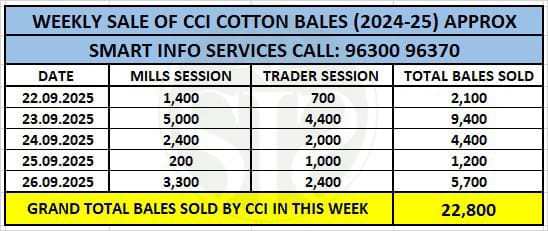
State-wise CCI Cotton Sales Details – 2025-26 SeasonThe Cotton Corporation of India (CCI) has increased cotton prices in Maharashtra by a total of ₹100 per candy for the 2025-26 season. So far, approximately 3,53,900 cotton bales have been sold by CCI during the 2025-26 season. Sales are highly concentrated in a few major cotton-producing states, emerging as the leading contributors.The CCI has sold a total of approximately 98,81,400 bales during the 2024-2025 season.
Meeting held for textile industry on cotton and EPFThe South India Spinners Association (SISPA), in association with Recycle Textile Federation (RTF), organised a panel discussion on “Current Cotton Scenario, Latest Schemes on EPF & New Labour Codes” recently in Coimbatore in which more than 100 members of SISPA and RTF participated.The sessions were on the cotton scenario, latest updates in Employees’ Provident Fund (EPF), Employees’ State Insurance Corporation (ESIC) schemes, Labour Codes and Factories Act.The discussions on cotton highlighted the prevailing cotton market situation, including availability, price trends, and quality aspects. The participants were advised to closely monitor arrivals, MSP operations, and market movements while planning procurement strategies.On the schemes under EPF, the panellists highlighted the recent updates and schemes and provided clarifications on compliance requirements, online processes, and benefits available to employers and employees. On the benefits of the ESIC, including medical coverage and employee welfare measures, the discussions were on the benefits of SPREE and Amnesty Scheme – 2025. The participants received practical guidance on coverage, contribution norms, and claim procedures.The salient features of the new Labour Codes were also explained at the event with focus on their implications for the textile industry. The industry was asked to prepare for implementation by reviewing internal HR policies, registers, and compliance systems. Key compliance expectations under the Factories Act were also discussed.S. Jagadesh Chandran, secretary, SISPA, highlighted the relevance of such interactive discussions in the present industry context. R. Arun Karthik, president of the SISPA, spoke on the prevailing cotton market scenario, emerging statutory challenges, and the continuous efforts of SISPA to safeguard the interests of member mills. M. Jayabal, chairman, Recycle Textile Federation, explained the importance of compliance and the benefits available to members.read more :- CCI: Cotton purchase figure reached 10 lakh quintals
CCI bought 10 lakh quintals of cottonYavatmal: This season, huge fluctuations are being seen in the market price of cotton, while Cotton Corporation of India (CCI) has purchased up to 10 lakh quintals of cotton in the district under the Market Intervention Scheme.Although the arrival from CCI has decreased this year compared to last year, farmers in the district have so far sold about 1.3 lakh quintals of cotton. Out of this, 10,19,784 quintals of cotton were purchased by CCI, while 3,90,686 quintals of cotton were purchased by private traders.Currently, the price of cotton in the open market is around Rs 8200 per quintal, which is about Rs 330 more than the CCI rate. Because of this, many farmers are preferring to sell cotton to private traders instead of government procurement. Because of this, the pace of purchases from CCI has slowed down.CCI is making purchases at different purchase centers in the district and registration has been done in the names of about one lakh 33 thousand farmers. Of these, 58 thousand farmers have received permission (token) to sell cotton and the remaining farmers are still waiting.If we look at the purchase according to taluka, there will be 9 lakh quintals in Yavatmal, 69 thousand in Kalamb, 52 thousand in Ghatanji, 1 lakh in Pandharkavda, 1.25 lakh in Maregaon, 57 thousand in Jhari, 50 thousand in Darwa, 29 thousand in Ner, 14 thousand in Arni, 3 thousand in Digras, 29 thousand in Pusad and 38 thousand quintals in Mahagaon. Cotton has been purchased. According to experts, increasing the pace of government procurement and timely payment of money to farmers can reduce the pressure on the open market. Otherwise, farmers will once again have to bear the brunt of price fluctuations.read more :- 3.53 lakh bales of CCI sold through online auction
CCI Online Cotton Bales Sale Remain Strong; Over 3.53 Lakh Bales Sold as Prices Rise ₹100 per Candy in Maharashtra For Season 2025-26The Cotton Corporation of India (CCI) witnessed robust trading activity during its online cotton bale auctions held throughout the week, with active participation from both mills and traders. Over the five-day bidding period, CCI raised cotton prices by a cumulative ₹100 per candy in Maharashtra for season 2025-26.Day-wise Sales PerformanceJanuary 19, 2026:CCI began the week with strong sales, disposing of 1,13,500 bales, including 1,12,600 bales from the 2025–26 season and 900 bales from 2024–25.Mills session accounted for 61,700 bales, including 700 older-season bales.Traders purchased 51,800 bales, of which 200 bales were from the previous season.January 20, 2026:The highest sales volume of the week was recorded on Tuesday, with 1,25,500 bales sold. This included 1,17,800 bales from the 2025–26 crop and 7,700 bales from 2024–25.Mills bought 56,600 bales, including 4,200 bales from the older season.Traders emerged as aggressive buyers with 68,900 bales, including 3,500 bales from 2024–25.January 21, 2026:Sales moderated slightly, with total volumes reaching 83,900 bales, comprising 82,200 bales from 2025–26 and 1,700 bales from the previous season.Mills bought 35,700 bales, including 1700 older-season bales.Traders purchased 48,200 bales, all from current season.January 22, 2026:CCI sold 30,600 bales, all belonging to the current season.Mills purchased 22,100 bales.Traders accounted for 8,500 bales.January 23, 2026:The week concluded with sales of 11,000 bales, including 10,700 bales from 2025–26 and 300 bales from 2024–25.Mills bought 8,300 bales, including 100 older-season bales.Traders purchased 2,700 bales, including 200 bales from 2024–25.Weekly OverviewOverall, CCI achieved total sales of approximately 3,53,900 bales during the week, including 10,600 bales from the 2024–25 season. The steady offloading of stocks and upward price revision underline firm demand from the domestic textile industry, even as prices remain at elevated levels.read more :- Rupee falls 42 paise to close at 91.94 per dollar
On Friday, the Indian rupee fell 42 paise to close at 91.94 per dollar, compared to its opening price of 91.52 in the morning.At close, the Sensex was down 769.67 points or 0.94 percent at 81,537.70, and the Nifty was down 241.25 points or 0.95 percent at 25,048.65. About 1295 shares advanced, 2736 shares declined, and 139 shares unchanged.read more:- India's GSP benefits suspended by EU, export shipments affected
EU Suspends India's GSP Export Benefits, Impacting ShipmentsThe European Union (EU) has suspended export benefits under the Generalized Scheme of Preferences (GSP) for India, Indonesia, and Kenya, effective January 1, 2026. This will impact India's shipments to the EU, particularly in the textiles, plastics, and other industrial sectors.According to the EU's official journal, the suspension will be in effect from 2026 to 2028. The think tank Global Trade Research Initiative (GTRI) estimates that this decision will subject approximately 87% of India's exports to the EU to higher Most Favored Nation (MFN) tariffs, while only about 13% of exports—primarily agricultural and leather products—will retain GSP benefits.Under the GSP, Indian exporters previously benefited from lower import duties. For example, apparel products faced a 9.6% duty instead of the standard 12%, but now the full duty will apply. This will increase costs and reduce competitiveness.Experts say this move comes at a time when India and the EU are in the final stages of negotiating a Free Trade Agreement (FTA). However, the FTA's implementation may take time, leaving Indian exporters facing higher tariffs and increased compliance costs in the near future.India's position in price-sensitive sectors like apparel could be weakened, and EU buyers may shift to duty-free suppliers like Bangladesh and Vietnam. According to FIEO, this decision eliminates an average tariff advantage of up to 20%.India-EU bilateral trade stood at $136.53 billion in FY 2024-25, with the EU being India's largest trading partner. Therefore, the withdrawal of GSP benefits is expected to have a significant impact on India's overall exports.read more :- Rupee opened 10 paise higher at 91.52
Rupee Opens at 91.52, Up 10 PaisaIndian rupee opened higher at 91.52 per dollar on Friday versus Thursday's close of 91.62.read more :- Brazil's cotton production projected to decline 10% in 2025/26
Brazil Cotton Output Seen Falling Nearly 10% in 2025/26 SeasonBrazil’s cotton production is projected to decline by nearly 10% in the 2025/26 season, as both planted area and yields are expected to decrease, according to the first crop report by the Brazilian Cotton Producers Association (Abrapa).Planted area is forecast to drop 5.5% year-on-year to 2.052 million hectares, while average yields are expected to fall 4.7% to 1,866 kg of lint per hectare. As a result, total lint production is estimated at 3.829 million tonnes, marking a 9.9% decline compared to the previous season.Abrapa Executive Director Marcio Portocarrero stated that the reduction in area is a strategic decision. He highlighted that Brazil’s cotton sector is responding cautiously to global market conditions, including excess supply and increasing competition from synthetic fibres driven by lower oil prices.He also noted that high interest rates and tighter credit availability have significantly raised production risks for farmers.Independent consultant Pery Pedro indicated that the sharpest decline in cotton area is likely among smaller and medium-scale farmers, particularly those who do not consistently invest in cotton. In contrast, large-scale producers are expected to reduce their planted area by no more than 1%.Pedro explained that many mid-sized farmers, typically cultivating around 3,000 hectares of soybeans, allocate part of their land to second-crop cotton but lack the infrastructure of larger operations. These farmers are more likely to shift away from cotton in favor of crop rotation to improve soil health, driven more by agronomic considerations than pricing factors.He added that the reduction in cotton area is not directly linked to price trends. Although New York cotton futures—an international benchmark—declined by 8% in 2025, current price levels still offer adequate returns for producers to maintain their cotton operations.Planting for the new season has already begun and usually accelerates in January, especially in regions where cotton is grown as a second crop. As of January 8, approximately 18% of the projected area had been planted, according to Abrapa.Despite the lower production outlook, total cotton supply is estimated at 4.76 million tonnes, up 17.6% from the previous season. This increase is largely due to a significant rise in beginning stocks, which are expected to grow by 65.7% to 835,000 tonnes.Exports are projected to reach 3.2 million tonnes, reflecting a 13% increase compared to the prior season.read more :- Big decision of BTMA: It has been announced to close textile mills from 1st February.
BTMA announces indefinite closure of all textile mills from 1 FebThe Bangladesh Textile Mills Association (BTMA) has announced the indefinite closure of all textile mills across the country from 1 February, citing the interim government's failure to take steps to protect local yarn-producing spinning mills.The announcement came at a press conference at the association's office in Dhaka's Karwan Bazar this afternoon (22 January).Addressing the briefing, BTMA President Showkat Aziz Russell said, "We will shut down no matter what. We do not have the capacity to repay bank loans."He alleged that despite approaching all relevant ministries and departments, no effective support had been forthcoming."Every department is simply passing responsibility to others, like a game of pillow passing," he added.He said the industry's capital base has shrunk by half, and there is no viable mechanism to repay bank loans. "Even if we sell off all our assets, it will not be possible to clear the debts," he said.Senior BTMA leaders were also present at the press conference.The decision to close mills came after the commerce ministry requested the National Board of Revenue on 12 January to suspend duty-free yarn imports under the bonded warehouse facility, a move intended to protect domestic spinning mills. Industry leaders warned that the measure could sharply increase production costs for garment and knitwear exporters, potentially raising import duties to around 37% and adding $0.30-$0.60 per kilogram of yarn.This prompted a standoff between textile millers and exporters, with top BGMEA and BKMEA representatives meeting Commerce Adviser SK Bashir Uddin to seek a review, while BTMA leaders separately met the finance adviser without resolution. The potential policy shift threatens to burden Bangladesh's $28 billion knitwear export sector and disrupt the balance between local yarn producers and garment manufacturers.read more :- Rupee fell 07 paise to close at 91.62 per dollar
The Indian rupee on thursday lower 07 paise to close at 91.62 per dollar, while it opened at 91.55 in the morning.At close, the Sensex was up 397.74 points or 0.49 percent at 82,307.37, and the Nifty was up 132.40 points or 0.53 percent at 25,289.90. About 2803 shares advanced, 1235 shares declined, and 146 shares unchanged.read more :- FY 2024-25: Cotton Corporation of India's dividend of ₹8.89 crore
Cotton Corporation of India Presents ₹8.89 Crore Dividend For FY 2024–25The Cotton Corporation of India Ltd. (CCI), a Public Sector Undertaking under the Ministry of Textiles, today presented a dividend cheque of ₹8.89 crore for the financial year 2024–25 to the Union Minister of Textiles, Shri Giriraj Singh, at a ceremonial function held in New Delhi, in the august presence of the Secretary, Textiles, Smt. Neelam Shami Rao and Joint Secretary, Textiles, Smt.Padmini Singla. Shri Lalit Kumar Gupta, CMD, CCI handed over the cheque.The Union Minister of Textiles appreciated CCI’s consistent efforts and emphasized the importance of growth, efficiency, transparency, and innovation in strengthening India’s cotton and textile value chain. He underscored CCI’s pivotal role in ensuring remunerative prices to cotton farmers under MSP operations while maintaining equilibrium in the domestic cotton market.Reviewing the initiatives undertaken during the year, the Secretary, Textiles commended the management and employees of CCI for their dedication and performance and reaffirmed the Ministry’s continued support in achieving future milestones and enhancing the global competitiveness of India’s textile sector.The Secretary, Textiles further highlighted CCI’s backbone role in scaling certified cotton in India. Nearly 97% of certified Kasturi Cotton Bharat—1.51 lakh bales out of 1.58 lakh bales—was produced by CCI, reinforcing quality assurance, traceability, and India’s growing presence in premium global cotton markets.During FY 2024–25, CCI achieved a turnover of ₹20,009 crore, marking one of the highest turnovers in the history of the Corporation. The dividend declaration reflects CCI’s strong financial performance, operational efficiency, and its sustained contribution to the Government of India, while fulfilling its mandate of safeguarding farmers’ interests and ensuring market stability.Strengthening MSP Procurement and Farmer OutreachTo ensure wider and more effective outreach under MSP operations, CCI expanded its procurement infrastructure by opening 571 procurement centres across 150 cotton-growing districts, compared to 508 centres in the previous season. The liberalised norms for opening procurement centres have significantly improved last-mile access, particularly for small and marginal farmers, while reducing transportation costs and waiting time.Farmer empowerment remained at the core of the Central Government under MSP operations through the Kapas Kisan Mobile App, with over 46 lakh farmers registered. The app has transformed MSP procurement into a transparent, paperless, and farmer-centric system, enabling self-registration, advance slot booking, Aadhaar-linked payments, and real-time SMS alerts at every stage—from registration and procurement to bill generation and payment.Procurement operations were being monitored through Local Monitoring Committees (LMCs)at each APMC, supported by dedicated helplines and WhatsApp numbers for prompt grievance redressal. Extensive awareness campaigns through print, radio, social media, and local-language outreach have further ensured informed and inclusive farmer participation.Digital Transformation and TraceabilityCCI has achieved100% traceability of cotton bales through its Blockchain-based Bale Identification and Traceability System (BITS), enabling end-to-end tracking from procurement to processing using QR codes.On the buyer side, CCI enhanced Ease of Doing Business through CotBiz, its online Cotton Seed and Bale Billing System. CotBiz facilitates faceless, paperless e-auctions, supported by real-time dashboards, digital contracts, invoices, and gate passes, fully integrated with CCI’s ERP system.read more :- The rupee opened 15 paise higher at 91.55 against the dollar.
| title | Created At | Action |
|---|---|---|
| The rupee closed 03 paisa higher against the dollar at 91.72 | 27-01-2026 22:40:40 | view |
| "Trump's decision: 25% tariff imposed on South Korea" | 27-01-2026 19:44:31 | view |
| Big decline in cotton production in Maharashtra, Khandesh's ginning industry in crisis | 27-01-2026 19:30:04 | view |
| Jacid alert in cotton cultivation in 2026 | 27-01-2026 17:57:59 | view |
| The rupee opened 19 paise higher at 91.75 against the dollar. | 27-01-2026 17:28:36 | view |
| State wise CCI Cotton Sales – 2025-26 | 24-01-2026 22:25:23 | view |
| Meeting on cotton and EPF for textile industry | 24-01-2026 18:33:13 | view |
| CCI: Cotton purchase figure reached 10 lakh quintals | 24-01-2026 18:17:57 | view |
| 3.53 lakh bales of CCI sold through online auction | 24-01-2026 01:07:31 | view |
| Rupee falls 42 paise to close at 91.94 per dollar | 23-01-2026 22:44:21 | view |
| India's GSP benefits suspended by EU, export shipments affected | 23-01-2026 19:01:42 | view |
| Rupee opened 10 paise higher at 91.52 | 23-01-2026 17:26:11 | view |
| Brazil Cotton Output to Drop 10% in 2025/26 | 23-01-2026 00:54:27 | view |
| Big decision of BTMA: It has been announced to close textile mills from 1st February. | 22-01-2026 23:00:52 | view |
| Rupee fell 07 paise to close at 91.62 per dollar | 22-01-2026 22:44:11 | view |
| FY 2024-25: Cotton Corporation of India's dividend of ₹8.89 crore | 22-01-2026 18:29:15 | view |