STAY UPDATED WITH COTTON UPDATES ON WHATSAPP AT AS LOW AS 6/- PER DAY
Start Your 7 Days Free Trial TodayRupee opened 15 paise higher at 91.55/USDIndian rupee opened higher by 15 paise at 91.55 per dollar on Thursday against previous close of 91.70.read more :- Rupee fell 51 paise to close at 91.70 per dollar

The Indian rupee on Wednesday lower 51 paise to close at 91.70 per dollar, while it opened at 91.19 in the morning.At close, the Sensex was down 270.84 points or 0.33 percent at 81,909.63, and the Nifty was down 75 points or 0.30 percent at 25,157.50. About 1357 shares advanced, 2509 shares declined, and 127 shares unchanged.read more :- US Tariff: Impact on domestic economy, foreign exporters safe
US tariffs hit domestic economy, not foreign exporters US import tariffs are paid by Americans, not foreign exporters contrary to official rhetoric, according to new research from the Kiel Institute for the World Economy. The study finds that 96 per cent of tariff costs are borne by US importers and consumers, acting like a domestic consumption tax that raises prices, shrinks product variety, and depresses trade volumes."The tariffs are an own goal. The claim that foreign countries pay these tariffs is a myth. The data show the opposite: Americans are footing the bill,” said Julian Hinz, research director at the Kiel Institute and one of the authors of the study. The research, analysing over 25 million shipment records worth nearly $4 trillion, showed US customs revenue rose by around $200 billion in 2025, while foreign exporters absorbed only four per cent of the burden. Trade volumes collapsed, but export prices did not fall, indicating exporters did not offset tariffs through discounts.Examining unexpected tariff hikes on Brazil and India in August 2025, the study found Indian exports to the US fell by up to 24 per cent in value and volume, while unit prices remained unchanged."We compared Indian exports to the US with shipments to Europe and Canada and identified a clear pattern. Both export value and volume to the US dropped sharply, by up to 24 per cent. But unit prices—the prices Indian exporters charged—remained unchanged. They shipped less, not cheaper," Hinz explained.Researchers conclude that tariffs squeeze US company margins, raise consumer prices, and force exporters to seek alternative markets, ultimately disadvantaging all sides.read more :- Deloitte estimates: 7.5–7.8% growth in FY 2025-26
Indian economy to grow 7.5-7.8% in FY2025-26: Deloitte India’s economy is expected to grow 7.5-7.8 per cent in FY2025-26, supported by resilient domestic demand, easing inflation, and a series of fiscal, monetary, and labour reforms, according to the Deloitte Global Economics Research Centre’s report, ‘India Economic Outlook, January 2026.’ Growth is projected to moderate to 6.6-6.9 per cent in FY2026-27 as global uncertainties and trade frictions persist.The global consultancy said 2026 will be defined by resilience in domestic consumption, decisive policy reforms, and recalibration of trade strategy, as India navigates spillover effects from protectionist shifts in advanced economies, volatile capital flows, and higher tariffs on select exports.Despite these headwinds, India maintained strong momentum in the first half of fiscal 2025-26, recording 8 per cent growth, driven by robust private consumption and investment. Inflation averaged 1.8 per cent, its lowest level in a decade, boosting real incomes and consumer confidence.Private consumption rose 7.9 per cent year-on-year (YoY) in the second quarter (Q2), supported by tax relief, goods and services tax (GST) rationalisation, and favourable monsoon conditions. At the same time, government capital expenditure accelerated, with utilisation reaching 51.8 per cent in the first half of the fiscal, lifting gross fixed capital formation growth to 7.6 per cent.On the production side, gross value added (GVA) expanded 8.1 per cent in Q2, led by manufacturing growth of 9.1 per cent and services growth of 9.2 per cent.Deloitte noted that policy co-ordination played a central role in cushioning the economy. Fiscal measures focused on boosting disposable incomes and sustaining infrastructure investment, while the Reserve Bank of India (RBI) delivered a cumulative 125-basis-point rate cut in 2025 to support credit growth and domestic demand. The long-pending labour codes, implemented in 2025, are expected to improve ease of doing business and accelerate job formalisation.On the external front, India continued to diversify trade partnerships through agreements with the UK, New Zealand, Oman, and European Free Trade Association (EFTA), while expanding engagement with emerging markets across Africa, Southeast Asia, and West Asia. However, delays in the proposed United States (US)-India trade agreement remain a key risk for exporters.Deloitte estimated that in the absence of a US-India trade agreement, American tariffs could shave 0.3-0.4 per cent of Gross Domestic Product (GDP) from Indian exports, likely keeping goods export growth subdued in the near-term.Looking ahead, policy priorities must transition from demand-led support to supply-side reforms such as GST 2.0, improved logistics efficiency, and productivity gains to sustain growth and strengthen resilience against future global shocks, Deloitte noted.read more :- CAD to reach 2.3% of GDP in FY26 Q3: ICRA
Indian CAD to widen to 13-quarter high of 2.3% of GDP in Q3 FY26: ICRA India’s merchandise trade deficit (MTD) widened to a higher-than-expected $25 billion in December last year from $20.6 billion in December 2024, amid a sustained double-digit growth in non-oil non-gold imports, even as export growth was muted at just 1.9 per cent year on year (YoY) in the month, according to ICRA.With a material widening in the MTD in Q3 FY26 compared to the year-ago quarter, ICRA projected the current account deficit (CAD) to surge to 2.3 per cent of gross domestic product (GDP) in Q3 FY26, which would be the highest level in last 13 quarters.The current account is likely to seasonally turn favourable in Q4 FY26 to a mild surplus of sub-1 per cent of GDP. Overall, ICRA estimates the FY26 CAD at a benign 0.8 per cent of GDP.India’s merchandise exports inched up by 1 per cent sequentially to $38.5 billion in December 2025. However, merchandise imports increased by a stronger 8.8 per cent YoY and 1.4 per cent month on month (MoM) to $63.6 billion in December 2025. Consequently, the MTD rose to $25 billion in December 2025 from $20.6 billion in the year ago month.Exports to the United States remained stable at $6.9 billion in December 2025 compared to November, while displaying a YoY dip of 1.8 per cent. In contrast, shipments to non-US regions rose by 2.7 per cent after a nearly 6-per cent average growth during July-November 2025.read more :- India's textile sector: hub of jobs
India’s textile sector emerging as major jobPrime Minister Narendra Modi on Tuesday highlighted the rapid transformation of India’s textile sector into a powerful, job-creating and people-centric engine of growth, stating that it reflects the true spirit of Aatmanirbhar Bharat.The Prime Minister shared an article authored by Union Minister for Textiles Giriraj Singh, which outlines how the sector has evolved from a legacy industry into a modern driver of employment, investment and exports.In a post on X, PM Modi said, “In this article, Union Minister Shri Giriraj Singh outlines the rise of India’s textile sector from a legacy industry to a powerful, job-creating, people-centric engine of growth, embodying the true spirit of Aatmanirbhar Bharat. He highlights that PM MITRA Parks, PLI schemes and new Free Trade Agreements are creating the next wave of employment.”In his article, Singh said that India’s textile resurgence is anchored in strong domestic demand and rising consumption. With a population of over 140 crore, India has emerged as one of the world’s most resilient textile markets. The domestic textile market expanded from around ₹8.4 lakh crore to an estimated ₹13 lakh crore over the past five years.Consumption trends further reinforce this momentum. Per capita textile consumption has nearly doubled over the last decade – from about ₹3,000 in 2014–15 to over ₹6,000 in 2024-25 – and is projected to double again to ₹12,000 by 2030, the minister noted.Export performance has mirrored this demand-led growth. Textile and apparel exports rose from ₹2.49 lakh crore in 2019-20, the year the COVID-19 pandemic struck, to nearly ₹3.5 lakh crore in 2024-25, registering around 28 per cent growth in the post-Covid period. This rebound, the minister said, highlights India’s ability to rapidly scale manufacturing as global demand recovers and convert export growth into employment across the textile value chain.The article places particular emphasis on the PM Mega Integrated Textile Region and Apparel (PM MITRA) Parks scheme. The government expects investments worth ₹18,500 crore to flow into the sector based on proposals received under the initiative, which aims to boost production, employment and exports.Once operational, PM MITRA Parks are expected to attract investments of around ₹10,000 crore and generate approximately three lakh direct and indirect jobs, significantly strengthening India’s textile manufacturing ecosystem.read more :- Rupee opens 22 paise down at 91.19
Rupee opens 22 paise lower at 91.19/USD Indian rupee opened at fresh low 91.19 per dollar on Wednesday against Tuesday's close of 90.97read more :- Rupee fell 03 paisa to close at 90.97 against dollar


The Indian rupee on tuesday lower 03 paise to close at 90.97 per dollar, while it opened at 90.94 in the morning.At close, the Sensex was down 1065.78 points or 1.28 percent at 82,180.47, and the Nifty was down 353 points or 1.38 percent at 25,232.50. About 748 shares advanced, 3146 shares declined, and 100 shares unchanged.read more :- india-removed-development-surcharges-and-increased-export-credit
India eases export credit rules, extends benefits to graduating MSMEsNew Delhi: India has revised its export credit framework to strengthen support for MSMEs as they scale up operations, introducing key changes under the Export Promotion Mission – Niryat Protsahan.The most significant reform allows exporters who move out of the MSME category due to higher turnover or investment to continue receiving interest subvention benefits for three years after reclassification, subject to conditions. The move is aimed at ensuring a smoother transition for growing businesses.According to DGFT Trade Notice No. 22/2025–26 dated January 16, 2026, the amended guidelines for interest subvention on pre- and post-shipment export credit are widely viewed as MSME-friendly.Earlier, exporters lost access to such benefits immediately upon crossing MSME thresholds, often creating a sudden strain on working capital at a critical stage of expansion. The new three-year transition window is expected to provide continuity, reduce uncertainty, and encourage capacity expansion.The notification further clarifies that revised interest subvention rates will apply only to export credit sanctioned after the issuance date, while existing loans will continue under previously applicable rates. This removes retrospective uncertainty and improves financial planning stability for exporters.In another supportive measure, the DGFT has confirmed that for FY 2025–26, the full annual interest subvention ceiling will apply regardless of when export credit is sanctioned or utilised during the year, benefiting MSMEs accessing finance mid-year.By linking subvention support to actual interest costs and simplifying reimbursement mechanisms for banks, the revised framework aims to ease working capital constraints and improve credit flow to exporters.Overall, the policy marks a shift from restricting benefits based on size thresholds to supporting MSMEs through their growth journey into larger export-oriented enterprises.Read More :- Government removed QCO from import of textile machinery
Government removed QCO on import of textile machineryThe Union Ministry of Heavy Industries has canceled its order related to Quality Standards for Safety of Machinery and Electrical Equipment issued on August 24, 2024.Additionally, there will be no quality control standards on imported textile machinery.Many textile units import weaving and processing machinery and the textile industry was demanding withdrawal of the order on quality standards on machinery. Although this order was introduced in 2024, the government had postponed its implementation.Now the government has removed the quality control order on all machinery and the textile industry will be able to import good quality machinery as per its requirement, said sources in the textile sector.read more :- Cotton prices seasonal high in 2025-26, CCI sold 1.14 lakh bales
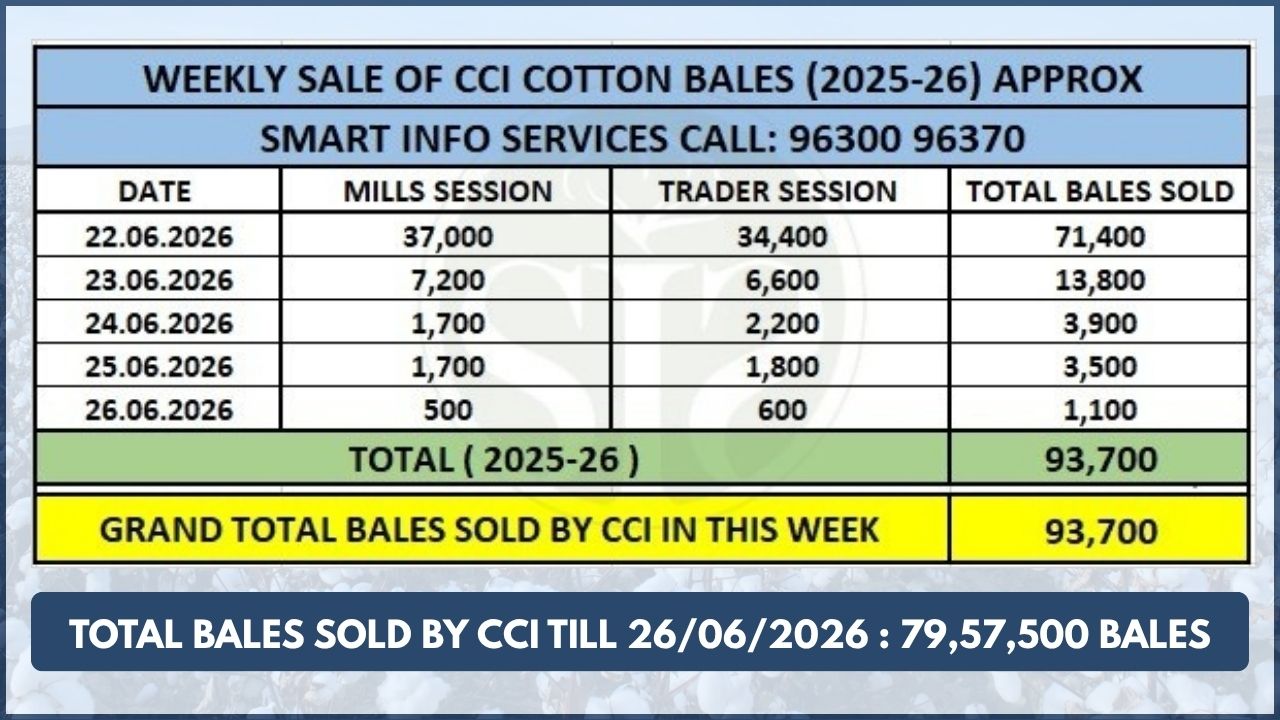
As Indian cotton surges to seasonal high, CCI sells 1.14 lakh bales from 2025-26 cropThe Cotton Corporation of India (CCI) on Monday began the sale of cotton procured during the ongoing 2025-26 season, even as prices touched a seasonal high crossing the ₹56,000 levels per candy (356 kg).The State-run entity sold around 1.14 lakh bales on the first day of the sale, said Lalit Kumar Gupta, Chairman-cum-Managing Director, CCI. “Since mills need quality cotton, sales have commenced,” Gupta said. Till last week, CCI procured some 83 lakh bales.CCI’s sale price for the 2025-26 season is the range of ₹56,300-57,300 for the 29 mm cotton, almost similar to the last year’s levels. However, the trade feels CCI prices are slightly on the higher side compared to the market.Unsustainable“The rates are higher by Rs 1000-1500 per candy than what the market expected. We need to see the quality of the CCI cotton. If the quality offered is good, then CCI will be able to sell slowly. If the quality is poor, then mills will buy imported cotton at Rs 58000-59000 mill delivery including import duty,” said Atul Ganatra, Chairman, Crop Committee of Cotton Association of India, the apex trade body.On Monday, mills bought 61,000 bales from the 2025-26 crop from CCI, while traders bought 51,600 bales.Ramanuj Das Boob, a sourcing agent in Raichur also felt that the prices set by CCI are slightly on the higher side compared to market. “Mills, which have immediate requirement can buy in small quantities. I don’t think these prices will sustain at these levels,” he said adding that Rs 54,000-55,000 is the ideal range.Crop estimate upPrevailing cotton prices are at their peak levels in the ongoing season inching up from early January after the Government ended the duty exemption on imports on December 31. Also the firming trend in cottonseed prices has lent support to the raw cotton prices.“Cotton prices, which were hovering in the range of Rs 52,000 levels per candy at the start of the season in early October have inched up gradually and have crossed the Rs 56,000 levels. Before January, the price was hovering around Rs 53000- 54,000 levels. This is the highest price of the season,” Das Boob said.Recently, trade body Cotton Association of India (CAI) revised upwards the crop estimate for 2025-26 by around 2.5 per cent or 7.5 lakh bales of 170 kg each to 317 lakh bales on higher than estimated production in Maharashtra and Telangana. CAI has projected a year-end surplus 122.59 lakh bales for the 2025-26 season, up 56 per cent year-on-year on record imports of 50 lakh bales during the year. Imports till December 31 stood higher at 31 lakh bales. For the current cotton year 2025-26 ending September, CAI is expecting the imports to be at a record 50 lakh bales against 41 lakh bales a year ago.read more :- Rupee open Falls 03 Paise to 90.94/USD
The Rupee opened 03 paise lower at 90.94 against the US dollar. Indian rupee opened lower at 90.94 per dollar on Tuesday against previous close of 90.91.read more :- Government's challenge before budget on cotton import duty
Ahead of the Budget, Central Government Under Pressure Over Cotton Import DutyFarmers oppose reduction, textile industry insists on removalAhead of the upcoming 2026-27 budget, the central government is caught between conflicting demands from farmers and the textile industry regarding import duties on cotton. In February 2021, the government imposed an 11 percent import duty on cotton to protect domestic farmers, which includes basic customs duty, agricultural infrastructure cess, and surcharge.The textile industry argues that the duty should be removed due to declining domestic production and quality constraints affecting competitiveness. Farmers' organizations, however, contend that cotton prices have already fallen from ₹57,000 to ₹52,500 per candy, and a reduction in the duty would further impact their income.According to sources, the government has received representations from both sides, but given the current weak cotton prices, an immediate reduction or removal of the duty is unlikely. A government official said, “Cotton prices have fallen and farmers' income has been affected, so a reduction in the duty is not likely.”The Confederation of Indian Textile Industry (CITI) argues that removing the import duty would help bridge the production gap and boost export competitiveness. The organization recently met with Agriculture Minister Shivraj Singh Chauhan to demand the permanent removal of the duty.Cotton production in India is the livelihood base for approximately six million farmers and 40 to 50 million people employed in the textile sector. The textile and apparel sector is one of the country's largest employers, directly employing over 45 million people.Pressure has also increased on the export front. Exports have been impacted since mid-2025 after the US imposed a 50 percent tariff on Indian textiles. In December 2025, textile and apparel exports registered a meager 0.4 percent year-on-year growth. In conclusion, the issue of cotton import duties has become a balancing act for the central government — weighing farmers' interests against the competitiveness of the textile industry.read more :- CM Bhupendra Patel: Announcement of amendment in Gujarat Textile Policy
CM Bhupendra Patel announces amendments to Gujarat Textile PolicyGujarat CM Bhupendra Patel has decided that certain units engaged in non-polluting textile manufacturing will be granted benefits under the Textile Policy-2024. Aiming to further strengthen and empower women’s self-help groups (SHGs), Gujarat Chief Minister Bhupendra Patel Sunday announced amendments to the Gujarat Textile Policy, 2024.In a release, the chief minister’s office stated, “…the Chief Minister has issued directions to make important amendments in certain provisions of the Textile Policy. Accordingly, one or more Self Help Groups consisting of women associated with similar livelihood objectives, registered under the National Rural Livelihood Mission and the National Urban Livelihood Mission, or other voluntary Self Help Groups, will be eligible to receive benefits under the Textile Policy.”It added, “The CM has also taken another decision that units engaged in non-polluting textile manufacturing activities related to garments, apparel and made-ups, stitching, embroidery, and other activities, which fall within municipal area limits in the state, will also be granted benefits under the Textile Policy-2024.”As per the release, “As a result of this decision… non-polluting textile units located within municipal corporation limits in the state will receive extensive benefits from the scheme. Additionally, employment generation in urban areas will be encouraged and local employment opportunities for skilled and semi-skilled workers will increase. Recognition of non-polluting textile activities in urban areas will also create a favourable environment for the growth of Micro, Small and Medium Enterprises (MSMEs).”It stated that encouragement to non-polluting activities will help achieve the objectives of environmental protection as well as balanced and sustainable industrial development.“Along with the benefits available to Self Help Groups (SHGs) under the Gujarat Textile Policy-2024, the outcome of this decision… will enable women of the state to become more economically empowered and self-reliant. Such measures will provide them with greater opportunities and empowerment, enabling them to become stronger in society, the economy, and the business sector,” the release added.read more :- Demand to suspend bond facility on 10-30 count yarn import
Commerce Ministry Proposes Suspension of Bond Facility for 10–30 Count Yarn ImportsThe Ministry of Commerce has proposed suspending duty-free import benefits for 10–30 count cotton yarn under the bonded warehouse scheme, aiming to protect domestic textile mills. In a formal letter sent to the National Board of Revenue (NBR) on January 12, the ministry recommended withdrawing the bond facility for this yarn category. However, NBR officials have stated that no official order has been issued so far.The ministry has also urged authorities to instruct customs houses to clearly mention yarn count in the commercial description on import bills of entry to ensure better transparency and monitoring.In textile terminology, yarn “count” refers to its thickness and fineness. The 10–30 count range is considered medium to coarse and is a key raw material for the country’s large knitwear sector. With the removal of duty-free benefits, importers may now face nearly 40% in taxes, which exporters warn could significantly impact more than half of the country’s ready-made garment (RMG) exports.Exporters have raised concerns that local yarn producers are already tightening supply, with some reportedly halting new orders. Fazlee Shamim Ehsan, executive president of the Bangladesh Knitwear Manufacturers and Exporters Association (BKMEA), criticized the move as arbitrary and warned of its negative impact on the industry.The interim government is currently evaluating several policy options, including stricter import controls, limiting duty-free yarn imports, and incentivizing the use of locally produced yarn. These considerations come amid growing pressure to support domestic spinning mills, particularly against a surge in subsidized yarn imports from India.Earlier this month, the Bangladesh Trade and Tariff Commission (BTTC) held discussions with representatives from the Bangladesh Textile Mills Association (BTMA) and garment exporters. While there was broad agreement on protecting the textile value chain, no consensus was reached due to differing interests between millers and exporters.Commerce Secretary Mahbubur Rahman stated that the government is actively reviewing the issue and working toward a balanced solution.Bangladesh’s RMG sector, the world’s second-largest exporter, has developed strong backward linkages over time. Local textile mills currently supply around 60% of woven fabric demand and nearly all yarn required for the knitwear sector. Despite this, spinning mills have been under significant financial stress for over a year, often selling yarn below production cost to remain competitive.read more :- Greenland dispute: Trump imposes 10% tariff on Denmark, UK and France
Trump Imposes 10% Tariff On Denmark, UK, France For Opposing Greenland Plan.US President Donald Trump on Saturday declared that he would charge a 10 per cent tariff on European countries because of their opposition to America's Greenland takeover. Countries like Denmark, the UK, France, and other EU countries will be hit with US tariffs from February 1.In a post on Truth Social, Trump announced that the tariffs would be raised to 25 per cent on June 1 if a deal is not reached for "the Complete and Total purchase of Greenland" by the United States.The decision comes a day after Trump warned that he could impose tariffs on countries that do not support his Greenland plans.European leaders have said that it's only for Denmark and Greenland to decide on matters concerning the territory, and Denmark said this week that it was increasing its military presence in Greenland in cooperation with allies.The White House has said Trump's aim to take over Greenland would not be affected by the European military presence, which French Armed Forces Minister Alice Rufo said was a sign that the continent was prepared to defend sovereignty.Trump has been insisting for quite a while now that the US needs the mineral-rich Greenland for its "national security". Earlier this week he said that anything less than Greenland being in US hands is "unacceptable". The Republican leader has justified his calls for a takeover by saying that it is to prevent the territory from being occupied by China and Russia.On Wednesday, after a meeting in Washington, Danish representatives said Copenhagen and Washington were in "fundamental disagreement" over Greenland's future.Thousands of people marched through Copenhagen on Saturday to protest in support of their own self-governance amid threats of US takeover. Protesters carried signs such as "We shape our future", "Greenland is not for sale" and "Greenland is already GREAT".Denmark's foreign minister on Thursday ruled out any US acquisition of Greenland, after the White House said a European military mission to the Arctic island had no effect on Donald Trump's territorial ambitions. Lars Lokke Rasmussen said, "This is out of the question. It's not what we want in Denmark, nor in Greenland and it runs counter to all international rules. It infringes on sovereignty."Greenland's prime minister, Jens-Frederik Nielsen, said on Tuesday that "if we have to choose between the United States and Denmark here and now, we choose Denmark. We choose NATO. We choose the Kingdom of Denmark. We choose the EU."read more :- CCI Cotton Sales Report 2024-25
| title | Created At | Action |
|---|---|---|
| The rupee opened 15 paise higher at 91.55 against the dollar. | 22-01-2026 17:29:49 | view |
| Rupee fell 51 paise to close at 91.70 per dollar | 21-01-2026 22:45:06 | view |
| US Tariff: Impact on domestic economy, foreign exporters safe | 21-01-2026 19:44:01 | view |
| Deloitte estimates: 7.5–7.8% growth in FY 2025-26 | 21-01-2026 19:27:39 | view |
| CAD to reach 2.3% of GDP in FY26 Q3: ICRA | 21-01-2026 18:54:45 | view |
| India's textile sector: hub of jobs | 21-01-2026 18:40:27 | view |
| Rupee opens 22 paise down at 91.19 | 21-01-2026 17:19:59 | view |
| Rupee fell 03 paisa to close at 90.97 against dollar | 20-01-2026 22:49:30 | view |
| India relaxes export credit norms, extends MSME benefits | 20-01-2026 19:35:15 | view |
| Government removed QCO from import of textile machinery | 20-01-2026 19:12:23 | view |
| Cotton prices seasonal high in 2025-26, CCI sold 1.14 lakh bales | 20-01-2026 18:58:21 | view |
| Rupee open Falls 03 Paise to 90.94/USD | 20-01-2026 17:19:55 | view |
| Government's challenge before budget on cotton import duty | 20-01-2026 01:26:29 | view |
| CM Bhupendra Patel: Announcement of amendment in Gujarat Textile Policy | 19-01-2026 19:44:15 | view |
| Demand to suspend bond facility on 10-30 count yarn import | 19-01-2026 19:03:36 | view |
| Greenland dispute: Trump imposes 10% tariff on Denmark, UK and France | 19-01-2026 18:50:11 | view |