Filter

Recent News

2026 Cotton Outlook: Dwindling stocks support prices

2026 Cotton Outlook: Economic pressure remains but declining stocks may support pricesMEMPHIS, Tennessee – Economists at the National Cotton Council point to some key reasons why the U.S. Will decide the cotton industry's economic outlook for 2026.Overall, by 2025 U.S. The cotton industry had another difficult year due to low prices, high production costs and weak demand. As the 2026 season approaches, farmers are facing difficult decisions about planting as current prices remain below the cost of production. Although worldwide cotton demand is expected to recover in 2026, potential changes in trade policy have created considerable uncertainty in the global cotton market.The outlook for the worldwide cotton market will, to some extent, be determined by continued growth in economic activity. Steady to slow economic growth is expected for the next two years.In her analysis of the results of the NCC's annual Planting Intentions Survey, Dr. Jody Campich, NCC's vice president of economics and policy analysis, said the NCC estimates that the U.S. will grow more than 100,000 acres of land in 2026. Cotton area will be 9.0 million acres in 2025, which is 3.2 percent less than 2025. Survey results Reflecting the economic condition of cotton growers, who are now facing their fourth year of poor market returns.Compared to average futures prices during the first quarter of 2025, all commodity prices were lower during the 2026 survey period, but cotton declined the most. Because of this, the price ratio of cotton compared to corn and soybean was lower than in 2025.Harvested area in the Cotton Belt is projected to reach 7.1 million acres by 2026, including the U.S. The crop abandonment rate is 21.3 percent. Using state level average yields, the cotton crop was 12.7 million bales, including 12.3 million upland bales and 393,000 ELS bales.U.S. Mills are expected to use 1.55 million bales in 2026, compared to 1.60 million bales in 2025. U.S. There is pressure on textile manufacturing.For the 2026 marketing year, worldwide consumption is projected to increase 1.0 percent to 120.0 million bales. U.S. production by 2025 due to projected increases in world consumption and lower world production. Export estimates are high. With higher export projections, the U.S. The end stock is estimated to decline to 3.5 million bales in 2026.World production is projected to decline to 114.1 million bales in 2026 due to reduced harvested acreage and lower yields, Campich said. With consumption increasing in the main importing countries, world trade is projected to grow to 44.6 million bales in 2026. For the 2026 marketing year, ending stocks will decline to 69.8 million bales due to lower production coupled with higher world consumption and trade. If that happens, it would be the lowest level of world end stocks outside China since 2016.If world consumption can overcome headwinds from a sluggish global economy and cheap man-made fibre, prices could provide some support from dwindling stocks on balance sheets to 2026.U.S. And current economic projections for the global economy should be viewed with caution given rising geopolitical tensions and the potential impact of changes in trade policy. U.S. The cotton industry is an export-oriented industry, both for raw fiber as well as cotton yarn and fabric, and tariff policies can significantly alter the trade environment.read more :- Tamil Nadu Textile Policy 2025-26 launched, budget of ₹1,943 crore 


Tamil Nadu Textile Policy 2025-26 launched, budget of ₹1,943 crore

Tamil Nadu Unveils Integrated Textile Policy 2025-26; 1,943 crore was allocated for the handloom and textile industry in the interim budgetCoimbatore (Tamil Nadu) [India]: The Tamil Nadu government is implementing a series of strategic policy initiatives and targeted benefits to enhance the global competitiveness of the state's textile industry, which accounts for one-third of India's total textile business.Recognized as a key driver of economic growth, the textile sector is poised to play a key role in realizing Tamil Nadu's vision of achieving a US$ 1 trillion economy by 2031.According to the release, Tamil Nadu Deputy Chief Minister Udhayanidhi Stalin unveiled the Tamil Nadu Integrated Textile Policy 2025-26 at the inaugural function of International Textile Summit 360, the first two-day event organized by the government in Coimbatore on January 29.In the interim budget announced by Finance Minister Thangam Thenarasu today, Rs 1,943 crore has been specifically allocated for the handloom and textile industry, besides an equal amount for MSMEs and Rs 4,282 crore for industries, which will also benefit the textile industry.Durai Palanisamy, president of The Southern India Mills Association, has said that adequate funds have been allocated to set up handloom parks, modernize powerlooms, set up shuttleless looms and attract new investment in technical textile processing and apparel.He also welcomed the proposal to issue a 'New Integrated Renewable Energy Policy' with a budget allocation of Rs 18,091 crore to increase renewable energy capacity in the state. (ANI)read more :- CMD Atul Ganatra: Hedging is necessary in business

CMD Atul Ganatra: Hedging is necessary in business

Shri Atul Ganatra, CMD of Radha Lakshmi Group, said – Every businessman should do hedging.Chairman and Managing Director (CMD) of Radha Lakshmi Group, in a special conversation with Zee Business, said that every businessman must use hedging.He said that NCDEX's "Cotton" and "Omace" contracts are very useful for farmers and ginners. Earlier, there was a cotton platform on MCX in India, where traders could do hedging. But now there is no liquidity in MCX contracts, due to which the business there has come to a standstill. In such a situation, the cotton contract of NCDEX is proving to be very important and profitable for the cotton traders.CMD said that this year most of the ginners have stored a large stock of cotton seeds. The crop is expected to be larger this time than in previous years — while 312 lakh bales were produced last year, this year's production is estimated at 317 lakh bales. Due to increase in crop, the price of seeds has declined. In such a situation, it is the right time for farmers to hedge their stocks to keep them safe. Both cotton and cake contracts of NCDEX can prove to be very useful for this purpose.He further said that according to the recent statement given by Union Minister Piyush Goyal, India has also received the same offer for the trade deal which Bangladesh has received. If this agreement materializes, cotton imported from America may become duty-free. Currently, India has imported about 35–40 lakh bales of cotton by January 2026, and if this deal is implemented, an additional import of 10–15 lakh bales is possible. This may increase pressure on the domestic cotton market, but it will not have a major impact on farmers as CCI (Cotton Corporation of India) has already purchased about 95–97 lakh bales of cotton at MSP ₹8100 per quintal.Therefore, it can be said that this trade deal will prove to be very positive for the entire textile industry.He further said that ginners have made adequate stock of both cotton seeds and cotton bales this time. During the January surge, all ginning factories had increased stocks — currently ginners have stocks of about 35-40 lakh bales and CCI has stocks of 95 lakh bales. Cotton prices have fallen by about 10% in the last 15 days. In such a situation, NCDEX platform is very useful for ginners, because there is sufficient liquidity available in cotton cake.CMD suggested “If a ginner has 200 trucks of cotton seed stock, he can hedge by selling 50–100 lots. This will keep his stock safe. This is an excellent platform for hedging and every ginner should use it to stay safe from risk.”read more :- The rupee opened 02 paise higher at 90.65.

US-India deal will impact Bangladesh garment industry

India’s Zero-Tariff Deal with US Jolts Bangladesh Garment IndustryIndia’s latest trade move has sent shockwaves through Bangladesh’s garment sector, raising concerns about losing its long-held competitive edge in the US market.Union Commerce Minister Piyush Goyal announced that India could soon secure a zero per cent tariff deal on textile exports to the United States, similar to the benefits currently enjoyed by Bangladesh. Under the proposed trade pact, Indian-made garments using American cotton will get duty-free access to the US market.The development has rattled Bangladesh’s exporters, who fear the move could erode their price advantage.“Bangladesh may lose its competitiveness to some extent in the US markets if similar trade benefits are extended to Indian exporters,” said Anwar-ul-Alam Chowdhury, former president of the Bangladesh Garment Manufacturers and Exporters Association, in an interview with The Daily Star.He noted that India’s lower production costs, smoother customs procedures, and strong government support give it a favourable position. “India is in an advantageous position in terms of cost of production, equal US customs treatment, and export facilities offered by the Indian government,” Chowdhury added.Despite the concerns, Bangladeshi industry leaders hope that India’s status as a cotton exporter—unlike Bangladesh, which relies heavily on imports—might balance the scales.India, the world’s second-largest exporter of raw cotton, shipped over US$6.4 billion worth of cotton in FY 2024–25, primarily to Bangladesh, China, and Vietnam. It also imported around 4.13 million bales of US cotton during the same period.However, Showkat Aziz Russell, president of the Bangladesh Textile Mills Association, said the tariff concessions by the Donald Trump administration might only apply to cotton importers.“India imposes a 12 per cent duty on cotton imports, while Bangladesh has zero duty. So, Bangladesh can still enjoy some advantages as a major importer of cotton,” he told The Daily Star.Still, experts warn that Bangladesh’s dependence on imported raw materials keeps its production costs higher than India’s. Meanwhile, India continues to strengthen its foothold in the global textile supply chain. Industry data shows that 77 per cent of US fashion brands and retailers sourced materials from India in 2025 — a trend expected to continue through 2027.read more :- 

CCI purchased 1.15 lakh quintals of cotton in Manawar Mandi, last date is 27th February

Last date of cotton purchase is 27 February: CCI purchased 1.15 lakh quintals of cotton in Manawar Mandi, 23 thousand bales were made.The Cotton Corporation of India (CCI)'s cotton procurement in the market located at Manawar Semalda Marg has now reached its last phase. The market administration has made it clear that the purchase of cotton from registered farmers will be completely stopped on February 27.There was huge arrival of cotton in Manawar Mandi in the last three months of this season. CCI has purchased a record 1 lakh 15 thousand quintals of cotton, from which about 23 thousand cotton bales have been prepared. Farmers say that due to the CCI policies of the Central Government and procurement at support price, they have got the right price for their crops and have become financially strong.Market revenue increasedMarket Secretary Bhagat Singh Dawar said that due to continuous purchase of CCI, a good increase in the revenue (earnings) of the market has also been recorded. However, according to the letter received from CCI, purchases will not be made after February 27. For this, the dates of 16th and 20th February are considered important for the arrival of cotton.Farmers' inclination towards private marketsAccording to Manawar Ginning Manager Pawan Kushwaha, cotton is expected to arrive in the market only by the end of February. He also told one special thing that these days the prices of cotton have increased in private ginning factories. Because of this, farmers are now showing more interest in selling their goods to private traders instead of CCI.read more :- Textile exports decreased by 3.75% in January, relief from US deal

Textile exports decreased by 3.75% in January, relief from US deal

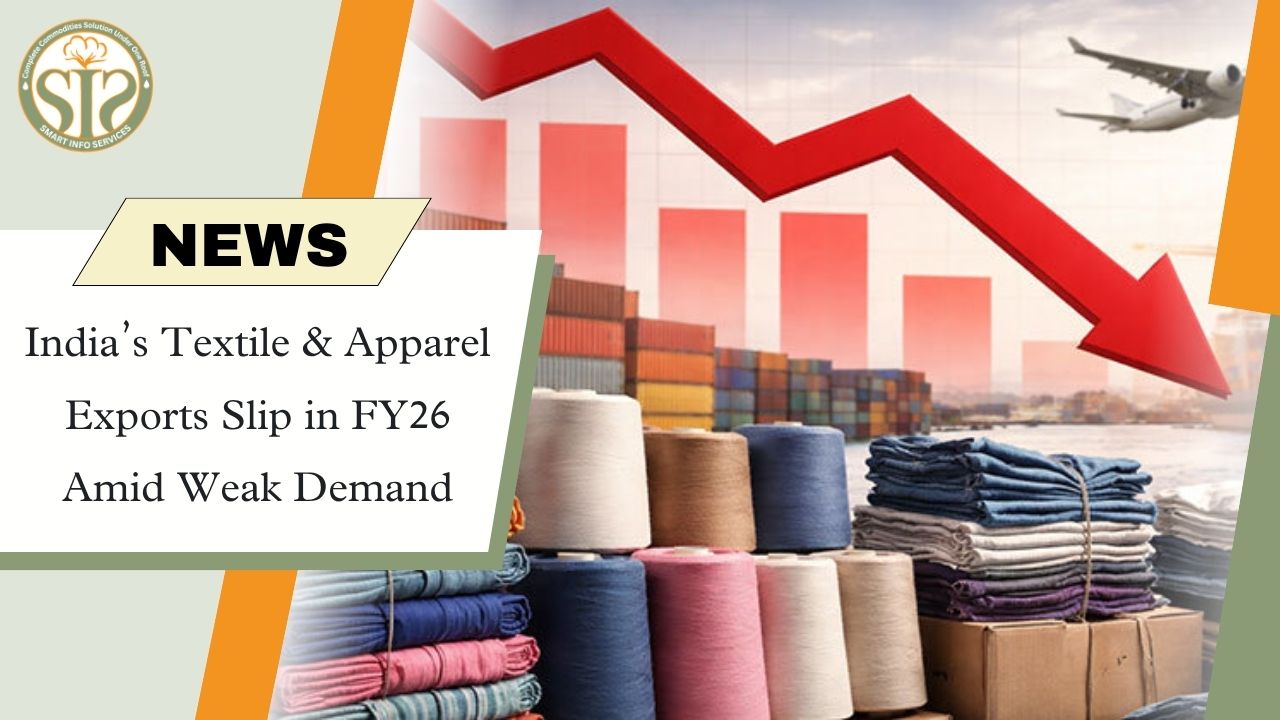
India's textile and apparel exports down by 3.75% in January, outlook improves now with India US interim dealNew Delhi: India's textile and apparel exports registered a decline in January compared with the same period last year, largely due to high tariffs imposed by the United States that remained in force till February 7.The tariffs impacted export competitiveness and led to lower shipments during the month.According to the data shared by Confederation of Indian Textile Industry (CITI), textile exports in January have declined by -3.68 per cent, while apparel exports are down by -3.84 per cent in January 2026 compared with January 2025.Overall, combined exports of textiles and apparel stood at 3,275.44 million US dollars in January 2026, down from 3,403.19 million US dollars in January 2025, registering a degrowth of -3.75 per cent.The decline was mainly seen across key textile segments. Exports of cotton yarn, fabrics, made-ups, and handloom products fell by -4.15 per cent to 995.58 million US dollars in January 2026 from 1,038.69 million US dollars in January 2025.Carpet exports also declined sharply by -12.05 per cent to 118.99 million US dollars, while exports of jute manufactured products, including floor coverings, dropped significantly by -18.92 per cent during the same period. Handicrafts, excluding handmade carpets, also saw a decline of -2.70 per cent.However, exports of man-made yarn, fabrics, and made-ups showed some resilience and recorded a slight growth of 1.01 per cent, rising to 430.29 million US dollars in January 2026 compared with 425.97 million US dollars in January 2025.The data further revealed that during the period from April 2025 to January 2026, textile exports registered a degrowth of -2.35 per cent, while apparel exports recorded a growth of 1.59 per cent compared with the same period of the previous financial year.Despite this growth in apparel exports, cumulative textile and apparel exports during April 2025 to January 2026 registered a marginal decline of -0.65 per cent compared with April 2024 to January 2025.The share of textile and apparel exports in India's total exports also declined. The sector accounted for 8.96 per cent of total exports in January 2026, compared with 9.37 per cent in January 2025.For the April 2025 to January 2026 period, the share stood at 8.13 per cent, lower than 8.36 per cent in the same period of the previous year.On the import side, imports of cotton raw and waste increased significantly by 12.33 per cent in January 2026 and rose sharply by 72.36 per cent during the April 2025 to January 2026 period. This increase suggests higher domestic demand for raw materials or supply adjustments within the textile industry.Now the outlook is expected to improve going forward following the United States' reduction of tariffs on February 7. The tariff reduction is likely to improve India's export competitiveness and support recovery in textile and apparel shipments in the coming months.read more :- The rupee opened 02 paise lower at 90.67/USD.

America's deal: expansion of economic interests

US trade agreement: the strategy behind the termsThe new reciprocal trade agreement signed between Dhaka and Washington on February 9 was initially considered a major diplomatic success. But now there is growing confusion and concern over the “cotton segment” in Bangladesh’s $47 billion apparel industry. This provision states that reciprocal tariff exemption will be available only if the apparel is made from American cotton or man-made fibers.Under the agreement, a 19 percent reciprocal tariff has been imposed on Bangladeshi apparel in addition to the already applicable MFN duty of about 16.5 percent. In case of no relief, the total fee reaches 35.5 percent. The government says that the 19 percent tariff on clothes made from American raw materials will be removed, but the industry argues that the basic duty will still be applicable.BGMEA President Mahmood Hasan Khan clarified that the pre-agreement fees will not be waived. He says that even after getting concession, exporters will have to pay 16.5 percent duty, due to which the cost will remain high. Also, the agreement sets a “specified quantity” limit, which will depend on the amount of raw materials imported from the US.Analysts and think-tank experts believe that the language of the agreement is vague and many technical aspects are not clear. If competing countries like India also get similar benefits, Bangladesh's competitive edge may weaken. In such a situation, it is necessary for the government to clarify the terms of the agreement, otherwise this much talked about deal may fail to provide the expected security.read more :- The rupee closed 05 paise lower against the dollar at 90.65.

Related News

Youtube Videos

जानिए आज का कपास बाज़ार? 😱 Cotton Market Rate Today #kapasbajar
जानिए आज का कपास बाज़ार? 😱 Cotton Market Rate Today #kapasba...
ऐसा रहा आज कपास बाज़ार 😱 राजस्थान कपास बुआई | Cotton Market 22 July
ऐसा रहा आज कपास बाज़ार 😱 राजस्थान कपास बुआई | Cotton Market...
कपास बाज़ार में आज क्या हुआ? 😱 Cotton Market Rate 21 July 2026
कपास बाज़ार में आज क्या हुआ? 😱 Cotton Market Rate 21 July 2...
कैसा रहा आज का कपास बाज़ार? 😱 Cotton Market Rate Today | 20 July 2026
कैसा रहा आज का कपास बाज़ार? 😱 Cotton Market Rate Today | 20...
इस हफ्ते कपास में तेज़ी या मंदी? 😱 CCI ने बेचीं 3.18 लाख गांठें | Weekly Cotton Market
इस हफ्ते कपास में तेज़ी या मंदी? 😱 CCI ने बेचीं 3.18 लाख गा...
Cotton rate today: आज के कपास के भाव 🤔 #kapas  #youtube
Cotton rate today: आज के कपास के भाव 🤔 #kapas #youtube
रुई बाज़ार में आज तेज़ी का रुख 😱 CCI ने बेचीं 40,000+ गठानें #kapas
रुई बाज़ार में आज तेज़ी का रुख 😱 CCI ने बेचीं 40,000+ गठानें...
ऐसा रहा आज कपास बाज़ार 😱  राजस्थान कपास बुआई | Cotton Market 15 July
ऐसा रहा आज कपास बाज़ार 😱 राजस्थान कपास बुआई | Cotton Marke...
कपास की कीमतों में उछाल 😱 Cotton market rate today #kapasnabhav
कपास की कीमतों में उछाल 😱 Cotton market rate today #kapasna...
CCI Update: आज कितनी रुई गठानें बिकीं? 😱 Cotton market price today
CCI Update: आज कितनी रुई गठानें बिकीं? 😱 Cotton market pric...
साप्ताहिक कपास बाजार में तेज़ी 😱 Weekly cotton market review #kapas
साप्ताहिक कपास बाजार में तेज़ी 😱 Weekly cotton market review...
जानिए आज का कपास बाज़ार 😱 Cotton market rate today #kapas
कपास की कीमतों में उछाल 😱 Cotton market rate today #kapas
रुई बाज़ार में आज तेज़ी का रुख 😱 CCI ने बेचीं  70,000+ गठानें  #kapas
रुई बाज़ार में आज तेज़ी का रुख 😱 CCI ने बेचीं 70,000+ गठानें...
कैसा रहा आज का कपास बाज़ार? 😱 | Cotton Market Rate Today | 06 July 2026
कैसा रहा आज का कपास बाज़ार? 😱 | Cotton Market Rate Today |...
Application Download
Whatsapp Contact